ANUSHA REDDY
SALLARAM
AYJNIHH, SRC
MOTOR SPEECH
DISORDERS
Definition :
• Disorders of speech results from neurological
impairment.
(or)
• A collection of communication disorders involving:
1) the retrieval and activation of motor plans for
speech (apraxia)
2) the execution of movements for speech
production (dysarthria)
(speech = movement)
Types of motor speech
disorders:
• The two main types of motor speech
disorders are Dysarthria and Apraxia.
Dysarthria
Definition:
A group of speech disorders
resulting from disturbances in muscular
control-weakness, slowness, or
incoordination- of the speech
mechanism due to damage to the central
or peripheral nervous system or both.
Dysarthria site of lesion:
•Upper motor Neuron (UMN) -Cerebellum,
basal ganglia, substantia nigra, and
pseudobulbar palsy)
•Lower motor neuron (LMN) -cranial nerves V,
VII, IX, X, XI, XII - all involved with
movements of speech
Dysarthria etiology
•Degenerative (ALS)
•Inflammatory (Meningitis, encephalitis)
•Toxic/Metabolic (kidney liver disease, vitamin
deficiency)
•Neoplastic (tumor)
•Traumatic (closed head injury)
•Vascular disease (CVA)
TYPES OF DYSARTHRIA
• Ataxic
• Spastic
• Flaccid
• Hyperkinetic
• Hypokinetic
• Unilateral UMN
• Mixed
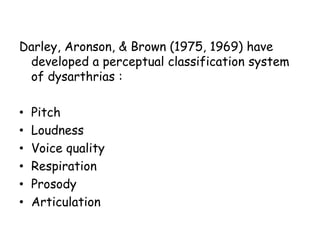
Darley, Aronson, & Brown (1975, 1969) have
developed a perceptual classification system
of dysarthrias :
• Pitch
• Loudness
• Voice quality
• Respiration
• Prosody
• Articulation
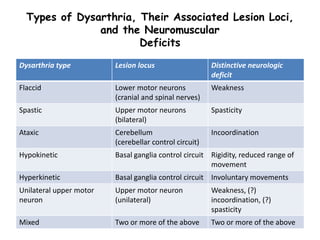
Types of Dysarthria, Their Associated Lesion Loci,
and the Neuromuscular
Deficits
Dysarthria type Lesion locus Distinctive neurologic
deficit
Flaccid Lower motor neurons
(cranial and spinal nerves)
Weakness
Spastic Upper motor neurons
(bilateral)
Spasticity
Ataxic Cerebellum
(cerebellar control circuit)
Incoordination
Hypokinetic Basal ganglia control circuit Rigidity, reduced range of
movement
Hyperkinetic Basal ganglia control circuit Involuntary movements
Unilateral upper motor
neuron
Upper motor neuron
(unilateral)
Weakness, (?)
incoordination, (?)
spasticity
Mixed Two or more of the above Two or more of the above
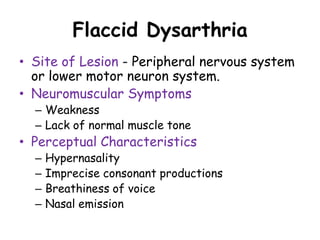
Flaccid Dysarthria
• Site of Lesion - Peripheral nervous system
or lower motor neuron system.
• Neuromuscular Symptoms
– Weakness
– Lack of normal muscle tone
• Perceptual Characteristics
– Hypernasality
– Imprecise consonant productions
– Breathiness of voice
– Nasal emission
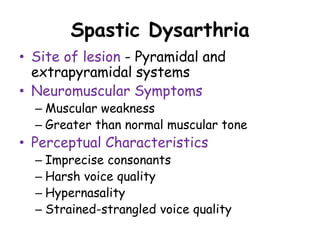
Spastic Dysarthria
• Site of lesion - Pyramidal and
extrapyramidal systems
• Neuromuscular Symptoms
– Muscular weakness
– Greater than normal muscular tone
• Perceptual Characteristics
– Imprecise consonants
– Harsh voice quality
– Hypernasality
– Strained-strangled voice quality
Ataxic Dysarthria
• Site of lesion - Cerebellum
• Neuromuscular Symptoms
– Inaccuracy of movement and Slowness of
movement.
• Perceptual Characteristics
– Imprecise consonants
– Irregular articulatory breakdowns
– Prolonged phonemes
– Prolonged intervals
– Slow rate
Hypokinetic Dysarthria
• Site of Lesion - Subcortical Structures
involving Basal Ganglia
• Neuromuscular Symptoms
– Slow movements
– Movements limited in extent (limited range of
movement)
• Perceptual Characteristics
– Articulatory mechanism - Impaired because of
reduced range of motion involving the lips,
tongue, and jaw. Disturbance may range from
mildly imprecise to total unintelligibility.
Hyperkinetic Dysarthrias
• Site of Lesion - Subcortical Structures
involving Basal Ganglia
• Neuromuscular Symptoms
– Quick, unsustained, involuntary movements
• Perceptual Characteristics associated with
Gilles de la Tourette's syndrome
– Emission of grunts as a result spontaneous
contractions of the respiratory and phonatory
muscles
– Barking noises
– Echolalia
– Coprolalia: obscene language without
provocation or reason.
Mixed Dysarthrias
• Amyotrophic Lateral Sclerosis
– Site of Lesion - Progressive degeneration of
the upper & lower neuron system. Most cases
appears without a known cause
– Neuromuscular Symptom
• Impairs the function (weakness and paralysis) of all
the muscles used in speech production
– Perceptual Characteristics
• Slow rate
• Shortness of phrase
• Imprecision of consonants
• Hypernasality
• Harshness
Apraxia of Speech
• “Disorders of the execution of learned
movement which cannot be accounted for
either by weakness, in coordination, or
sensory loss, or by incomprehension or
inattention to command”.
• Although it can affect any component of
speech production, it is primarily a
disturbance of articulation and prosody.
Apraxia: Also known as...
• Apraxia
• Dyspraxia
• Verbal Apraxia of Speech (VAS)
• Childhood Apraxia of Speech(CAS)
• Developmental Apraxia.
Causes :
• Genetic Disorder
• Stroke
• TBI
• Unknown
• Localization -
Apraxia results from a unilateral, left
hemisphere lesion involving the third
frontal convolution, Broca's area. There
is a possibility of apraxia following more
posterior, probably parietal lesions.
Early Possible Indicators
• Decreased babbling/cooing in infancy
• Late acquisition of first words
• Avoidance of first words (grunts/points)
• One syllable words favored beyond age 2
Limited consonant/vowel repertoire noted
(compared to developmental expectations)
• Open mouth posturing prominent.
Speech Characteristics
• Articulation Process
– Common characteristic is the patient's groping to find
the correct articulatory postures and sequences.
– Facial grimaces, moments of silence, and phonated
movements of articulators are common occurrences.
– Consonant phonemes are involved more often than vowel
phonemes
– Articulation errors are inconsistent and highly variable,
not referable to specific muscle dysfunction
– Articulatory errors are primarily substitutions,
additions, repetitions, and prolongations-essentially
complications of the act of articulation.
• Prosody Process
– Durational relationships of vowels and consonants are
distorted
– Rate of production is slow
– Alterations of the intonation
Apraxia 23
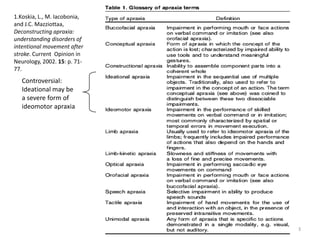
1.Koskia, L., M. Iacobonia,
and J.C. Mazziottaa,
Deconstructing apraxia:
understanding disorders of
intentional movement after
stroke. Current Opinion in
Neurology, 2002. 15: p. 71-
77.
Controversial:
Ideational may be
a severe form of
ideomotor apraxia
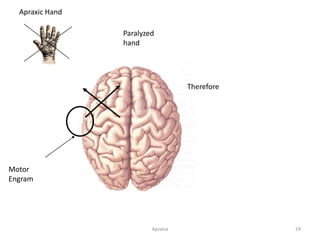
Apraxia 24
Motor
Engram
Paralyzed
hand
Apraxic Hand
Therefore
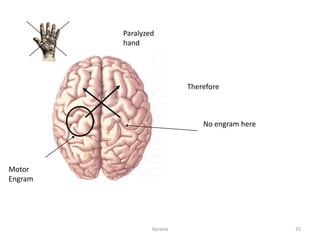
Apraxia 25
Motor
Engram
Paralyzed
hand
Therefore
No engram here
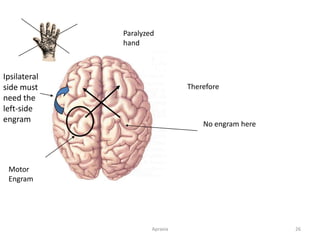
Apraxia 26
Motor
Engram
Paralyzed
hand
Therefore
No engram here
Ipsilateral
side must
need the
left-side
engram
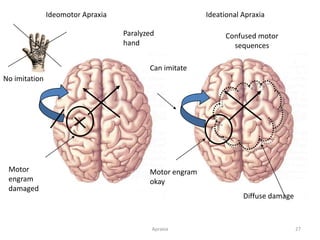
Apraxia 27
Motor
engram
damaged
Paralyzed
hand
Ideational ApraxiaIdeomotor Apraxia
No imitation
Motor engram
okay
Diffuse damage
Can imitate
Confused motor
sequences
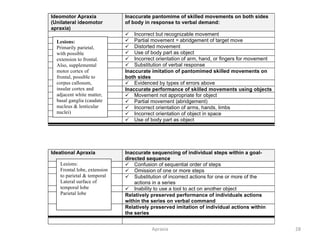
Apraxia 28
Ideomotor Apraxia
(Unilateral ideomotor
apraxia)
Inaccurate pantomime of skilled movements on both sides
of body in response to verbal demand:
 Incorrect but recognizable movement
 Partial movement = abridgement of target move
 Distorted movement
 Use of body part as object
 Incorrect orientation of arm, hand, or fingers for movement
 Substitution of verbal response
Inaccurate imitation of pantomimed skilled movements on
both sides
 Evidenced by types of errors above
Inaccurate performance of skilled movements using objects
 Movement not appropriate for object
 Partial movement (abridgement)
 Incorrect orientation of arms, hands, limbs
 Incorrect orientation of object in space
 Use of body part as object
Ideational Apraxia Inaccurate sequencing of individual steps within a goal-
directed sequence
 Confusion of sequential order of steps
 Omission of one or more steps
 Substitution of incorrect actions for one or more of the
actions in a series
 Inability to use a tool to act on another object
Relatively preserved performance of individuals actions
within the series on verbal command
Relatively preserved imitation of individual actions within
the series
Lesions:
Primarily parietal,
with possible
extension to frontal.
Also, supplemental
motor cortex of
frontal, possible to
corpus callosum,
insular cortex and
adjacent white matter,
basal ganglia (caudate
nucleus & lenticular
nuclei)
Lesions:
Frontal lobe, extension
to parietal & temporal
Lateral surface of
temporal lobe
Parietal lobe
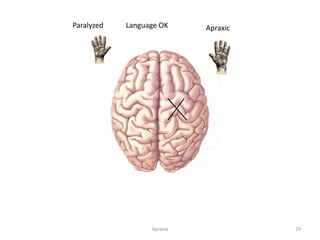
Apraxia 29
Paralyzed ApraxicLanguage OK
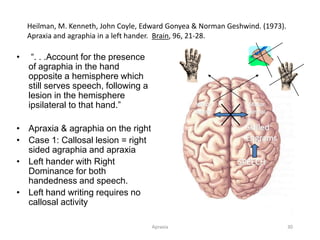
Apraxia 30
Heilman, M. Kenneth, John Coyle, Edward Gonyea & Norman Geshwind. (1973).
Apraxia and agraphia in a left hander. Brain, 96, 21-28.
• “. . .Account for the presence
of agraphia in the hand
opposite a hemisphere which
still serves speech, following a
lesion in the hemisphere
ipsilateral to that hand.”
• Apraxia & agraphia on the right
• Case 1: Callosal lesion = right
sided agraphia and apraxia
• Left hander with Right
Dominance for both
handedness and speech.
• Left hand writing requires no
callosal activity
SPEECH
Skilled
Engrams
Motor
Control
Motor
Control
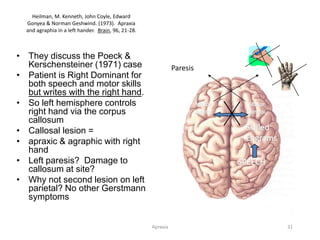
Apraxia 31
Heilman, M. Kenneth, John Coyle, Edward
Gonyea & Norman Geshwind. (1973). Apraxia
and agraphia in a left hander. Brain, 96, 21-28.
• They discuss the Poeck &
Kerschensteiner (1971) case
• Patient is Right Dominant for
both speech and motor skills
but writes with the right hand.
• So left hemisphere controls
right hand via the corpus
callosum
• Callosal lesion =
• apraxic & agraphic with right
hand
• Left paresis? Damage to
callosum at site?
• Why not second lesion on left
parietal? No other Gerstmann
symptoms
SPEECH
Skilled
Engrams
Motor
Control
Motor
Control
Paresis

MOTOR SPEECH DISORDERS

  • 1.
  • 2.
  • 3.
    Definition : • Disordersof speech results from neurological impairment. (or) • A collection of communication disorders involving: 1) the retrieval and activation of motor plans for speech (apraxia) 2) the execution of movements for speech production (dysarthria) (speech = movement)
  • 4.
    Types of motorspeech disorders: • The two main types of motor speech disorders are Dysarthria and Apraxia.
  • 5.
    Dysarthria Definition: A group ofspeech disorders resulting from disturbances in muscular control-weakness, slowness, or incoordination- of the speech mechanism due to damage to the central or peripheral nervous system or both.
  • 6.
    Dysarthria site oflesion: •Upper motor Neuron (UMN) -Cerebellum, basal ganglia, substantia nigra, and pseudobulbar palsy) •Lower motor neuron (LMN) -cranial nerves V, VII, IX, X, XI, XII - all involved with movements of speech
  • 7.
    Dysarthria etiology •Degenerative (ALS) •Inflammatory(Meningitis, encephalitis) •Toxic/Metabolic (kidney liver disease, vitamin deficiency) •Neoplastic (tumor) •Traumatic (closed head injury) •Vascular disease (CVA)
  • 8.
    TYPES OF DYSARTHRIA •Ataxic • Spastic • Flaccid • Hyperkinetic • Hypokinetic • Unilateral UMN • Mixed
  • 9.
    Darley, Aronson, &Brown (1975, 1969) have developed a perceptual classification system of dysarthrias : • Pitch • Loudness • Voice quality • Respiration • Prosody • Articulation
  • 10.
    Types of Dysarthria,Their Associated Lesion Loci, and the Neuromuscular Deficits Dysarthria type Lesion locus Distinctive neurologic deficit Flaccid Lower motor neurons (cranial and spinal nerves) Weakness Spastic Upper motor neurons (bilateral) Spasticity Ataxic Cerebellum (cerebellar control circuit) Incoordination Hypokinetic Basal ganglia control circuit Rigidity, reduced range of movement Hyperkinetic Basal ganglia control circuit Involuntary movements Unilateral upper motor neuron Upper motor neuron (unilateral) Weakness, (?) incoordination, (?) spasticity Mixed Two or more of the above Two or more of the above
  • 11.
    Flaccid Dysarthria • Siteof Lesion - Peripheral nervous system or lower motor neuron system. • Neuromuscular Symptoms – Weakness – Lack of normal muscle tone • Perceptual Characteristics – Hypernasality – Imprecise consonant productions – Breathiness of voice – Nasal emission
  • 12.
    Spastic Dysarthria • Siteof lesion - Pyramidal and extrapyramidal systems • Neuromuscular Symptoms – Muscular weakness – Greater than normal muscular tone • Perceptual Characteristics – Imprecise consonants – Harsh voice quality – Hypernasality – Strained-strangled voice quality
  • 13.
    Ataxic Dysarthria • Siteof lesion - Cerebellum • Neuromuscular Symptoms – Inaccuracy of movement and Slowness of movement. • Perceptual Characteristics – Imprecise consonants – Irregular articulatory breakdowns – Prolonged phonemes – Prolonged intervals – Slow rate
  • 14.
    Hypokinetic Dysarthria • Siteof Lesion - Subcortical Structures involving Basal Ganglia • Neuromuscular Symptoms – Slow movements – Movements limited in extent (limited range of movement) • Perceptual Characteristics – Articulatory mechanism - Impaired because of reduced range of motion involving the lips, tongue, and jaw. Disturbance may range from mildly imprecise to total unintelligibility.
  • 15.
    Hyperkinetic Dysarthrias • Siteof Lesion - Subcortical Structures involving Basal Ganglia • Neuromuscular Symptoms – Quick, unsustained, involuntary movements • Perceptual Characteristics associated with Gilles de la Tourette's syndrome – Emission of grunts as a result spontaneous contractions of the respiratory and phonatory muscles – Barking noises – Echolalia – Coprolalia: obscene language without provocation or reason.
  • 16.
    Mixed Dysarthrias • AmyotrophicLateral Sclerosis – Site of Lesion - Progressive degeneration of the upper & lower neuron system. Most cases appears without a known cause – Neuromuscular Symptom • Impairs the function (weakness and paralysis) of all the muscles used in speech production – Perceptual Characteristics • Slow rate • Shortness of phrase • Imprecision of consonants • Hypernasality • Harshness
  • 17.
    Apraxia of Speech •“Disorders of the execution of learned movement which cannot be accounted for either by weakness, in coordination, or sensory loss, or by incomprehension or inattention to command”. • Although it can affect any component of speech production, it is primarily a disturbance of articulation and prosody.
  • 18.
    Apraxia: Also knownas... • Apraxia • Dyspraxia • Verbal Apraxia of Speech (VAS) • Childhood Apraxia of Speech(CAS) • Developmental Apraxia.
  • 19.
    Causes : • GeneticDisorder • Stroke • TBI • Unknown
  • 20.
    • Localization - Apraxiaresults from a unilateral, left hemisphere lesion involving the third frontal convolution, Broca's area. There is a possibility of apraxia following more posterior, probably parietal lesions.
  • 21.
    Early Possible Indicators •Decreased babbling/cooing in infancy • Late acquisition of first words • Avoidance of first words (grunts/points) • One syllable words favored beyond age 2 Limited consonant/vowel repertoire noted (compared to developmental expectations) • Open mouth posturing prominent.
  • 22.
    Speech Characteristics • ArticulationProcess – Common characteristic is the patient's groping to find the correct articulatory postures and sequences. – Facial grimaces, moments of silence, and phonated movements of articulators are common occurrences. – Consonant phonemes are involved more often than vowel phonemes – Articulation errors are inconsistent and highly variable, not referable to specific muscle dysfunction – Articulatory errors are primarily substitutions, additions, repetitions, and prolongations-essentially complications of the act of articulation. • Prosody Process – Durational relationships of vowels and consonants are distorted – Rate of production is slow – Alterations of the intonation
  • 23.
    Apraxia 23 1.Koskia, L.,M. Iacobonia, and J.C. Mazziottaa, Deconstructing apraxia: understanding disorders of intentional movement after stroke. Current Opinion in Neurology, 2002. 15: p. 71- 77. Controversial: Ideational may be a severe form of ideomotor apraxia
  • 24.
  • 25.
  • 26.
    Apraxia 26 Motor Engram Paralyzed hand Therefore No engramhere Ipsilateral side must need the left-side engram
  • 27.
    Apraxia 27 Motor engram damaged Paralyzed hand Ideational ApraxiaIdeomotorApraxia No imitation Motor engram okay Diffuse damage Can imitate Confused motor sequences
  • 28.
    Apraxia 28 Ideomotor Apraxia (Unilateralideomotor apraxia) Inaccurate pantomime of skilled movements on both sides of body in response to verbal demand:  Incorrect but recognizable movement  Partial movement = abridgement of target move  Distorted movement  Use of body part as object  Incorrect orientation of arm, hand, or fingers for movement  Substitution of verbal response Inaccurate imitation of pantomimed skilled movements on both sides  Evidenced by types of errors above Inaccurate performance of skilled movements using objects  Movement not appropriate for object  Partial movement (abridgement)  Incorrect orientation of arms, hands, limbs  Incorrect orientation of object in space  Use of body part as object Ideational Apraxia Inaccurate sequencing of individual steps within a goal- directed sequence  Confusion of sequential order of steps  Omission of one or more steps  Substitution of incorrect actions for one or more of the actions in a series  Inability to use a tool to act on another object Relatively preserved performance of individuals actions within the series on verbal command Relatively preserved imitation of individual actions within the series Lesions: Primarily parietal, with possible extension to frontal. Also, supplemental motor cortex of frontal, possible to corpus callosum, insular cortex and adjacent white matter, basal ganglia (caudate nucleus & lenticular nuclei) Lesions: Frontal lobe, extension to parietal & temporal Lateral surface of temporal lobe Parietal lobe
  • 29.
  • 30.
    Apraxia 30 Heilman, M.Kenneth, John Coyle, Edward Gonyea & Norman Geshwind. (1973). Apraxia and agraphia in a left hander. Brain, 96, 21-28. • “. . .Account for the presence of agraphia in the hand opposite a hemisphere which still serves speech, following a lesion in the hemisphere ipsilateral to that hand.” • Apraxia & agraphia on the right • Case 1: Callosal lesion = right sided agraphia and apraxia • Left hander with Right Dominance for both handedness and speech. • Left hand writing requires no callosal activity SPEECH Skilled Engrams Motor Control Motor Control
  • 31.
    Apraxia 31 Heilman, M.Kenneth, John Coyle, Edward Gonyea & Norman Geshwind. (1973). Apraxia and agraphia in a left hander. Brain, 96, 21-28. • They discuss the Poeck & Kerschensteiner (1971) case • Patient is Right Dominant for both speech and motor skills but writes with the right hand. • So left hemisphere controls right hand via the corpus callosum • Callosal lesion = • apraxic & agraphic with right hand • Left paresis? Damage to callosum at site? • Why not second lesion on left parietal? No other Gerstmann symptoms SPEECH Skilled Engrams Motor Control Motor Control Paresis