APHASIA : A CASE
STUDY
BY : POOJA TOMAR & Mrs. KALYANI
SINGH
What is Aphasia…?
Aphasia is “ an acquired impairment of language
processes underlying receptive and expressive
modalities and caused by damage to areas of
the brain which are primarily responsible for
the language function “ ( By Davis 1983 ).
Aphasia is the “loss of verbal communication
due to an acquired lesion of the nervous
system involving one or more aspects of the
processes of comprehending and producing
verbal messages” ( Basso and Cubelli, 1999 ).
Incidence and Prevalence
• The incidence estimated that there are
80,000 new cases of aphasia per year
(National Stroke Association, 2008).
• Prevalence estimates that approximately
1 million people, or 1 in 250 , suffer from
aphasia.
Signs and Symptoms
• Verbal Expression Impairments
• Auditory Comprehension
Impairments
• Reading Comprehension
Impairments (Alexia)
• Written Language Impairments
(Agraphia)
APHASIA ETIOLOGIES
• Aphasia is caused by damage to the language centers of the brain. In
most people, these language centers are located in the left
hemisphere, but aphasia can also occur as a result of damage to the
right hemisphere; this is often referred to as crossed aphasia to
denote that the right hemisphere is language dominant in these
individuals. Common causes of aphasia are
 CVA ( stroke )
– ischemic: blockage that disrupts blood flow to a region of the brain
– hemorrhagic: a ruptured blood vessel that damages surrounding
brain tissue
 traumatic brain injury
 brain tumors
 brain infections
 other neurological diseases (e.g., dementia).
CLASSIFICATION• There are several classification system based on main characteristics are :
 Functional anatomy
 Clinical features
 Associated condition
• According to wernicke’s 1874 based on antomical lesion, there are 3 types of
aphasia motor aphasia, sensory aphasia and conduction aphasia.
• According to wernicke’s theme model 1884classification system there are 7
types of aphasia :
1. Motor aphasia : subcortical motor aphasia , cortical motor aphasia and
transcortical motor aphasia
2. Conduction aphasia
3. Sensory aphasia : subcortical sensory aphasia , cortical sensory aphasia and
trans cortical sensory aphasia
• According to Goodglass classification 1974 there are 8 types of aphasia
which are generally used in administering the WAB , these are broca’s
aphasia , wernicke’s aphasia, global aphasia , anomic aphasia, transcortical
motor aphasia, transcortical sensory aphasia, conduction aphasia and
isolation aphasia.
CLASSIFICATION OF APHASIA
Fluent
Non-
Fluent
Wernicke’s Aphasia
Conduction Aphasia
Transcortical sensory
Aphasia
Anomic Aphasia
Broca’s Aphasia
Transcortical motor
Aphasia
Isolation Aphasia
Global Aphasia
Given by Goodglass( 1974)
Classification
Given by Boston 2002
Type of Aphasia Lesion localization
Broca’s area Posterior-Inferior frontal (area 44, 45,
sometimes 46 )
Wernicke’s Aphasia Posterior- Superior Temporal ( area 22 )
Conduction Aphasia Arcuate Fasciculus- supramarginal gyrus
Anomic Aphasia Inferior – parietal ( angular gyrus )
Global Aphasia Perisylvian region ( middle cerebral
artery territory )
Transcortical Motor aphasia Anterior & superior to broca’s area (
supplementary motor area )
Transcortical sensory Aphasia Watershed areas of middle & posterior
cerebral artery
Isolation Aphasia Watershed areas of middle, anterior &
posterior cerebral artery
ASSESSMENT
• Purpose of assessment : Generally , methods of
assessment vary greatly, depending on the examiner’s
goal. There are six general types of evaluation purpose
may be distinguished in aphasic assessment :
a) Screening procedures
b) Diagnostic assessment
c) Descriptive testing in rehabilitation and counselling
d) Progressive evaluation
e) Assessment of functional and pragmatic
communication; and
f) Assessment of related disorders
• Assessment of aphasia is a comprehensive
examination of speech & language
characteristics along with other behavioral
and medical condition.
• Assessment can involve many phases such as
reviewing medical records, a patient and
family interview and a bedside screening ,
formal testing procedures.
• Formal testing involves a comprehensive
language test battery to assess patient
linguistic and communication impairments.
Language Test Batteries
Basically assess two primary input
modalities & three output modalities,
language test batteries generally assess
four modalities, these are :
 Speech
 Auditory comprehension
 Reading
 Writing
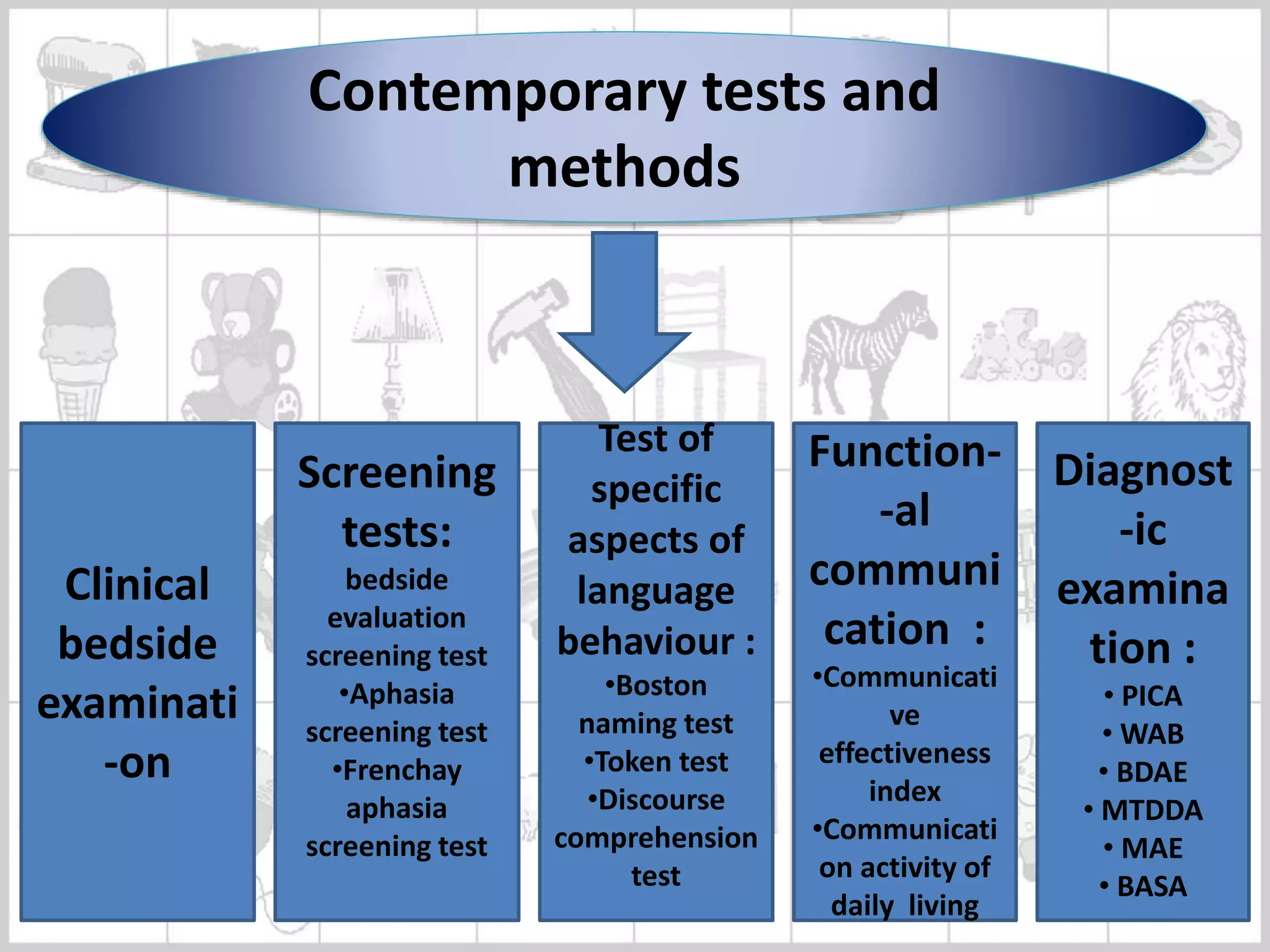
Contemporary tests and
methods
Clinical
bedside
examinati
-on
Screening
tests:
bedside
evaluation
screening test
•Aphasia
screening test
•Frenchay
aphasia
screening test
Test of
specific
aspects of
language
behaviour :
•Boston
naming test
•Token test
•Discourse
comprehension
test
Function-
-al
communi
cation :
•Communicati
ve
effectiveness
index
•Communicati
on activity of
daily living
Diagnost
-ic
examina
tion :
• PICA
• WAB
• BDAE
• MTDDA
• MAE
• BASA
Treatment
Sometimes aphasia will improve on its own without treatment, but speech
and language therapy is usually recommended.
For people with aphasia, speech and language therapy aims to:
• help you communicate to the best of your ability
• help restore as much of your speech and language as possible
• find alternative ways of communicating
Evidence suggests speech and language therapy is more effective if it's
started as soon as possible.
Other treatments:
• Medication – such as piracetam, bifemelane, piribedial, bromocriptine
and idebenone
• Transcranial magnetic stimulation – where an electromagnet placed on
the scalp is stimulated for a short time using an electric current to
stimulate parts of the brain affected by aphasia
Summarizing aphasia
• C:Userstech guruDocumentsAphasia_ The
disorder that makes you lose your words -
Susan Wortman-Jutt.mp4
Case
Presentation
Patient Background history
Assessment for aphasia & allied disorder(WAB)
& TOKEN TEST
Voice assessment
Recommendation
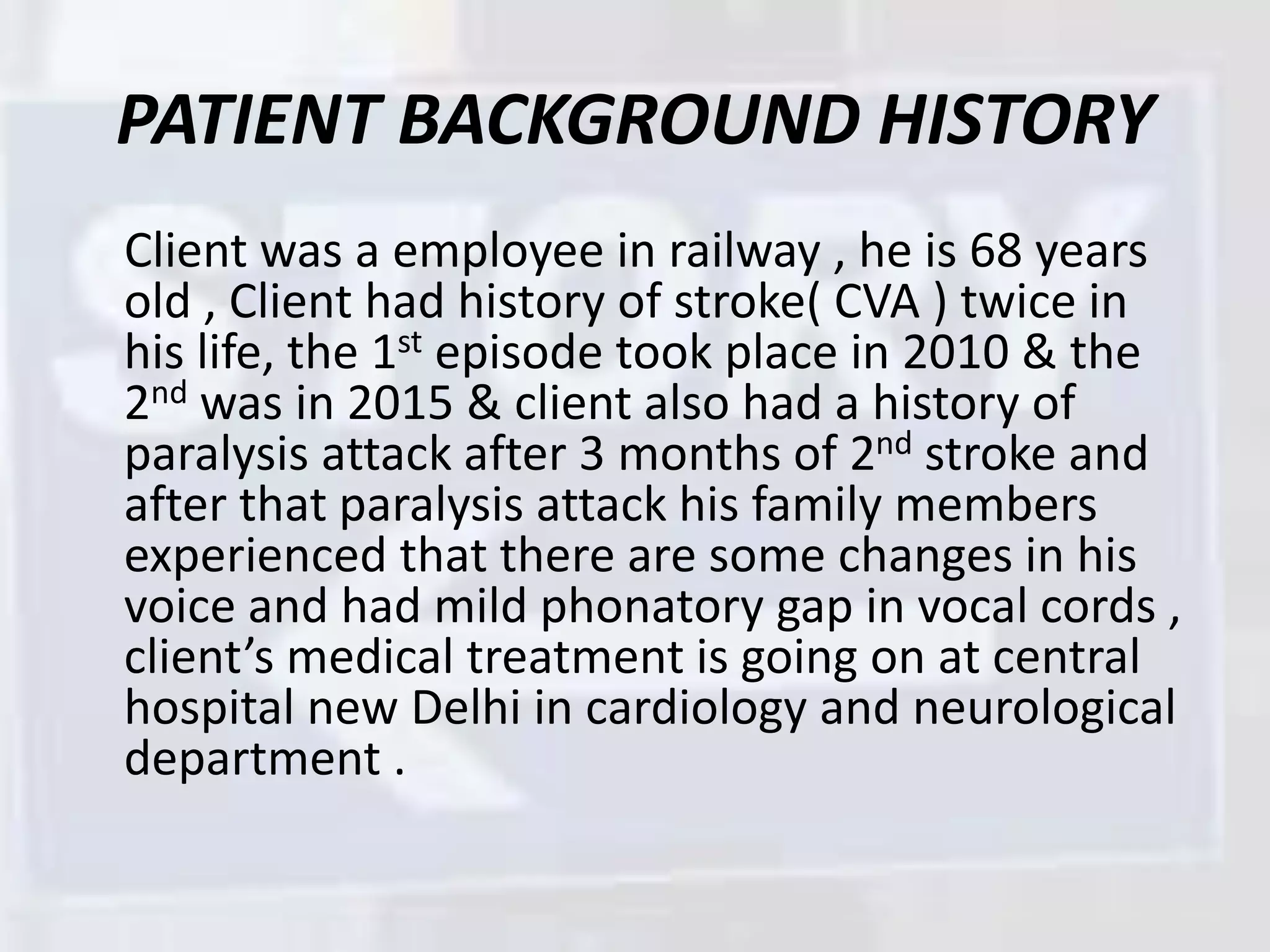
PATIENT BACKGROUND HISTORY
Client was a employee in railway , he is 68 years
old , Client had history of stroke( CVA ) twice in
his life, the 1st episode took place in 2010 & the
2nd was in 2015 & client also had a history of
paralysis attack after 3 months of 2nd stroke and
after that paralysis attack his family members
experienced that there are some changes in his
voice and had mild phonatory gap in vocal cords ,
client’s medical treatment is going on at central
hospital new Delhi in cardiology and neurological
department .
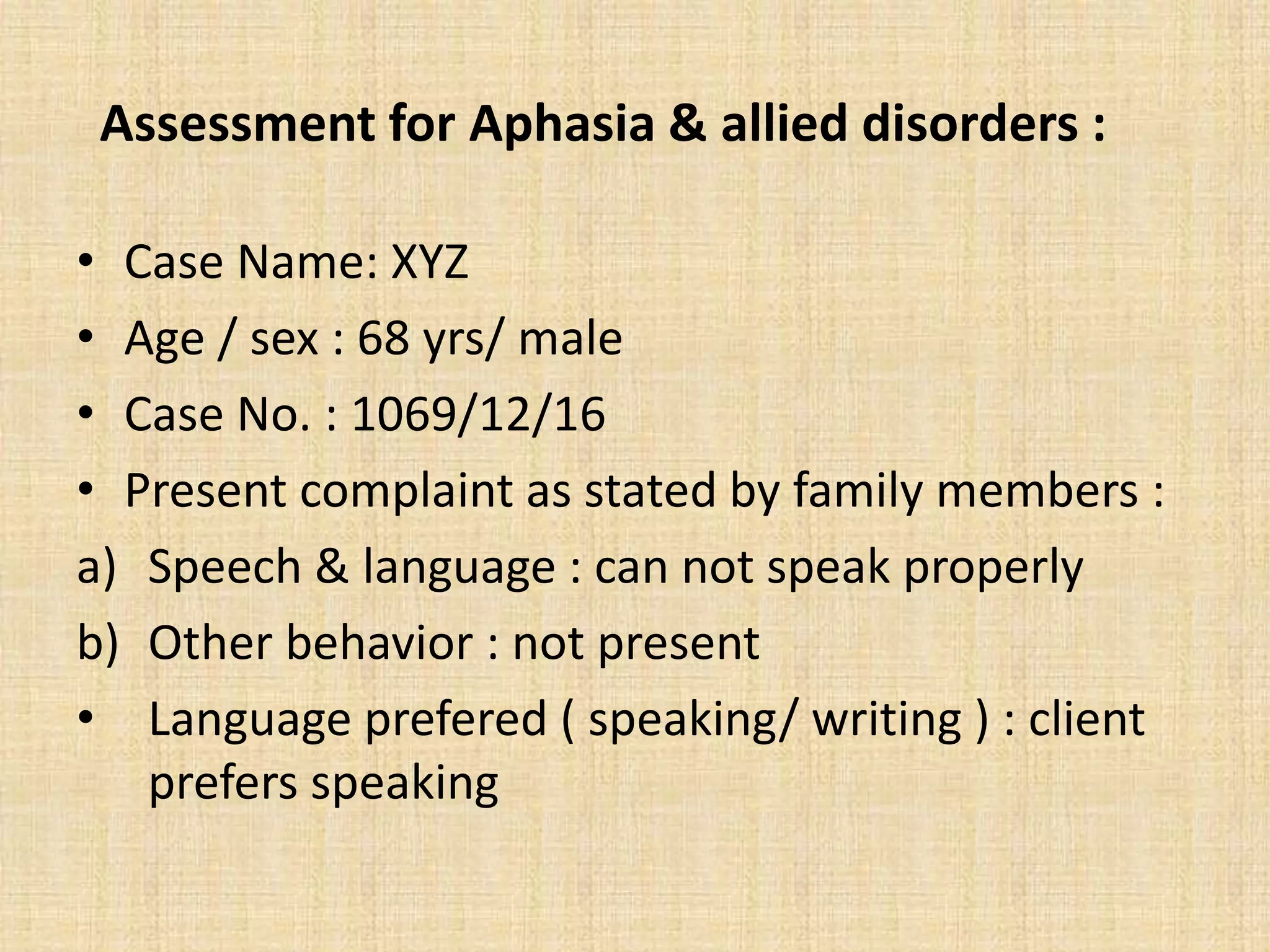
Assessment for Aphasia & allied disorders :
• Case Name: XYZ
• Age / sex : 68 yrs/ male
• Case No. : 1069/12/16
• Present complaint as stated by family members :
a) Speech & language : can not speak properly
b) Other behavior : not present
• Language prefered ( speaking/ writing ) : client
prefers speaking
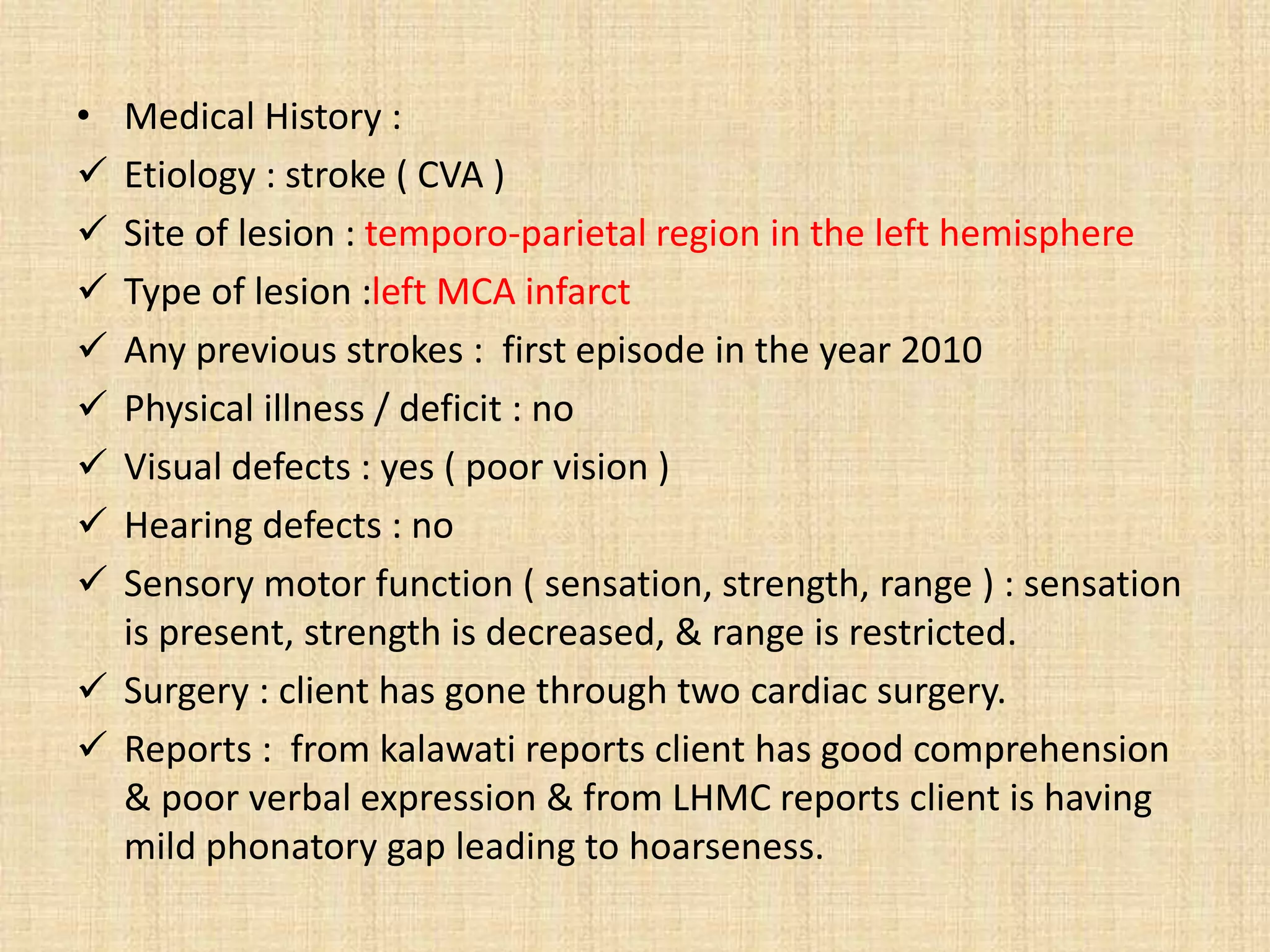
• Medical History :
 Etiology : stroke ( CVA )
 Site of lesion : temporo-parietal region in the left hemisphere
 Type of lesion :left MCA infarct
 Any previous strokes : first episode in the year 2010
 Physical illness / deficit : no
 Visual defects : yes ( poor vision )
 Hearing defects : no
 Sensory motor function ( sensation, strength, range ) : sensation
is present, strength is decreased, & range is restricted.
 Surgery : client has gone through two cardiac surgery.
 Reports : from kalawati reports client has good comprehension
& poor verbal expression & from LHMC reports client is having
mild phonatory gap leading to hoarseness.
• Present status :
 General physical condition : client appears to be normal
 Personality & behavior :socially adequate personality & behavior
 Hobbies & interests : client show interest in listening to songs &
reading newspaper
 Management of activities of daily living : client complete his
tasks by himself including cooking , washing cloths.
• Ongoing treatment :
 Medical : In central hospital new delhi ( in cardiology &
neurology department )
 Physiotherapy : no
 Occupational therapy : no
 Psychological counseling : no
 Other rehabilitation : yes client takes speech therapy.
• Oral peripheral examination :
Lips : lateral movements is affected ,
protrusion is normal , alternate movement is
affected deviated towards right side.
Tongue : Normal in appearance & function.
Soft palate : Normal in appearance & function.
Vegetative skills : all vegetative skills are
normal except blowing , client can resist air in
the mouth but he has difficulty in blowing.
• Communication behavior including speech &
language :
Mode of communication : mode is both verbal &
non verbal. In verbal, client has a limited
vocabulary and paraphasic speech & non verbally,
he uses gestures and pointing.
Linguistic behavior ( verbal, written in terms of
content, form & use of language comprehension
and production ) : written expression is poor,
reading text and reading commands are poor and
verbal output is limited.
• Other areas :
 Attention / perception : Adequate
 Motivation : Adequate
 Thinking : above average
 Memory : Intact
 Material facilitating response : Adequate but non verbal
only.
 Modality ( visual, auditory or tactile ) : vision is poor &
other modalities are present.
 Cueing ( verbal, gestural, visual-printed/ written ) : yes
through verbal or gestural sometimes.
 Arithmetic : fair arithmetic skills
• Language test administered & results : ( Token test/ WAB/
BDAE / PICA / Border Reading Test ) :
WAB was administered and aphasia quotient & cortical
quotient were calculated for :-
WAB & TOKEN TEST
Scoring of WAB
 Spontaneous speech : 2+ 2 = 4
 Auditory comprehension : 57+ 47+ 5 = 109
 Repetition : 0
 Naming : 0
 Reading :0
 Writing :0
• Aphasia severity rating scale : AQ is 18.9
Aphasia quotient = ( 4 + 109/20 ) * 2
= ( 4 + 5.45 ) * 2
= 9.45* 2 = 18.9
Scoring of Token test
• Part A ( 7 points possible ) = 7
• Part B ( 8 points possible ) = 8
• Part C ( 12 points possible ) = 12
• Part D ( 16 points possible ) = 12
• Part E ( 24 points possible ) = 18
• Part F ( 96 points possible ) = 49
TOTAL SCORES : 163
Scores obtained : 106
• Diagnostic formulation : case came to NISHD
with complaint of aphasia, he expresses
verbally through common words and phrases (
paraphasic error is present ) and non verbally
through pointing and gestures, client’s
vocabulary consists of common objects, client
has fair auditory comprehension.
• Provisional diagnosis : Broca’s aphasia
• Recommendation :
 Speech and language therapy at nearest
center / NISHD
 Speech and language stimulation at home
Aphasia therapy
Follow up
VOICE ASSESSMENT
• Brief history of the problem : client had dinner and he was normal for 10
minutes, after 10 minutes he had stroke first episode took place in 2010 &
again the 2nd episode took place in 2015 . The voice problem is started
after 2nd stroke that was on 15th august 2015.
• Medical history : CVA in tempo-parietal region in left hemisphere & had
left MCA infarction.
 Client get irritation/ pain in the throat- while speaking after 2nd stroke
 Onset of problem was sudden
 The problem of voice is static
 Client indulge in excessive & loud speaking & had a habbit of clearing of
throat 6-7 times in a day
 Other development ( physical , secondary sexual development ) are
normal
 Client has history of phonatory gap.
• Speech mechanism ( structure & function ) :
structurally all articulators are normal expect lips,
alternate & lateral movement are affected & jerks
present and all vegetative skills are present but
blowing is affected.
• Perceptual assessment :
 Pitch : pitch range is limited, habitual pitch is
high , & pitch breaks are also present
Loudness : very loud
Quality : hoarsness
Phonation duration : for [ a ] is 7.4 sec for [ i ] is 8
sec & for [ u ] is 5 sec.
• Diagnostic formulation : client came to NISHD
with the complaint of unclear voice as a post sign
of aphasia, client has normal physical &
secondary sexual development , oral peripheral
examination reveals that there is restriction in lip
movement & blowing is affected, on perceptually
assessment of voice, client has limited pitch
range , loudness is very loud & quality of voice is
hoarse voice
• Provisional diagnosis : phonatory gap with
hoarseness
• Recommendation :
 vocal hygiene
Voice therapy at NISHD/ nearnest center
Follow up
aphasia in brief

aphasia in brief

  • 1.
    APHASIA : ACASE STUDY BY : POOJA TOMAR & Mrs. KALYANI SINGH
  • 2.
    What is Aphasia…? Aphasiais “ an acquired impairment of language processes underlying receptive and expressive modalities and caused by damage to areas of the brain which are primarily responsible for the language function “ ( By Davis 1983 ). Aphasia is the “loss of verbal communication due to an acquired lesion of the nervous system involving one or more aspects of the processes of comprehending and producing verbal messages” ( Basso and Cubelli, 1999 ).
  • 3.
    Incidence and Prevalence •The incidence estimated that there are 80,000 new cases of aphasia per year (National Stroke Association, 2008). • Prevalence estimates that approximately 1 million people, or 1 in 250 , suffer from aphasia.
  • 4.
    Signs and Symptoms •Verbal Expression Impairments • Auditory Comprehension Impairments • Reading Comprehension Impairments (Alexia) • Written Language Impairments (Agraphia)
  • 5.
    APHASIA ETIOLOGIES • Aphasiais caused by damage to the language centers of the brain. In most people, these language centers are located in the left hemisphere, but aphasia can also occur as a result of damage to the right hemisphere; this is often referred to as crossed aphasia to denote that the right hemisphere is language dominant in these individuals. Common causes of aphasia are  CVA ( stroke ) – ischemic: blockage that disrupts blood flow to a region of the brain – hemorrhagic: a ruptured blood vessel that damages surrounding brain tissue  traumatic brain injury  brain tumors  brain infections  other neurological diseases (e.g., dementia).
  • 7.
    CLASSIFICATION• There areseveral classification system based on main characteristics are :  Functional anatomy  Clinical features  Associated condition • According to wernicke’s 1874 based on antomical lesion, there are 3 types of aphasia motor aphasia, sensory aphasia and conduction aphasia. • According to wernicke’s theme model 1884classification system there are 7 types of aphasia : 1. Motor aphasia : subcortical motor aphasia , cortical motor aphasia and transcortical motor aphasia 2. Conduction aphasia 3. Sensory aphasia : subcortical sensory aphasia , cortical sensory aphasia and trans cortical sensory aphasia • According to Goodglass classification 1974 there are 8 types of aphasia which are generally used in administering the WAB , these are broca’s aphasia , wernicke’s aphasia, global aphasia , anomic aphasia, transcortical motor aphasia, transcortical sensory aphasia, conduction aphasia and isolation aphasia.
  • 8.
    CLASSIFICATION OF APHASIA Fluent Non- Fluent Wernicke’sAphasia Conduction Aphasia Transcortical sensory Aphasia Anomic Aphasia Broca’s Aphasia Transcortical motor Aphasia Isolation Aphasia Global Aphasia Given by Goodglass( 1974)
  • 9.
  • 10.
    Type of AphasiaLesion localization Broca’s area Posterior-Inferior frontal (area 44, 45, sometimes 46 ) Wernicke’s Aphasia Posterior- Superior Temporal ( area 22 ) Conduction Aphasia Arcuate Fasciculus- supramarginal gyrus Anomic Aphasia Inferior – parietal ( angular gyrus ) Global Aphasia Perisylvian region ( middle cerebral artery territory ) Transcortical Motor aphasia Anterior & superior to broca’s area ( supplementary motor area ) Transcortical sensory Aphasia Watershed areas of middle & posterior cerebral artery Isolation Aphasia Watershed areas of middle, anterior & posterior cerebral artery
  • 11.
    ASSESSMENT • Purpose ofassessment : Generally , methods of assessment vary greatly, depending on the examiner’s goal. There are six general types of evaluation purpose may be distinguished in aphasic assessment : a) Screening procedures b) Diagnostic assessment c) Descriptive testing in rehabilitation and counselling d) Progressive evaluation e) Assessment of functional and pragmatic communication; and f) Assessment of related disorders
  • 12.
    • Assessment ofaphasia is a comprehensive examination of speech & language characteristics along with other behavioral and medical condition. • Assessment can involve many phases such as reviewing medical records, a patient and family interview and a bedside screening , formal testing procedures. • Formal testing involves a comprehensive language test battery to assess patient linguistic and communication impairments.
  • 13.
    Language Test Batteries Basicallyassess two primary input modalities & three output modalities, language test batteries generally assess four modalities, these are :  Speech  Auditory comprehension  Reading  Writing
  • 14.
    Contemporary tests and methods Clinical bedside examinati -on Screening tests: bedside evaluation screeningtest •Aphasia screening test •Frenchay aphasia screening test Test of specific aspects of language behaviour : •Boston naming test •Token test •Discourse comprehension test Function- -al communi cation : •Communicati ve effectiveness index •Communicati on activity of daily living Diagnost -ic examina tion : • PICA • WAB • BDAE • MTDDA • MAE • BASA
  • 15.
    Treatment Sometimes aphasia willimprove on its own without treatment, but speech and language therapy is usually recommended. For people with aphasia, speech and language therapy aims to: • help you communicate to the best of your ability • help restore as much of your speech and language as possible • find alternative ways of communicating Evidence suggests speech and language therapy is more effective if it's started as soon as possible. Other treatments: • Medication – such as piracetam, bifemelane, piribedial, bromocriptine and idebenone • Transcranial magnetic stimulation – where an electromagnet placed on the scalp is stimulated for a short time using an electric current to stimulate parts of the brain affected by aphasia
  • 16.
    Summarizing aphasia • C:UserstechguruDocumentsAphasia_ The disorder that makes you lose your words - Susan Wortman-Jutt.mp4
  • 17.
    Case Presentation Patient Background history Assessmentfor aphasia & allied disorder(WAB) & TOKEN TEST Voice assessment Recommendation
  • 18.
    PATIENT BACKGROUND HISTORY Clientwas a employee in railway , he is 68 years old , Client had history of stroke( CVA ) twice in his life, the 1st episode took place in 2010 & the 2nd was in 2015 & client also had a history of paralysis attack after 3 months of 2nd stroke and after that paralysis attack his family members experienced that there are some changes in his voice and had mild phonatory gap in vocal cords , client’s medical treatment is going on at central hospital new Delhi in cardiology and neurological department .
  • 19.
    Assessment for Aphasia& allied disorders : • Case Name: XYZ • Age / sex : 68 yrs/ male • Case No. : 1069/12/16 • Present complaint as stated by family members : a) Speech & language : can not speak properly b) Other behavior : not present • Language prefered ( speaking/ writing ) : client prefers speaking
  • 20.
    • Medical History:  Etiology : stroke ( CVA )  Site of lesion : temporo-parietal region in the left hemisphere  Type of lesion :left MCA infarct  Any previous strokes : first episode in the year 2010  Physical illness / deficit : no  Visual defects : yes ( poor vision )  Hearing defects : no  Sensory motor function ( sensation, strength, range ) : sensation is present, strength is decreased, & range is restricted.  Surgery : client has gone through two cardiac surgery.  Reports : from kalawati reports client has good comprehension & poor verbal expression & from LHMC reports client is having mild phonatory gap leading to hoarseness.
  • 21.
    • Present status:  General physical condition : client appears to be normal  Personality & behavior :socially adequate personality & behavior  Hobbies & interests : client show interest in listening to songs & reading newspaper  Management of activities of daily living : client complete his tasks by himself including cooking , washing cloths. • Ongoing treatment :  Medical : In central hospital new delhi ( in cardiology & neurology department )  Physiotherapy : no  Occupational therapy : no  Psychological counseling : no  Other rehabilitation : yes client takes speech therapy.
  • 22.
    • Oral peripheralexamination : Lips : lateral movements is affected , protrusion is normal , alternate movement is affected deviated towards right side. Tongue : Normal in appearance & function. Soft palate : Normal in appearance & function. Vegetative skills : all vegetative skills are normal except blowing , client can resist air in the mouth but he has difficulty in blowing.
  • 23.
    • Communication behaviorincluding speech & language : Mode of communication : mode is both verbal & non verbal. In verbal, client has a limited vocabulary and paraphasic speech & non verbally, he uses gestures and pointing. Linguistic behavior ( verbal, written in terms of content, form & use of language comprehension and production ) : written expression is poor, reading text and reading commands are poor and verbal output is limited.
  • 24.
    • Other areas:  Attention / perception : Adequate  Motivation : Adequate  Thinking : above average  Memory : Intact  Material facilitating response : Adequate but non verbal only.  Modality ( visual, auditory or tactile ) : vision is poor & other modalities are present.  Cueing ( verbal, gestural, visual-printed/ written ) : yes through verbal or gestural sometimes.  Arithmetic : fair arithmetic skills • Language test administered & results : ( Token test/ WAB/ BDAE / PICA / Border Reading Test ) : WAB was administered and aphasia quotient & cortical quotient were calculated for :-
  • 25.
  • 26.
    Scoring of WAB Spontaneous speech : 2+ 2 = 4  Auditory comprehension : 57+ 47+ 5 = 109  Repetition : 0  Naming : 0  Reading :0  Writing :0 • Aphasia severity rating scale : AQ is 18.9 Aphasia quotient = ( 4 + 109/20 ) * 2 = ( 4 + 5.45 ) * 2 = 9.45* 2 = 18.9
  • 27.
    Scoring of Tokentest • Part A ( 7 points possible ) = 7 • Part B ( 8 points possible ) = 8 • Part C ( 12 points possible ) = 12 • Part D ( 16 points possible ) = 12 • Part E ( 24 points possible ) = 18 • Part F ( 96 points possible ) = 49 TOTAL SCORES : 163 Scores obtained : 106
  • 28.
    • Diagnostic formulation: case came to NISHD with complaint of aphasia, he expresses verbally through common words and phrases ( paraphasic error is present ) and non verbally through pointing and gestures, client’s vocabulary consists of common objects, client has fair auditory comprehension. • Provisional diagnosis : Broca’s aphasia
  • 29.
    • Recommendation : Speech and language therapy at nearest center / NISHD  Speech and language stimulation at home Aphasia therapy Follow up
  • 30.
    VOICE ASSESSMENT • Briefhistory of the problem : client had dinner and he was normal for 10 minutes, after 10 minutes he had stroke first episode took place in 2010 & again the 2nd episode took place in 2015 . The voice problem is started after 2nd stroke that was on 15th august 2015. • Medical history : CVA in tempo-parietal region in left hemisphere & had left MCA infarction.  Client get irritation/ pain in the throat- while speaking after 2nd stroke  Onset of problem was sudden  The problem of voice is static  Client indulge in excessive & loud speaking & had a habbit of clearing of throat 6-7 times in a day  Other development ( physical , secondary sexual development ) are normal  Client has history of phonatory gap.
  • 31.
    • Speech mechanism( structure & function ) : structurally all articulators are normal expect lips, alternate & lateral movement are affected & jerks present and all vegetative skills are present but blowing is affected. • Perceptual assessment :  Pitch : pitch range is limited, habitual pitch is high , & pitch breaks are also present Loudness : very loud Quality : hoarsness Phonation duration : for [ a ] is 7.4 sec for [ i ] is 8 sec & for [ u ] is 5 sec.
  • 32.
    • Diagnostic formulation: client came to NISHD with the complaint of unclear voice as a post sign of aphasia, client has normal physical & secondary sexual development , oral peripheral examination reveals that there is restriction in lip movement & blowing is affected, on perceptually assessment of voice, client has limited pitch range , loudness is very loud & quality of voice is hoarse voice • Provisional diagnosis : phonatory gap with hoarseness • Recommendation :  vocal hygiene Voice therapy at NISHD/ nearnest center Follow up