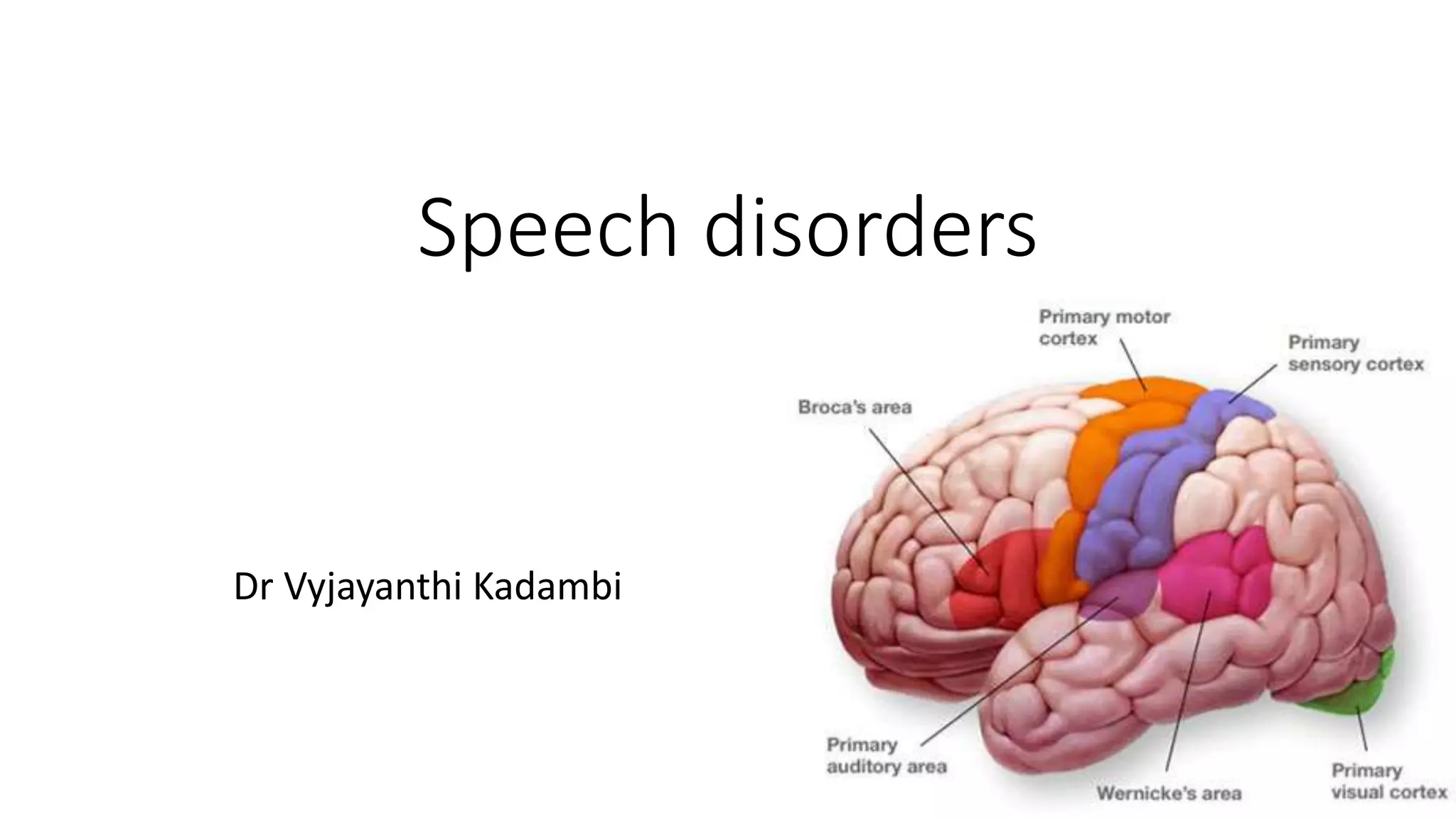
Speech disorders
Dr Vyjayanthi Kadambi
Language
• PHONOLOGY: It is the study of sound
• MORPHOLOGY: It is the study of word formation. This component of
language focuses on the internal structure of words.
• MORPHEMES: They are the smallest unit of linguistic meaning or
function.
Lexical morphemes have meaning and can stand alone.
Examples are man, girl, play, etc.
Grammatical morphemes, conversely, are mostly used to specify a
relationship between 2 lexical morphemes or modify one.
Examples are at, and, the, etc.
• Free morphemes include lexical or grammatical morphemes and they can stand
alone.
Examples: nouns, verbs, etc. (lexical) or prepositions, conjunctions, and
articles(grammatical).
• Bound morphemes include lexical or grammatical morphemes but they cannot
stand alone. Examples: suffixes and prefixes (all affixes in English are bound
morphemes).
• Fair is a free morpheme. Fairness includes a free morpheme and a bound
morpheme which is fairness.
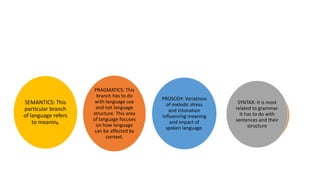
SYNTAX: It is most
related to grammar.
It has to do with
sentences and their
structure
PROSODY: Variations
of melodic stress
and intonation
influencing meaning
and impact of
spoken language.
PRAGMATICS: This
branch has to do
with language use
and not language
structure. This area
of language focuses
on how language
can be affected by
context.
SEMANTICS: This
particular branch
of language refers
to meaning.
Speech
• Speech is the vocalized form of communication which is based upon the syntactic
combination of lexicals drawn from the vocabulary. Each spoken word is created
out of the phonetic combination of a limited set of vowel and consonant speech
sound units (phonemes).
• It includes language production, phonation, articulation.
• 5 PARAMETERS:
1. • Comprehension
2. • Reading
3. • Writing
4. • Naming
5. • Repetition
• Aphasia: Loss of language due to dysfunction of central mechanism in
the brain
• Dysphasia: Minor form of aphasia
• Dysarthria: Dysfunction of the peripheral mechanism of speech
leading to defective articulation.
• Dysphonia: Loss of voice due to dysfunction of voice producing
mechanisms.
• Alexia: Loss of ability to read
• Agraphia: Loss of ability to write.
• Word deafness: Difficulty in understanding meaning of words heard.
• Word blindness: Difficulty in understanding the meaning of words
seen.
• Bradylalia: Slowness of speech.
• Echolalia: Repetition of examiners words by the patient.
• Palilalia: Repetition of the terminal words of own speech.
• Paraphasias: Simple syllabic words are missing and replaced by
substitutions so that desired response is only approximated.
1. Literal: Incorrect letters( grass is green)
2. Verbal: Incorrect words( grass is blue)
3. Neologisms: Nonsense words( grass is grumps).
• Mutism: Inability to speak.
Classification
• Disorders of Language- Aphasia
• Disorders of articulation – Dysarthria
• Disorders of voice production- Dysphonia
DYSARTHRIA
Dysarthria is defective articulation of sounds or words of neurologic origin.
language functions are normal
proper syntax
pronunciation is faulty
breakdown in performing the coordinated muscular movements necessary
for speech production.
A good general rule is that no matter how garbled the speech, if the patient
is speaking in correct sentences—using grammar and vocabulary
commensurate with his dialect and education—he has dysarthria and not
aphasia.
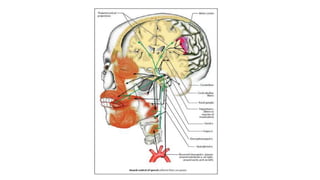
ANATOMY AND PHYSIOLOGY OF SOUND PRODUCTION
• Sounds -expired air -vocal cords.
• Properly articulated speech - coordination between the respiratory muscles and
the muscles of the larynx, pharynx, soft palate, tongue, and lips--- vocal (oral)
tract.
• Respiratory movements - strength and rhythm of the voice.
• Variations in pitch - alterations in the tension and length of the vocal cords.
• oropharynx, nasopharynx, mouth -resonating chambers- the timbre and
character of the voice.
• Articulation -bulbar functions.
• Several cranial nerves (CNs)
• trigeminal nerves -muscles of mastication , open and close the mouth.
• facial nerves -facial expression,orbicularis oris.
• vagus nerves and glossopharyngeal nerves - soft palate, pharynx, and larynx.
• hypoglossal nerves -tongue movements.
• upper cervical nerves, which communicate with the lower CNs and in part supply
the infrahyoid and suprahyoid muscles, the cervical sympathetic nerves that
contribute to the pharyngeal plexus, the phrenic and intercostal nerves.
SPEECH SOUNDS : TYPES AND SITES OF PRODUCTION
• Articulated labials (b, p, m, and w) - lips.
• Labiodentals (f and v) -placing the teeth against the lower lip.
• Linguals - tongue action.
• tongue-point, or alveolar, sounds T, d, l, r, and n - touching the tip of the tongue to the upper alveolar
ridge.
• dentals or tongue-blade sounds- S, z, sh, zh, ch, and j
• Gutturals (velars, or tongue-back sounds, such as k, g, and ng) - back of the tongue and the soft palate.
• Palatals (German ch and g, and the French gn) - dorsum of the tongue approximates the hard palate.
CLINICAL EXAMINATION AND ASSESSMENT
• patient’s spontaneous speech in normal conversation- during taking of the
history.
• pronunciation, rate of speech, resonance, and prosody
• tremulousness, stuttering, slurring or sliding of letters or words, scanning,
explosiveness, and difficulties with specific sound formations.
• “puhtuhkuh” or “pataka” tests all three: labials (puh/pa), linguals (tuh/ta),
and velars (kuh/ka).
• normal cough -vocal cord innervation is intact
TYPES AND CAUSES
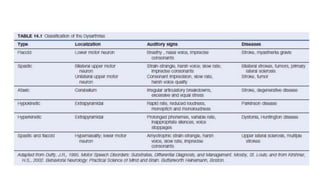
• flaccid, spastic, ataxic, hypokinetic, hyperkinetic, and mixed
types.
• Hypoglossal nerve or nucleus or ankyloglossia - difficulty in pronouncing lingual
sounds. Lisping clumsy.
• Paralysis of the laryngeal musculature , laryngitis and in tumors of the larynx -
hoarseness, whisper; vowels.
• Weakness of the soft palate results in nasal speech (rhinolalia) - inability to seal
off the nasal from the oral cavity.
• Seventh nerve paralysis - labials and labiodentals.
• U/L CN X -hypernasality.
• B/L - vocal cords paralyzed in adduction, resulting in a weak voice with stridor.
• In bulbar palsy- weakness of the tongue, pharynx, larynx, soft palate.
The patient talks as though his mouth were full of mashed potatoes.
• Bilateral supranuclear lesions - pseudobulbar palsy with spastic dysarthria.
Phonation is typically strained-strangled, and articulation and
diadochokinesis are slow.
• In acute hemiplegia-transient slurring or thickness of speech depending on
the degree of face and tongue weakness.
• Cerebellar dysfunction - defect of articulatory coordination (scanning
speech, ataxic dysarthria, or speech asynergy)
• Neuromuscular disorders- MG, prolonged speaking, such as counting
• Motor neuron disease - the dysarthria is of mixed type.
• Speech in parkinsonism is often mumbled, hesitant, rapid, and soft
(hypophonic),bradylalia, monotone.
• Patients with some forms of aphasia, dysarthria, dysprosodia, and speech
apraxia may begin to sound as if they have developed an unusual accent.
• The foreign accent syndrome during recovering facial diplegia made one
patient from Virginia sound for several months as if she were a Bavarian
countess.
NON ORGANIC SPEECH DISORDERS
Emotional and psychogenic factors influence articulation.
• Stuttering (spasmophemia) refers to faulty, spasmodic, interrupted speech characterized by
involuntary hesitations in which the speaker is unable to produce the next expected sound.
• In lalling (lallation, “baby talk”), the speech is childish, babbling, and characterized by a lack of
precision in pronouncing certain consonants, especially the letters r and l.
• In anxiety and agitation the speech may be broken, tremulous, high-pitched, uneven, and breathless
• In hysterical aphonia, there is profound speech difficulty but no disturbance of coughing or
respiration.
• Palilalia, echolalia, and perseveration are often manifestations of
psychosis, but they can occur with organic lesions, especially of the
frontal lobes.
• Perseveration is the persistence of one reply or one idea in response
to various questions.
• Idioglossia is imperfect articulation with utterance of meaningless
sounds; the individual may speak with a vocabulary all his own.
MANAGMENT
• Identification of the cause and specific treatment if available.
• Speech therapy.
• Cognitive training.
• Physiotherapy in helping recovery of paralysed muscles.
APHASIA
• Aphasia (dysphasia) refers to a disorder of language, including various
combinations of impairment in the ability to spontaneously produce,
understand, and repeat speech, as well as defects in the ability to read and
write, due to brain damage.
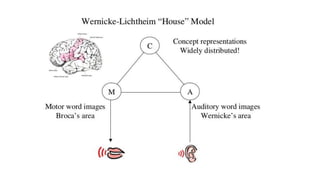
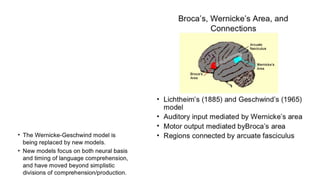
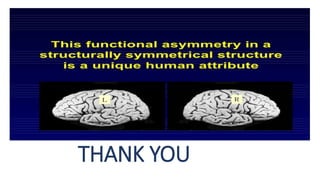
• Functional neuroimaging has shown that the 19th-century model of
language is remarkably insightful, confirming the importance of the left
posterior inferior frontal (PIF) and posterior superior temporal (PST)
cortices as predicted by Broca, Wernicke, and Lichtheim.
• However, the Wernicke- Geschwind model has a number of limitations, for
example: it does not account for language disturbances caused by
subcortical lesions other than conduction aphasia; it does not account for
the often significant recovery after stroke; and it does not account for the
diverse nature of most aphasias.
ANATOMY AND PHYSIOLOGY
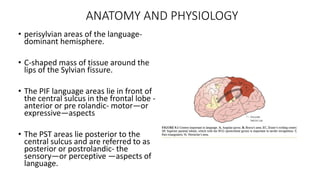
• perisylvian areas of the language-
dominant hemisphere.
• C-shaped mass of tissue around the
lips of the Sylvian fissure.
• The PIF language areas lie in front of
the central sulcus in the frontal lobe -
anterior or pre rolandic- motor—or
expressive—aspects
• The PST areas lie posterior to the
central sulcus and are referred to as
posterior or postrolandic- the
sensory—or perceptive —aspects of
language.
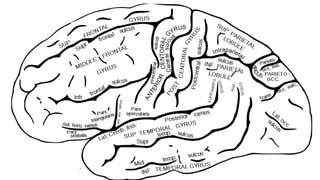
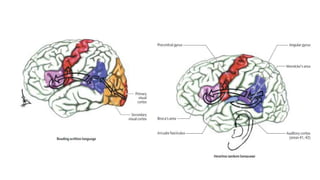
• The arcuate fasciculus (AF) is a deep white matter tract that arches from
Wernicke’s area around the posterior end of the Sylvian fissure and
through the subcortical white matter of the insula to Broca’s area.
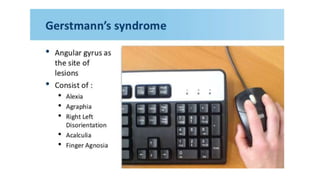
• The angular gyrus is part of the inferior parietal lobule. The angular gyrus is
important for reading and similar nonverbal language functions.
• The supramarginal gyrus also lies between the visual cortex and the
posterior perisylvian language areas and is involved with visual language
functions.
• Exner’s center is a purported cortical area concerned with writing that lies
in the middle frontal gyrus of the language-dominant frontal lobe.
• According to current thinking, there are no centers for “hearing
words,” “perceiving space,” or “storing memories.”
• Cognitive and behavioral functions (domains) are coordinated by
intersecting large-scale neural networks that contain interconnected
cortical and subcortical components.
• Perisylvian network – language
• Parietofrontal network – spatial cognition
• Occipitotemporal network – face and object recognition
• Limbic network – memory
• Prefrontal network – cognitive and behavioural control
• LEFT HEMISPHERE
• 90% right handers
• 60% left handers
• Crossed aphasia
CAUSES
• perisylvian language areas -middle cerebral artery
• the anterior -superior division(M1)
• posterior areas - inferior division(M2).
• ischemia in the MCA distribution , sudden in onset.
• Aphasias - neurodegenerative diseases - insidious onset - relentless
progression.
EXAMINATION
• Initial appraisal of language - taking of the history.
• PREREQUISITES :
In evaluating aphasia- patient’s handedness ,cultural background,
native language and other languages spoken, vocabulary, educational
level, intellectual capacity, and vocation.
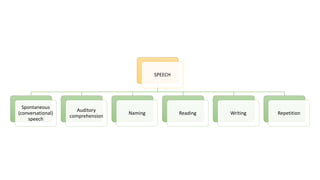
SPEECH
Spontaneous
(conversational)
speech
Auditory
comprehension
Naming Reading Writing Repetition
SPONTANEOUS SPEECH
• Spontaneous speech - fluent- appropriate output volume, phrase length, and
melody
• Nonfluent- sparse, halting and <4 words.
• There are three levels of motor speech function. In aphasia, the most elementary of
these is least frequently affected, and the most complex most often involved.
1. Emotional speech is spontaneous speech prompted by a high emotional charge, is the most
primitive. Some patients with aphasia, may swear and curse eloquently when angry, often to
the shock and surprise of friends and family.
2. Automatic speech refers to the recitation of simple overlearned items from early childhood
or to a specific retained speech fragment that an aphasic patient is still capable of saying even
in the presence of severe nonfluency.
3. Propositional language is the communication of thoughts, ideas, feelings, and judgments
using words, syntax, semantics, and rules of conversation. It is most easily disrupted and most
difficult to repair.
• Paraphasia is a speech error in which the patient substitutes a wrong word
or sound for the intended word or sound.
• A neologism is a novel utterance, a nonword made up on the spot. The
patient might call a watch a woshap.
• Fluency refers to the volume of speech output. Normal speech is 100 to
115 words per minute. Speech output is often as low as 10 to 15 words per
minute, sometimes less, in patients with nonfluent aphasia. If the
maximum sentence length is fewer than seven words, then the patient is
nonfluent.
COMPREHENSION
• The patient’s responses to verbal requests and commands and to everyday
questions and comments give information about his ability to understand speech.
• verbal commands (“show me your teeth,” “stick out your tongue,” “close your eyes,”
or “point to the ceiling”).
• Patients with a left hemisphere lesion may even have apraxia for functions of their
nonparetic left hand. They may be unable to perform simple functions on command
using the left hand because of involvement of fibers that transmit information from
the language areas on the left to the motor areas on the right (sympathetic apraxia).
NAMING
• Naming is a delicate function.
• nonspecific
• In confrontation naming--- key, pencil, coin, watch, parts of the body (nose, ear,
chin, fingernail, knuckle), or to name colors.
• When lost for the name of an object, the patient may describe it or tell its use.
• Another measure of spontaneous naming is to ask the patient to list all of the
words he can think of that begin with a certain letter. The FAS test is popular. For
FAS, a person of average education should produce 12 or more words per letter in
1 minute, or 36 words with all three letters in 3 minutes.
REPETITION
• The ability to repeat may be selectively involved or paradoxically
preserved in certain aphasic syndromes.
• Most often the inability to repeat is proportional to the defect in
comprehension or fluency, and repetition is a good screening test for
aphasia.
• Patients with impaired repetition may omit words, change the word
order, or commit paraphasic errors.
• Repetition is preserved in anomic, transcortical, and some cases of
subcortical aphasia.
WRITING
• The patient’s ability to use written language should also be assessed.
It may be disturbed in conjunction with abnormalities of spoken
language, or separately.
• Patients who are aphasic in speech are also aphasic in writing, but
writing may be preserved in patients with dysarthria or verbal
apraxia.
• In all aphasias, reading and writing are typically worse than
understanding and speaking, probably because they are secondarily
acquired skills.
READING
• The patient’s ability to comprehend written language symbols can be
tested by having him read.
• Written language is perceived by the visual system and the
information conveyed to the perisylvian language centers.
• Dysfunction of the language centers or interruption of the
connections with the visual system may cause an inability to read
(alexia).
• Patients may have alexia without any accompanying inability to
comprehend speech—the syndrome of pure word blindness.
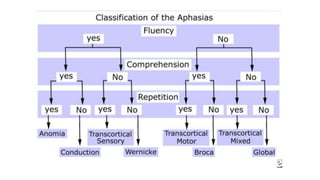
Classification
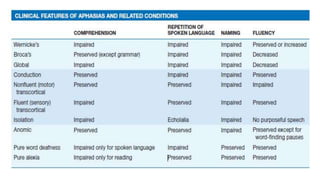
Aphasia with repetition disturbances
1. Broca’s aphasia
2. Wernicke’s aphasia
3. Conduction aphasia
Aphasia with repetition preserved
1. Isolation of speech area
2. Transcortical motor aphasia
3. Transcortical sensory aphasia
4. Anomic/nominal aphasia
Disturbance primarily affecting reading and writing
Alexia with agraphia
Total aphasia
Global aphasia
Syndrome with disturbance of single language modalities
1. Alexia without agraphia
2. Aphemia
3. Pure word deafness
4. Nonaphasic misnaming
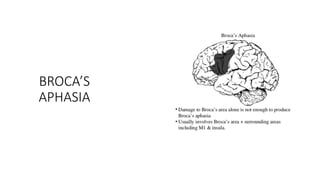
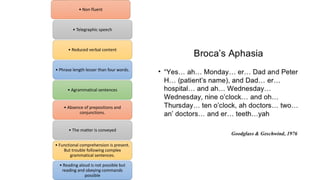
BROCA’S
APHASIA
• Non fluent
• Telegraphic speech
• Reduced verbal content
• Phrase length lesser than four words.
• Agrammatical sentences
• Absence of prepositions and
conjunctions.
• The matter is conveyed
• Functional comprehension is present.
But trouble following complex
grammatical sentences.
• Reading aloud is not possible but
reading and obeying commands
possible
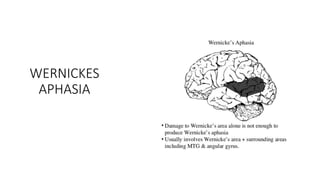
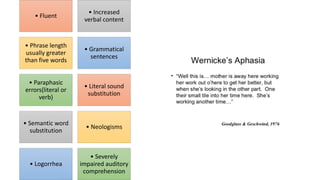
WERNICKES
APHASIA
• Fluent
• Increased
verbal content
• Phrase length
usually greater
than five words
• Grammatical
sentences
• Paraphasic
errors(literal or
verb)
• Literal sound
substitution
• Semantic word
substitution
• Neologisms
• Logorrhea
• Severely
impaired auditory
comprehension
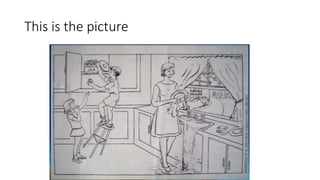
This is the picture
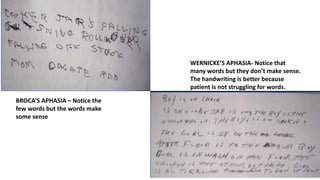
BROCA’S APHASIA – Notice the
few words but the words make
some sense
WERNICKE’S APHASIA- Notice that
many words but they don’t make sense.
The handwriting is better because
patient is not struggling for words.
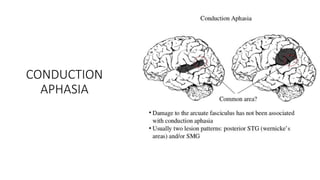
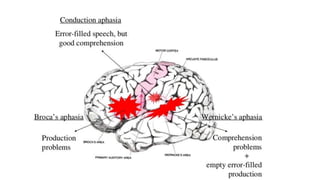
CONDUCTION
APHASIA
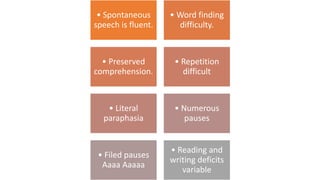
• Spontaneous
speech is fluent.
• Word finding
difficulty.
• Preserved
comprehension.
• Repetition
difficult
• Literal
paraphasia
• Numerous
pauses
• Filed pauses
Aaaa Aaaaa
• Reading and
writing deficits
variable
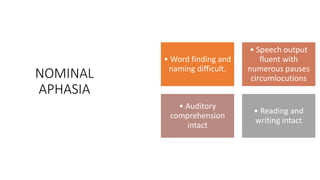
NOMINAL
APHASIA
• Word finding and
naming difficult.
• Speech output
fluent with
numerous pauses
circumlocutions
• Auditory
comprehension
intact
• Reading and
writing intact
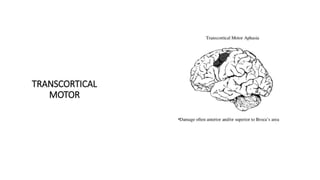
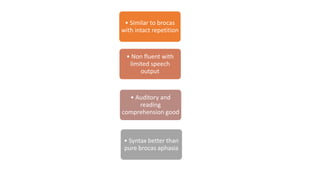
TRANSCORTICAL
MOTOR
• Similar to brocas
with intact repetition
• Non fluent with
limited speech
output
• Auditory and
reading
comprehension good
• Syntax better than
pure brocas aphasia
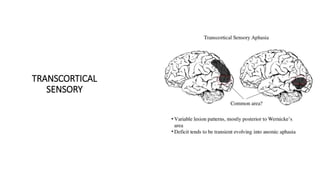
TRANSCORTICAL
SENSORY
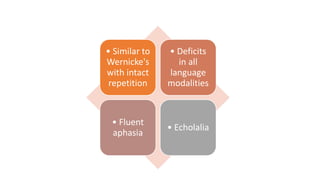
• Similar to
Wernicke's
with intact
repetition
• Deficits
in all
language
modalities
• Fluent
aphasia
• Echolalia
• ISOLATION APAHASIA: Combination of two transcortical aphasias
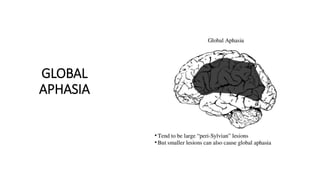
GLOBAL
APHASIA
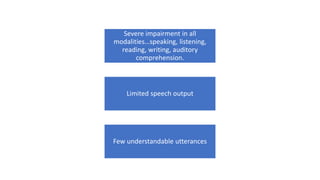
Severe impairment in all
modalities…speaking, listening,
reading, writing, auditory
comprehension.
Limited speech output
Few understandable utterances
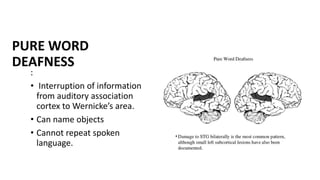
PURE WORD
DEAFNESS
:
• Interruption of information
from auditory association
cortex to Wernicke’s area.
• Can name objects
• Cannot repeat spoken
language.
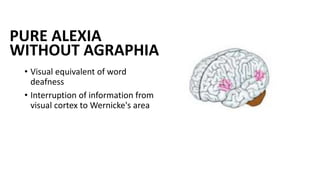
PURE ALEXIA
WITHOUT AGRAPHIA
• Visual equivalent of word
deafness
• Interruption of information from
visual cortex to Wernicke's area
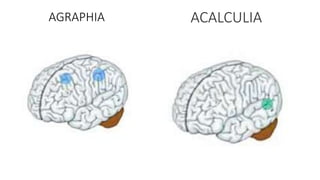
AGRAPHIA ACALCULIA
NON DOMINANT HEMISPHERE LANGUAGE DISTURBANCES
• matter of debate
• Non–right-handers, particularly, are thought to have some speech function in the
nondominant hemisphere.
• Some of the recovery from aphasia and the persistence of emotional and
automatic speech suggest some language function may be present in the minor
hemisphere.
• Lesions of the nondominant hemisphere cause speech disturbances that affect
the non-linguistic elements of language. There is loss or impairment of the
rhythm and emotional elements of language.
• Prosody refers to the melodic aspects of Dysprosody, typically hypoprosody or
aprosody, may occur with right hemisphere lesions. Patients lose the ability to
convey emotion in speech or to detect the emotion expressed by others.
• There is often difficulty processing nonliteral, context bound, complex aspects of
language, such as understanding figurative language, stories, and jokes.
THANK YOU

Speech disorders

  • 1.
  • 2.
    Language • PHONOLOGY: Itis the study of sound • MORPHOLOGY: It is the study of word formation. This component of language focuses on the internal structure of words. • MORPHEMES: They are the smallest unit of linguistic meaning or function. Lexical morphemes have meaning and can stand alone. Examples are man, girl, play, etc. Grammatical morphemes, conversely, are mostly used to specify a relationship between 2 lexical morphemes or modify one. Examples are at, and, the, etc.
  • 3.
    • Free morphemesinclude lexical or grammatical morphemes and they can stand alone. Examples: nouns, verbs, etc. (lexical) or prepositions, conjunctions, and articles(grammatical). • Bound morphemes include lexical or grammatical morphemes but they cannot stand alone. Examples: suffixes and prefixes (all affixes in English are bound morphemes). • Fair is a free morpheme. Fairness includes a free morpheme and a bound morpheme which is fairness.
  • 4.
    SYNTAX: It ismost related to grammar. It has to do with sentences and their structure PROSODY: Variations of melodic stress and intonation influencing meaning and impact of spoken language. PRAGMATICS: This branch has to do with language use and not language structure. This area of language focuses on how language can be affected by context. SEMANTICS: This particular branch of language refers to meaning.
  • 5.
    Speech • Speech isthe vocalized form of communication which is based upon the syntactic combination of lexicals drawn from the vocabulary. Each spoken word is created out of the phonetic combination of a limited set of vowel and consonant speech sound units (phonemes). • It includes language production, phonation, articulation. • 5 PARAMETERS: 1. • Comprehension 2. • Reading 3. • Writing 4. • Naming 5. • Repetition
  • 6.
    • Aphasia: Lossof language due to dysfunction of central mechanism in the brain • Dysphasia: Minor form of aphasia • Dysarthria: Dysfunction of the peripheral mechanism of speech leading to defective articulation. • Dysphonia: Loss of voice due to dysfunction of voice producing mechanisms. • Alexia: Loss of ability to read • Agraphia: Loss of ability to write.
  • 7.
    • Word deafness:Difficulty in understanding meaning of words heard. • Word blindness: Difficulty in understanding the meaning of words seen. • Bradylalia: Slowness of speech. • Echolalia: Repetition of examiners words by the patient. • Palilalia: Repetition of the terminal words of own speech.
  • 8.
    • Paraphasias: Simplesyllabic words are missing and replaced by substitutions so that desired response is only approximated. 1. Literal: Incorrect letters( grass is green) 2. Verbal: Incorrect words( grass is blue) 3. Neologisms: Nonsense words( grass is grumps). • Mutism: Inability to speak.
  • 9.
    Classification • Disorders ofLanguage- Aphasia • Disorders of articulation – Dysarthria • Disorders of voice production- Dysphonia
  • 10.
    DYSARTHRIA Dysarthria is defectivearticulation of sounds or words of neurologic origin. language functions are normal proper syntax pronunciation is faulty breakdown in performing the coordinated muscular movements necessary for speech production. A good general rule is that no matter how garbled the speech, if the patient is speaking in correct sentences—using grammar and vocabulary commensurate with his dialect and education—he has dysarthria and not aphasia.
  • 11.
    ANATOMY AND PHYSIOLOGYOF SOUND PRODUCTION • Sounds -expired air -vocal cords. • Properly articulated speech - coordination between the respiratory muscles and the muscles of the larynx, pharynx, soft palate, tongue, and lips--- vocal (oral) tract. • Respiratory movements - strength and rhythm of the voice. • Variations in pitch - alterations in the tension and length of the vocal cords. • oropharynx, nasopharynx, mouth -resonating chambers- the timbre and character of the voice.
  • 12.
    • Articulation -bulbarfunctions. • Several cranial nerves (CNs) • trigeminal nerves -muscles of mastication , open and close the mouth. • facial nerves -facial expression,orbicularis oris. • vagus nerves and glossopharyngeal nerves - soft palate, pharynx, and larynx. • hypoglossal nerves -tongue movements. • upper cervical nerves, which communicate with the lower CNs and in part supply the infrahyoid and suprahyoid muscles, the cervical sympathetic nerves that contribute to the pharyngeal plexus, the phrenic and intercostal nerves.
  • 14.
    SPEECH SOUNDS :TYPES AND SITES OF PRODUCTION • Articulated labials (b, p, m, and w) - lips. • Labiodentals (f and v) -placing the teeth against the lower lip. • Linguals - tongue action. • tongue-point, or alveolar, sounds T, d, l, r, and n - touching the tip of the tongue to the upper alveolar ridge. • dentals or tongue-blade sounds- S, z, sh, zh, ch, and j • Gutturals (velars, or tongue-back sounds, such as k, g, and ng) - back of the tongue and the soft palate. • Palatals (German ch and g, and the French gn) - dorsum of the tongue approximates the hard palate.
  • 15.
    CLINICAL EXAMINATION ANDASSESSMENT • patient’s spontaneous speech in normal conversation- during taking of the history. • pronunciation, rate of speech, resonance, and prosody • tremulousness, stuttering, slurring or sliding of letters or words, scanning, explosiveness, and difficulties with specific sound formations. • “puhtuhkuh” or “pataka” tests all three: labials (puh/pa), linguals (tuh/ta), and velars (kuh/ka). • normal cough -vocal cord innervation is intact
  • 16.
    TYPES AND CAUSES •flaccid, spastic, ataxic, hypokinetic, hyperkinetic, and mixed types. • Hypoglossal nerve or nucleus or ankyloglossia - difficulty in pronouncing lingual sounds. Lisping clumsy. • Paralysis of the laryngeal musculature , laryngitis and in tumors of the larynx - hoarseness, whisper; vowels. • Weakness of the soft palate results in nasal speech (rhinolalia) - inability to seal off the nasal from the oral cavity. • Seventh nerve paralysis - labials and labiodentals. • U/L CN X -hypernasality. • B/L - vocal cords paralyzed in adduction, resulting in a weak voice with stridor.
  • 17.
    • In bulbarpalsy- weakness of the tongue, pharynx, larynx, soft palate. The patient talks as though his mouth were full of mashed potatoes. • Bilateral supranuclear lesions - pseudobulbar palsy with spastic dysarthria. Phonation is typically strained-strangled, and articulation and diadochokinesis are slow. • In acute hemiplegia-transient slurring or thickness of speech depending on the degree of face and tongue weakness. • Cerebellar dysfunction - defect of articulatory coordination (scanning speech, ataxic dysarthria, or speech asynergy)
  • 18.
    • Neuromuscular disorders-MG, prolonged speaking, such as counting • Motor neuron disease - the dysarthria is of mixed type. • Speech in parkinsonism is often mumbled, hesitant, rapid, and soft (hypophonic),bradylalia, monotone. • Patients with some forms of aphasia, dysarthria, dysprosodia, and speech apraxia may begin to sound as if they have developed an unusual accent. • The foreign accent syndrome during recovering facial diplegia made one patient from Virginia sound for several months as if she were a Bavarian countess.
  • 20.
    NON ORGANIC SPEECHDISORDERS Emotional and psychogenic factors influence articulation. • Stuttering (spasmophemia) refers to faulty, spasmodic, interrupted speech characterized by involuntary hesitations in which the speaker is unable to produce the next expected sound. • In lalling (lallation, “baby talk”), the speech is childish, babbling, and characterized by a lack of precision in pronouncing certain consonants, especially the letters r and l. • In anxiety and agitation the speech may be broken, tremulous, high-pitched, uneven, and breathless • In hysterical aphonia, there is profound speech difficulty but no disturbance of coughing or respiration.
  • 21.
    • Palilalia, echolalia,and perseveration are often manifestations of psychosis, but they can occur with organic lesions, especially of the frontal lobes. • Perseveration is the persistence of one reply or one idea in response to various questions. • Idioglossia is imperfect articulation with utterance of meaningless sounds; the individual may speak with a vocabulary all his own.
  • 22.
    MANAGMENT • Identification ofthe cause and specific treatment if available. • Speech therapy. • Cognitive training. • Physiotherapy in helping recovery of paralysed muscles.
  • 23.
    APHASIA • Aphasia (dysphasia)refers to a disorder of language, including various combinations of impairment in the ability to spontaneously produce, understand, and repeat speech, as well as defects in the ability to read and write, due to brain damage. • Functional neuroimaging has shown that the 19th-century model of language is remarkably insightful, confirming the importance of the left posterior inferior frontal (PIF) and posterior superior temporal (PST) cortices as predicted by Broca, Wernicke, and Lichtheim. • However, the Wernicke- Geschwind model has a number of limitations, for example: it does not account for language disturbances caused by subcortical lesions other than conduction aphasia; it does not account for the often significant recovery after stroke; and it does not account for the diverse nature of most aphasias.
  • 26.
    ANATOMY AND PHYSIOLOGY •perisylvian areas of the language- dominant hemisphere. • C-shaped mass of tissue around the lips of the Sylvian fissure. • The PIF language areas lie in front of the central sulcus in the frontal lobe - anterior or pre rolandic- motor—or expressive—aspects • The PST areas lie posterior to the central sulcus and are referred to as posterior or postrolandic- the sensory—or perceptive —aspects of language.
  • 27.
    • The arcuatefasciculus (AF) is a deep white matter tract that arches from Wernicke’s area around the posterior end of the Sylvian fissure and through the subcortical white matter of the insula to Broca’s area. • The angular gyrus is part of the inferior parietal lobule. The angular gyrus is important for reading and similar nonverbal language functions. • The supramarginal gyrus also lies between the visual cortex and the posterior perisylvian language areas and is involved with visual language functions. • Exner’s center is a purported cortical area concerned with writing that lies in the middle frontal gyrus of the language-dominant frontal lobe.
  • 29.
    • According tocurrent thinking, there are no centers for “hearing words,” “perceiving space,” or “storing memories.” • Cognitive and behavioral functions (domains) are coordinated by intersecting large-scale neural networks that contain interconnected cortical and subcortical components.
  • 30.
    • Perisylvian network– language • Parietofrontal network – spatial cognition • Occipitotemporal network – face and object recognition • Limbic network – memory • Prefrontal network – cognitive and behavioural control
  • 31.
    • LEFT HEMISPHERE •90% right handers • 60% left handers • Crossed aphasia
  • 32.
    CAUSES • perisylvian languageareas -middle cerebral artery • the anterior -superior division(M1) • posterior areas - inferior division(M2). • ischemia in the MCA distribution , sudden in onset. • Aphasias - neurodegenerative diseases - insidious onset - relentless progression.
  • 33.
    EXAMINATION • Initial appraisalof language - taking of the history. • PREREQUISITES : In evaluating aphasia- patient’s handedness ,cultural background, native language and other languages spoken, vocabulary, educational level, intellectual capacity, and vocation.
  • 34.
  • 35.
    SPONTANEOUS SPEECH • Spontaneousspeech - fluent- appropriate output volume, phrase length, and melody • Nonfluent- sparse, halting and <4 words. • There are three levels of motor speech function. In aphasia, the most elementary of these is least frequently affected, and the most complex most often involved. 1. Emotional speech is spontaneous speech prompted by a high emotional charge, is the most primitive. Some patients with aphasia, may swear and curse eloquently when angry, often to the shock and surprise of friends and family. 2. Automatic speech refers to the recitation of simple overlearned items from early childhood or to a specific retained speech fragment that an aphasic patient is still capable of saying even in the presence of severe nonfluency. 3. Propositional language is the communication of thoughts, ideas, feelings, and judgments using words, syntax, semantics, and rules of conversation. It is most easily disrupted and most difficult to repair.
  • 36.
    • Paraphasia isa speech error in which the patient substitutes a wrong word or sound for the intended word or sound. • A neologism is a novel utterance, a nonword made up on the spot. The patient might call a watch a woshap. • Fluency refers to the volume of speech output. Normal speech is 100 to 115 words per minute. Speech output is often as low as 10 to 15 words per minute, sometimes less, in patients with nonfluent aphasia. If the maximum sentence length is fewer than seven words, then the patient is nonfluent.
  • 37.
    COMPREHENSION • The patient’sresponses to verbal requests and commands and to everyday questions and comments give information about his ability to understand speech. • verbal commands (“show me your teeth,” “stick out your tongue,” “close your eyes,” or “point to the ceiling”). • Patients with a left hemisphere lesion may even have apraxia for functions of their nonparetic left hand. They may be unable to perform simple functions on command using the left hand because of involvement of fibers that transmit information from the language areas on the left to the motor areas on the right (sympathetic apraxia).
  • 38.
    NAMING • Naming isa delicate function. • nonspecific • In confrontation naming--- key, pencil, coin, watch, parts of the body (nose, ear, chin, fingernail, knuckle), or to name colors. • When lost for the name of an object, the patient may describe it or tell its use. • Another measure of spontaneous naming is to ask the patient to list all of the words he can think of that begin with a certain letter. The FAS test is popular. For FAS, a person of average education should produce 12 or more words per letter in 1 minute, or 36 words with all three letters in 3 minutes.
  • 39.
    REPETITION • The abilityto repeat may be selectively involved or paradoxically preserved in certain aphasic syndromes. • Most often the inability to repeat is proportional to the defect in comprehension or fluency, and repetition is a good screening test for aphasia. • Patients with impaired repetition may omit words, change the word order, or commit paraphasic errors. • Repetition is preserved in anomic, transcortical, and some cases of subcortical aphasia.
  • 40.
    WRITING • The patient’sability to use written language should also be assessed. It may be disturbed in conjunction with abnormalities of spoken language, or separately. • Patients who are aphasic in speech are also aphasic in writing, but writing may be preserved in patients with dysarthria or verbal apraxia. • In all aphasias, reading and writing are typically worse than understanding and speaking, probably because they are secondarily acquired skills.
  • 41.
    READING • The patient’sability to comprehend written language symbols can be tested by having him read. • Written language is perceived by the visual system and the information conveyed to the perisylvian language centers. • Dysfunction of the language centers or interruption of the connections with the visual system may cause an inability to read (alexia). • Patients may have alexia without any accompanying inability to comprehend speech—the syndrome of pure word blindness.
  • 43.
    Classification Aphasia with repetitiondisturbances 1. Broca’s aphasia 2. Wernicke’s aphasia 3. Conduction aphasia Aphasia with repetition preserved 1. Isolation of speech area 2. Transcortical motor aphasia 3. Transcortical sensory aphasia 4. Anomic/nominal aphasia
  • 44.
    Disturbance primarily affectingreading and writing Alexia with agraphia Total aphasia Global aphasia Syndrome with disturbance of single language modalities 1. Alexia without agraphia 2. Aphemia 3. Pure word deafness 4. Nonaphasic misnaming
  • 45.
  • 46.
    • Non fluent •Telegraphic speech • Reduced verbal content • Phrase length lesser than four words. • Agrammatical sentences • Absence of prepositions and conjunctions. • The matter is conveyed • Functional comprehension is present. But trouble following complex grammatical sentences. • Reading aloud is not possible but reading and obeying commands possible
  • 47.
  • 48.
    • Fluent • Increased verbalcontent • Phrase length usually greater than five words • Grammatical sentences • Paraphasic errors(literal or verb) • Literal sound substitution • Semantic word substitution • Neologisms • Logorrhea • Severely impaired auditory comprehension
  • 50.
    This is thepicture
  • 51.
    BROCA’S APHASIA –Notice the few words but the words make some sense WERNICKE’S APHASIA- Notice that many words but they don’t make sense. The handwriting is better because patient is not struggling for words.
  • 52.
  • 53.
    • Spontaneous speech isfluent. • Word finding difficulty. • Preserved comprehension. • Repetition difficult • Literal paraphasia • Numerous pauses • Filed pauses Aaaa Aaaaa • Reading and writing deficits variable
  • 55.
    NOMINAL APHASIA • Word findingand naming difficult. • Speech output fluent with numerous pauses circumlocutions • Auditory comprehension intact • Reading and writing intact
  • 56.
  • 57.
    • Similar tobrocas with intact repetition • Non fluent with limited speech output • Auditory and reading comprehension good • Syntax better than pure brocas aphasia
  • 58.
  • 59.
    • Similar to Wernicke's withintact repetition • Deficits in all language modalities • Fluent aphasia • Echolalia
  • 60.
    • ISOLATION APAHASIA:Combination of two transcortical aphasias
  • 61.
  • 62.
    Severe impairment inall modalities…speaking, listening, reading, writing, auditory comprehension. Limited speech output Few understandable utterances
  • 63.
    PURE WORD DEAFNESS : • Interruptionof information from auditory association cortex to Wernicke’s area. • Can name objects • Cannot repeat spoken language.
  • 64.
    PURE ALEXIA WITHOUT AGRAPHIA •Visual equivalent of word deafness • Interruption of information from visual cortex to Wernicke's area
  • 65.
  • 68.
    NON DOMINANT HEMISPHERELANGUAGE DISTURBANCES • matter of debate • Non–right-handers, particularly, are thought to have some speech function in the nondominant hemisphere. • Some of the recovery from aphasia and the persistence of emotional and automatic speech suggest some language function may be present in the minor hemisphere. • Lesions of the nondominant hemisphere cause speech disturbances that affect the non-linguistic elements of language. There is loss or impairment of the rhythm and emotional elements of language. • Prosody refers to the melodic aspects of Dysprosody, typically hypoprosody or aprosody, may occur with right hemisphere lesions. Patients lose the ability to convey emotion in speech or to detect the emotion expressed by others. • There is often difficulty processing nonliteral, context bound, complex aspects of language, such as understanding figurative language, stories, and jokes.
  • 73.