


Hina Khalid
 Language is said to acquire in both the right
and the left hemisphere.
 Right Hemisphere Functions: Intonation,
pragmatic, and contextual
 Left Hemisphere Functions:
grammar/vocabulary and literal
 Parts of the Brain consist of the frontal lobe,
temporal lobe, occipital lobe, parietal lobe,
cerebellum. The main two parts for major
types of aphasia are located in the frontal and
the temporal lobe.
 Is a language disorder that results in brain
damage caused by disease or trauma” (Fromkin,
Rodman, Hyams 46).
Lateralization-is the term to be used when
defining the function to one hemisphere of the
brain
Anomia-not being able to find the word that one
wishes to say
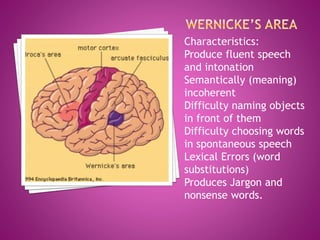
Characteristics:
Produce fluent speech
and intonation
Semantically (meaning)
incoherent
Difficulty naming objects
in front of them
Difficulty choosing words
in spontaneous speech
Lexical Errors (word
substitutions)
Produces Jargon and
nonsense words.
http://www.youtube.com/watch?v=67HMx-
TdAZI&feature=related
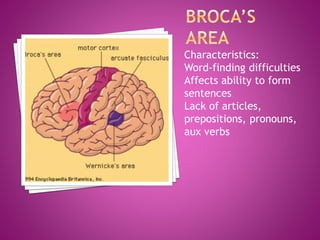
Characteristics:
Word-finding difficulties
Affects ability to form
sentences
Lack of articles,
prepositions, pronouns,
aux verbs
http://www.youtube.com/watch?v=67HM
x-TdAZI&feature=related
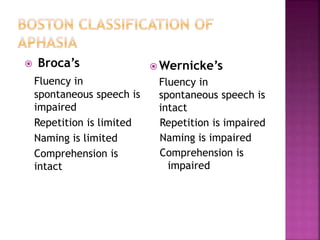
 Broca’s
Fluency in
spontaneous speech is
impaired
Repetition is limited
Naming is limited
Comprehension is
intact
 Wernicke’s
Fluency in
spontaneous speech is
intact
Repetition is impaired
Naming is impaired
Comprehension is
impaired
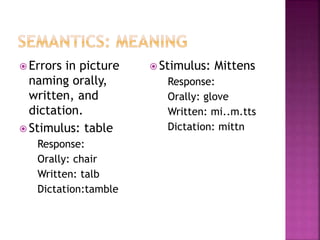
 Errors in picture
naming orally,
written, and
dictation.
 Stimulus: table
Response:
Orally: chair
Written: talb
Dictation:tamble
 Stimulus: Mittens
Response:
Orally: glove
Written: mi..m.tts
Dictation: mittn
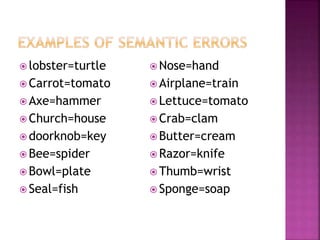
 lobster=turtle
 Carrot=tomato
 Axe=hammer
 Church=house
 doorknob=key
 Bee=spider
 Bowl=plate
 Seal=fish
 Nose=hand
 Airplane=train
 Lettuce=tomato
 Crab=clam
 Butter=cream
 Razor=knife
 Thumb=wrist
 Sponge=soap
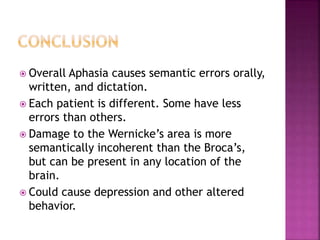
 Overall Aphasia causes semantic errors orally,
written, and dictation.
 Each patient is different. Some have less
errors than others.
 Damage to the Wernicke’s area is more
semantically incoherent than the Broca’s,
but can be present in any location of the
brain.
 Could cause depression and other altered
behavior.
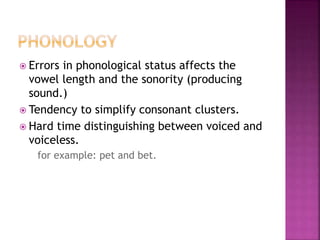
 Errors in phonological status affects the
vowel length and the sonority (producing
sound.)
 Tendency to simplify consonant clusters.
 Hard time distinguishing between voiced and
voiceless.
for example: pet and bet.
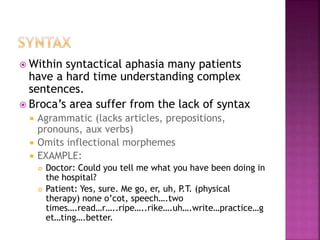
 Within syntactical aphasia many patients
have a hard time understanding complex
sentences.
 Broca’s area suffer from the lack of syntax
 Agrammatic (lacks articles, prepositions,
pronouns, aux verbs)
 Omits inflectional morphemes
 EXAMPLE:
 Doctor: Could you tell me what you have been doing in
the hospital?
 Patient: Yes, sure. Me go, er, uh, P.T. (physical
therapy) none o’cot, speech….two
times….read…r…..ripe…..rike….uh….write…practice…g
et…ting….better.
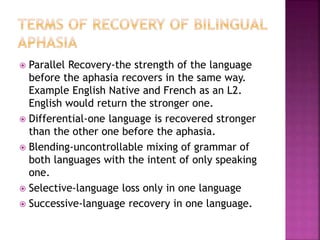
 Parallel Recovery-the strength of the language
before the aphasia recovers in the same way.
Example English Native and French as an L2.
English would return the stronger one.
 Differential-one language is recovered stronger
than the other one before the aphasia.
 Blending-uncontrollable mixing of grammar of
both languages with the intent of only speaking
one.
 Selective-language loss only in one language
 Successive-language recovery in one language.
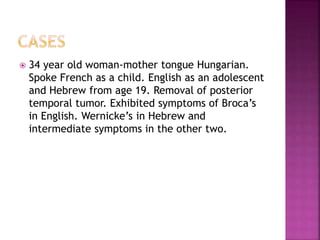
 34 year old woman-mother tongue Hungarian.
Spoke French as a child. English as an adolescent
and Hebrew from age 19. Removal of posterior
temporal tumor. Exhibited symptoms of Broca’s
in English. Wernicke’s in Hebrew and
intermediate symptoms in the other two.
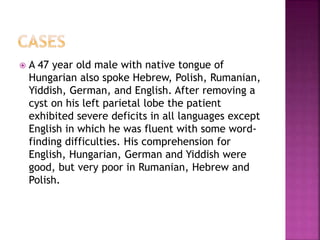
 A 47 year old male with native tongue of
Hungarian also spoke Hebrew, Polish, Rumanian,
Yiddish, German, and English. After removing a
cyst on his left parietal lobe the patient
exhibited severe deficits in all languages except
English in which he was fluent with some word-
finding difficulties. His comprehension for
English, Hungarian, German and Yiddish were
good, but very poor in Rumanian, Hebrew and
Polish.
 It is not definite in these cases why some
languages were recovered. Some say the
structure of the language have something to do
with it, but overall it is a new study.
 It is important to treat it by attempting to
recover each language individually.
 A hypothesis and some MRI’s say that it is
possible that L2 and L3 languages are stored in a
different hemisphere than the L1.
 People can recover from aphasia, but in
bilinguals each individual language needs to be
separate.
 Each person with aphasia has a unique case and
in bilinguals it is not definite what language will
recover first, but the theory is that the native
tongue will return first.
 Language plays a major role in our lives and
without the ability to communicate fully is very
difficult and can lead to depression.
 Aphasia affects people’s oral and written ability
to produce language.
 Dave, Prachi. "The Implications of Bilinguality and Bilingual Aphasia." Serendip.
2007. Web. 30 Nov. 2010. <http://serendip.brynmawr.edu/exchange/node/1902#5>.
 Fabbro, Franco. "The Bilingual Brain: Bilingual Aphasia." University of Udine Italy,
2001. Web. 30 Nov. 2010.
<http://www.uniurb.it/lingue/matdid/donati/LinguisticaGenerale/2006-
07/bilinguismo2.pdf>.
 Fromkin, Victoria, Robert Rodman, and Nina M. Hyams. An Introduction to
Language. Boston, MA: Thomson Wadsworth, 2007. Print.
 Lesser, Ruth. Linguistic Investigations of Aphasia. New York: Elsevier, 1978. Print.
 Lorenzen, Bonnie, and Laura Murray. "Bilingual Aphasia: Theory, Research, & Its
Application to Clinical Practice." Bilingual Aphasia: Theory, Research, & Its
Application to Clinical Practice. Indiana University, 1993. Web. 29 Nov. 2010.
<http://www.eshow2000.com/asha/2008/handouts/1420_1100Lorenzen_Bonnie_08
9791_Nov17_2008_Time_021320PM.pdf>.
 Paradis, Michel. Readings on Aphasia in Bilinguals and Polyglots. [Canada?]: Didier,
1983. Print.
 Visch-Brink, Evy G., and Roelien Bastiaanse. Linguistic Levels in Aphasiology. San
Diego: Singular Pub., 1998. Print.
 "YouTube - Wernicke's and Broca's Aphasia." YouTube - Broadcast Yourself. Web. 30
Nov. 2010. <http://www.youtube.com/watch?v=67HMx-TdAZI&feature=related>.

Aphasia on Linguistic

  • 1.
  • 2.
     Language issaid to acquire in both the right and the left hemisphere.  Right Hemisphere Functions: Intonation, pragmatic, and contextual  Left Hemisphere Functions: grammar/vocabulary and literal  Parts of the Brain consist of the frontal lobe, temporal lobe, occipital lobe, parietal lobe, cerebellum. The main two parts for major types of aphasia are located in the frontal and the temporal lobe.
  • 3.
     Is alanguage disorder that results in brain damage caused by disease or trauma” (Fromkin, Rodman, Hyams 46).
  • 4.
    Lateralization-is the termto be used when defining the function to one hemisphere of the brain Anomia-not being able to find the word that one wishes to say
  • 5.
    Characteristics: Produce fluent speech andintonation Semantically (meaning) incoherent Difficulty naming objects in front of them Difficulty choosing words in spontaneous speech Lexical Errors (word substitutions) Produces Jargon and nonsense words.
  • 6.
  • 7.
    Characteristics: Word-finding difficulties Affects abilityto form sentences Lack of articles, prepositions, pronouns, aux verbs
  • 8.
  • 9.
     Broca’s Fluency in spontaneousspeech is impaired Repetition is limited Naming is limited Comprehension is intact  Wernicke’s Fluency in spontaneous speech is intact Repetition is impaired Naming is impaired Comprehension is impaired
  • 11.
     Errors inpicture naming orally, written, and dictation.  Stimulus: table Response: Orally: chair Written: talb Dictation:tamble  Stimulus: Mittens Response: Orally: glove Written: mi..m.tts Dictation: mittn
  • 12.
     lobster=turtle  Carrot=tomato Axe=hammer  Church=house  doorknob=key  Bee=spider  Bowl=plate  Seal=fish  Nose=hand  Airplane=train  Lettuce=tomato  Crab=clam  Butter=cream  Razor=knife  Thumb=wrist  Sponge=soap
  • 13.
     Overall Aphasiacauses semantic errors orally, written, and dictation.  Each patient is different. Some have less errors than others.  Damage to the Wernicke’s area is more semantically incoherent than the Broca’s, but can be present in any location of the brain.  Could cause depression and other altered behavior.
  • 14.
     Errors inphonological status affects the vowel length and the sonority (producing sound.)  Tendency to simplify consonant clusters.  Hard time distinguishing between voiced and voiceless. for example: pet and bet.
  • 15.
     Within syntacticalaphasia many patients have a hard time understanding complex sentences.  Broca’s area suffer from the lack of syntax  Agrammatic (lacks articles, prepositions, pronouns, aux verbs)  Omits inflectional morphemes  EXAMPLE:  Doctor: Could you tell me what you have been doing in the hospital?  Patient: Yes, sure. Me go, er, uh, P.T. (physical therapy) none o’cot, speech….two times….read…r…..ripe…..rike….uh….write…practice…g et…ting….better.
  • 17.
     Parallel Recovery-thestrength of the language before the aphasia recovers in the same way. Example English Native and French as an L2. English would return the stronger one.  Differential-one language is recovered stronger than the other one before the aphasia.  Blending-uncontrollable mixing of grammar of both languages with the intent of only speaking one.  Selective-language loss only in one language  Successive-language recovery in one language.
  • 18.
     34 yearold woman-mother tongue Hungarian. Spoke French as a child. English as an adolescent and Hebrew from age 19. Removal of posterior temporal tumor. Exhibited symptoms of Broca’s in English. Wernicke’s in Hebrew and intermediate symptoms in the other two.
  • 19.
     A 47year old male with native tongue of Hungarian also spoke Hebrew, Polish, Rumanian, Yiddish, German, and English. After removing a cyst on his left parietal lobe the patient exhibited severe deficits in all languages except English in which he was fluent with some word- finding difficulties. His comprehension for English, Hungarian, German and Yiddish were good, but very poor in Rumanian, Hebrew and Polish.
  • 20.
     It isnot definite in these cases why some languages were recovered. Some say the structure of the language have something to do with it, but overall it is a new study.  It is important to treat it by attempting to recover each language individually.  A hypothesis and some MRI’s say that it is possible that L2 and L3 languages are stored in a different hemisphere than the L1.
  • 21.
     People canrecover from aphasia, but in bilinguals each individual language needs to be separate.  Each person with aphasia has a unique case and in bilinguals it is not definite what language will recover first, but the theory is that the native tongue will return first.  Language plays a major role in our lives and without the ability to communicate fully is very difficult and can lead to depression.  Aphasia affects people’s oral and written ability to produce language.
  • 22.
     Dave, Prachi."The Implications of Bilinguality and Bilingual Aphasia." Serendip. 2007. Web. 30 Nov. 2010. <http://serendip.brynmawr.edu/exchange/node/1902#5>.  Fabbro, Franco. "The Bilingual Brain: Bilingual Aphasia." University of Udine Italy, 2001. Web. 30 Nov. 2010. <http://www.uniurb.it/lingue/matdid/donati/LinguisticaGenerale/2006- 07/bilinguismo2.pdf>.  Fromkin, Victoria, Robert Rodman, and Nina M. Hyams. An Introduction to Language. Boston, MA: Thomson Wadsworth, 2007. Print.  Lesser, Ruth. Linguistic Investigations of Aphasia. New York: Elsevier, 1978. Print.  Lorenzen, Bonnie, and Laura Murray. "Bilingual Aphasia: Theory, Research, & Its Application to Clinical Practice." Bilingual Aphasia: Theory, Research, & Its Application to Clinical Practice. Indiana University, 1993. Web. 29 Nov. 2010. <http://www.eshow2000.com/asha/2008/handouts/1420_1100Lorenzen_Bonnie_08 9791_Nov17_2008_Time_021320PM.pdf>.  Paradis, Michel. Readings on Aphasia in Bilinguals and Polyglots. [Canada?]: Didier, 1983. Print.  Visch-Brink, Evy G., and Roelien Bastiaanse. Linguistic Levels in Aphasiology. San Diego: Singular Pub., 1998. Print.  "YouTube - Wernicke's and Broca's Aphasia." YouTube - Broadcast Yourself. Web. 30 Nov. 2010. <http://www.youtube.com/watch?v=67HMx-TdAZI&feature=related>.