Apraxia of speech
• A neurologic deficit in the production of speech sounds.
• Errors are not caused by muscle weakness, abnormal muscle tone,
reduced range of movement, or decreased muscle steadiness.
• Errors are caused by a deficit in the ability to accurately sequence the
movements needed to produce speech sounds
• Greek word praxis – performance of action
• Apraxia – without action
• Dyspraxia – disordered actions
• Indl with apraxia – not without movement
• Problem with selecting and sequencing of movements needed to
produce speech
• Several types of aparaxia, of which AOS is only one of the
subcategories
• Main two types – Ideational apraxia
- Ideomotor apraxia
• Ideational – inability to make use of an object or gesture bc the indl
has lost the knowledge (idea) of the objects or gestures function
• Means cannot make proper use an object or gesture bc they no
longer know its purpose
• Uncommon disorder – result from damage to the left parietal lobe
• Usually symptoms can be masked easily by accompanying disorder
like aphasia
• Sometimes it resolves quickly when caused by a stroke
• Ideomotor apraxia – disturbance in the performance of the
movements needed to use an object, make a gesture, or complete a
sequence of individual movements
• AOS – one of the ideomotor apraxia
• Not lost their knowledge of an object or gesture
• They have a deficit in the ability to carry out the motor plan needed
to use an object or make a gesture
• Ideomotor apraxia typically affects voluntary movements more often
than spontaneous or automatic movements
• Movement sequencing is easier when actually manipulating a real
object compared with only pantomiming its use
• Completing a movement sequence is easier when given gestural
command (imitation)
• Movement sequencing errors can be sometimes inconsistent on
repeated attempts of the same action
• 3 subcategories of ideomotor apraxia
• Limb apraxia – inability to sequence the movements of the arms, legs,
hands, or feet during a voluntary action
• Most often the result of left hemisphere damage
• Nonverbal oral apraxia – buccofacial apraxia, facial apraxia, orofacial
praxia, lingual apraxia
• Deficit in the inability to sequence non verbal voluntary movements
of the tongue, lips, jaw and other associated oral structures
• Difficulty protruding tongue, whistling, biting the lower lip, puffing
out the cheeks
• Seen in indl with left hemisphere damage, often co-oocurwith
aphasia
• Able to perform automatic oral movements without difficulty- little
clinical significance
• Third category - AOS
AOS
• A deficit in the ability to select and sequence the motor commas
needed to correctly position the articulators during the voluntary
production of phonemes.
• It can co-occur with limb or non-verbal apraxia
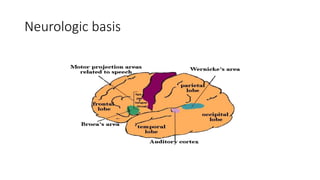
• Caused by damage to lt frontal lobe, especially near Broca’s area
• Majority of cases – AOS co-occurs with Broca’s aphasia
• Common to co-occur with UUMN dysarthria (Duffy, 2005)
Neurologic basis
Causes of AOS
• Disorders that damage the MSP
• most common site – damage to left perisylvian area
• Injuries to insula and basal ganglia
• A retrospective study at the Mayo Clinic – 155 quasirandomly
selected cases – Duffy (2005)
- 49% of cases – stroke
Strokes affecting the perisylvian area of lt hemisphere, primarly frontal
and parietal lobes
- second most common – 27% - degenerative disease-
Alzheimer’s disease, PPA, Creutzfeldt-Jakob disease
Usually associated with diffuse brain damage
- third- 14%- Trauma
Surgical trauma – aneurysm repair, removal of a tumor, hemorrhage
evacuation
Closed head injury – very few
Remaining cases – tumors in lt frontal lobe, seizure d/o, undetermined
etiology or multiple causes like lt hemisphere stroke and dementia

Apraxia of speech

  • 1.
  • 2.
    • A neurologicdeficit in the production of speech sounds. • Errors are not caused by muscle weakness, abnormal muscle tone, reduced range of movement, or decreased muscle steadiness. • Errors are caused by a deficit in the ability to accurately sequence the movements needed to produce speech sounds • Greek word praxis – performance of action • Apraxia – without action • Dyspraxia – disordered actions
  • 3.
    • Indl withapraxia – not without movement • Problem with selecting and sequencing of movements needed to produce speech • Several types of aparaxia, of which AOS is only one of the subcategories • Main two types – Ideational apraxia - Ideomotor apraxia
  • 4.
    • Ideational –inability to make use of an object or gesture bc the indl has lost the knowledge (idea) of the objects or gestures function • Means cannot make proper use an object or gesture bc they no longer know its purpose • Uncommon disorder – result from damage to the left parietal lobe • Usually symptoms can be masked easily by accompanying disorder like aphasia • Sometimes it resolves quickly when caused by a stroke
  • 5.
    • Ideomotor apraxia– disturbance in the performance of the movements needed to use an object, make a gesture, or complete a sequence of individual movements • AOS – one of the ideomotor apraxia • Not lost their knowledge of an object or gesture • They have a deficit in the ability to carry out the motor plan needed to use an object or make a gesture
  • 6.
    • Ideomotor apraxiatypically affects voluntary movements more often than spontaneous or automatic movements • Movement sequencing is easier when actually manipulating a real object compared with only pantomiming its use • Completing a movement sequence is easier when given gestural command (imitation) • Movement sequencing errors can be sometimes inconsistent on repeated attempts of the same action
  • 7.
    • 3 subcategoriesof ideomotor apraxia • Limb apraxia – inability to sequence the movements of the arms, legs, hands, or feet during a voluntary action • Most often the result of left hemisphere damage • Nonverbal oral apraxia – buccofacial apraxia, facial apraxia, orofacial praxia, lingual apraxia • Deficit in the inability to sequence non verbal voluntary movements of the tongue, lips, jaw and other associated oral structures
  • 8.
    • Difficulty protrudingtongue, whistling, biting the lower lip, puffing out the cheeks • Seen in indl with left hemisphere damage, often co-oocurwith aphasia • Able to perform automatic oral movements without difficulty- little clinical significance • Third category - AOS
  • 9.
    AOS • A deficitin the ability to select and sequence the motor commas needed to correctly position the articulators during the voluntary production of phonemes. • It can co-occur with limb or non-verbal apraxia • Caused by damage to lt frontal lobe, especially near Broca’s area • Majority of cases – AOS co-occurs with Broca’s aphasia • Common to co-occur with UUMN dysarthria (Duffy, 2005)
  • 10.
  • 11.
    Causes of AOS •Disorders that damage the MSP • most common site – damage to left perisylvian area • Injuries to insula and basal ganglia • A retrospective study at the Mayo Clinic – 155 quasirandomly selected cases – Duffy (2005) - 49% of cases – stroke Strokes affecting the perisylvian area of lt hemisphere, primarly frontal and parietal lobes
  • 12.
    - second mostcommon – 27% - degenerative disease- Alzheimer’s disease, PPA, Creutzfeldt-Jakob disease Usually associated with diffuse brain damage - third- 14%- Trauma Surgical trauma – aneurysm repair, removal of a tumor, hemorrhage evacuation Closed head injury – very few Remaining cases – tumors in lt frontal lobe, seizure d/o, undetermined etiology or multiple causes like lt hemisphere stroke and dementia