Speech defects
Definition
• Speech disorders or speech impediments are
a type of communication disorders where
'normal' speech is disrupted.
Classification
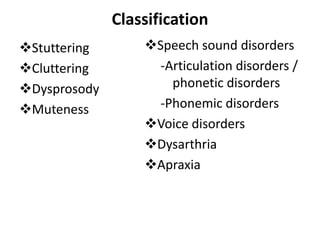
Stuttering
Cluttering
Dysprosody
Muteness

Speech sound disorders
-Articulation disorders /
phonetic disorders
-Phonemic disorders
Voice disorders
Dysarthria
Apraxia
Terminologies
• Dysprosody: is characterized by alterations in
intensity, in the timing of utterance
segments, and in rhythm, cadence, and
intonation of words.
• Muteness: is complete inability to speak.
• Articulation disorders: are characterized by
difficulty learning to produce sounds
physically.
• Phonemic disorders: are characterized by difficulty in
learning the sound distinctions of a language, so that
one sound may be used in place of many.
• Voice disorders: are impairments, often physical, that
involve the function of the larynx or vocal resonance.
• Dysarthria: is a weakness or paralysis of speech
muscles caused by damage to the nerves and/or
brain.
• Apraxia: of speech may result from stroke or be
developmental, and involves inconsistent production
of speech sounds and rearranging of sounds in a
word ("potato" may become "topato" and next
"totapo").
Causes
•
•
•
•
•
•
•
•

Unknown
Hearing Loss,
Neurological Disorders,
Brain Injury,
Mental Retardation,
Drug Abuse,
Physical Impairments: Cleft Lip And Palate,
Vocal Abuse Or Misuse.
Treatment
• Speech therapy
Speech therapy / Speech Language
therapy
• In speech language therapy, an sleep language
pathologist (SLP) will work with a child one on
one, in a small group, or directly on a
classroom to overcome difficulties involved
with a specific disorder.
Indications
•
•
•
•
•
•
•
•
•
•
•

Hearing impairment
Cognitive or developmental delays
Weak oral muscles
Excessive drooling
Chronic hoarseness
Birth defects such as CL/CP
Autism
Motor planning problems
Respiratory problems
Feeding and swallowing disorders
Traumatic brain injury
Strategies used
1. Language intervention activities:
– A SLP will interact with a child by playing and
talking, using pictures, books, objects or ongoing
events to stimulate language development. The
therapist model correct pronunciation & use
repetition exercises to build speech and language
skills.
2. Articulation therapy
- Articulation exercises involve having the therapist
model correct sounds and syllables for a
child, often during play activities. The level of
play is age appropriate and related to the childs
specific needs
3. Oral-motor / feeding and swallowing
therapy
- The SLP will use a variety of oral exercisesincluding facial massage and various
tongue, lip and jaw exercises to strengthen
the muscles of the mouth.
Thank you

Speech defects

  • 1.
  • 2.
    Definition • Speech disordersor speech impediments are a type of communication disorders where 'normal' speech is disrupted.
  • 3.
    Classification Stuttering Cluttering Dysprosody Muteness Speech sound disorders -Articulationdisorders / phonetic disorders -Phonemic disorders Voice disorders Dysarthria Apraxia
  • 4.
    Terminologies • Dysprosody: ischaracterized by alterations in intensity, in the timing of utterance segments, and in rhythm, cadence, and intonation of words. • Muteness: is complete inability to speak. • Articulation disorders: are characterized by difficulty learning to produce sounds physically.
  • 5.
    • Phonemic disorders:are characterized by difficulty in learning the sound distinctions of a language, so that one sound may be used in place of many. • Voice disorders: are impairments, often physical, that involve the function of the larynx or vocal resonance. • Dysarthria: is a weakness or paralysis of speech muscles caused by damage to the nerves and/or brain. • Apraxia: of speech may result from stroke or be developmental, and involves inconsistent production of speech sounds and rearranging of sounds in a word ("potato" may become "topato" and next "totapo").
  • 6.
    Causes • • • • • • • • Unknown Hearing Loss, Neurological Disorders, BrainInjury, Mental Retardation, Drug Abuse, Physical Impairments: Cleft Lip And Palate, Vocal Abuse Or Misuse.
  • 7.
  • 8.
    Speech therapy /Speech Language therapy • In speech language therapy, an sleep language pathologist (SLP) will work with a child one on one, in a small group, or directly on a classroom to overcome difficulties involved with a specific disorder.
  • 9.
    Indications • • • • • • • • • • • Hearing impairment Cognitive ordevelopmental delays Weak oral muscles Excessive drooling Chronic hoarseness Birth defects such as CL/CP Autism Motor planning problems Respiratory problems Feeding and swallowing disorders Traumatic brain injury
  • 10.
    Strategies used 1. Languageintervention activities: – A SLP will interact with a child by playing and talking, using pictures, books, objects or ongoing events to stimulate language development. The therapist model correct pronunciation & use repetition exercises to build speech and language skills.
  • 11.
    2. Articulation therapy -Articulation exercises involve having the therapist model correct sounds and syllables for a child, often during play activities. The level of play is age appropriate and related to the childs specific needs
  • 12.
    3. Oral-motor /feeding and swallowing therapy - The SLP will use a variety of oral exercisesincluding facial massage and various tongue, lip and jaw exercises to strengthen the muscles of the mouth.
  • 13.