Aphasia
By: Hasan Arafat
1. What is aphasia ?
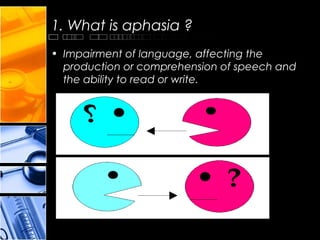
• Impairment of language, affecting the
production or comprehension of speech and
the ability to read or write.
2. Causes
• Aphasia is caused by damage to the parts of
the brain that control speech:
1. Injury;
2. Stroke.
• Progressive aphasia is caused by:
1. Brain tumors;
2. Infection;
3. Dementia.
• Transient aphasia caused by:
1. Epilepsy;
2. Migraine.
3.Classification
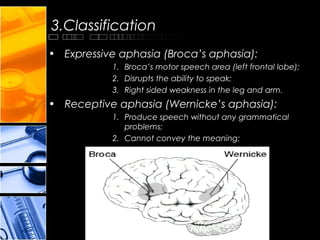
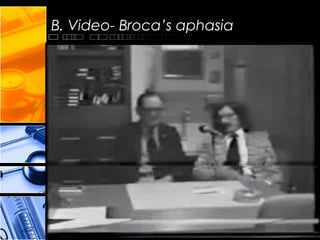
• Expressive aphasia (Broca’s aphasia):
1. Broca’s motor speech area (left frontal lobe);
2. Disrupts the ability to speak;
3. Right sided weakness in the leg and arm.
• Receptive aphasia (Wernicke’s aphasia):
1. Produce speech without any grammatical
problems;
2. Cannot convey the meaning;
3. No body weakness.
B. Video- Broca’s aphasia
C. Video- Wernicke’s aphasia
4. Signs and symptoms
• Inability to comprehend language;
• Inability to pronounce, not due to muscle
paralysis or weakness;
• Inability to form words;
• Inability to read and write;
• limited verbal output;
• Difficulty in naming;
• Other symptoms.
5. Diagnosis
• Usually diagnosed by the physician who treats
the person for his/her brain injury;
• Frequently a neurologist;
• Tests include:
1. Following commands;
2. Answering questions;
3. Naming objects;
4. Carrying on a conversation.
• The patient is usually referred to a speech-
language pathologist:- comprehensive
examination.
6. Treatment
• In some cases, the patient may recover from
aphasia without treatment- transient ischemic
attack;
• For most cases, however, language recovery is
not as quick or as complete;
• Aphasia therapy encourages the patient to:
1. Use remaining language abilities;
2. Restore language ability;
3. Compensate for language problems;
4. Learn other methods of communicating.
6. Treatment (Cont.)
• Individual therapy (specific needs);
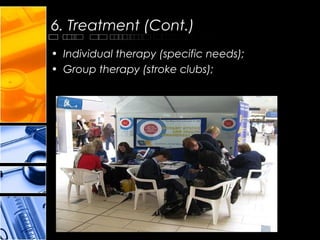
• Group therapy (stroke clubs);
7. How aphasia can be prevented?
• Regular exercise;
• Eating Healthy;
• Keeping alcohol consumption low and avoid
using tobacco;
• Controlling blood pressure.
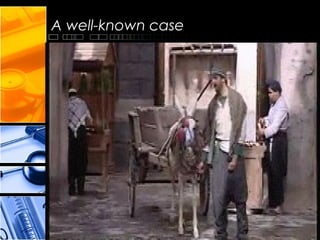
A well-known case
Questions?
1. Overview
• Language development varies among
individuals;
• Health professionals have milestones;
• Common words: ‘Dada’, ‘Mama’, ’Dog’, ‘Hi’;
• Delay may be due to:
1. Hearing loss;
2. Language disorder.
• Language disorders: mean that the child has
trouble understanding what others say or
difficulty sharing his thoughts.
A. Comparison
Type of aphasia Repetition Naming Auditory
comprehension
Broca’s aphasia Mod-sever Mod-
sever
Mild difficulty
Wernicke’s aphasia Mod-sever Mod-
sever
defective

Aphasia

  • 1.
  • 2.
    1. What isaphasia ? • Impairment of language, affecting the production or comprehension of speech and the ability to read or write.
  • 3.
    2. Causes • Aphasiais caused by damage to the parts of the brain that control speech: 1. Injury; 2. Stroke. • Progressive aphasia is caused by: 1. Brain tumors; 2. Infection; 3. Dementia. • Transient aphasia caused by: 1. Epilepsy; 2. Migraine.
  • 4.
    3.Classification • Expressive aphasia(Broca’s aphasia): 1. Broca’s motor speech area (left frontal lobe); 2. Disrupts the ability to speak; 3. Right sided weakness in the leg and arm. • Receptive aphasia (Wernicke’s aphasia): 1. Produce speech without any grammatical problems; 2. Cannot convey the meaning; 3. No body weakness.
  • 5.
  • 6.
  • 7.
    4. Signs andsymptoms • Inability to comprehend language; • Inability to pronounce, not due to muscle paralysis or weakness; • Inability to form words; • Inability to read and write; • limited verbal output; • Difficulty in naming; • Other symptoms.
  • 8.
    5. Diagnosis • Usuallydiagnosed by the physician who treats the person for his/her brain injury; • Frequently a neurologist; • Tests include: 1. Following commands; 2. Answering questions; 3. Naming objects; 4. Carrying on a conversation. • The patient is usually referred to a speech- language pathologist:- comprehensive examination.
  • 9.
    6. Treatment • Insome cases, the patient may recover from aphasia without treatment- transient ischemic attack; • For most cases, however, language recovery is not as quick or as complete; • Aphasia therapy encourages the patient to: 1. Use remaining language abilities; 2. Restore language ability; 3. Compensate for language problems; 4. Learn other methods of communicating.
  • 10.
    6. Treatment (Cont.) •Individual therapy (specific needs); • Group therapy (stroke clubs);
  • 11.
    7. How aphasiacan be prevented? • Regular exercise; • Eating Healthy; • Keeping alcohol consumption low and avoid using tobacco; • Controlling blood pressure.
  • 12.
  • 13.
  • 15.
    1. Overview • Languagedevelopment varies among individuals; • Health professionals have milestones; • Common words: ‘Dada’, ‘Mama’, ’Dog’, ‘Hi’; • Delay may be due to: 1. Hearing loss; 2. Language disorder. • Language disorders: mean that the child has trouble understanding what others say or difficulty sharing his thoughts.
  • 16.
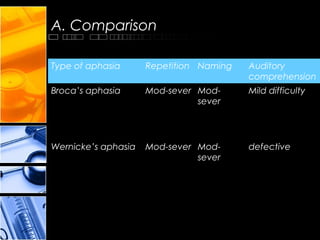
    A. Comparison Type ofaphasia Repetition Naming Auditory comprehension Broca’s aphasia Mod-sever Mod- sever Mild difficulty Wernicke’s aphasia Mod-sever Mod- sever defective

Editor's Notes

  • #4 I’m going to talk only about general aphasia in it’s most prominent forms.
  • #6 Individuals with Broca's aphasia understand language fairly well however they have increasing comprehension and understanding difficulties as grammatical structures get more and more complex. Their main and real struggle is with producing speech. They usually speak in short phrases. connecting phrases are not present and grammatical structure is butchered. It is difficult to understand someone with Broca's aphasia because they speak using the general nouns of what they are trying to say, thus if possible, it is up to the listener to try to connect the dots.
  • #7 individuals with Receptive aphasia may speak in long sentences that have no meaning, add unnecessary words, and even create new "words" .  Individuals with Receptive aphasia usually have great difficulty understanding the speech of both themselves and others and are therefore often unaware of their mistakes.
  • #10 stroke in which blood flow to the brain is temporarily interrupted but quickly restored, called a transient ischemic attack.