DYSLEXIA
DYSLEXIA
Historical Perspective
If a child's difficulty with
reading could not be
explained by low
intelligence, poor eye sight,
poor hearing, inadequate
educational opportunities,
or any other problem, then
the child must be dyslexic.
Simple Definition
Dyslexia is an inherited
condition that makes it
extremely difficult to read,
write, and spell in your
native language—despite at
least average intelligence.
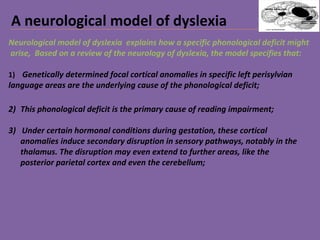
A neurological model of dyslexia
Neurological model of dyslexia explains how a specific phonological deficit might
arise, Based on a review of the neurology of dyslexia, the model specifies that:
1) Genetically determined focal cortical anomalies in specific left perisylvian
language areas are the underlying cause of the phonological deficit;
2) This phonological deficit is the primary cause of reading impairment;
3) Under certain hormonal conditions during gestation, these cortical
anomalies induce secondary disruption in sensory pathways, notably in the
thalamus. The disruption may even extend to further areas, like the
posterior parietal cortex and even the cerebellum;
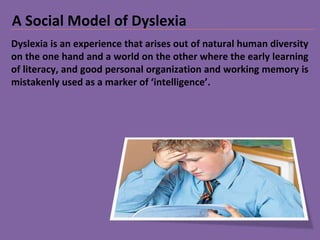
A Social Model of Dyslexia
Dyslexia is an experience that arises out of natural human diversity
on the one hand and a world on the other where the early learning
of literacy, and good personal organization and working memory is
mistakenly used as a marker of ‘intelligence’.
The Phonological Model of Dyslexia
•The phonological model of dyslexia argues that dyslexics have impaired
reading ability because they have a deficit in phonological processing.
• According to this model, dyslexics have a difficult time with written language
because they have an impaired ability to deconstruct written words into
phonemes, thus preventing word identification.
•This low level phonological deficit prevents words from reaching high level
linguistic processing, which would allow the reader to gain meaning from the
text.
•Thus, dyslexics have intact memory and comprehension language processes
that are not activated because they can only be activated after a word has
been identified through phonological processing.
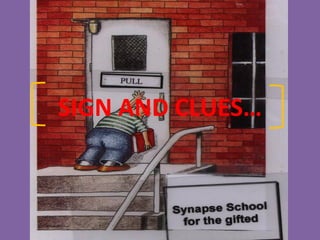
SIGN AND CLUES…
SIGN AND CLUES OF DYSLEXIA…
• Diagnosed for the first time in third grade. Since
dyslexic readers often do not use a decoding strategy to
identify a word and instead rely heavily on the
surrounding context to figure out.
• Depend on context for understanding rather than
written words de-coding.
• Poor spelling is often a sign of dyslexia.
• Handwriting [can] be an important clue to dyslexia.
© 2005-2007 Nemours
BrightStart! Dyslexia Initiative.
All rights reserved.
Symptoms of Possible
Dyslexia in Young Children
• Difficulty recognizing and writing
letters in kindergarten
• Difficulty connecting letters to their
sounds
• Difficulty breaking words into syllables
(e.g., baseball into base and ball)
• Difficulty recognizing rhyming words
© 2005-2007 Nemours
BrightStart! Dyslexia Initiative.
All rights reserved.
Symptoms of Possible
Dyslexia in Young Children
• Difficulty identifying words with the same
beginning or ending sounds
• Difficulty reading simple words that can
be sounded out (e.g., big, cat)
• Difficulty remembering common,
irregularly spelled words (e.g., said, who)
© 2005-2007 Nemours
BrightStart! Dyslexia Initiative.
All rights reserved.
Symptoms of Dyslexia in Children 8
years and Up
• Persistent difficulty decoding one-syllable regular words and
recognizing common words.
• Difficulty reading small function words (e.g., of, that, to)
• Difficulty with spelling
• Mispronunciation of longer words
© 2005-2007 Nemours
BrightStart! Dyslexia Initiative.
All rights reserved.
Symptoms of Dyslexia in Children 8
years and Up
• Difficulty decoding multi-syllable words, especially the
middle syllables
• Difficulty completing longer reading and writing assignments
• Slow reading rate and reduced comprehension
• Dislike or fear of reading and writing
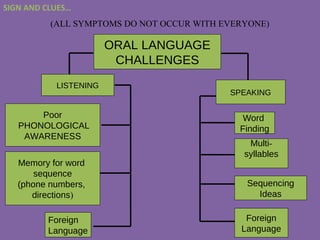
(ALL SYMPTOMS DO NOT OCCUR WITH EVERYONE)
ORAL LANGUAGE
CHALLENGES
LISTENING
Memory for word
sequence
(phone numbers,
directions)
Poor
PHONOLOGICAL
AWARENESS
Foreign
Language
SPEAKING
Word
Finding
Multi-
syllables
Sequencing
Ideas
Foreign
Language
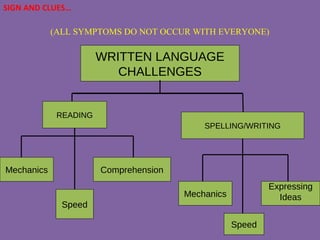
SIGN AND CLUES…
WRITTEN LANGUAGE
CHALLENGES
(ALL SYMPTOMS DO NOT OCCUR WITH EVERYONE)
READING
Mechanics Comprehension
Speed
Mechanics
Speed
SPELLING/WRITING
Expressing
Ideas
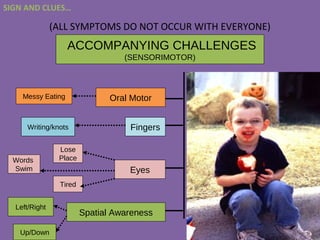
SIGN AND CLUES…
(ALL SYMPTOMS DO NOT OCCUR WITH EVERYONE)
ACCOMPANYING CHALLENGES
(SENSORIMOTOR)
Oral MotorMessy Eating
Writing/knots Fingers
Eyes
Tired
Words
Swim
Lose
Place
Spatial Awareness
Up/Down
Left/Right
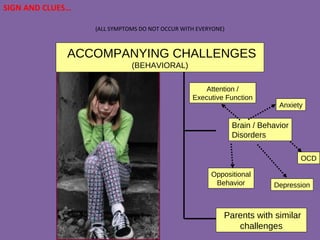
SIGN AND CLUES…
(ALL SYMPTOMS DO NOT OCCUR WITH EVERYONE)
ACCOMPANYING CHALLENGES
(BEHAVIORAL)
Parents with similar
challenges
Brain / Behavior
Disorders
Attention /
Executive Function
Anxiety
Depression
OCD
Oppositional
Behavior
SIGN AND CLUES…
Causes And Types
There are several types of dyslexia that can affect the child's ability
to spell as well as read.
1. "Trauma dyslexia" usually occurs after some form of brain trauma
or injury to the area of the brain that controls reading and writing.
2. A second type of dyslexia is referred to as "primary dyslexia." This
type of dyslexia is a dysfunction of, rather than damage to, the left
side of the brain (cerebral cortex) and does not change with age.
Individuals with this type are rarely able to read above a fourth-
grade level and may struggle with reading, spelling, and writing as
adults. Primary dyslexia is passed in family lines through their genes
(hereditary). It is found more often in boys than in girls.
4. Visual dyslexia is characterized by number and
letter reversals and the inability to write
symbols in the correct sequence.
3. A third type of dyslexia is referred to as
"secondary" or "developmental dyslexia" and is felt
to be caused by hormonal problems during the early
stages of fetal development.
Developmental dyslexia diminishes as the child
matures. It is also more common in boys.
Dyslexia may affect several different functions.
5. Auditory dyslexia
involves difficulty with sounds of letters or
groups of letters. The sounds are perceived as
jumbled or not heard correctly.
6. Dysgraphia
refers to the child's difficulty holding and
controlling a pencil so that the correct
markings can be made on the paper.
Dyslexia Diagnosis
 Dyslexia is a difficult disorder to diagnose.
 The testing determines the child's functional reading level and
compares it to reading potential, which is evaluated by an
intelligence test.
 All aspects of the reading process are examined to pinpoint
where the breakdown is occurring.
 The testing assesses how a child takes in and processes
information and what the child does with the information.
 The tests determine whether a child learns better by hearing
information (auditory), looking at information (visual), or doing
something (kinesthetic).
The tests assess and determines how the child can perform better
When allowed to give information (output),
When saying something (oral), or
When doing something with their hands (tactile-kinesthetic).
The tests also evaluate how all of these sensory systems (modalities) work in
conjunction with each other.
DYSLEXIA ASSESSMENT
Dyslexic Evaluation check Lists:
1.Dyslexia screening form
2.A check list for dyslexia
A standard battery of tests can include, but is not limited to, the
following:
1.Wechsler Intelligence Scale for Children-Third Edition (WISC-III)
2.Kaufman Assessment Battery for Children (KABC)
3.Bender Gestalt Test of Visual Motor Perception
4.Woodcock-Johnson Psycho-Educational Battery
5.Peabody Individual Achievement Tests-Revised (PIAT)
6.Kaufman Tests of Educational Achievement (KTEA)
7.Beery Developmental Test of Visual-Motor Integration
8.Test of Visual Perception (TVPS)
9.Test for Auditory Comprehension of Language
10.Stanford-Binet Intelligence Scale
11.Test of Auditory Perception (TAPS)
12.Peabody Picture Vocabulary Test-Revised
Dyslexia Assessment
dyslexia_screeening_form.pdf
Dyslexic_Assessment.pdf
TYPES OF TREATMENT FOR DYSLEXIA
Before any treatment is started, an evaluation must be done to
determine the child's
 Specific area of disability.
 The plan may be implemented in a Special Education setting or in
the regular classroom.
 An appropriate treatment plan will focus on strengthening the
child's weaknesses while utilizing the strengths.
 A direct approach may include a systematic study of phonics.
( phonological approach)
There are many theories about successful treatment for dyslexia, there is
no actual cure for it. The school will develop a plan with the parent
involving occupational therapist to meet the child's needs.
COPMPUTERIZED INSTRUCTIONAL METHODS:
Computers are powerful tools for these children and should be utilized
as much as possible. The child should be taught compensation and
coping skills. Attention should be given to optimum learning conditions
and alternative avenues for student performance
MULTISENSORY APPROACH:
Techniques designed to help all the senses work together efficiently can
also be used. Specific reading approaches that require a child to hear,
see, say, and do something (multisensory), the Orton-Gillingham
Method.
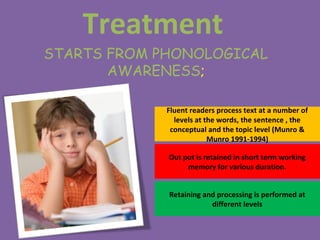
Treatment
STARTS FROM PHONOLOGICAL
AWARENESS;
Fluent readers process text at a number of
levels at the words, the sentence , the
conceptual and the topic level (Munro &
Munro 1991-1994)
Out put is retained in short term working
memory for various duration.
Retaining and processing is performed at
different levels
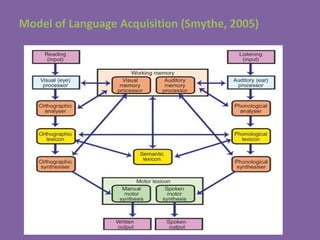
Model of Language Acquisition (Smythe, 2005)
© 2005-2007 Nemours
BrightStart! Dyslexia Initiative.
All rights reserved.
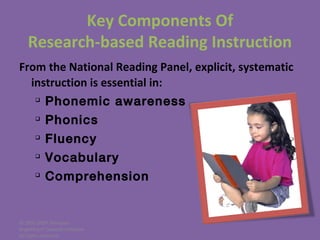
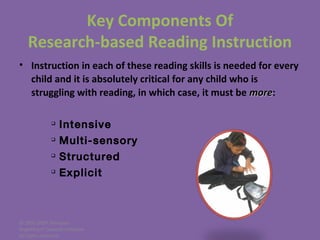
Key Components Of
Research-based Reading Instruction
From the National Reading Panel, explicit, systematic
instruction is essential in:

Phonemic awareness

Phonics

Fluency

Vocabulary

Comprehension
© 2005-2007 Nemours
BrightStart! Dyslexia Initiative.
All rights reserved.
• Instruction in each of these reading skills is needed for every
child and it is absolutely critical for any child who is
struggling with reading, in which case, it must be moremore:

Intensive

Multi-sensory

Structured

Explicit
Key Components Of
Research-based Reading Instruction
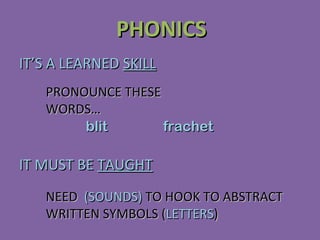
PHONICSPHONICS
IT MUST BEIT MUST BE TAUGHTTAUGHT
NEEDNEED (SOUNDS)(SOUNDS) TO HOOK TO ABSTRACTTO HOOK TO ABSTRACT
WRITTEN SYMBOLS (WRITTEN SYMBOLS (LETTERSLETTERS))
IT’S A LEARNEDIT’S A LEARNED SKILLSKILL
PRONOUNCE THESEPRONOUNCE THESE
WORDS…WORDS…
blitblit frachetfrachet
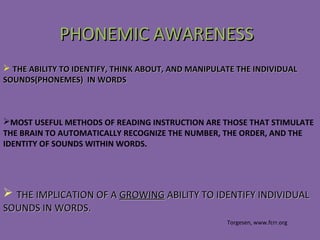
 THE ABILITY TO IDENTIFY, THINK ABOUT, AND MANIPULATE THE INDIVIDUALTHE ABILITY TO IDENTIFY, THINK ABOUT, AND MANIPULATE THE INDIVIDUAL
SOUNDS(PHONEMES) IN WORDSSOUNDS(PHONEMES) IN WORDS
 THE IMPLICATION OF ATHE IMPLICATION OF A GROWINGGROWING ABILITY TO IDENTIFY INDIVIDUALABILITY TO IDENTIFY INDIVIDUAL
SOUNDS IN WORDS.SOUNDS IN WORDS.
PHONEMIC AWARENESSPHONEMIC AWARENESS
Torgesen, www.fcrr.org
MOST USEFUL METHODS OF READING INSTRUCTION ARE THOSE THAT STIMULATE
THE BRAIN TO AUTOMATICALLY RECOGNIZE THE NUMBER, THE ORDER, AND THE
IDENTITY OF SOUNDS WITHIN WORDS.
The brain must not only auditorily perceive, but also visually
represent, sounds, letters, and words. This is known as
Symbol Imagery (SI) and it appears to be a major factor in
the creation of both independent reading fluency, as well as
orthographic (standardized way of using a specific writing
system) spelling.
SYMBOL IMAGERY
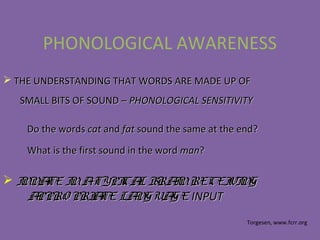
PHONOLOGICAL AWARENESS
 THE UNDERSTANDING THAT WORDS ARE MADE UP OFTHE UNDERSTANDING THAT WORDS ARE MADE UP OF
SMALL BITS OF SOUND –SMALL BITS OF SOUND – PHONOLOGICAL SENSITIVITYPHONOLOGICAL SENSITIVITY
 INNATE INATYPICAL BRAINRECEIVINGINNATE INATYPICAL BRAINRECEIVING
APPRO PRIATE LANGUAGEAPPRO PRIATE LANGUAGE INPUTINPUT
Do the wordsDo the words catcat andand fatfat sound the same at the end?sound the same at the end?
What is the first sound in the wordWhat is the first sound in the word manman??
Torgesen, www.fcrr.org
FLUENCY
Ultimately, the goal is to build the student’s auditory
and visual processing systems to the level of
independence so that they may show strong fluency
in reading and writing.
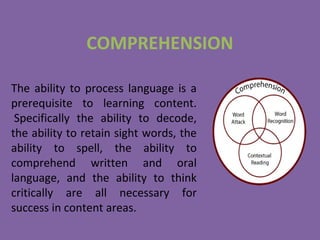
COMPREHENSION
The ability to process language is a
prerequisite to learning content.
Specifically the ability to decode,
the ability to retain sight words, the
ability to spell, the ability to
comprehend written and oral
language, and the ability to think
critically are all necessary for
success in content areas.
EARLY READING DEVELOPMENT
BREAKING THE CODE
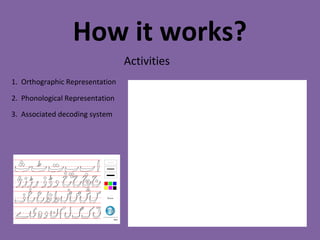
How it works?
1. Orthographic Representation
2. Phonological Representation
3. Associated decoding system
Activities
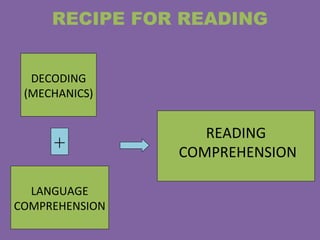
DECODING
(MECHANICS)
LANGUAGE
COMPREHENSION
READING
COMPREHENSION+
RECIPE FOR READING
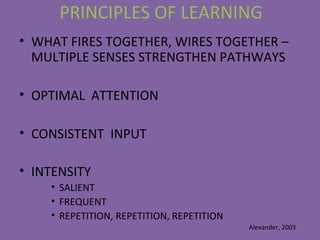
PRINCIPLES OF LEARNING
• WHAT FIRES TOGETHER, WIRES TOGETHER –
MULTIPLE SENSES STRENGTHEN PATHWAYS
• OPTIMAL ATTENTION
• CONSISTENT INPUT
• INTENSITY
• SALIENT
• FREQUENT
• REPETITION, REPETITION, REPETITION
Alexander, 2003
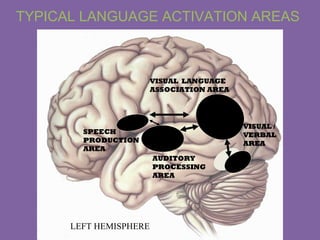
TYPICAL LANGUAGE ACTIVATION AREAS
SPEECH
PRODUCTION
AREA
AUDITORY
PROCESSING
AREA
VISUAL-LANGUAGE
ASSOCIATION AREA
VISUAL /
VERBAL
AREA
LEFT HEMISPHERE
© 2005-2007 Nemours
BrightStart! Dyslexia Initiative.
All rights reserved.
Risk Factors for Dyslexia
• Family history of dyslexia or other learning
disabilities
• Low parental reading level
• Preschool language disorder, especially
language comprehension disorder
• Low socioeconomic status and attendance at
schools with a high poverty rate
© 2005-2007 Nemours
BrightStart! Dyslexia Initiative.
All rights reserved.
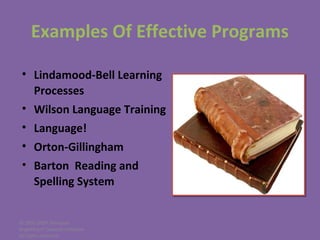
Examples Of Effective Programs
• Lindamood-Bell Learning
Processes
• Wilson Language Training
• Language!
• Orton-Gillingham
• Barton Reading and
Spelling System
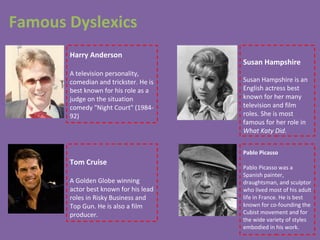
Famous Dyslexics
Harry Anderson
A television personality,
comedian and trickster. He is
best known for his role as a
judge on the situation
comedy "Night Court" (1984-
92)
Tom Cruise
A Golden Globe winning
actor best known for his lead
roles in Risky Business and
Top Gun. He is also a film
producer.
Susan Hampshire
Susan Hampshire is an
English actress best
known for her many
television and film
roles. She is most
famous for her role in
What Katy Did.
Pablo Picasso
Pablo Picasso was a
Spanish painter,
draughtsman, and sculptor
who lived most of his adult
life in France. He is best
known for co-founding the
Cubist movement and for
the wide variety of styles
embodied in his work.
Dyslexia writting
[1]http://www.brainhe.com/students/types/dyslexia.html
[2]http://www.cheapwebhostingservices.org/go/dyslexia-in-adults-test.html
1) Dyslexia, by Sally E. Shaywitz , on the Scientific American web site
2) What is Dyslexia, by Roger P. Harrie and Carol Weller SITE, on the Kid Source web
site
3) Advances in dyslexia research , on the Geocities web site
4)10 Years of Brain Imaging Research Shows The Brain Reads Sound by Sound , on the
Healthy Place web site
5) Dyslexia and Brain Activity , on the Harvard web site
6) Dyslexia: Cultural Diversity and Biological Unity by Paulesu et al. , on the Science
Magazine Online web site
7) Dyslexia: Same Brains, Different Languages by Laura Helmuth , on the Science
Magazine Online web site
8) Fact Sheet: Dyslexia , on the Learning Disabilities Association web site
9) Beginning Reading And Phonological Awareness For Students With Learning
Disabilities by Michael M. Behrmann , on the Kid Source web site
10) Brief Introduction to FMRI , on the FMRIB web site
11) I world multimedia Education, www.iwmme.com working for delayed learners.
http://www.dyslexia-parent.com/mag30.html
References:
Timely Assessment and intervention with Educational Therapies is the answer.
A.R.T
Phone: 021-5344161
Cell: 0300-2286662
Karachi, Pakistan
educational_therapies@yahoo.com
Assessment
If your child shows some of the symptoms. A comprehensive assessment is
recommended:
Teacher/Parents Training
Certificate Course in the Teaching of Children with Dyslexia with certification from UK.
Neuro Linguistic Programming
A tool to assist children with Dyslexia Teaching strategies for dyslexic students are
enhanced by the use of NLP.
Special education center for mentally retarded
(intellectually challenged) children
H-8/4, Islamabad.
National Institute of Psychology , Quaid-Azam
University , Islamabad
Computerized System of Education
Kindergarten
H No.75A Block, 6th
road
Rawalpindi, Pakistan.
Ph: 0333 55 64 117
Working for Dyslexic children using multimedia education.
Dyslexia

Dyslexia

  • 2.
  • 3.
    DYSLEXIA Historical Perspective If achild's difficulty with reading could not be explained by low intelligence, poor eye sight, poor hearing, inadequate educational opportunities, or any other problem, then the child must be dyslexic. Simple Definition Dyslexia is an inherited condition that makes it extremely difficult to read, write, and spell in your native language—despite at least average intelligence.
  • 6.
    A neurological modelof dyslexia Neurological model of dyslexia explains how a specific phonological deficit might arise, Based on a review of the neurology of dyslexia, the model specifies that: 1) Genetically determined focal cortical anomalies in specific left perisylvian language areas are the underlying cause of the phonological deficit; 2) This phonological deficit is the primary cause of reading impairment; 3) Under certain hormonal conditions during gestation, these cortical anomalies induce secondary disruption in sensory pathways, notably in the thalamus. The disruption may even extend to further areas, like the posterior parietal cortex and even the cerebellum;
  • 7.
    A Social Modelof Dyslexia Dyslexia is an experience that arises out of natural human diversity on the one hand and a world on the other where the early learning of literacy, and good personal organization and working memory is mistakenly used as a marker of ‘intelligence’.
  • 8.
    The Phonological Modelof Dyslexia •The phonological model of dyslexia argues that dyslexics have impaired reading ability because they have a deficit in phonological processing. • According to this model, dyslexics have a difficult time with written language because they have an impaired ability to deconstruct written words into phonemes, thus preventing word identification. •This low level phonological deficit prevents words from reaching high level linguistic processing, which would allow the reader to gain meaning from the text. •Thus, dyslexics have intact memory and comprehension language processes that are not activated because they can only be activated after a word has been identified through phonological processing.
  • 9.
  • 10.
    SIGN AND CLUESOF DYSLEXIA… • Diagnosed for the first time in third grade. Since dyslexic readers often do not use a decoding strategy to identify a word and instead rely heavily on the surrounding context to figure out. • Depend on context for understanding rather than written words de-coding. • Poor spelling is often a sign of dyslexia. • Handwriting [can] be an important clue to dyslexia.
  • 11.
    © 2005-2007 Nemours BrightStart!Dyslexia Initiative. All rights reserved. Symptoms of Possible Dyslexia in Young Children • Difficulty recognizing and writing letters in kindergarten • Difficulty connecting letters to their sounds • Difficulty breaking words into syllables (e.g., baseball into base and ball) • Difficulty recognizing rhyming words
  • 12.
    © 2005-2007 Nemours BrightStart!Dyslexia Initiative. All rights reserved. Symptoms of Possible Dyslexia in Young Children • Difficulty identifying words with the same beginning or ending sounds • Difficulty reading simple words that can be sounded out (e.g., big, cat) • Difficulty remembering common, irregularly spelled words (e.g., said, who)
  • 13.
    © 2005-2007 Nemours BrightStart!Dyslexia Initiative. All rights reserved. Symptoms of Dyslexia in Children 8 years and Up • Persistent difficulty decoding one-syllable regular words and recognizing common words. • Difficulty reading small function words (e.g., of, that, to) • Difficulty with spelling • Mispronunciation of longer words
  • 14.
    © 2005-2007 Nemours BrightStart!Dyslexia Initiative. All rights reserved. Symptoms of Dyslexia in Children 8 years and Up • Difficulty decoding multi-syllable words, especially the middle syllables • Difficulty completing longer reading and writing assignments • Slow reading rate and reduced comprehension • Dislike or fear of reading and writing
  • 15.
    (ALL SYMPTOMS DONOT OCCUR WITH EVERYONE) ORAL LANGUAGE CHALLENGES LISTENING Memory for word sequence (phone numbers, directions) Poor PHONOLOGICAL AWARENESS Foreign Language SPEAKING Word Finding Multi- syllables Sequencing Ideas Foreign Language SIGN AND CLUES…
  • 16.
    WRITTEN LANGUAGE CHALLENGES (ALL SYMPTOMSDO NOT OCCUR WITH EVERYONE) READING Mechanics Comprehension Speed Mechanics Speed SPELLING/WRITING Expressing Ideas SIGN AND CLUES…
  • 17.
    (ALL SYMPTOMS DONOT OCCUR WITH EVERYONE) ACCOMPANYING CHALLENGES (SENSORIMOTOR) Oral MotorMessy Eating Writing/knots Fingers Eyes Tired Words Swim Lose Place Spatial Awareness Up/Down Left/Right SIGN AND CLUES…
  • 18.
    (ALL SYMPTOMS DONOT OCCUR WITH EVERYONE) ACCOMPANYING CHALLENGES (BEHAVIORAL) Parents with similar challenges Brain / Behavior Disorders Attention / Executive Function Anxiety Depression OCD Oppositional Behavior SIGN AND CLUES…
  • 19.
    Causes And Types Thereare several types of dyslexia that can affect the child's ability to spell as well as read. 1. "Trauma dyslexia" usually occurs after some form of brain trauma or injury to the area of the brain that controls reading and writing. 2. A second type of dyslexia is referred to as "primary dyslexia." This type of dyslexia is a dysfunction of, rather than damage to, the left side of the brain (cerebral cortex) and does not change with age. Individuals with this type are rarely able to read above a fourth- grade level and may struggle with reading, spelling, and writing as adults. Primary dyslexia is passed in family lines through their genes (hereditary). It is found more often in boys than in girls.
  • 20.
    4. Visual dyslexiais characterized by number and letter reversals and the inability to write symbols in the correct sequence. 3. A third type of dyslexia is referred to as "secondary" or "developmental dyslexia" and is felt to be caused by hormonal problems during the early stages of fetal development. Developmental dyslexia diminishes as the child matures. It is also more common in boys. Dyslexia may affect several different functions.
  • 21.
    5. Auditory dyslexia involvesdifficulty with sounds of letters or groups of letters. The sounds are perceived as jumbled or not heard correctly. 6. Dysgraphia refers to the child's difficulty holding and controlling a pencil so that the correct markings can be made on the paper.
  • 22.
    Dyslexia Diagnosis  Dyslexiais a difficult disorder to diagnose.  The testing determines the child's functional reading level and compares it to reading potential, which is evaluated by an intelligence test.  All aspects of the reading process are examined to pinpoint where the breakdown is occurring.  The testing assesses how a child takes in and processes information and what the child does with the information.  The tests determine whether a child learns better by hearing information (auditory), looking at information (visual), or doing something (kinesthetic).
  • 23.
    The tests assessand determines how the child can perform better When allowed to give information (output), When saying something (oral), or When doing something with their hands (tactile-kinesthetic). The tests also evaluate how all of these sensory systems (modalities) work in conjunction with each other. DYSLEXIA ASSESSMENT Dyslexic Evaluation check Lists: 1.Dyslexia screening form 2.A check list for dyslexia
  • 24.
    A standard batteryof tests can include, but is not limited to, the following: 1.Wechsler Intelligence Scale for Children-Third Edition (WISC-III) 2.Kaufman Assessment Battery for Children (KABC) 3.Bender Gestalt Test of Visual Motor Perception 4.Woodcock-Johnson Psycho-Educational Battery 5.Peabody Individual Achievement Tests-Revised (PIAT) 6.Kaufman Tests of Educational Achievement (KTEA) 7.Beery Developmental Test of Visual-Motor Integration 8.Test of Visual Perception (TVPS) 9.Test for Auditory Comprehension of Language 10.Stanford-Binet Intelligence Scale 11.Test of Auditory Perception (TAPS) 12.Peabody Picture Vocabulary Test-Revised
  • 25.
  • 26.
    TYPES OF TREATMENTFOR DYSLEXIA Before any treatment is started, an evaluation must be done to determine the child's  Specific area of disability.  The plan may be implemented in a Special Education setting or in the regular classroom.  An appropriate treatment plan will focus on strengthening the child's weaknesses while utilizing the strengths.  A direct approach may include a systematic study of phonics. ( phonological approach) There are many theories about successful treatment for dyslexia, there is no actual cure for it. The school will develop a plan with the parent involving occupational therapist to meet the child's needs.
  • 27.
    COPMPUTERIZED INSTRUCTIONAL METHODS: Computersare powerful tools for these children and should be utilized as much as possible. The child should be taught compensation and coping skills. Attention should be given to optimum learning conditions and alternative avenues for student performance MULTISENSORY APPROACH: Techniques designed to help all the senses work together efficiently can also be used. Specific reading approaches that require a child to hear, see, say, and do something (multisensory), the Orton-Gillingham Method.
  • 28.
    Treatment STARTS FROM PHONOLOGICAL AWARENESS; Fluentreaders process text at a number of levels at the words, the sentence , the conceptual and the topic level (Munro & Munro 1991-1994) Out put is retained in short term working memory for various duration. Retaining and processing is performed at different levels
  • 29.
    Model of LanguageAcquisition (Smythe, 2005)
  • 30.
    © 2005-2007 Nemours BrightStart!Dyslexia Initiative. All rights reserved. Key Components Of Research-based Reading Instruction From the National Reading Panel, explicit, systematic instruction is essential in:  Phonemic awareness  Phonics  Fluency  Vocabulary  Comprehension
  • 31.
    © 2005-2007 Nemours BrightStart!Dyslexia Initiative. All rights reserved. • Instruction in each of these reading skills is needed for every child and it is absolutely critical for any child who is struggling with reading, in which case, it must be moremore:  Intensive  Multi-sensory  Structured  Explicit Key Components Of Research-based Reading Instruction
  • 32.
    PHONICSPHONICS IT MUST BEITMUST BE TAUGHTTAUGHT NEEDNEED (SOUNDS)(SOUNDS) TO HOOK TO ABSTRACTTO HOOK TO ABSTRACT WRITTEN SYMBOLS (WRITTEN SYMBOLS (LETTERSLETTERS)) IT’S A LEARNEDIT’S A LEARNED SKILLSKILL PRONOUNCE THESEPRONOUNCE THESE WORDS…WORDS… blitblit frachetfrachet
  • 33.
     THE ABILITYTO IDENTIFY, THINK ABOUT, AND MANIPULATE THE INDIVIDUALTHE ABILITY TO IDENTIFY, THINK ABOUT, AND MANIPULATE THE INDIVIDUAL SOUNDS(PHONEMES) IN WORDSSOUNDS(PHONEMES) IN WORDS  THE IMPLICATION OF ATHE IMPLICATION OF A GROWINGGROWING ABILITY TO IDENTIFY INDIVIDUALABILITY TO IDENTIFY INDIVIDUAL SOUNDS IN WORDS.SOUNDS IN WORDS. PHONEMIC AWARENESSPHONEMIC AWARENESS Torgesen, www.fcrr.org MOST USEFUL METHODS OF READING INSTRUCTION ARE THOSE THAT STIMULATE THE BRAIN TO AUTOMATICALLY RECOGNIZE THE NUMBER, THE ORDER, AND THE IDENTITY OF SOUNDS WITHIN WORDS.
  • 34.
    The brain mustnot only auditorily perceive, but also visually represent, sounds, letters, and words. This is known as Symbol Imagery (SI) and it appears to be a major factor in the creation of both independent reading fluency, as well as orthographic (standardized way of using a specific writing system) spelling. SYMBOL IMAGERY
  • 35.
    PHONOLOGICAL AWARENESS  THEUNDERSTANDING THAT WORDS ARE MADE UP OFTHE UNDERSTANDING THAT WORDS ARE MADE UP OF SMALL BITS OF SOUND –SMALL BITS OF SOUND – PHONOLOGICAL SENSITIVITYPHONOLOGICAL SENSITIVITY  INNATE INATYPICAL BRAINRECEIVINGINNATE INATYPICAL BRAINRECEIVING APPRO PRIATE LANGUAGEAPPRO PRIATE LANGUAGE INPUTINPUT Do the wordsDo the words catcat andand fatfat sound the same at the end?sound the same at the end? What is the first sound in the wordWhat is the first sound in the word manman?? Torgesen, www.fcrr.org
  • 36.
    FLUENCY Ultimately, the goalis to build the student’s auditory and visual processing systems to the level of independence so that they may show strong fluency in reading and writing.
  • 37.
    COMPREHENSION The ability toprocess language is a prerequisite to learning content. Specifically the ability to decode, the ability to retain sight words, the ability to spell, the ability to comprehend written and oral language, and the ability to think critically are all necessary for success in content areas.
  • 38.
  • 39.
    How it works? 1.Orthographic Representation 2. Phonological Representation 3. Associated decoding system Activities
  • 40.
  • 41.
    PRINCIPLES OF LEARNING •WHAT FIRES TOGETHER, WIRES TOGETHER – MULTIPLE SENSES STRENGTHEN PATHWAYS • OPTIMAL ATTENTION • CONSISTENT INPUT • INTENSITY • SALIENT • FREQUENT • REPETITION, REPETITION, REPETITION Alexander, 2003
  • 42.
    TYPICAL LANGUAGE ACTIVATIONAREAS SPEECH PRODUCTION AREA AUDITORY PROCESSING AREA VISUAL-LANGUAGE ASSOCIATION AREA VISUAL / VERBAL AREA LEFT HEMISPHERE
  • 43.
    © 2005-2007 Nemours BrightStart!Dyslexia Initiative. All rights reserved. Risk Factors for Dyslexia • Family history of dyslexia or other learning disabilities • Low parental reading level • Preschool language disorder, especially language comprehension disorder • Low socioeconomic status and attendance at schools with a high poverty rate
  • 44.
    © 2005-2007 Nemours BrightStart!Dyslexia Initiative. All rights reserved. Examples Of Effective Programs • Lindamood-Bell Learning Processes • Wilson Language Training • Language! • Orton-Gillingham • Barton Reading and Spelling System
  • 45.
    Famous Dyslexics Harry Anderson Atelevision personality, comedian and trickster. He is best known for his role as a judge on the situation comedy "Night Court" (1984- 92) Tom Cruise A Golden Globe winning actor best known for his lead roles in Risky Business and Top Gun. He is also a film producer. Susan Hampshire Susan Hampshire is an English actress best known for her many television and film roles. She is most famous for her role in What Katy Did. Pablo Picasso Pablo Picasso was a Spanish painter, draughtsman, and sculptor who lived most of his adult life in France. He is best known for co-founding the Cubist movement and for the wide variety of styles embodied in his work.
  • 46.
    Dyslexia writting [1]http://www.brainhe.com/students/types/dyslexia.html [2]http://www.cheapwebhostingservices.org/go/dyslexia-in-adults-test.html 1) Dyslexia,by Sally E. Shaywitz , on the Scientific American web site 2) What is Dyslexia, by Roger P. Harrie and Carol Weller SITE, on the Kid Source web site 3) Advances in dyslexia research , on the Geocities web site 4)10 Years of Brain Imaging Research Shows The Brain Reads Sound by Sound , on the Healthy Place web site 5) Dyslexia and Brain Activity , on the Harvard web site 6) Dyslexia: Cultural Diversity and Biological Unity by Paulesu et al. , on the Science Magazine Online web site 7) Dyslexia: Same Brains, Different Languages by Laura Helmuth , on the Science Magazine Online web site 8) Fact Sheet: Dyslexia , on the Learning Disabilities Association web site 9) Beginning Reading And Phonological Awareness For Students With Learning Disabilities by Michael M. Behrmann , on the Kid Source web site 10) Brief Introduction to FMRI , on the FMRIB web site 11) I world multimedia Education, www.iwmme.com working for delayed learners. http://www.dyslexia-parent.com/mag30.html References:
  • 47.
    Timely Assessment andintervention with Educational Therapies is the answer. A.R.T Phone: 021-5344161 Cell: 0300-2286662 Karachi, Pakistan educational_therapies@yahoo.com Assessment If your child shows some of the symptoms. A comprehensive assessment is recommended: Teacher/Parents Training Certificate Course in the Teaching of Children with Dyslexia with certification from UK. Neuro Linguistic Programming A tool to assist children with Dyslexia Teaching strategies for dyslexic students are enhanced by the use of NLP.
  • 48.
    Special education centerfor mentally retarded (intellectually challenged) children H-8/4, Islamabad. National Institute of Psychology , Quaid-Azam University , Islamabad
  • 49.
    Computerized System ofEducation Kindergarten H No.75A Block, 6th road Rawalpindi, Pakistan. Ph: 0333 55 64 117 Working for Dyslexic children using multimedia education.

Editor's Notes

  • #18 Thought since Dyuslexics have problems with directionality the slide anim,ation would emphasize that!
  • #19 Thought since Dyuslexics have problems with directionality the slide anim,ation would emphasize that!