Language and Brain  Presented by: Jahanzeb Jahan Tasawar Abbas Shah Irfan Abbas Zulfiqar Ali
What is Language?
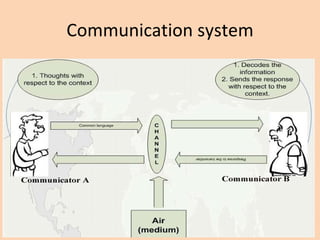
Communication system
Food For Mind Does this Communication system present in other species as well? How this system originated in human beings? How does we acquire it?
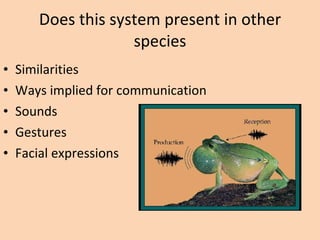
Does this system present in other species Similarities Ways implied for communication Sounds  Gestures Facial expressions
Differences 1)Complexity of Human communication system Phonetics, phonology , morphology Semantics Syntax Pragmatics Discourse 2)Creativity
How this system originated in human beings? The Divine source The natural-sound source The oral-gesture source Glossogenetics Neurolinguistics
How we acquire it Chomsky’s idea of Universal Grammar Location of Universal Grammar
Language and Brain How language works in the brain How brain works on the language
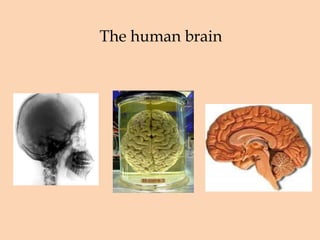
The Human Brain
 
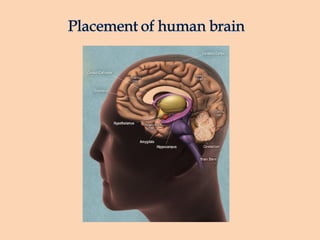
The human brain
Interesting brain facts! About 1.4 kg (2% of body weight) mass of fat & protein with 75% water content W = 140 mm, L = 167 mm, H = 93  mm. Left hemisphere is larger than the right  40% grey matter (outer covering: cerebral cortex)  60% white matter (myelinated fiber tracts traveling to & from the cerebral cortex)  Uses 10 – 23 watt of energy, consuming 20% oxygen from the body. Goes unconscious in 8 – 10 sec. w/o oxygen 100 billion neurons (166 times human population & would take 171 years to count!  (Tony Buzan) 2,50,000 neurons/ minute in early development & stops growing at 18 12 pairs of cranial nerves & 31 pairs of spinal nerves Thinking initiates electro-chemical-neuro-impulse transmission from 0.5 m/sec  - 120 m/sec. (434 km/hr)
Why should we as teachers want to better understand how the brain works? Share your thoughts with your neighbor! (write only two points that you could think of)
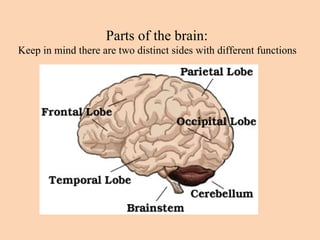
Parts of the brain:  Keep in mind there are two distinct sides with different functions
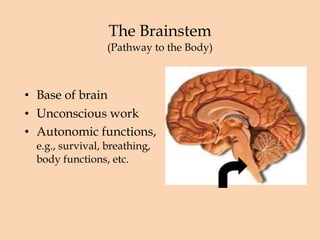
The Brainstem (Pathway to the Body) Base of brain Unconscious work Autonomic functions,  e.g., survival, breathing, body functions, etc.
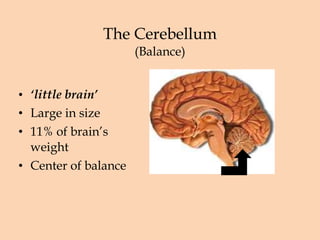
The Cerebellum (Balance) ‘ little brain’ Large in size 11% of brain’s weight Center of balance
The brain has 4 areas called lobes Frontal Parietal Temporal Occipital
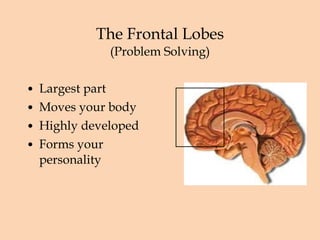
The Frontal Lobes (Problem Solving) Largest part Moves your body Highly developed Forms your personality
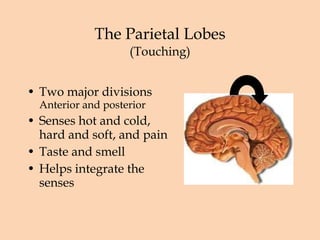
The Parietal Lobes (Touching) Two major divisions Anterior and posterior Senses hot and cold, hard and soft, and pain Taste and smell Helps integrate the senses
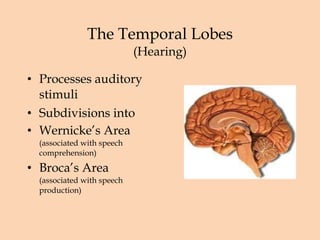
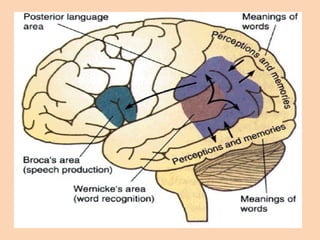
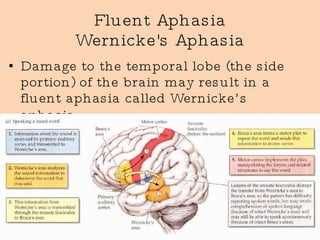
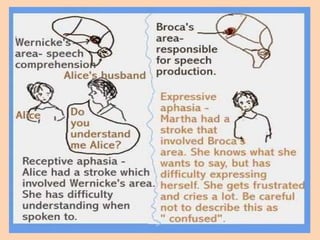
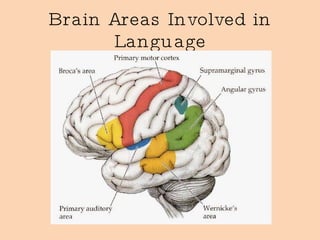
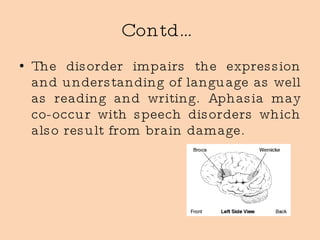
The Temporal Lobes (Hearing) Processes auditory stimuli Subdivisions into Wernicke’s Area (associated with speech comprehension) Broca’s Area (associated with speech production)
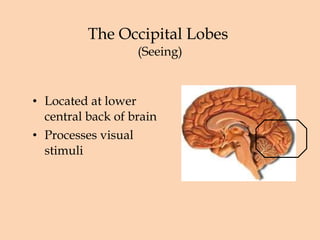
The Occipital Lobes  (Seeing) Located at lower central back of brain Processes visual stimuli
Taking sides …. two sides that is! Two sides or hemispheres of the brain: LEFT and RIGHT We have two cerebral hemispheres connected by the corpus callosum This is a bundle of nerves that allows each side of the brain to communicate with each other Each side of the brain processes things differently It is an outdated assumption that “artsy” type people are right-brained
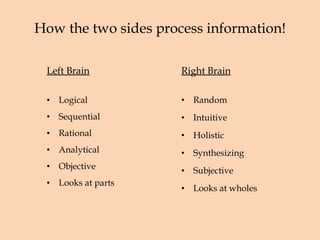
How the two sides process information! Left Brain Logical Sequential Rational Analytical Objective Looks at parts Right Brain Random Intuitive Holistic Synthesizing Subjective Looks at wholes
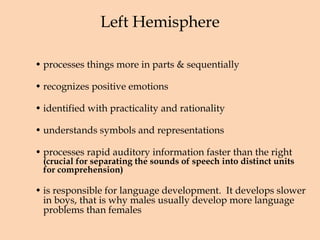
Left Hemisphere processes things more in parts & sequentially  recognizes positive emotions identified with practicality and rationality understands symbols and representations processes rapid auditory information faster than the right  (crucial for separating the sounds of speech into distinct units for comprehension) is responsible for language development.  It develops slower in boys, that is why males usually develop more language problems than females
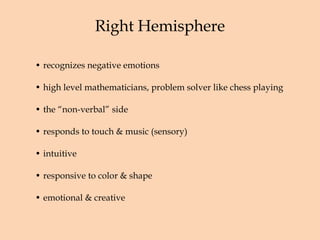
Right Hemisphere recognizes negative emotions high level mathematicians, problem solver like chess playing  the “non-verbal” side responds to touch & music (sensory) intuitive responsive to color & shape emotional & creative
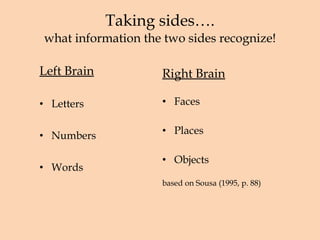
Taking sides…. what information the two sides recognize! Left Brain Letters Numbers Words Right Brain Faces Places Objects based on Sousa (1995, p. 88)
Taking sides…. take the test! Hemispheric Dominance Inventory Test at http://brain.web-us.com/brain/braindominance.htm
Aphasia Jahanzeb   Jahan
 
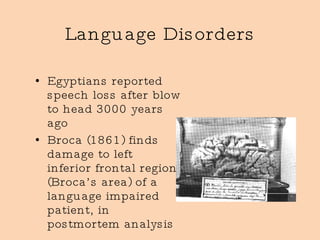
Language Disorders Egyptians reported speech loss after blow to head 3000 years ago Broca (1861) finds damage to left inferior frontal region (Broca’s area) of a language impaired patient, in postmortem analysis
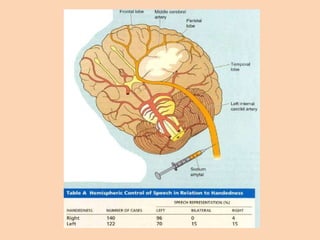
Language Disorders In language disorders 90-95% of cases, damage is to the left hemisphere 5-10% of cases, to the right hemisphere Wada test is used to determine the hemispheric dominance Sodium amydal is injected to the carotid artery First to the left and then to the right
 
Brain Areas Involved in Language
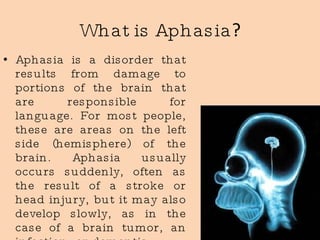
What   is   Aphasia ? Aphasia is a disorder that results from damage to portions of the brain that are responsible for language. For most people, these are areas on the left side (hemisphere) of the brain. Aphasia usually occurs suddenly, often as the result of a stroke or head injury, but it may also develop slowly, as in the case of a brain tumor, an infection, or dementia.
Contd… The disorder impairs the expression and understanding of language as well as reading and writing. Aphasia may co-occur with speech disorders which also result from brain damage.
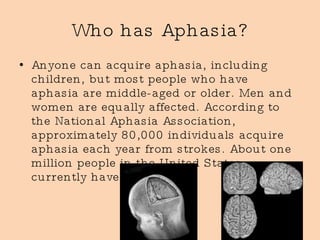
Who has Aphasia? Anyone can acquire aphasia, including children, but most people who have aphasia are middle-aged or older. Men and women are equally affected. According to the National Aphasia Association, approximately 80,000 individuals acquire aphasia each year from strokes. About one million people in the United States currently have aphasia
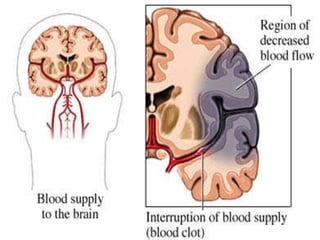
What Causes Aphasia? Aphasia is caused by damage to one or more of the language areas of the brain. Many times, the cause of the brain injury is a stroke. A stroke occurs when blood is unable to reach a part of the brain. Brain cells die when they do not receive their normal supply of blood, which carries oxygen and important nutrients. Other causes of brain injury are severe blows to the head, brain tumors, brain infections, and other conditions that affect the brain.
 
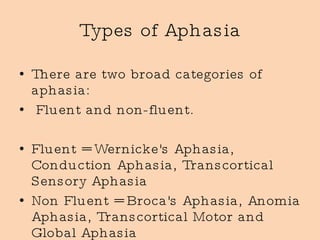
Types of Aphasia There are two broad categories of aphasia: Fluent and non-fluent.  Fluent = Wernicke's Aphasia, Conduction Aphasia, Transcortical Sensory Aphasia Non Fluent = Broca's Aphasia, Anomia Aphasia, Transcortical Motor and Global Aphasia
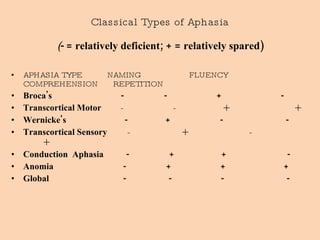
Classical Types of Aphasia ( - = relatively deficient; + = relatively spared) APHASIA TYPE  NAMING   FLUENCY  COMPREHENSION  REPETITION Broca's   -    -    +    - Transcortical Motor   -    -    +   + Wernicke's  -  +  -  -  Transcortical Sensory  -  +  -  + Conduction  Aphasia  -  +  +  - Anomia  -  +  +  + Global  -  -  -  -
Fluent Aphasia Wernicke's Aphasia Damage to the temporal lobe (the side portion) of the brain may result in a fluent aphasia called Wernicke’s aphasia.
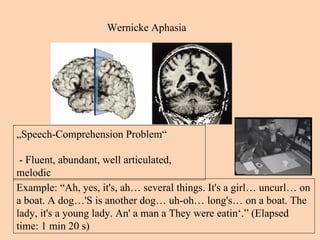
Wernicke’s Aphasia In most people, the damage occurs in the left temporal lobe, although it can result from damage to the right lobe as well. People with Wernicke’s aphasia may speak in long sentences that have no meaning, add unnecessary words, and even create made-up words. For example, someone with Wernicke’s aphasia may say,  “ You know that Beautiful Cow and that I want to get him round and take care of him like you want before.”
Wernicke’s Aphasia As a result, it is often difficult to follow what the person is trying to say. People with Wernicke’s aphasia usually have great difficulty understanding speech, and they are often unaware of their mistakes. These individuals usually have no body weakness because their brain injury is not near the parts of the brain that control movement.
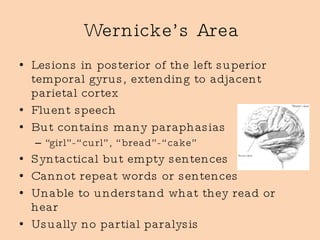
Wernicke’s Area Lesions in posterior of the left superior temporal gyrus, extending to adjacent parietal cortex Fluent speech But contains many paraphasias “ girl”-“curl”, “bread”-“cake” Syntactical but empty sentences Cannot repeat words or sentences Unable to understand what they read or hear Usually no partial paralysis
Wernicke Aphasia „ Speech-Comprehension Problem“ -  Fluent, abundant, well articulated, melodic Example: “Ah, yes, it's, ah… several things. It's a girl… uncurl… on a boat. A dog…'S is another dog… uh-oh… long's… on a boat. The lady, it's a young lady. An' a man a They were eatin‘.” (Elapsed time: 1 min 20 s)
Conduction aphasia Conduction aphasia , also called  associative aphasia , is a relatively rare form of aphasia. An acquired language disorder, it is characterized by intact auditory comprehension, fluent (yet paraphasic) speech production, but poor speech repetition. Patients will display frequent errors during spontaneous speech, substituting or transposing sounds. They will also be aware of their errors, and will show significant difficulty correcting them.   Conduction aphasia usually is the result of damage to the left brain hemisphere, such as by sstroke.
Transcortical Sensory Aphasia TSA, is a type of Aphasia where sufferers have poor comprehension, but have fluent, grammatical speech. Patients can communicate well and are capable of good repetition. The main problem lies within the brain in a region known as the Temporal-occipital-parietal junction, located behind Wernicke’s Area. This disruption causes TSA sufferers to have Semantic paraphasia wherein aphasics do not use the correct word, but use another word of similar content (e.g. Apple is mistaken for Orange, Paper is mistaken for Pencil, etc.)
Non- Fluent  Broca’s Area A type of non-fluent aphasia is Broca’s aphasia. People with Broca’s aphasia have damage to the frontal lobe of the brain. They frequently speak in short phrases that make sense but are produced with great effort. They often omit small words such as ”is,” ”and,” and ”the.” For example, a person with Broca’s aphasia may say, ”Walk dog,” meaning, ”I will take the dog for a walk,” or ”book book two table,” for ”There are two books on the table.”
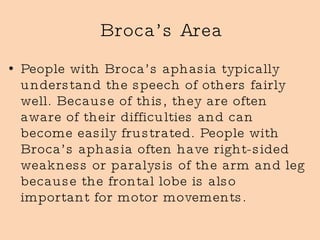
Broca’s Area People with Broca’s aphasia typically understand the speech of others fairly well. Because of this, they are often aware of their difficulties and can become easily frustrated. People with Broca’s aphasia often have right-sided weakness or paralysis of the arm and leg because the frontal lobe is also important for motor movements.
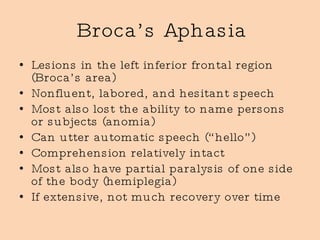
Broca’s Aphasia Lesions in the left inferior frontal region (Broca’s area) Nonfluent, labored, and hesitant speech Most also lost the ability to name persons or subjects (anomia) Can utter automatic speech (“hello”) Comprehension relatively intact Most also have partial paralysis of one side of the body (hemiplegia) If extensive, not much recovery over time
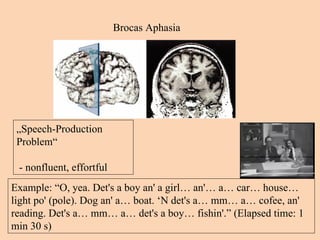
Brocas Aphasia „ Speech-Production Problem“ - nonfluent, effortful Example: “O, yea. Det's a boy an' a girl… an'… a… car… house… light po' (pole). Dog an' a… boat. ‘N det's a… mm… a… cofee, an' reading. Det's a… mm… a… det's a boy… fishin'.” (Elapsed time: 1 min 30 s)
 
Anomia Aphaisa Persons who are left with a persistent inability to supply words for the things that they want to talk about. Significant in nouns and verbs Understand speech well most cases read adequately Poor writing ability
Transcortical motor aphasia (TMA), also known as adynamic aphasia, results from an injury to the anterior superior frontal lobe. The injury is typically caused by a cerebrovascular accident (CVA), commonly referred to as a stroke. The area of insult is sometimes referred to as a watershed region, a region surrounding Broca’s Area. The insult typically involves the left hemisphere as most people (regardless of handedness) are left hemisphere dominant for language (nearly 100% of right-handers, about 85% of left-handers).
Global Aphasia Another type of non-fluent aphasia, global aphasia, results from damage to extensive portions of the language areas of the brain. Individuals with global aphasia have severe communication difficulties and may be extremely limited in their ability to speak or comprehend language
How is Aphasia Diagnosed? Aphasia is usually first recognized by the physician who treats the person for his or her brain injury. Frequently this is a neurologist. The physician typically performs tests that require the person to follow commands, answer questions, name objects, and carry on a conversation. If the physician suspects aphasia, the patient is often referred to a speech-language pathologist, who performs a comprehensive examination of the person’s communication abilities. The examination includes the person’s ability to speak, express ideas, converse socially, understand language, read, and write, as well as the ability to swallow and to use alternative and augmentative communication.
How is Aphasia Treated? In some cases, a person will completely recover from aphasia without treatment. This type of spontaneous recovery usually occurs following a type of stroke in which blood flow to the brain is temporarily interrupted but quickly restored, called a transient ischemic attack. In these circumstances, language abilities may return in a few hours or a few days.
How is Aphasia Treated? For most cases, however, language recovery is not as quick or as complete. While many people with aphasia experience partial spontaneous recovery, in which some language abilities return a few days to a month after the brain injury, some amount of aphasia typically remains. In these instances, speech-language therapy is often helpful. Recovery usually continues over a two-year period. Many health professionals believe that the most effective treatment begins early in the recovery process.
How is Aphasia Treated? Some of the factors that influence the amount of improvement include the cause of the brain damage, the area of the brain that was damaged, the extent of the brain injury, and the age and health of the individual. Additional factors include motivation, handedness, and educational level.
Family Members are Directed to: Simplify language by using short, uncomplicated sentences. Repeat the content words or write down key words to clarify meaning as needed. Maintain a natural conversational manner appropriate for an adult. Minimize distractions, such as a loud radio or TV, whenever possible. Include the person with aphasia in conversations.  Ask for and value the opinion of the person with aphasia, especially regarding family matters. Encourage any type of communication, whether it is speech, gesture, pointing, or drawing.  Avoid correcting the person’s speech. Allow the person plenty of time to talk. Help the person become involved outside the home. Seek out support groups such as stroke clubs.
Other Treatments Other treatment approaches involve the use of computers to improve the language abilities of people with aphasia. Studies have shown that computer-assisted therapy can help people with aphasia retrieve certain parts of speech, such as the use of verbs. Computers can also provide an alternative system of communication for people with difficulty expressing language. Lastly, computers can help people who have problems perceiving the difference between phonemes (the sounds from which words are formed) by providing auditory discrimination exercises.
Summary Human Language is a system that is quite unique in its characteristics and at the same time very intricate in its nature. It is crystal clear that human language is dependant on brain thought we can’t as to how the brain formulates the language, yet is plays the pivotal role which can’t be denied at all
3. It can be said that both Language and Brain are interdependent as language cant be made possible without brain. Same is the case with the lateralization of the brain that can’t take place without having exposure to any language. 4. This unique quality, known as “Species Specific”, is pre-programmed to a larger extent in our brain as study and research has proved it
5. We have discovered the fact that it is the output of certain specific parts of the brain. 6. Sign Language is also the part of the working of the brain which emphasizes the fact that language, which is commonly used for the tool of communication, can’t be possible without brain.
7. Language disorder or aphasia is another evidence which shows the role of brain related to language as in the case of certain aphasias, people lose their prominent part of the language largely though exceptions are always there…
References Bandura, A.(1994). Social learning theory. From Theory into practice database. (Kearsley, G.). Retrieved March 25, 2003 from the World Wide Web:  http://tip.psychology.org/bandura.html  Bloom's Taxonomy: (2003). retrieved December 2, 2003, from http://www.olemiss.edu/depts/educ_school2/docs/stai_manual/manual10.htm Chicurel, M. (1995) The Inner Life of Neurons, retrieved on-line, http://www.med.harvard.edu/publications/On_The_Brain/Volume4/Number2/SP95In.html  Doolittle, P. (2001). Multimedia Learning: Empirical Results and Practical Applications [Online]. Available http://edpsychserver.ed.vt.edu/workshops/edtech/pdf/multimedia.pdf  [2002, Aug 18]. Gaines, B.R. & Shaw, M. (1995). Collaboration Through Concept Maps. Retrieved November 20, 2002, from: http://ksi.cpsc.ucalgary.ca/articles/CSCL95CM/  Sousa, D. R. (1995). How the Brain Learns. Reston, VA: NASSP
Any Questions?

Language & brain by ali zulfiqar

  • 1.
    Language and Brain Presented by: Jahanzeb Jahan Tasawar Abbas Shah Irfan Abbas Zulfiqar Ali
  • 2.
  • 3.
  • 4.
    Food For MindDoes this Communication system present in other species as well? How this system originated in human beings? How does we acquire it?
  • 5.
    Does this systempresent in other species Similarities Ways implied for communication Sounds Gestures Facial expressions
  • 6.
    Differences 1)Complexity ofHuman communication system Phonetics, phonology , morphology Semantics Syntax Pragmatics Discourse 2)Creativity
  • 7.
    How this systemoriginated in human beings? The Divine source The natural-sound source The oral-gesture source Glossogenetics Neurolinguistics
  • 8.
    How we acquireit Chomsky’s idea of Universal Grammar Location of Universal Grammar
  • 9.
    Language and BrainHow language works in the brain How brain works on the language
  • 10.
  • 11.
  • 12.
  • 13.
    Interesting brain facts!About 1.4 kg (2% of body weight) mass of fat & protein with 75% water content W = 140 mm, L = 167 mm, H = 93 mm. Left hemisphere is larger than the right 40% grey matter (outer covering: cerebral cortex) 60% white matter (myelinated fiber tracts traveling to & from the cerebral cortex) Uses 10 – 23 watt of energy, consuming 20% oxygen from the body. Goes unconscious in 8 – 10 sec. w/o oxygen 100 billion neurons (166 times human population & would take 171 years to count! (Tony Buzan) 2,50,000 neurons/ minute in early development & stops growing at 18 12 pairs of cranial nerves & 31 pairs of spinal nerves Thinking initiates electro-chemical-neuro-impulse transmission from 0.5 m/sec - 120 m/sec. (434 km/hr)
  • 14.
    Why should weas teachers want to better understand how the brain works? Share your thoughts with your neighbor! (write only two points that you could think of)
  • 15.
    Parts of thebrain: Keep in mind there are two distinct sides with different functions
  • 16.
    The Brainstem (Pathwayto the Body) Base of brain Unconscious work Autonomic functions, e.g., survival, breathing, body functions, etc.
  • 17.
    The Cerebellum (Balance)‘ little brain’ Large in size 11% of brain’s weight Center of balance
  • 18.
    The brain has4 areas called lobes Frontal Parietal Temporal Occipital
  • 19.
    The Frontal Lobes(Problem Solving) Largest part Moves your body Highly developed Forms your personality
  • 20.
    The Parietal Lobes(Touching) Two major divisions Anterior and posterior Senses hot and cold, hard and soft, and pain Taste and smell Helps integrate the senses
  • 21.
    The Temporal Lobes(Hearing) Processes auditory stimuli Subdivisions into Wernicke’s Area (associated with speech comprehension) Broca’s Area (associated with speech production)
  • 22.
    The Occipital Lobes (Seeing) Located at lower central back of brain Processes visual stimuli
  • 23.
    Taking sides ….two sides that is! Two sides or hemispheres of the brain: LEFT and RIGHT We have two cerebral hemispheres connected by the corpus callosum This is a bundle of nerves that allows each side of the brain to communicate with each other Each side of the brain processes things differently It is an outdated assumption that “artsy” type people are right-brained
  • 24.
    How the twosides process information! Left Brain Logical Sequential Rational Analytical Objective Looks at parts Right Brain Random Intuitive Holistic Synthesizing Subjective Looks at wholes
  • 25.
    Left Hemisphere processesthings more in parts & sequentially recognizes positive emotions identified with practicality and rationality understands symbols and representations processes rapid auditory information faster than the right (crucial for separating the sounds of speech into distinct units for comprehension) is responsible for language development. It develops slower in boys, that is why males usually develop more language problems than females
  • 26.
    Right Hemisphere recognizesnegative emotions high level mathematicians, problem solver like chess playing the “non-verbal” side responds to touch & music (sensory) intuitive responsive to color & shape emotional & creative
  • 27.
    Taking sides…. whatinformation the two sides recognize! Left Brain Letters Numbers Words Right Brain Faces Places Objects based on Sousa (1995, p. 88)
  • 28.
    Taking sides…. takethe test! Hemispheric Dominance Inventory Test at http://brain.web-us.com/brain/braindominance.htm
  • 29.
  • 30.
  • 31.
    Language Disorders Egyptiansreported speech loss after blow to head 3000 years ago Broca (1861) finds damage to left inferior frontal region (Broca’s area) of a language impaired patient, in postmortem analysis
  • 32.
    Language Disorders Inlanguage disorders 90-95% of cases, damage is to the left hemisphere 5-10% of cases, to the right hemisphere Wada test is used to determine the hemispheric dominance Sodium amydal is injected to the carotid artery First to the left and then to the right
  • 33.
  • 34.
  • 35.
    What is Aphasia ? Aphasia is a disorder that results from damage to portions of the brain that are responsible for language. For most people, these are areas on the left side (hemisphere) of the brain. Aphasia usually occurs suddenly, often as the result of a stroke or head injury, but it may also develop slowly, as in the case of a brain tumor, an infection, or dementia.
  • 36.
    Contd… The disorderimpairs the expression and understanding of language as well as reading and writing. Aphasia may co-occur with speech disorders which also result from brain damage.
  • 37.
    Who has Aphasia?Anyone can acquire aphasia, including children, but most people who have aphasia are middle-aged or older. Men and women are equally affected. According to the National Aphasia Association, approximately 80,000 individuals acquire aphasia each year from strokes. About one million people in the United States currently have aphasia
  • 38.
    What Causes Aphasia?Aphasia is caused by damage to one or more of the language areas of the brain. Many times, the cause of the brain injury is a stroke. A stroke occurs when blood is unable to reach a part of the brain. Brain cells die when they do not receive their normal supply of blood, which carries oxygen and important nutrients. Other causes of brain injury are severe blows to the head, brain tumors, brain infections, and other conditions that affect the brain.
  • 39.
  • 40.
    Types of AphasiaThere are two broad categories of aphasia: Fluent and non-fluent. Fluent = Wernicke's Aphasia, Conduction Aphasia, Transcortical Sensory Aphasia Non Fluent = Broca's Aphasia, Anomia Aphasia, Transcortical Motor and Global Aphasia
  • 41.
    Classical Types ofAphasia ( - = relatively deficient; + = relatively spared) APHASIA TYPE NAMING FLUENCY COMPREHENSION REPETITION Broca's - - + - Transcortical Motor - - + + Wernicke's - + - - Transcortical Sensory - + - + Conduction Aphasia - + + - Anomia - + + + Global - - - -
  • 42.
    Fluent Aphasia Wernicke'sAphasia Damage to the temporal lobe (the side portion) of the brain may result in a fluent aphasia called Wernicke’s aphasia.
  • 43.
    Wernicke’s Aphasia Inmost people, the damage occurs in the left temporal lobe, although it can result from damage to the right lobe as well. People with Wernicke’s aphasia may speak in long sentences that have no meaning, add unnecessary words, and even create made-up words. For example, someone with Wernicke’s aphasia may say, “ You know that Beautiful Cow and that I want to get him round and take care of him like you want before.”
  • 44.
    Wernicke’s Aphasia Asa result, it is often difficult to follow what the person is trying to say. People with Wernicke’s aphasia usually have great difficulty understanding speech, and they are often unaware of their mistakes. These individuals usually have no body weakness because their brain injury is not near the parts of the brain that control movement.
  • 45.
    Wernicke’s Area Lesionsin posterior of the left superior temporal gyrus, extending to adjacent parietal cortex Fluent speech But contains many paraphasias “ girl”-“curl”, “bread”-“cake” Syntactical but empty sentences Cannot repeat words or sentences Unable to understand what they read or hear Usually no partial paralysis
  • 46.
    Wernicke Aphasia „Speech-Comprehension Problem“ - Fluent, abundant, well articulated, melodic Example: “Ah, yes, it's, ah… several things. It's a girl… uncurl… on a boat. A dog…'S is another dog… uh-oh… long's… on a boat. The lady, it's a young lady. An' a man a They were eatin‘.” (Elapsed time: 1 min 20 s)
  • 47.
    Conduction aphasia Conductionaphasia , also called associative aphasia , is a relatively rare form of aphasia. An acquired language disorder, it is characterized by intact auditory comprehension, fluent (yet paraphasic) speech production, but poor speech repetition. Patients will display frequent errors during spontaneous speech, substituting or transposing sounds. They will also be aware of their errors, and will show significant difficulty correcting them. Conduction aphasia usually is the result of damage to the left brain hemisphere, such as by sstroke.
  • 48.
    Transcortical Sensory AphasiaTSA, is a type of Aphasia where sufferers have poor comprehension, but have fluent, grammatical speech. Patients can communicate well and are capable of good repetition. The main problem lies within the brain in a region known as the Temporal-occipital-parietal junction, located behind Wernicke’s Area. This disruption causes TSA sufferers to have Semantic paraphasia wherein aphasics do not use the correct word, but use another word of similar content (e.g. Apple is mistaken for Orange, Paper is mistaken for Pencil, etc.)
  • 49.
    Non- Fluent Broca’s Area A type of non-fluent aphasia is Broca’s aphasia. People with Broca’s aphasia have damage to the frontal lobe of the brain. They frequently speak in short phrases that make sense but are produced with great effort. They often omit small words such as ”is,” ”and,” and ”the.” For example, a person with Broca’s aphasia may say, ”Walk dog,” meaning, ”I will take the dog for a walk,” or ”book book two table,” for ”There are two books on the table.”
  • 50.
    Broca’s Area Peoplewith Broca’s aphasia typically understand the speech of others fairly well. Because of this, they are often aware of their difficulties and can become easily frustrated. People with Broca’s aphasia often have right-sided weakness or paralysis of the arm and leg because the frontal lobe is also important for motor movements.
  • 51.
    Broca’s Aphasia Lesionsin the left inferior frontal region (Broca’s area) Nonfluent, labored, and hesitant speech Most also lost the ability to name persons or subjects (anomia) Can utter automatic speech (“hello”) Comprehension relatively intact Most also have partial paralysis of one side of the body (hemiplegia) If extensive, not much recovery over time
  • 52.
    Brocas Aphasia „Speech-Production Problem“ - nonfluent, effortful Example: “O, yea. Det's a boy an' a girl… an'… a… car… house… light po' (pole). Dog an' a… boat. ‘N det's a… mm… a… cofee, an' reading. Det's a… mm… a… det's a boy… fishin'.” (Elapsed time: 1 min 30 s)
  • 53.
  • 54.
    Anomia Aphaisa Personswho are left with a persistent inability to supply words for the things that they want to talk about. Significant in nouns and verbs Understand speech well most cases read adequately Poor writing ability
  • 55.
    Transcortical motor aphasia(TMA), also known as adynamic aphasia, results from an injury to the anterior superior frontal lobe. The injury is typically caused by a cerebrovascular accident (CVA), commonly referred to as a stroke. The area of insult is sometimes referred to as a watershed region, a region surrounding Broca’s Area. The insult typically involves the left hemisphere as most people (regardless of handedness) are left hemisphere dominant for language (nearly 100% of right-handers, about 85% of left-handers).
  • 56.
    Global Aphasia Anothertype of non-fluent aphasia, global aphasia, results from damage to extensive portions of the language areas of the brain. Individuals with global aphasia have severe communication difficulties and may be extremely limited in their ability to speak or comprehend language
  • 57.
    How is AphasiaDiagnosed? Aphasia is usually first recognized by the physician who treats the person for his or her brain injury. Frequently this is a neurologist. The physician typically performs tests that require the person to follow commands, answer questions, name objects, and carry on a conversation. If the physician suspects aphasia, the patient is often referred to a speech-language pathologist, who performs a comprehensive examination of the person’s communication abilities. The examination includes the person’s ability to speak, express ideas, converse socially, understand language, read, and write, as well as the ability to swallow and to use alternative and augmentative communication.
  • 58.
    How is AphasiaTreated? In some cases, a person will completely recover from aphasia without treatment. This type of spontaneous recovery usually occurs following a type of stroke in which blood flow to the brain is temporarily interrupted but quickly restored, called a transient ischemic attack. In these circumstances, language abilities may return in a few hours or a few days.
  • 59.
    How is AphasiaTreated? For most cases, however, language recovery is not as quick or as complete. While many people with aphasia experience partial spontaneous recovery, in which some language abilities return a few days to a month after the brain injury, some amount of aphasia typically remains. In these instances, speech-language therapy is often helpful. Recovery usually continues over a two-year period. Many health professionals believe that the most effective treatment begins early in the recovery process.
  • 60.
    How is AphasiaTreated? Some of the factors that influence the amount of improvement include the cause of the brain damage, the area of the brain that was damaged, the extent of the brain injury, and the age and health of the individual. Additional factors include motivation, handedness, and educational level.
  • 61.
    Family Members areDirected to: Simplify language by using short, uncomplicated sentences. Repeat the content words or write down key words to clarify meaning as needed. Maintain a natural conversational manner appropriate for an adult. Minimize distractions, such as a loud radio or TV, whenever possible. Include the person with aphasia in conversations. Ask for and value the opinion of the person with aphasia, especially regarding family matters. Encourage any type of communication, whether it is speech, gesture, pointing, or drawing. Avoid correcting the person’s speech. Allow the person plenty of time to talk. Help the person become involved outside the home. Seek out support groups such as stroke clubs.
  • 62.
    Other Treatments Othertreatment approaches involve the use of computers to improve the language abilities of people with aphasia. Studies have shown that computer-assisted therapy can help people with aphasia retrieve certain parts of speech, such as the use of verbs. Computers can also provide an alternative system of communication for people with difficulty expressing language. Lastly, computers can help people who have problems perceiving the difference between phonemes (the sounds from which words are formed) by providing auditory discrimination exercises.
  • 63.
    Summary Human Languageis a system that is quite unique in its characteristics and at the same time very intricate in its nature. It is crystal clear that human language is dependant on brain thought we can’t as to how the brain formulates the language, yet is plays the pivotal role which can’t be denied at all
  • 64.
    3. It canbe said that both Language and Brain are interdependent as language cant be made possible without brain. Same is the case with the lateralization of the brain that can’t take place without having exposure to any language. 4. This unique quality, known as “Species Specific”, is pre-programmed to a larger extent in our brain as study and research has proved it
  • 65.
    5. We havediscovered the fact that it is the output of certain specific parts of the brain. 6. Sign Language is also the part of the working of the brain which emphasizes the fact that language, which is commonly used for the tool of communication, can’t be possible without brain.
  • 66.
    7. Language disorderor aphasia is another evidence which shows the role of brain related to language as in the case of certain aphasias, people lose their prominent part of the language largely though exceptions are always there…
  • 67.
    References Bandura, A.(1994).Social learning theory. From Theory into practice database. (Kearsley, G.). Retrieved March 25, 2003 from the World Wide Web: http://tip.psychology.org/bandura.html Bloom's Taxonomy: (2003). retrieved December 2, 2003, from http://www.olemiss.edu/depts/educ_school2/docs/stai_manual/manual10.htm Chicurel, M. (1995) The Inner Life of Neurons, retrieved on-line, http://www.med.harvard.edu/publications/On_The_Brain/Volume4/Number2/SP95In.html Doolittle, P. (2001). Multimedia Learning: Empirical Results and Practical Applications [Online]. Available http://edpsychserver.ed.vt.edu/workshops/edtech/pdf/multimedia.pdf [2002, Aug 18]. Gaines, B.R. & Shaw, M. (1995). Collaboration Through Concept Maps. Retrieved November 20, 2002, from: http://ksi.cpsc.ucalgary.ca/articles/CSCL95CM/ Sousa, D. R. (1995). How the Brain Learns. Reston, VA: NASSP
  • 68.

Editor's Notes

  • #16 Notes Cerebellum controls your balance, body posture, and muscle functions. By age 2, it has almost reached its adult size.
  • #17 The brainstem controls unconscious work such as breathing, heartbeat, and blood pressure. This area of the brain holds the key to life itself.
  • #18 The cerebellum is the key to balance, maintenance of body posture, and coordination of muscle function. The cerebellum ‘remembers’ such movements learned at a young age such as walking and grabbing.
  • #20 The frontal lobes are responsible for allowing you to think of the past, plan for the future, focus your attention, solve problems, make decisions, and have conversation with others. This region is also responsible for thinking creatively and analytically in a problem-solving mode.
  • #21 The brain must always know where each part of the body is located and its relation to it’s surroundings. The anterior part (front) is responsible for receiving incoming sensory stimuli. The posterior part (rear) is continuously analyzing to give a person a sense of spatial awareness.
  • #22 Subdivisions cope with hearing, language, and some aspects to memory. Wernicke’s Area is critical for speech including reading. It allows us to comprehend or interpret speech and to words together correctly so they make sense. Broca’s area is behind the frontal lobes. This area is the center of our speech. It also relates to other language areas such as writing and reading.
  • #23 This area gives a person the ability to see and observe.