
http://flickr.com/photos/7447470@N06/1345266896/ INTRODUCTION  TO  WEB 2.0
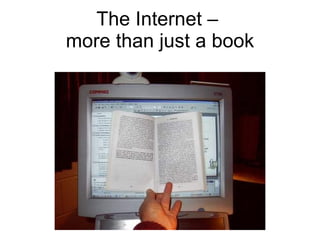
The Internet –  more than just a book
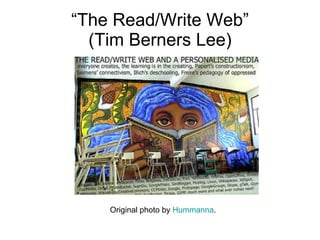
“ The Read/Write Web” (Tim Berners Lee) Original photo by  Hummanna .
eLearning 2.0/Web 2.0 (Stephen Downes) Elearning 1.0: static packaged content  little true interactivity and learner input and  very little contact with a tutor. represented by Learner Management Systems. (eg WebCT, Blackboard, etc)  Elearning 2.0: more student-centred centred around a Personal Learning Environment using social software.  students generate and share content.   they  interact  not only with teachers and their peers, but  with anyone in the world they can learn from . (this description courtesy of Sean Fitzgerald)
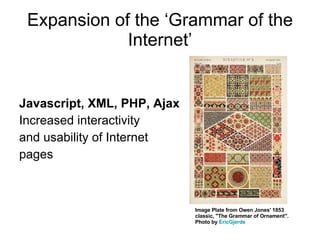
Expansion of the ‘Grammar of the Internet’ Javascript, XML, PHP, Ajax Increased interactivity  and usability of Internet  pages Image Plate from Owen Jones' 1853 classic, "The Grammar of Ornament". Photo by  EricGjerde
PERSONAL PUBLISHING/  PARTICIPATORY MEDIA TOOLS Blogs – writing Podcasts - audio Wikis  –  collaboration (mostly text) MEDIA Video repositories:  YouTube, TeacherTube, Google Video, BlipTV Flickr  (photo sharing)
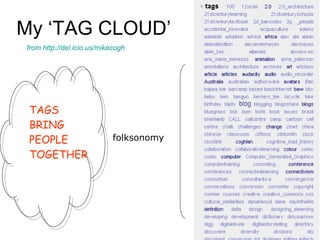
My ‘TAG CLOUD’ folksonomy from http://del.icio.us/mikecogh TAGS  BRING PEOPLE  TOGETHER
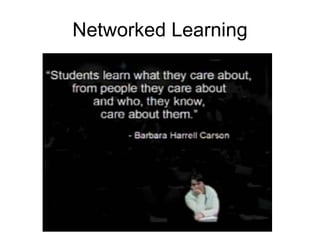
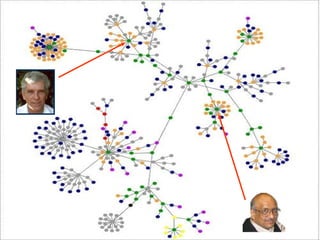
Networked Learning
 
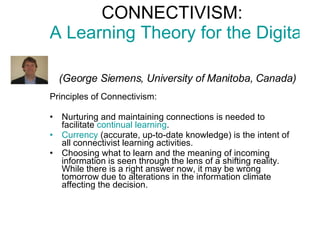
CONNECTIVISM:  A Learning Theory for the Digital Age     (George Siemens, University of Manitoba, Canada) Principles of Connectivism: Nurturing and maintaining connections  is needed to facilitate  continual learning .  Currency  (accurate, up-to-date knowledge) is the intent of all connectivist learning activities.  Choosing what to learn and the meaning of incoming information is seen through the lens of a shifting reality.  While there is a right answer now, it may be wrong tomorrow  due to alterations in the information climate affecting the decision.
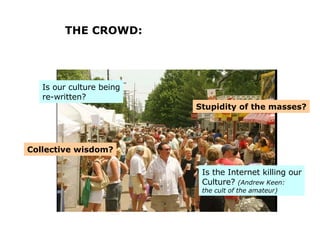
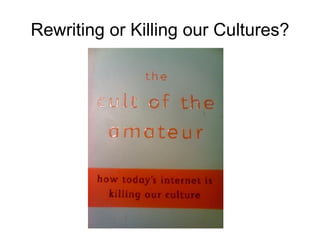
THE CROWD: Collective wisdom? Stupidity of the masses? Is our culture being re-written? Is the Internet killing our Culture?  (Andrew Keen: the cult of the amateur)
Proliferation of Content and Services Decline of the gatekeepers of content (the end of copyright?) Affects status and position of the expert (‘the professional’) The World is Flat (Thomas Friedman)
Rewriting or Killing our Cultures?
Coping with the Proliferation of Content Social Bookmarking (Delic.io.us) RSS feeds and  content aggregators  (Bloglines, Netvibes, iTunes, Moodle) “ People just don’t subscribe to magazines anymore; they also subscribe to people.” “ You don’t have to look for content. Content finds you.”  Twitter Friendfeed
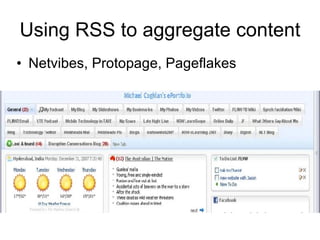
Using RSS to aggregate content Netvibes, Protopage, Pageflakes
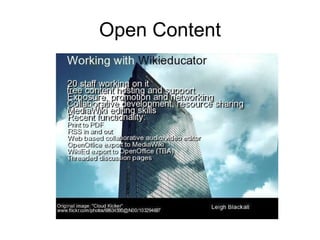
Open Content
Creative Commons Licensing from Jeffrey Beall at http://www.flickr.com/photos/denverjeffrey/301014978/
 
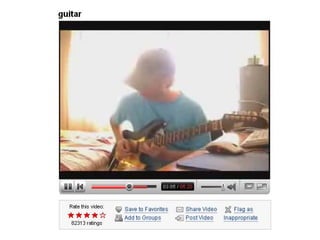
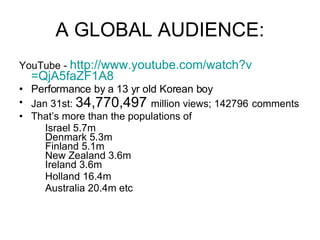
A GLOBAL AUDIENCE: YouTube -  http:// www.youtube.com/watch?v =QjA5faZF1A8 Performance by a 13 yr old Korean boy Jan 31st:  34,770,497  million views; 142796   comments That’s more than the populations of  Israel 5.7m Denmark 5.3m Finland 5.1m New Zealand 3.6m Ireland 3.6m Holland 16.4m Australia 20.4m etc
WHAT’S ALL THE FUSS ABOUT? Is it real? Who are these 34.7 million people? Copyright implications? – I can reuse the content for my own purposes Who is exercising editorial control? Disintermediation  – the decline of the gatekeepers of content Should students have access to sites like this?  (see ‘YouTube – a Class Act’) How do students like this feel at school? Should we be encouraging our students  to create content To publish to these kinds of sites Empowerment and realisation of identity through personal publishing to social networking sites MIT; Jason and TV shows…..
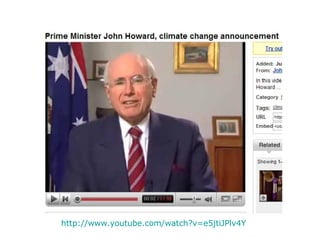
http:// www.youtube.com/watch?v =e5jtiJPlv4Y
 
Indian YouTube Equivalents http:// meravideo.com / http:// apnatube.com / http://layfile.com/ http:// www.aapkavideo.com
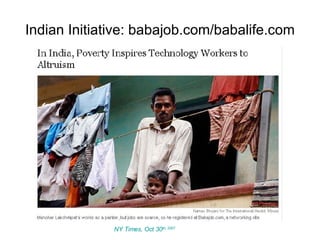
Indian Initiative: babajob.com/babalife.com NY Times, Oct 30 th , 2007
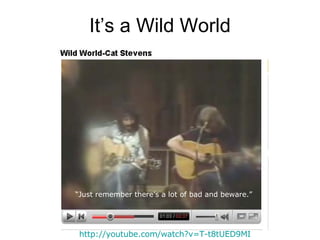
It’s a Wild World http:// youtube.com/watch?v =T-t8tUED9MI “ Just remember there’s a lot of bad and beware.”
 
Are we sociologically ready? What are our  ethical responsibilities  as educators : to our students? to ourselves?  (teacher sacked for    posting photo on MySpace)
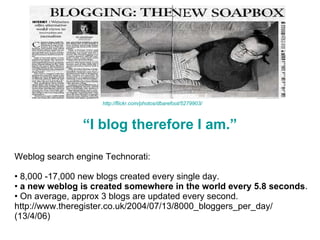
“ I blog therefore I am.” Weblog search engine Technorati:  8,000 -17,000 new blogs created every single day.  a new weblog is created somewhere in the world every 5.8 seconds .  On average, approx 3 blogs are updated every second. http://www.theregister.co.uk/2004/07/13/8000_bloggers_per_day/ (13/4/06) http://flickr.com/photos/dbarefoot/5279903/
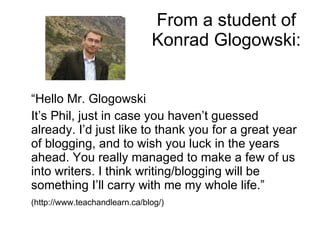
From a student of  Konrad Glogowski: “ Hello Mr. Glogowski It’s Phil, just in case you haven’t guessed already. I’d just like to thank you for a great year of blogging, and to wish you luck in the years ahead. You really managed to make a few of us into writers. I think writing/blogging will be something I’ll carry with me my whole life.” (http://www.teachandlearn.ca/blog/)
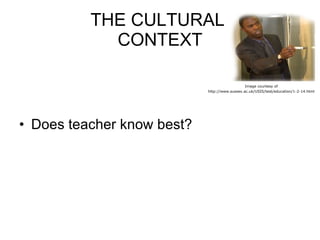
THE CULTURAL  CONTEXT Does teacher know best? Image courtesy of http://www.sussex.ac.uk/USIS/test/education/1-2-14.html
http://flickr.com/photos/32912387@N00/171506548/
SLOW LEARNING "It is going to become very fashionable at some point to be disconnected," Silicon Valley futurist Paul Saffo predicts. "There are going to be people who wear their disconnectivity like a badge.“ ( http://www.usatoday.com/printedition/news/20070111/1a_tech-noxx.art.htm )
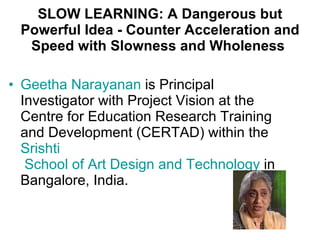
SLOW LEARNING: A Dangerous but Powerful Idea - Counter Acceleration and Speed with Slowness and Wholeness  Geetha  Narayanan  is Principal Investigator with Project Vision at the Centre for Education Research Training and Development (CERTAD) within the  Srishti  School of Art Design and Technology  in Bangalore, India.
Geetha  Narayanan  -  Slowness as a pedagogy consciously embrace the core value of slowness  – both as way of being and as a way of learning culture of immediacy  values fast knowledge which in turn runs counter to the development of both the self and the mind. The  thoughtless and widespread use of technology  as the universal solution to the rising need for fast knowledge is wrong and must be questioned. Often in developing countries, such as India, the term ‘digital divide’ is used to support the argument that the use of new technologies, alone, will create conditions of learning … That is not true the new digital technologies are  tools that allow for learners to develop their imaginations, to be able to play and to have fun, to be able to tell stories in different and exciting ways.  But in order to generate value they need to be integrated into new forms and structures in an invisible and contextual manner - one where  new media arts can sustain social change . Slowness promotes “wellness of being”
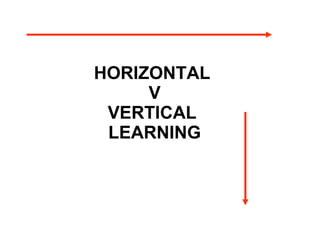
HORIZONTAL  V VERTICAL  LEARNING
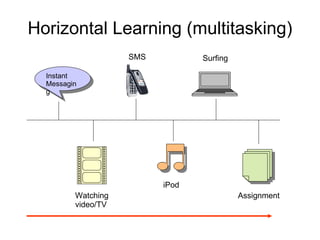
Horizontal Learning (multitasking) Instant Messaging Assignment SMS iPod Surfing Watching  video/TV
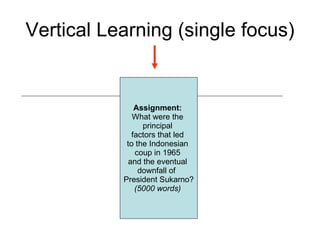
Vertical Learning (single focus) Assignment:  What were the  principal  factors that led  to the Indonesian  coup in 1965  and the eventual  downfall of  President Sukarno? (5000 words)
Horizontal v Vertical Learning The discerning eteacher: Acknowledges the nature and influence of  horizontal learning  (multitasking) Knows when to encourage  vertical learning  (single focus activity)
The excellent eteacher:   has an online presence/website (eg course homepage on LMS, or own website, blog, etc)  Knows how to use technology for delivery and assessment and therefore has a blog, a wiki, or podcast site Includes media in delivery and production of teaching materials and student assessment Models and teaches digital literacy  Creates and provides digital resources Teaches search, validation, and verification skills Employs and models RSS as a means of aggregating and distributing content
The excellent eteacher: Teaches about, and employs collaborative approaches Switches between sage and guide as appropriate  Knows when to call in the wisdom of the experts to balance the wisdom of the crowd Acknowledges the value of informal learning Accepts that engaging learners is necessary  (and that probably means using technology)
The excellent eteacher: Acknowledges that students may assess the value of a resource via their networks rather than accept the word of the expert  (teacher/lecturer) Uses social bookmarking for collective mining and sharing of resources Is a good (and frequent) online communicator Knows how to effectively combine synchronous and asynchronous modes of delivery Is able to teach in a virtual classroom/web conferencing environment (eg Centra, Elluminate, etc) Must be e-connected and draw on the resources of their networks to remain current (and demonstrate to students)
IN CONCLUSION: Living as a connected educator  (Nancy White: ‘eliving’):  reduces the time you have available to attend to relationships locally  broadens your sphere of influence  widens your catchment area for information, knowledge, and collegiality. involves reconceptualising the way you learn and the way you teach.
IN CONCLUSION: Being a connected educator   involves :  engaging with the world of participatory media guiding students in this new  disintermediated  world modelling the use of technology for lifelong learning allowing time for ‘slow learning’ and reflection It’s all about  connections ……
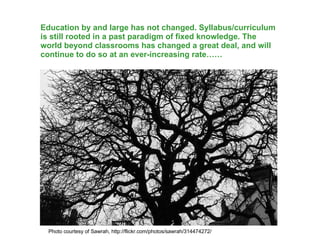
Education by and large has not changed. Syllabus/curriculum is still rooted in a past paradigm of fixed knowledge. The world beyond classrooms has changed a great deal, and will continue to do so at an ever-increasing rate…… Photo courtesy of Sawrah, http://flickr.com/photos/sawrah/314474272/
Tools to Trial Delicious -  http:// del.icio.us Flickr -  http:// www.flickr.com / TeacherTube -  http:// teachertube.com / Edublogs -  http:// edublogs.org / Podzone -  http:// podzone.tafesa.edu.au / Slideshare -  http:// www.slideshare.net Twitter -  http:// twitter.com / Facebook -  http:// www.facebook.com / Ning -  http:// www.ning.com / Bloglines -  http:// www.bloglines.com /
Further Resources New Technologies Means New Learning   Designing eLearning Thinking about the ‘M’ in M-learning  (Dr Norbert Pachler)  (paper to be part of forthcoming proceedings of mLearn conference, Oct 2007) The 8 Competencies of Online Interaction  (Nancy White) Multiliteracies for Collaborative Learning Environments -  http:// www.opensource.idv.tw/moodle/course/view.php?id =23   (log in as guest)

Web2.0 Intro

  • 1.
  • 2.
    The Internet – more than just a book
  • 3.
    “ The Read/WriteWeb” (Tim Berners Lee) Original photo by Hummanna .
  • 4.
    eLearning 2.0/Web 2.0(Stephen Downes) Elearning 1.0: static packaged content little true interactivity and learner input and very little contact with a tutor. represented by Learner Management Systems. (eg WebCT, Blackboard, etc) Elearning 2.0: more student-centred centred around a Personal Learning Environment using social software. students generate and share content. they interact not only with teachers and their peers, but with anyone in the world they can learn from . (this description courtesy of Sean Fitzgerald)
  • 5.
    Expansion of the‘Grammar of the Internet’ Javascript, XML, PHP, Ajax Increased interactivity and usability of Internet pages Image Plate from Owen Jones' 1853 classic, "The Grammar of Ornament". Photo by EricGjerde
  • 6.
    PERSONAL PUBLISHING/ PARTICIPATORY MEDIA TOOLS Blogs – writing Podcasts - audio Wikis – collaboration (mostly text) MEDIA Video repositories: YouTube, TeacherTube, Google Video, BlipTV Flickr (photo sharing)
  • 7.
    My ‘TAG CLOUD’folksonomy from http://del.icio.us/mikecogh TAGS BRING PEOPLE TOGETHER
  • 8.
  • 9.
  • 10.
    CONNECTIVISM: ALearning Theory for the Digital Age (George Siemens, University of Manitoba, Canada) Principles of Connectivism: Nurturing and maintaining connections is needed to facilitate continual learning . Currency (accurate, up-to-date knowledge) is the intent of all connectivist learning activities. Choosing what to learn and the meaning of incoming information is seen through the lens of a shifting reality. While there is a right answer now, it may be wrong tomorrow due to alterations in the information climate affecting the decision.
  • 11.
    THE CROWD: Collectivewisdom? Stupidity of the masses? Is our culture being re-written? Is the Internet killing our Culture? (Andrew Keen: the cult of the amateur)
  • 12.
    Proliferation of Contentand Services Decline of the gatekeepers of content (the end of copyright?) Affects status and position of the expert (‘the professional’) The World is Flat (Thomas Friedman)
  • 13.
    Rewriting or Killingour Cultures?
  • 14.
    Coping with theProliferation of Content Social Bookmarking (Delic.io.us) RSS feeds and content aggregators (Bloglines, Netvibes, iTunes, Moodle) “ People just don’t subscribe to magazines anymore; they also subscribe to people.” “ You don’t have to look for content. Content finds you.” Twitter Friendfeed
  • 15.
    Using RSS toaggregate content Netvibes, Protopage, Pageflakes
  • 16.
  • 17.
    Creative Commons Licensingfrom Jeffrey Beall at http://www.flickr.com/photos/denverjeffrey/301014978/
  • 18.
  • 19.
    A GLOBAL AUDIENCE:YouTube - http:// www.youtube.com/watch?v =QjA5faZF1A8 Performance by a 13 yr old Korean boy Jan 31st: 34,770,497 million views; 142796 comments That’s more than the populations of Israel 5.7m Denmark 5.3m Finland 5.1m New Zealand 3.6m Ireland 3.6m Holland 16.4m Australia 20.4m etc
  • 20.
    WHAT’S ALL THEFUSS ABOUT? Is it real? Who are these 34.7 million people? Copyright implications? – I can reuse the content for my own purposes Who is exercising editorial control? Disintermediation – the decline of the gatekeepers of content Should students have access to sites like this? (see ‘YouTube – a Class Act’) How do students like this feel at school? Should we be encouraging our students to create content To publish to these kinds of sites Empowerment and realisation of identity through personal publishing to social networking sites MIT; Jason and TV shows…..
  • 21.
  • 22.
  • 23.
    Indian YouTube Equivalentshttp:// meravideo.com / http:// apnatube.com / http://layfile.com/ http:// www.aapkavideo.com
  • 24.
  • 25.
    It’s a WildWorld http:// youtube.com/watch?v =T-t8tUED9MI “ Just remember there’s a lot of bad and beware.”
  • 26.
  • 27.
    Are we sociologicallyready? What are our ethical responsibilities as educators : to our students? to ourselves? (teacher sacked for posting photo on MySpace)
  • 28.
    “ I blogtherefore I am.” Weblog search engine Technorati: 8,000 -17,000 new blogs created every single day. a new weblog is created somewhere in the world every 5.8 seconds . On average, approx 3 blogs are updated every second. http://www.theregister.co.uk/2004/07/13/8000_bloggers_per_day/ (13/4/06) http://flickr.com/photos/dbarefoot/5279903/
  • 29.
    From a studentof Konrad Glogowski: “ Hello Mr. Glogowski It’s Phil, just in case you haven’t guessed already. I’d just like to thank you for a great year of blogging, and to wish you luck in the years ahead. You really managed to make a few of us into writers. I think writing/blogging will be something I’ll carry with me my whole life.” (http://www.teachandlearn.ca/blog/)
  • 30.
    THE CULTURAL CONTEXT Does teacher know best? Image courtesy of http://www.sussex.ac.uk/USIS/test/education/1-2-14.html
  • 31.
  • 32.
    SLOW LEARNING "Itis going to become very fashionable at some point to be disconnected," Silicon Valley futurist Paul Saffo predicts. "There are going to be people who wear their disconnectivity like a badge.“ ( http://www.usatoday.com/printedition/news/20070111/1a_tech-noxx.art.htm )
  • 33.
    SLOW LEARNING: ADangerous but Powerful Idea - Counter Acceleration and Speed with Slowness and Wholeness Geetha Narayanan is Principal Investigator with Project Vision at the Centre for Education Research Training and Development (CERTAD) within the Srishti School of Art Design and Technology in Bangalore, India.
  • 34.
    Geetha Narayanan - Slowness as a pedagogy consciously embrace the core value of slowness – both as way of being and as a way of learning culture of immediacy values fast knowledge which in turn runs counter to the development of both the self and the mind. The thoughtless and widespread use of technology as the universal solution to the rising need for fast knowledge is wrong and must be questioned. Often in developing countries, such as India, the term ‘digital divide’ is used to support the argument that the use of new technologies, alone, will create conditions of learning … That is not true the new digital technologies are tools that allow for learners to develop their imaginations, to be able to play and to have fun, to be able to tell stories in different and exciting ways. But in order to generate value they need to be integrated into new forms and structures in an invisible and contextual manner - one where new media arts can sustain social change . Slowness promotes “wellness of being”
  • 35.
    HORIZONTAL VVERTICAL LEARNING
  • 36.
    Horizontal Learning (multitasking)Instant Messaging Assignment SMS iPod Surfing Watching video/TV
  • 37.
    Vertical Learning (singlefocus) Assignment: What were the principal factors that led to the Indonesian coup in 1965 and the eventual downfall of President Sukarno? (5000 words)
  • 38.
    Horizontal v VerticalLearning The discerning eteacher: Acknowledges the nature and influence of horizontal learning (multitasking) Knows when to encourage vertical learning (single focus activity)
  • 39.
    The excellent eteacher: has an online presence/website (eg course homepage on LMS, or own website, blog, etc) Knows how to use technology for delivery and assessment and therefore has a blog, a wiki, or podcast site Includes media in delivery and production of teaching materials and student assessment Models and teaches digital literacy Creates and provides digital resources Teaches search, validation, and verification skills Employs and models RSS as a means of aggregating and distributing content
  • 40.
    The excellent eteacher:Teaches about, and employs collaborative approaches Switches between sage and guide as appropriate Knows when to call in the wisdom of the experts to balance the wisdom of the crowd Acknowledges the value of informal learning Accepts that engaging learners is necessary (and that probably means using technology)
  • 41.
    The excellent eteacher:Acknowledges that students may assess the value of a resource via their networks rather than accept the word of the expert (teacher/lecturer) Uses social bookmarking for collective mining and sharing of resources Is a good (and frequent) online communicator Knows how to effectively combine synchronous and asynchronous modes of delivery Is able to teach in a virtual classroom/web conferencing environment (eg Centra, Elluminate, etc) Must be e-connected and draw on the resources of their networks to remain current (and demonstrate to students)
  • 42.
    IN CONCLUSION: Livingas a connected educator (Nancy White: ‘eliving’): reduces the time you have available to attend to relationships locally broadens your sphere of influence widens your catchment area for information, knowledge, and collegiality. involves reconceptualising the way you learn and the way you teach.
  • 43.
    IN CONCLUSION: Beinga connected educator involves : engaging with the world of participatory media guiding students in this new disintermediated world modelling the use of technology for lifelong learning allowing time for ‘slow learning’ and reflection It’s all about connections ……
  • 44.
    Education by andlarge has not changed. Syllabus/curriculum is still rooted in a past paradigm of fixed knowledge. The world beyond classrooms has changed a great deal, and will continue to do so at an ever-increasing rate…… Photo courtesy of Sawrah, http://flickr.com/photos/sawrah/314474272/
  • 45.
    Tools to TrialDelicious - http:// del.icio.us Flickr - http:// www.flickr.com / TeacherTube - http:// teachertube.com / Edublogs - http:// edublogs.org / Podzone - http:// podzone.tafesa.edu.au / Slideshare - http:// www.slideshare.net Twitter - http:// twitter.com / Facebook - http:// www.facebook.com / Ning - http:// www.ning.com / Bloglines - http:// www.bloglines.com /
  • 46.
    Further Resources NewTechnologies Means New Learning Designing eLearning Thinking about the ‘M’ in M-learning (Dr Norbert Pachler) (paper to be part of forthcoming proceedings of mLearn conference, Oct 2007) The 8 Competencies of Online Interaction (Nancy White) Multiliteracies for Collaborative Learning Environments - http:// www.opensource.idv.tw/moodle/course/view.php?id =23 (log in as guest)