E-Learning 2.0 – Why the New Tools Stephen Downes July 18, 2006 MP3 Audio Link:  http://www.downes.ca/files/audio/emerg.mp3
Outline What are the new tools? Enabling new forms of learning The theory underlying the learning How do we know it will work?
What are the new tools?
Content Creation Blogs E-Portfolios –  ELGG ePortfolios  – Helen Barrett ELGG and blogging  – Miles Berry (a good way of promoting learner autonomy and voice) Video -  YouTube
Collaborative Writing Wikis –  PB Wiki ,  Media Wiki RSS inside a Wiki  – Alan Levine South African Curriculum  on a wiki Collaborative Bookmarking –  del.icio.us ,  Furl Online Office Applications –  Writely ,  Gliffy ,  iRows
Aggregators Aggregate This , Scott McLemee  MetaxuCafe  is "a network of literary blogs with over 300 members.“ Postgenomic , aggregates "posts from life science blogs."  Edu_RSS   Intute  - the new face of the Resource Discovery Network (RDN)
Webtops 30Boxes ,  PageFlakes ,  ProtoPage ,  Goowy Interfaces of the future  – Mark Oehlert The Personal Learning Environment PLE Blog Windows Live
More Web 2.0 presentations Alan Levine :  New Learning Technologies Buffet   John Evans :  IMYM Tutorials Wiki Anne Davis :  Through the Use of Weblogs Quentin D'Souza :  Teaching Hacks Wiki Will Richardson :  Read/Write Web Wiki Darren Kuropatwa :  Whiplash   Web 2.0 Slides
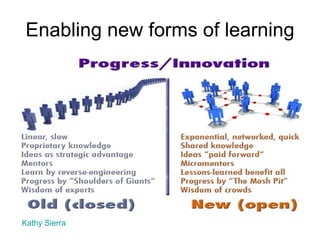
Enabling new forms of learning Kathy Sierra
Community of Enquiry Konrad Glogowski  – “My classroom is now a community of inquiry where knowledge emerges from conversation” Cameron and Anderson:  Collaborative Learning Activities Using Social Software Tools
Social Spaces “ Teachers need to become proficient in creating social spaces…” -  Glogowski   “ Thought is internalized conversation…” ( Vygotsky ,  Bakhtin ,  Wells ,)
The Wisdom of Crowds “ Texts are tentative attempts to construct knowledge.” -  Glogowski   Bruce Hoppe  - "Empirical research is finding that users rather than manufacturers are the actual developers of many or most new products and services…”
Identity “ We mutually define each other.” -  Glogowski   Identity Production in a Networked Culture: Why Youth Heart MySpace –  Danah Boyd “ The dynamics of identity production play out visibly on MySpace. Profiles are digital bodies, public displays of identity where people can explore impression management.”
Interaction vs Authority “ I do not correct - I read, interact, and assist the members of my community in constructing their knowledge.” -  Glogowski   Teacher Centered vs Student Centered Just-in-time vs Just-in-Case
Participation “ Learning and teaching take place through participation.” -  Glogowski   Educational Robots –  Alfred Thompson Lego Mindstorms
The theory and the learning Paul Sundberg
Flat World Learning Friedman – Learning in a flat world  (Barrett) Learn how to learn CQ (curiosity) + PQ (passion) > IQ People skills Right brain stuff (Daniel Pink – conceptual age) David Maister  –  “trying to get people excited about the topic, so they will leave the session actively seeking out the new learning for themselves”
Learning Networks Ton Zylstra :  successful social software :  Flickr and delicious work in a triangle: person, picture/bookmark, and tag(s).   Jyri Engesrom :  about social objects :  social networks consist of people who are connected by a shared object. Downes :  Social networking becomes a semantic social network when we can determine how A and B are connected.
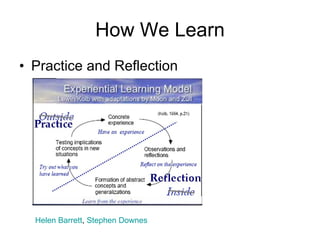
How We Learn Practice and Reflection Helen Barrett ,  Stephen Downes
Reflection Allows us to Learn Marvin Minsky : “the kinds of AI projects that have been happening for the last 30 or 40 years have had almost no reflective thinking at all.” Reflection entails autonomy
Autonomy Autonomy and motivation Jere Brophy : "Schools are established for the benefit of students, but from students' point of view, time spent in the classroom is devoted to enforced attempts to meet externally imposed demands."
How Do We Know It Will Work? Jon Cates
The Challenge Tony Karrer : I'm becoming convinced that folks in the informal learning realm are quite willing to live with 'free range' learning. It's way too touchy-feely and abstract for me. If this stuff is important, then I want to:  Know that it will work  Know why it works  Know that it's repeatable."
What Counts as ‘Working’? "Contemporary society is seen to be characterized by oppression, whereby the oppressed are prevented from being subjects of history, and become mere objects, determined by other people's intentions and without real agency... that human beings must move towards increasing humanization." -  Friere
Beyond Bloom Doug Belshaw : "The problem is that the bureaucrats who run education in many western education systems - the majority of whom have never taught - have an outdated conception of knowledge."  Louise Starkey  observes that this conception "...was based on an underlying assumption that the mind behaves like a filing cabinet.
The Misleading Definition Mazur describes: What’s becoming a standard definition of an inquiry-based classroom (from the experiences I’ve had with it thus far) is one where the instructor does not lecture and does not impose topics, but instead stops, turns the lights around, and asks students what they want to learn.  http://elgg.net/vinall/weblog/124887.html
What Are You Trying To Do? Becta/Futurelab Innovation Workshop ( Day One ,  Day Two ) July 14-15.  "To create an ecosystem and processes, fuelled by the ever changing needs and ideas of all learners, nurtured by the people that support them and delivered to help individuals achieve their full potential."
What Are You Building? MediaCommons Cel4145 : "Installing and configuring a content management system website is the easy part. Creating content for the site and building a community of people who use it is much harder.“ Christopher D. Sessums:  Teacher PD and the Learning Organization I ask: “why do people persist in treating communities of practice as though they were some sort of mini organization, with 'success factors' and other formal properties?”
Escaping the Prison Doris Lessing –  Prisons We Choose To Live Inside  – What we need to teach: "no matter how much you have to conform outwardly - because the world you are going to live in often punishes unconformity with death - keep your own being alive inwardly, your own judgment, your own thought." (p. 74) Dave Pollard:  Escaping the Prison

Elearning 2.0

  • 1.
    E-Learning 2.0 –Why the New Tools Stephen Downes July 18, 2006 MP3 Audio Link: http://www.downes.ca/files/audio/emerg.mp3
  • 2.
    Outline What arethe new tools? Enabling new forms of learning The theory underlying the learning How do we know it will work?
  • 3.
    What are thenew tools?
  • 4.
    Content Creation BlogsE-Portfolios – ELGG ePortfolios – Helen Barrett ELGG and blogging – Miles Berry (a good way of promoting learner autonomy and voice) Video - YouTube
  • 5.
    Collaborative Writing Wikis– PB Wiki , Media Wiki RSS inside a Wiki – Alan Levine South African Curriculum on a wiki Collaborative Bookmarking – del.icio.us , Furl Online Office Applications – Writely , Gliffy , iRows
  • 6.
    Aggregators Aggregate This, Scott McLemee MetaxuCafe is "a network of literary blogs with over 300 members.“ Postgenomic , aggregates "posts from life science blogs." Edu_RSS Intute - the new face of the Resource Discovery Network (RDN)
  • 7.
    Webtops 30Boxes , PageFlakes , ProtoPage , Goowy Interfaces of the future – Mark Oehlert The Personal Learning Environment PLE Blog Windows Live
  • 8.
    More Web 2.0presentations Alan Levine : New Learning Technologies Buffet John Evans : IMYM Tutorials Wiki Anne Davis : Through the Use of Weblogs Quentin D'Souza : Teaching Hacks Wiki Will Richardson : Read/Write Web Wiki Darren Kuropatwa : Whiplash Web 2.0 Slides
  • 9.
    Enabling new formsof learning Kathy Sierra
  • 10.
    Community of EnquiryKonrad Glogowski – “My classroom is now a community of inquiry where knowledge emerges from conversation” Cameron and Anderson: Collaborative Learning Activities Using Social Software Tools
  • 11.
    Social Spaces “Teachers need to become proficient in creating social spaces…” - Glogowski “ Thought is internalized conversation…” ( Vygotsky , Bakhtin , Wells ,)
  • 12.
    The Wisdom ofCrowds “ Texts are tentative attempts to construct knowledge.” - Glogowski Bruce Hoppe - "Empirical research is finding that users rather than manufacturers are the actual developers of many or most new products and services…”
  • 13.
    Identity “ Wemutually define each other.” - Glogowski Identity Production in a Networked Culture: Why Youth Heart MySpace – Danah Boyd “ The dynamics of identity production play out visibly on MySpace. Profiles are digital bodies, public displays of identity where people can explore impression management.”
  • 14.
    Interaction vs Authority“ I do not correct - I read, interact, and assist the members of my community in constructing their knowledge.” - Glogowski Teacher Centered vs Student Centered Just-in-time vs Just-in-Case
  • 15.
    Participation “ Learningand teaching take place through participation.” - Glogowski Educational Robots – Alfred Thompson Lego Mindstorms
  • 16.
    The theory andthe learning Paul Sundberg
  • 17.
    Flat World LearningFriedman – Learning in a flat world (Barrett) Learn how to learn CQ (curiosity) + PQ (passion) > IQ People skills Right brain stuff (Daniel Pink – conceptual age) David Maister – “trying to get people excited about the topic, so they will leave the session actively seeking out the new learning for themselves”
  • 18.
    Learning Networks TonZylstra : successful social software : Flickr and delicious work in a triangle: person, picture/bookmark, and tag(s). Jyri Engesrom : about social objects : social networks consist of people who are connected by a shared object. Downes : Social networking becomes a semantic social network when we can determine how A and B are connected.
  • 19.
    How We LearnPractice and Reflection Helen Barrett , Stephen Downes
  • 20.
    Reflection Allows usto Learn Marvin Minsky : “the kinds of AI projects that have been happening for the last 30 or 40 years have had almost no reflective thinking at all.” Reflection entails autonomy
  • 21.
    Autonomy Autonomy andmotivation Jere Brophy : "Schools are established for the benefit of students, but from students' point of view, time spent in the classroom is devoted to enforced attempts to meet externally imposed demands."
  • 22.
    How Do WeKnow It Will Work? Jon Cates
  • 23.
    The Challenge TonyKarrer : I'm becoming convinced that folks in the informal learning realm are quite willing to live with 'free range' learning. It's way too touchy-feely and abstract for me. If this stuff is important, then I want to: Know that it will work Know why it works Know that it's repeatable."
  • 24.
    What Counts as‘Working’? "Contemporary society is seen to be characterized by oppression, whereby the oppressed are prevented from being subjects of history, and become mere objects, determined by other people's intentions and without real agency... that human beings must move towards increasing humanization." - Friere
  • 25.
    Beyond Bloom DougBelshaw : "The problem is that the bureaucrats who run education in many western education systems - the majority of whom have never taught - have an outdated conception of knowledge." Louise Starkey observes that this conception "...was based on an underlying assumption that the mind behaves like a filing cabinet.
  • 26.
    The Misleading DefinitionMazur describes: What’s becoming a standard definition of an inquiry-based classroom (from the experiences I’ve had with it thus far) is one where the instructor does not lecture and does not impose topics, but instead stops, turns the lights around, and asks students what they want to learn. http://elgg.net/vinall/weblog/124887.html
  • 27.
    What Are YouTrying To Do? Becta/Futurelab Innovation Workshop ( Day One , Day Two ) July 14-15. "To create an ecosystem and processes, fuelled by the ever changing needs and ideas of all learners, nurtured by the people that support them and delivered to help individuals achieve their full potential."
  • 28.
    What Are YouBuilding? MediaCommons Cel4145 : "Installing and configuring a content management system website is the easy part. Creating content for the site and building a community of people who use it is much harder.“ Christopher D. Sessums: Teacher PD and the Learning Organization I ask: “why do people persist in treating communities of practice as though they were some sort of mini organization, with 'success factors' and other formal properties?”
  • 29.
    Escaping the PrisonDoris Lessing – Prisons We Choose To Live Inside – What we need to teach: "no matter how much you have to conform outwardly - because the world you are going to live in often punishes unconformity with death - keep your own being alive inwardly, your own judgment, your own thought." (p. 74) Dave Pollard: Escaping the Prison