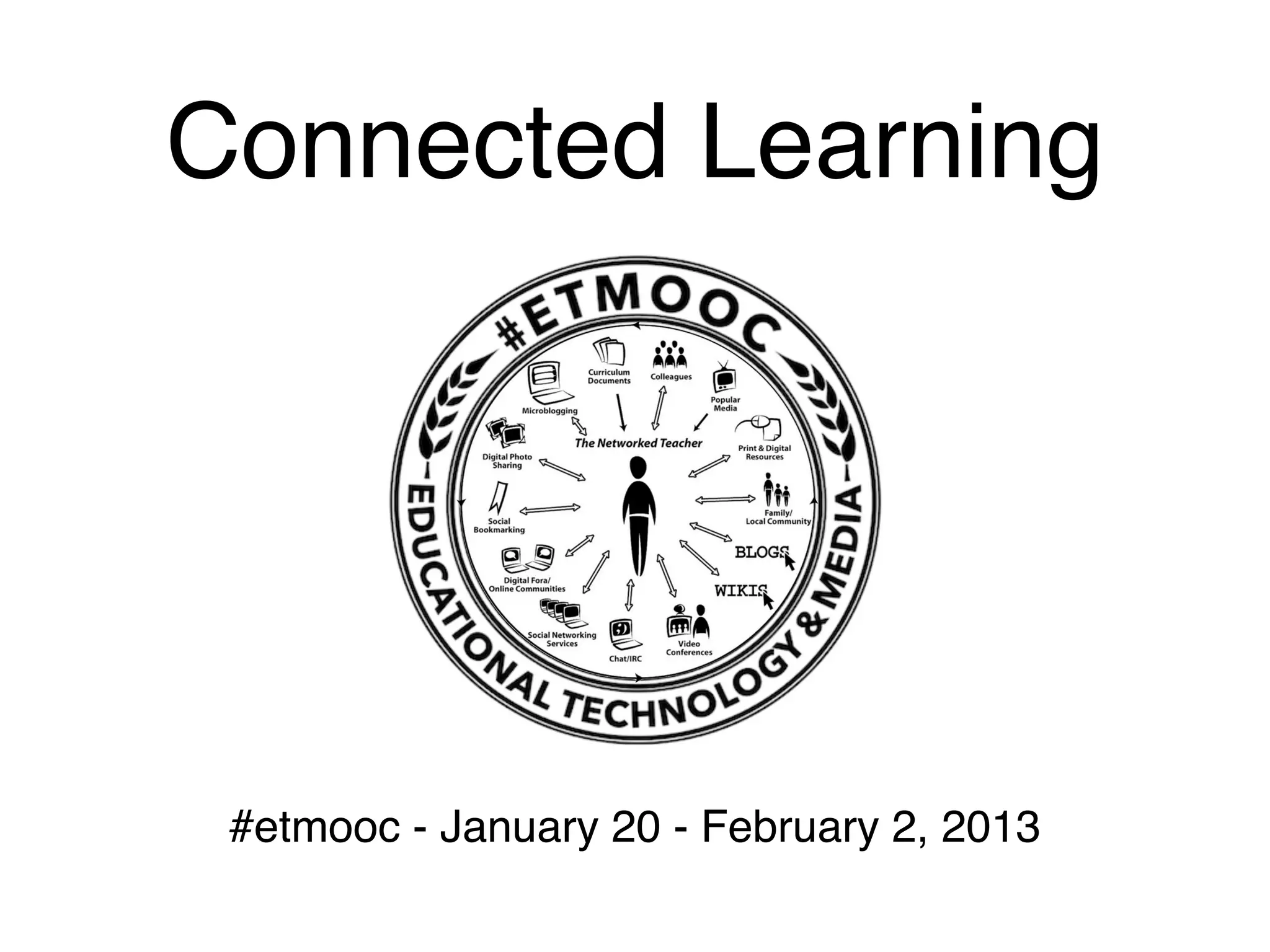
Connected Learning


 #etmooc - January 20 - February 2, 2013
#etmooc
introductions
memories of media past
what are your memories of
(media, information, educational) technology?
Handheld
Multi-Player
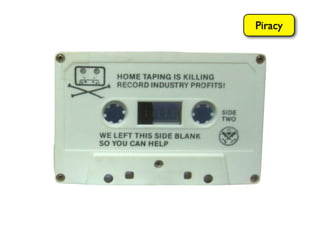
Piracy
Adaptation
Personalization
Troubleshooting
Mobile
Edtech
Edtech
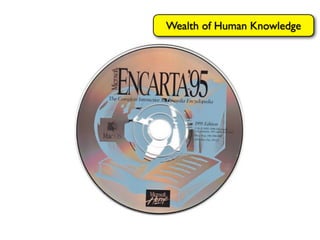
Wealth of Human Knowledge
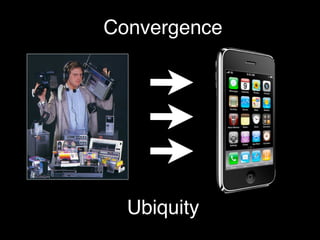
Convergence


  Ubiquity
significant shifts
     atoms <-----> bits
   scarcity <-----> abundance
consuming <-----> creating
individuals <-----> networks
    control <-----> freedom
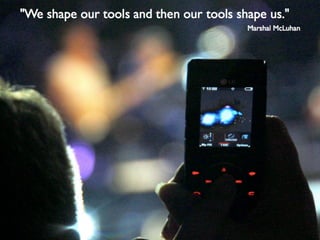
http://www.huffingtonpost.com/2008/07/24/obama-in-berlin-video-of_n_114771.html
photographed by
George Couros
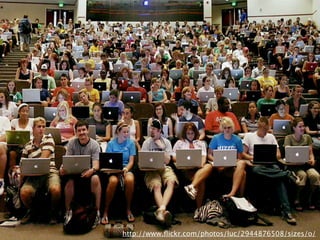
http://www.flickr.com/photos/luc/2944876508/sizes/o/
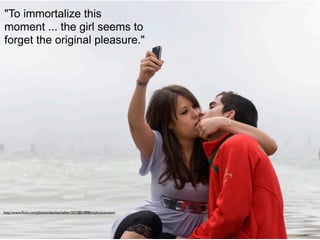
"To immortalize this
moment ... the girl seems to
forget the original pleasure."


http://www.flickr.com/photos/alainbachellier/2572801898/in/photostream/
(making sense of)
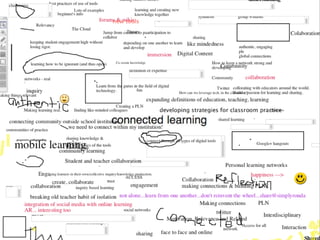
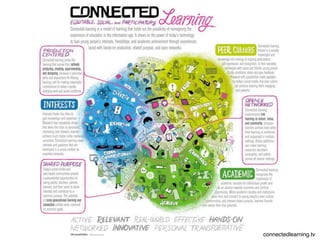
connected learning
how should we, as teachers and learners, respond
 to this highly connected, information-rich reality?
connectedlearning.tv
Free & Open Source
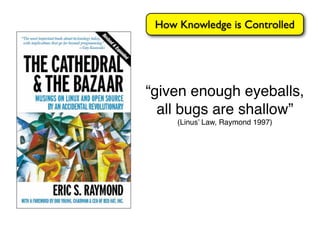
How Knowledge is Controlled


“given enough eyeballs,
  all bugs are shallow”
     (Linus’ Law, Raymond 1997)
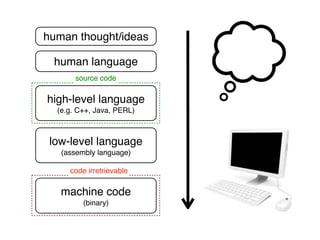
human thought/ideas

 human language
       source code

high-level language
  (e.g. C++, Java, PERL)


 low-level language
   (assembly language)

     code irretrievable

   machine code
         (binary)
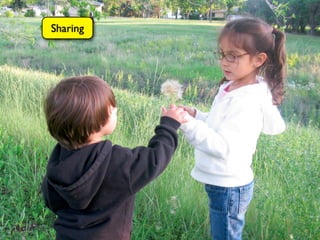
Sharing


          http://www.flickr.com/photos/dolmansaxlil/4802611949/
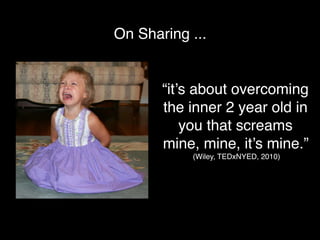
On Sharing ...


       “it’s about overcoming
       the inner 2 year old in
           you that screams
       mine, mine, it’s mine.”
           (Wiley, TEDxNYED, 2010)
Leveraging Networks


     “Open source software
communities are one of the most
     successful -- and least
 understood -- examples of high
 performance collaboration and
   community building on the
        Internet today.”
            (Kim, 2003)
Networked Affordances
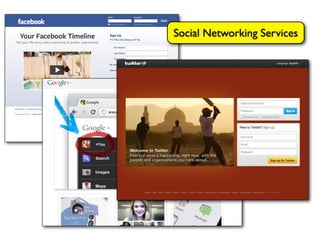
Social Networking Services
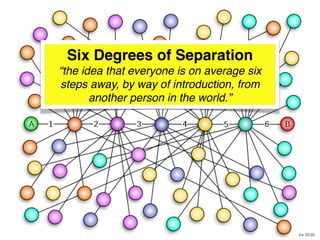
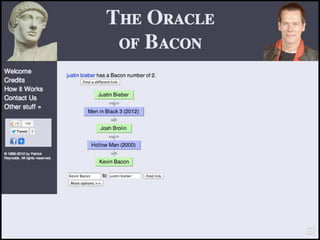
Six Degrees of Separation
“the idea that everyone is on average six
steps away, by way of introduction, from
       another person in the world.”
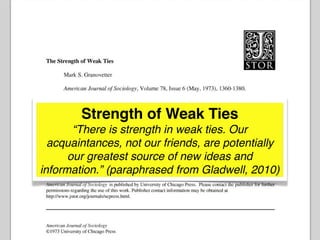
Strength of Weak Ties
       “There is strength in weak ties. Our
  acquaintances, not our friends, are potentially
      our greatest source of new ideas and
information.” (paraphrased from Gladwell, 2010)
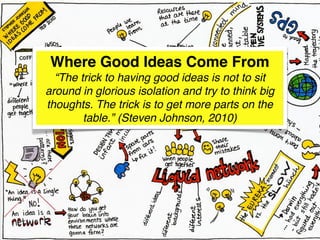
Where Good Ideas Come From
  “The trick to having good ideas is not to sit
around in glorious isolation and try to think big
thoughts. The trick is to get more parts on the
        table.” (Steven Johnson, 2010)
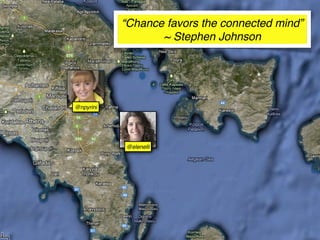
“Chance favors the connected mind”
                  ~ Stephen Johnson


@npyrini


           @elenelli
networks
  1. as mechanisms: enable communication &
collaboration in ways that were once impossible.

  2. for inspiration: connect us to new ideas &
 expand our thinking & potential for innovation.

       * ‘us’ meaning those who are increasingly literate
Leveraging Networks
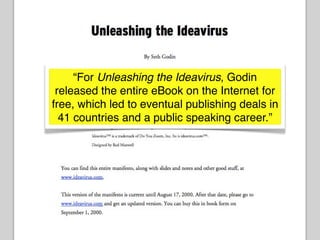
“For Unleashing the Ideavirus, Godin
 released the entire eBook on the Internet for
free, which led to eventual publishing deals in
  41 countries and a public speaking career.”
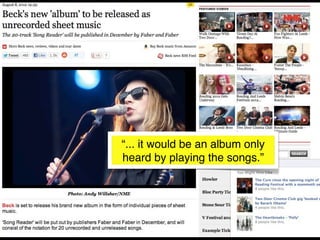
“... it would be an album only
heard by playing the songs.”
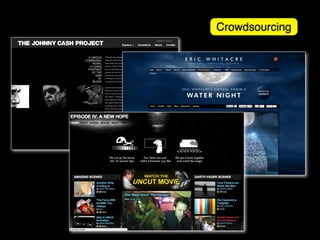
Crowdsourcing
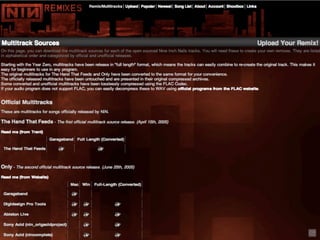
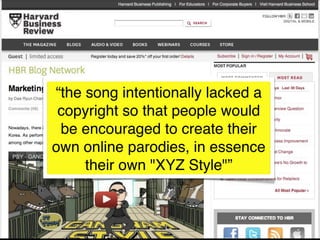
“the song intentionally lacked a
 copyright so that people would
 be encouraged to create their
own online parodies, in essence
     their own "XYZ Style"”
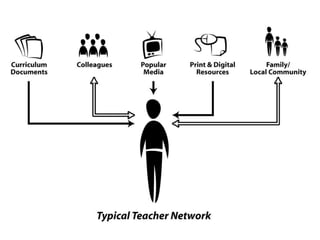
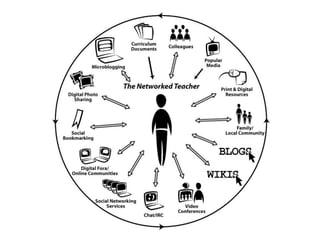
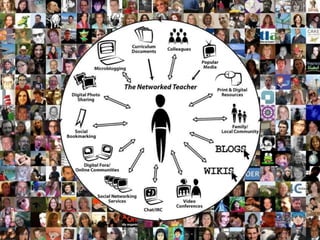
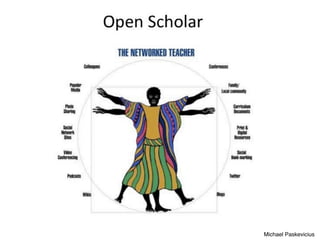
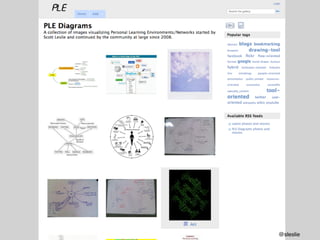
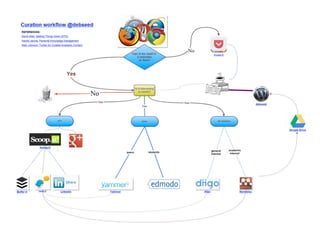
PLNs/PLEs
what is a PLN?
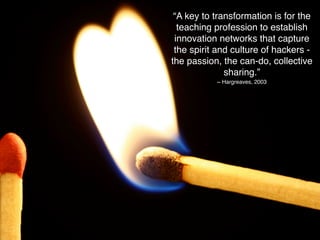
“A key to transformation is for the
  teaching profession to establish
 innovation networks that capture
 the spirit and culture of hackers -
the passion, the can-do, collective
              sharing.”
           ~ Hargreaves, 2003
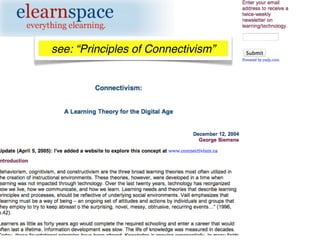
see: “Principles of Connectivism”
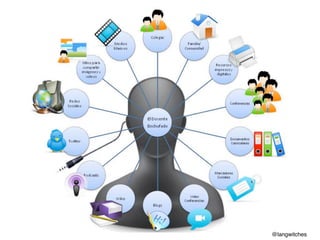
@langwitches
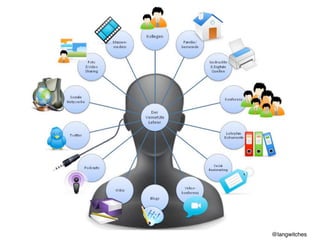
@langwitches
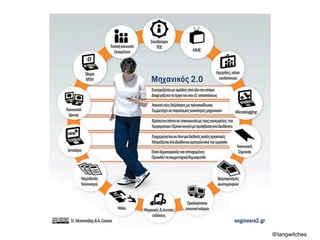
@langwitches
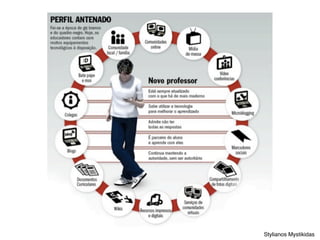
Stylianos Mystikidas
Michael Paskevicius
@sleslie
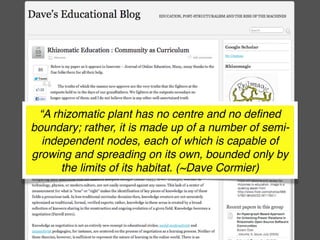
“A rhizomatic plant has no centre and no defined
boundary; rather, it is made up of a number of semi-
  independent nodes, each of which is capable of
growing and spreading on its own, bounded only by
      the limits of its habitat. (~Dave Cormier)
social learning
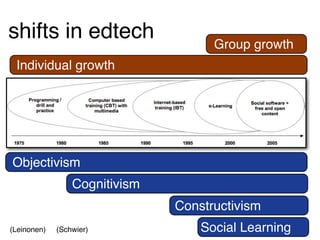
shifts in edtech                     Group growth
 Individual growth


Objectivism
                 Cognitivism
                               Constructivism
(Leinonen)   (Schwier)             Social Learning
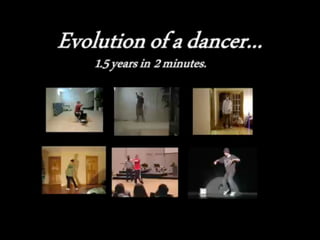
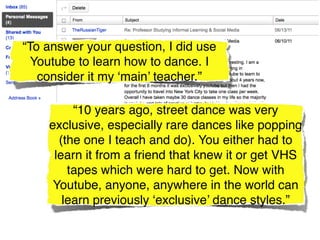
“To answer your question, I did use
  Youtube to learn how to dance. I
   consider it my ‘main’ teacher.”

         “10 years ago, street dance was very
    exclusive, especially rare dances like popping
      (the one I teach and do). You either had to
     learn it from a friend that knew it or get VHS
        tapes which were hard to get. Now with
     Youtube, anyone, anywhere in the world can
       learn previously ‘exclusive’ dance styles.”
slide by Dean Shareski
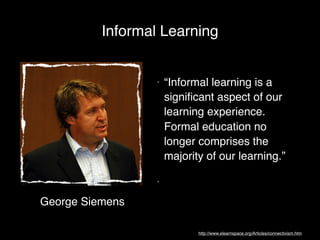
Informal Learning


                 •   “Informal learning is a
                     significant aspect of our
                     learning experience.
                     Formal education no
                     longer comprises the
                     majority of our learning.”

                 •

George Siemens

                            http://www.elearnspace.org/Articles/connectivism.htm
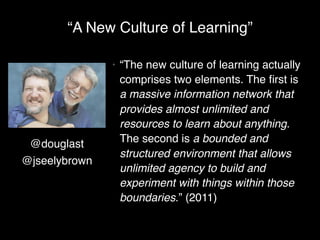
“A New Culture of Learning”

               •   “The new culture of learning actually
                   comprises two elements. The first is
                   a massive information network that
                   provides almost unlimited and
                   resources to learn about anything.
 @douglast         The second is a bounded and
                   structured environment that allows
@jseelybrown
                   unlimited agency to build and
                   experiment with things within those
                   boundaries.” (2011)
slide by Dean Shareski
concluding thoughts
(Joichi Ito)
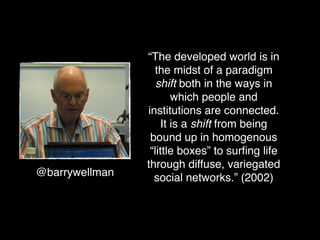
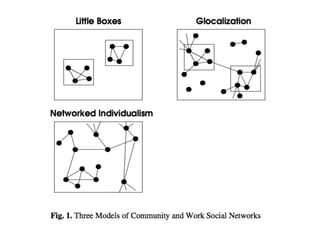
“The developed world is in
                  the midst of a paradigm
                   shift both in the ways in
                        which people and
                institutions are connected.
                     It is a shift from being
                 bound up in homogenous
                 “little boxes” to surfing life
                through diffuse, variegated
@barrywellman     social networks.” (2002)
blog fodder
Thinking Points
•What does my PLE/PLN look like? How can I share it?
•How important is connected learning? Why?
•Is it possible for our classrooms and institutions to support
this kind of learning? If so, how?

•What skills and literacies are necessary for connected
learning? How do we develop these?

•What are limits of openness in regards to privacy &
vulnerability? Are we creating or worsening a digital divide?

•How do we expand this conversation?
•Your questions?
join me in the
  the first ever
MOOC-enabled
    lip dub?
song nominations?
process
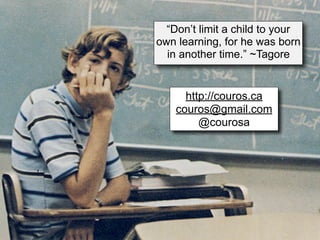
“Don’t limit a child to your
own learning, for he was born
  in another time.” ~Tagore


      http://couros.ca
    couros@gmail.com
         @courosa

#Etmooc connected learning