Literacy in  the Web 2.0 World (New Literacy) Daniel Churchill Background image source: Flickr by  Noah Sussman This work is licensed under Creative Commons Attribution-No Derivative Works 3.0 Hong Kong License
Welcome! Dr.  Daniel Churchill Room 116, Runme Shaw Building The University of Hong Kong Pokfulam Road, Hong Kong Email:  [email_address] Web:  http://www.learnactivity.com   Tel: +852 28591141
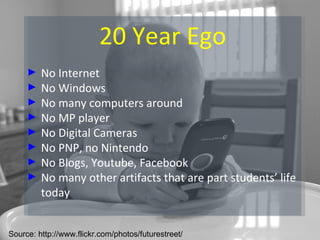
20 Year Ego No Internet No Windows No many computers around No MP player No Digital Cameras No PNP, no Nintendo No Blogs, Youtube, Facebook No many other artifacts that are part students’ life today Source: http://www.flickr.com/photos/futurestreet/
Central Thesis Emerging technologies create new possibilities, practices and demands These challenge traditional conception of ‘a literate person’ while making outdated what is traditionally taught in schools ‘Literacy’ as in the ‘new literacy’ is a metaphor for essential abilities required today to shape and communicate meanings, develop oneself, and participate in a society.
 
Other Emerging Literacies? Health Literacy Economic Literacy Multicultural Literacy Environmental Literacy Human Conditions Literacy
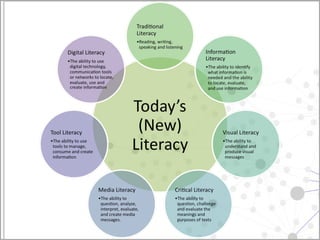
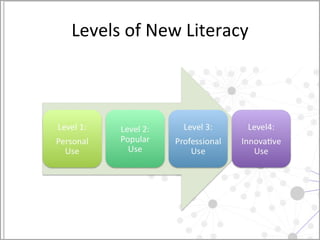
Levels of New Literacy
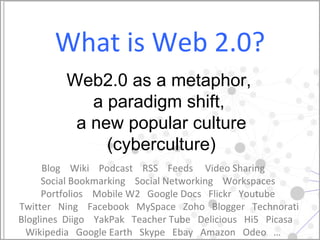
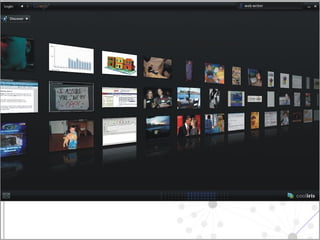
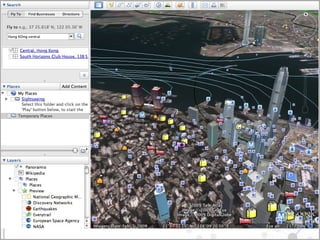
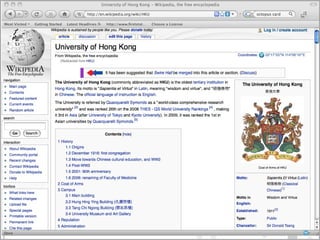
What is Web 2.0? Blog  Wiki  Podcast  RSS  Feeds  Video Sharing  Social Bookmarking  Social Networking  Workspaces  Portfolios  Mobile W2  Google Docs  Flickr  Youtube  Twitter  Ning  Facebook  MySpace  Zoho  Blogger  Technorati Bloglines  Diigo  YakPak  Teacher Tube  Delicious  Hi5  Picasa  Wikipedia  Google Earth  Skype  Ebay  Amazon  Odeo  …  Web2.0 as a metaphor,  a paradigm shift,  a new popular culture (cyberculture)
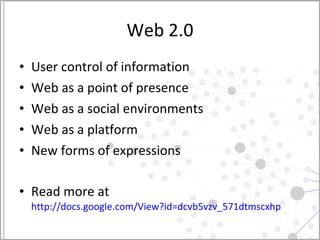
Web 2.0 User control of information Web as a point of presence Web as a social environments Web as a platform New forms of expressions Read more at  http://docs.google.com/View?id=dcvb5vzv_571dtmscxhp
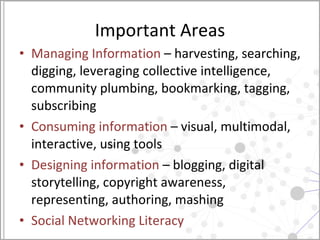
Important Areas Managing Information  – harvesting, searching, digging, leveraging collective intelligence, community plumbing, bookmarking, tagging, subscribing Consuming information  – visual, multimodal, interactive, using tools Designing information  – blogging, digital storytelling, copyright awareness, representing, authoring, mashing Social Networking Literacy
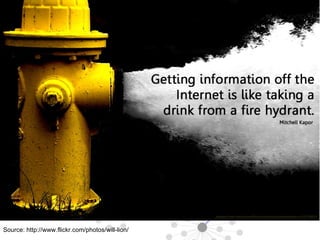
Source: http://www.flickr.com/photos/will-lion/
Growth of Information Google trillionth addresses http://www.nytimes.com/2009/02/23/technology/internet/23search.html?_r=2   Millions of:  Your tube videos Blog posts  Wikipedia articles Flickr Images, Bookmarks, Slides, Voicethreads Other stuff (podcasts, mindmaps, cartoons, items for sale)  Over 1b Internet users (300m in China, 170m mobile internet users) http://www.nytimes.com/2009/01/15/world/asia/15beijing.html?_r=3&ref=technology


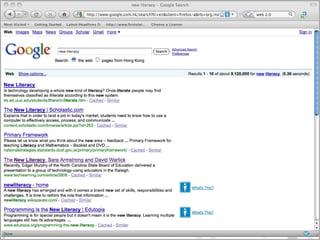
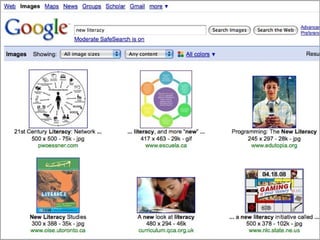
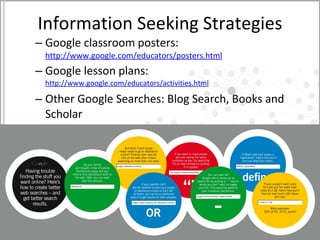
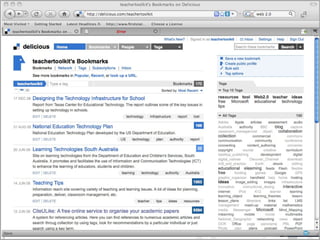
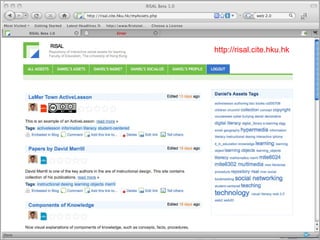
Information Seeking Strategies Google classroom posters: http://www.google.com/educators/posters.html   Google lesson plans:  http://www.google.com/educators/activities.html Other Google Searches:  Blog Search, Books and Scholar


http://risal.cite.hku.hk
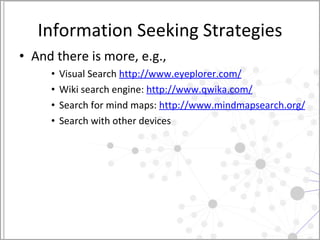
Information Seeking Strategies And there is more, e.g., Visual Search  http://www.eyeplorer.com/   Wiki search engine:  http://www.qwika.com/   Search for mind maps:  http://www.mindmapsearch.org/ Search with other devices
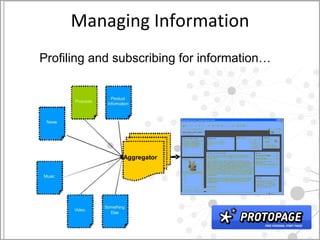
Managing Information Profiling and subscribing for information…
Multimodal Information Traditional literacy focuses on R-W-S-L (Reading, Writing, Speaking and Listening) New literacy expands this to include Viewing and Representing through ‘multimodal text’
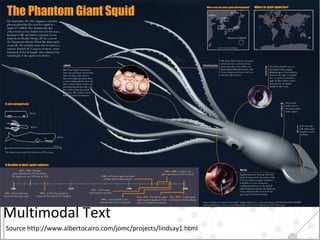
Multimodal Text Source http://www.albertocairo.com/jomc/projects/lindsay1.html
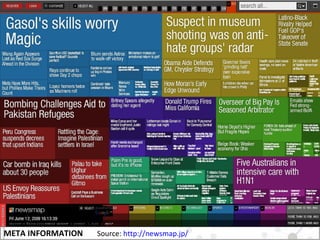
META INFORMATION  Source:  http://newsmap.jp/
 
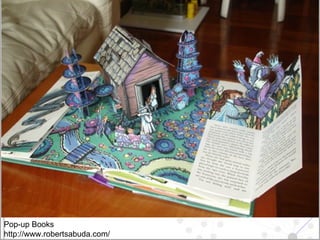
Pop-up Books  http://www.robertsabuda.com/


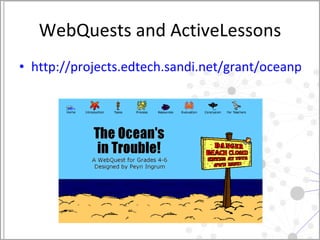
WebQuests and ActiveLessons http://projects.edtech.sandi.net/grant/oceanpollution/
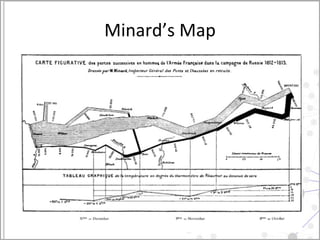
Minard’s Map
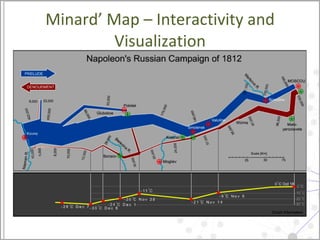
Minard’ Map – Interactivity and Visualization
Interactivity Contemporary technology brings visualization to much higher level by enabling interactivity In addition, through technology it is possible to create dynamic and animated displays and to add other modalities such as audio.  Also, meta-information extends meanings
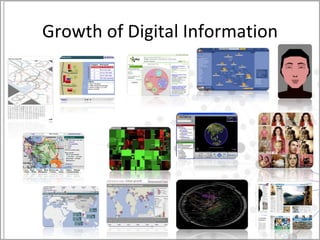
Growth of Digital Information
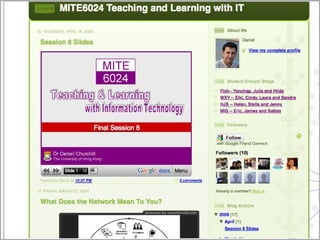
Creating Digital Content Blogs (e.g.,  Blogger ) Wikies (e.g.,  Wikispaces ) Web-as-a-platform applications (e.g.,  GoogleDocs ) Podcasting (e.g.,  Gcast ) Digital Storytelling (e.g.,  Voicethread ) Mashing -- Mixing and re-mixing existing resources and media to create new resources
 
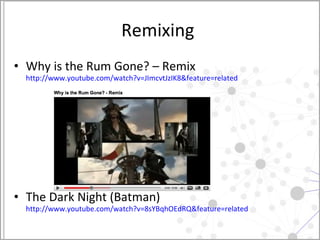
Remixing  Why is the Rum Gone? – Remix http://www.youtube.com/watch?v=JImcvtJzIK8&feature=related   The Dark Night (Batman)  http://www.youtube.com/watch?v=8sYBqhOEdRQ&feature=related
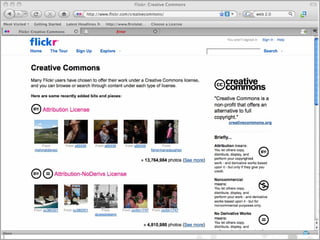
Copyright in Digital Age Traditional copyright? Why is copyright important in the digital age? Creative Commons
 
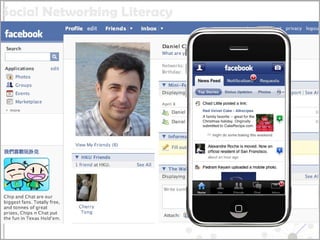
Social Networking Literacy
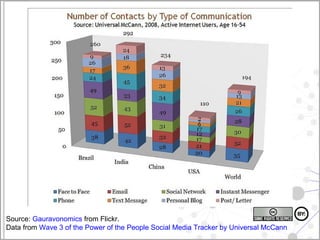
Source:  Gauravonomics  from Flickr.  Data from  Wave 3 of the Power of the People Social Media Tracker by Universal McCann
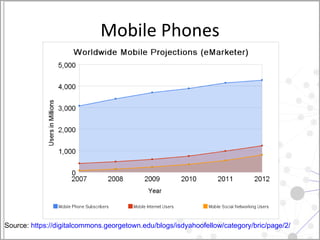
Mobile Phones Source:  https://digitalcommons.georgetown.edu/blogs/isdyahoofellow/category/bric/page/2/
Bullying Name-calling, spreading rumors, excluding people and turning someone’s friends against them, abusive messages, racist comments, gender and sexual orientation comments (e.g., calling someone a homosexual), etc… Last year 69% of young people said they'd been bullied… but In a survey 83% of teachers said they hadn't seen bullying in the last 12 months Source:  National Bullying Survey 2006
Example Thirteen-year-old suffered from cyber bullying for six months. She said:  "They were making me feel alone, like I had nobody, making me feel worthless. They dedicated whole web pages about how much they hated me and a couple of hate mail sites… I even thought about taking my own life because I thought I had nothing to live for.” Source BBC News:  http://news.bbc.co.uk/newsbeat/hi/health/newsid_7921000/7921500.stm
Let’s check these… You newer know who you are chatting to: http://www.youtube.com/watch?v=xZHq4CQekTY   Also check Megan Meier Story  http://www.youtube.com/watch?v=cw2FG-Fwpek&feature=related
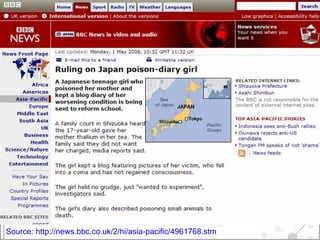
Source: http://news.bbc.co.uk/2/hi/asia-pacific/4961768.stm
Social Networking Literacy Ability to interact with other is cyberspace in specific ways that are ethical, beneficial to other and beneficial to self.  Developing strategic alliances and engaging in uses of collaborative tools  Awareness of dangerous as well as responsibilities, knowledge of socially acceptable behavior in cyberspace Understanding privacy issues
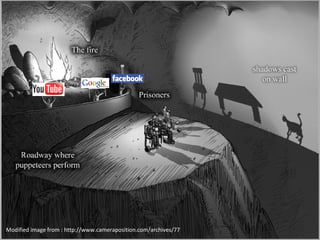
Modified image from : http://www.cameraposition.com/archives/77
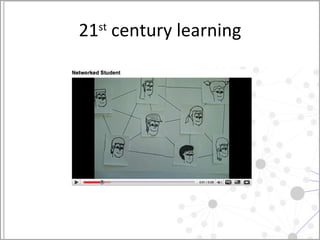
21 st  century learning
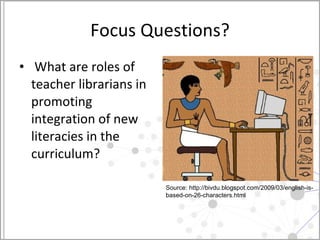
Focus Questions? What are roles of teacher librarians in promoting integration of new literacies in the curriculum? Source: http://bivdu.blogspot.com/2009/03/english-is-based-on-26-characters.html

New Literacy in the Web 2.0 World

  • 1.
      Literacy in the Web 2.0 World (New Literacy) Daniel Churchill Background image source: Flickr by Noah Sussman This work is licensed under Creative Commons Attribution-No Derivative Works 3.0 Hong Kong License
  • 2.
    Welcome! Dr. Daniel Churchill Room 116, Runme Shaw Building The University of Hong Kong Pokfulam Road, Hong Kong Email: [email_address] Web: http://www.learnactivity.com Tel: +852 28591141
  • 3.
    20 Year EgoNo Internet No Windows No many computers around No MP player No Digital Cameras No PNP, no Nintendo No Blogs, Youtube, Facebook No many other artifacts that are part students’ life today Source: http://www.flickr.com/photos/futurestreet/
  • 4.
    Central Thesis Emergingtechnologies create new possibilities, practices and demands These challenge traditional conception of ‘a literate person’ while making outdated what is traditionally taught in schools ‘Literacy’ as in the ‘new literacy’ is a metaphor for essential abilities required today to shape and communicate meanings, develop oneself, and participate in a society.
  • 5.
  • 6.
    Other Emerging Literacies?Health Literacy Economic Literacy Multicultural Literacy Environmental Literacy Human Conditions Literacy
  • 7.
    Levels of NewLiteracy
  • 8.
    What is Web2.0? Blog Wiki Podcast RSS Feeds Video Sharing Social Bookmarking Social Networking Workspaces Portfolios Mobile W2 Google Docs Flickr Youtube Twitter Ning Facebook MySpace Zoho Blogger Technorati Bloglines Diigo YakPak Teacher Tube Delicious Hi5 Picasa Wikipedia Google Earth Skype Ebay Amazon Odeo … Web2.0 as a metaphor, a paradigm shift, a new popular culture (cyberculture)
  • 9.
    Web 2.0 Usercontrol of information Web as a point of presence Web as a social environments Web as a platform New forms of expressions Read more at http://docs.google.com/View?id=dcvb5vzv_571dtmscxhp
  • 10.
    Important Areas ManagingInformation – harvesting, searching, digging, leveraging collective intelligence, community plumbing, bookmarking, tagging, subscribing Consuming information – visual, multimodal, interactive, using tools Designing information – blogging, digital storytelling, copyright awareness, representing, authoring, mashing Social Networking Literacy
  • 11.
  • 12.
    Growth of InformationGoogle trillionth addresses http://www.nytimes.com/2009/02/23/technology/internet/23search.html?_r=2 Millions of: Your tube videos Blog posts Wikipedia articles Flickr Images, Bookmarks, Slides, Voicethreads Other stuff (podcasts, mindmaps, cartoons, items for sale) Over 1b Internet users (300m in China, 170m mobile internet users) http://www.nytimes.com/2009/01/15/world/asia/15beijing.html?_r=3&ref=technology
  • 13.
  • 14.
  • 15.
  • 16.
    Information Seeking StrategiesGoogle classroom posters: http://www.google.com/educators/posters.html Google lesson plans: http://www.google.com/educators/activities.html Other Google Searches: Blog Search, Books and Scholar
  • 17.
  • 18.
  • 19.
  • 20.
  • 21.
    Information Seeking StrategiesAnd there is more, e.g., Visual Search http://www.eyeplorer.com/ Wiki search engine: http://www.qwika.com/ Search for mind maps: http://www.mindmapsearch.org/ Search with other devices
  • 22.
    Managing Information Profilingand subscribing for information…
  • 23.
    Multimodal Information Traditionalliteracy focuses on R-W-S-L (Reading, Writing, Speaking and Listening) New literacy expands this to include Viewing and Representing through ‘multimodal text’
  • 24.
    Multimodal Text Sourcehttp://www.albertocairo.com/jomc/projects/lindsay1.html
  • 25.
    META INFORMATION Source: http://newsmap.jp/
  • 26.
  • 27.
    Pop-up Books http://www.robertsabuda.com/
  • 28.
  • 29.
  • 30.
  • 31.
  • 32.
    WebQuests and ActiveLessonshttp://projects.edtech.sandi.net/grant/oceanpollution/
  • 33.
  • 34.
    Minard’ Map –Interactivity and Visualization
  • 35.
    Interactivity Contemporary technologybrings visualization to much higher level by enabling interactivity In addition, through technology it is possible to create dynamic and animated displays and to add other modalities such as audio. Also, meta-information extends meanings
  • 36.
    Growth of DigitalInformation
  • 37.
    Creating Digital ContentBlogs (e.g., Blogger ) Wikies (e.g., Wikispaces ) Web-as-a-platform applications (e.g., GoogleDocs ) Podcasting (e.g., Gcast ) Digital Storytelling (e.g., Voicethread ) Mashing -- Mixing and re-mixing existing resources and media to create new resources
  • 38.
  • 39.
    Remixing Whyis the Rum Gone? – Remix http://www.youtube.com/watch?v=JImcvtJzIK8&feature=related The Dark Night (Batman) http://www.youtube.com/watch?v=8sYBqhOEdRQ&feature=related
  • 40.
    Copyright in DigitalAge Traditional copyright? Why is copyright important in the digital age? Creative Commons
  • 41.
  • 42.
  • 43.
    Source: Gauravonomics from Flickr. Data from Wave 3 of the Power of the People Social Media Tracker by Universal McCann
  • 44.
    Mobile Phones Source: https://digitalcommons.georgetown.edu/blogs/isdyahoofellow/category/bric/page/2/
  • 45.
    Bullying Name-calling, spreadingrumors, excluding people and turning someone’s friends against them, abusive messages, racist comments, gender and sexual orientation comments (e.g., calling someone a homosexual), etc… Last year 69% of young people said they'd been bullied… but In a survey 83% of teachers said they hadn't seen bullying in the last 12 months Source: National Bullying Survey 2006
  • 46.
    Example Thirteen-year-old sufferedfrom cyber bullying for six months. She said: "They were making me feel alone, like I had nobody, making me feel worthless. They dedicated whole web pages about how much they hated me and a couple of hate mail sites… I even thought about taking my own life because I thought I had nothing to live for.” Source BBC News: http://news.bbc.co.uk/newsbeat/hi/health/newsid_7921000/7921500.stm
  • 47.
    Let’s check these…You newer know who you are chatting to: http://www.youtube.com/watch?v=xZHq4CQekTY Also check Megan Meier Story http://www.youtube.com/watch?v=cw2FG-Fwpek&feature=related
  • 48.
  • 49.
    Social Networking LiteracyAbility to interact with other is cyberspace in specific ways that are ethical, beneficial to other and beneficial to self. Developing strategic alliances and engaging in uses of collaborative tools Awareness of dangerous as well as responsibilities, knowledge of socially acceptable behavior in cyberspace Understanding privacy issues
  • 50.
    Modified image from: http://www.cameraposition.com/archives/77
  • 51.
    21 st century learning
  • 52.
    Focus Questions? Whatare roles of teacher librarians in promoting integration of new literacies in the curriculum? Source: http://bivdu.blogspot.com/2009/03/english-is-based-on-26-characters.html