
Teachers have to keep learning to be effective teachers Use your creative input Technology is not a magic bullet Don’t be too serious Technological determinism and the wow factor Learning is a social activity Choose one thing you may  able to use (for your bag of tricks) Take your classroom to the World or bring the world to your classroom   Technology does not of itself promote  Language learning Continual Partial Attention


Language learning in a connected world   Michael Coghlan IATEFL  Conference (Chennai) August 4, 2007 This presentation on the web at  http:// www.slideshare.net/michaelc/chennai
 
 
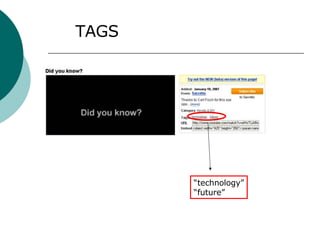
“ technology” “ future” TAGS
 
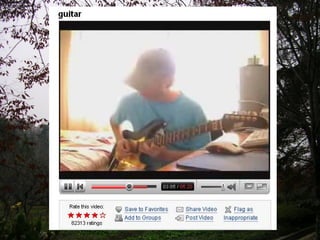
A GLOBAL AUDIENCE? YouTube -  http:// www.youtube.com/watch?v =QjA5faZF1A8 Performance by a 13 yr old Korean boy July 23rd: 24,510,118   million views; 90006   comments That’s more than the populations of  Israel 5.7m Denmark 5.3m Finland 5.1m New Zealand 3.6m Ireland 3.6m Holland 16.4m Australia 20.4m
DIGITAL STORY PLAYED AT THIS  POINT AVAILABLE AT http:// www.youtube.com/watch?v =Pue4FtOb3HM
WHAT’S ALL THE FUSS ABOUT? Is it real? Who are these 24.5 million people? Copyright implications? – I can reuse the content for my own purposes Who is exercising editorial control? Disintermediation  – the decline of the gatekeepers of content Should students have access to sites like this?  (see ‘ YouTube  – a Class Act’) How do students like this feel at school? Should we be encouraging our students  to create content Publish to these kinds of sites Empowerment and realisation of identity through personal publishing to social networking sites MIT; Jason and TV shows…..
IN A CONNECTED WORLD: Daily contact with the planet  In the supermarket…..Australian made products are made offshore My neighbours may not be my closest companions Overseas call centres
 
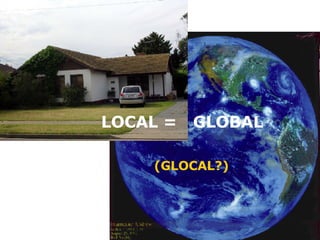
LOCAL    GLOBAL LOCAL = (GLOCAL?)
Implications for the Classroom? The Local, Unconnected Pre-Global World all dialogue was between teacher and students with some communication between students  (but who was really listening?)  Internet enter Internet tools: writing/speaking for an audience other than just your teacher ie authentic contexts for language learning The Global, Connected World Personal publishing tools Teachers and students can now reach a global audience Moot point : does everyone find this idea appealing?
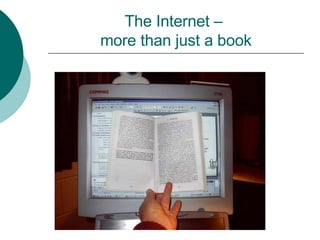
The Internet –  more than just a book
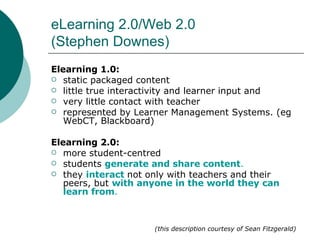
eLearning 2.0/Web 2.0 (Stephen Downes) Elearning 1.0: static packaged content  little true interactivity and learner input and  very little contact with teacher represented by Learner Management Systems. (eg WebCT, Blackboard)  Elearning 2.0: more student-centred students  generate and share content .  they  interact   not only with teachers and their peers, but  with anyone in the world they can learn from . (this description courtesy of Sean Fitzgerald)
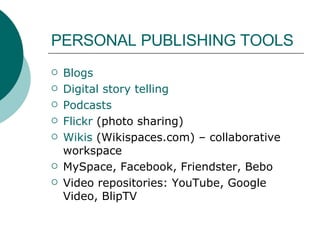
PERSONAL PUBLISHING TOOLS Blogs Digital story telling Podcasts Flickr  (photo sharing) Wikis   (Wikispaces.com) – collaborative workspace MySpace, Facebook, Friendster, Bebo Video repositories: YouTube, Google Video, BlipTV
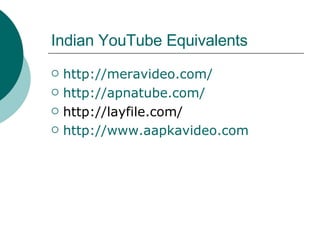
Indian YouTube Equivalents http:// meravideo.com / http:// apnatube.com / http://layfile.com/ http:// www.aapkavideo.com
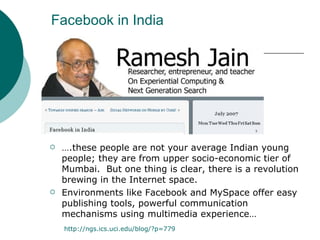
Facebook in India … .these people are not your average Indian young people; they are from upper socio-economic tier of Mumbai.  But one thing is clear, there is a revolution brewing in the Internet space.   Environments like Facebook and MySpace offer easy publishing tools, powerful communication mechanisms using multimedia experience… http:// ngs.ics.uci.edu/blog/?p =779
CREATING ONLINE PRESENCE  Why bother?
Why might teachers create an online presence? You will get wider recognition Wider network of professional and personal contacts Greater variety of options for learning activities Place to store and record resources
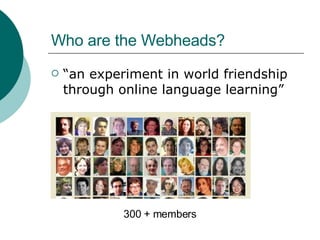
Who are the Webheads? “an experiment in world friendship through online language learning” 300 + members
Where are the Webheads? in approximately 50 countries To join the Webhead community send an email to [email_address]
 
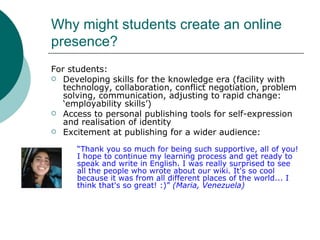
Why might students create an online presence? For students: Developing skills for the knowledge era (facility with technology, collaboration, conflict negotiation, problem solving, communication, adjusting to rapid change: ‘employability skills’) Access to personal publishing tools for self-expression and realisation of identity Excitement at publishing for a wider audience: “ Thank you so much for being such supportive, all of you! I hope to continue my learning process and get ready to speak and write in English. I was really surprised to see all the people who wrote about our wiki. It's so cool because it was from all different places of the world... I think that's so great! :)”  (Maria, Venezuela)
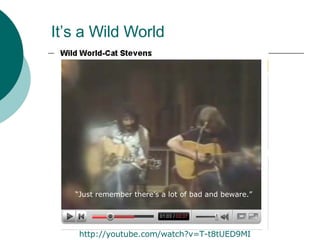
It’s a Wild World http:// youtube.com/watch?v =T-t8tUED9MI “ Just remember there’s a lot of bad and beware.”
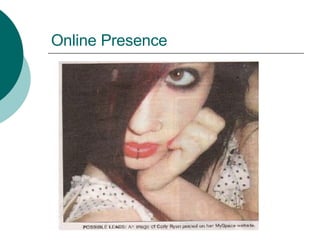
Online Presence
Are we sociologically ready? What are ethical responsibilities as educators?
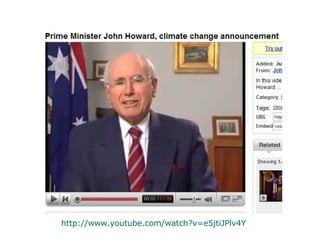
http:// www.youtube.com/watch?v =e5jtiJPlv4Y
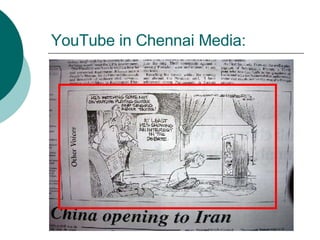
YouTube in Chennai Media:
ONLINE PRESENCE  “ I blog therefore I am.” Weblog search engine Technorati:  8,000 -17,000 new blogs created every single day.  a new weblog is created somewhere in the world every 5.8 seconds .  On average, approx 3 blogs are updated every second. http://www.theregister.co.uk/2004/07/13/8000_bloggers_per_day/ (13/4/06)
From a student of Konrad Glogowski: “ Hello Mr. Glogowski It’s Phil, just in case you haven’t guessed already. I’d just like to thank you for a great year of blogging, and to wish you luck in the years ahead. You really managed to make a few of us into writers. I think writing/blogging will be something I’ll carry with me my whole life.” (http://www.teachandlearn.ca/blog/)
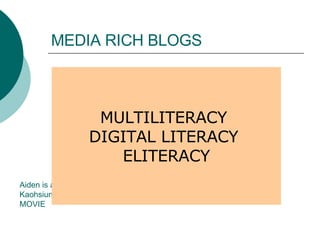
MEDIA RICH BLOGS http://english-ad.blogspot.com /  by students of Aiden Yeh Aiden is an EFL Lecturer, Wenzao Ursuline College of Languages Kaohsiung, Taiwan MOVIE MULTILITERACY  DIGITAL LITERACY  ELITERACY
ORAL PRESENTATIONS FOR A GLOBAL AUDIENCE From Buthaina al Othman (Kuwait) http://alothman-b.tripod.com/present_162.htm
CONNECTIVISM:  A Learning Theory for the Digital Age   (George Siemens, Red River Community College, Canada) Principles of Connectivism: Nurturing and maintaining connections  is needed to facilitate continual learning.  Currency  (accurate, up-to-date knowledge) is the intent of all connectivist learning activities.  Choosing what to learn and the meaning of incoming information is seen through the lens of a shifting reality.  While there is a right answer now, it may be wrong tomorrow  due to alterations in the information climate affecting the decision.
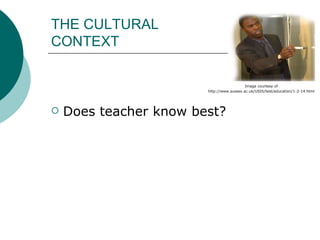
THE CULTURAL  CONTEXT Does teacher know best? Image courtesy of http://www.sussex.ac.uk/USIS/test/education/1-2-14.html
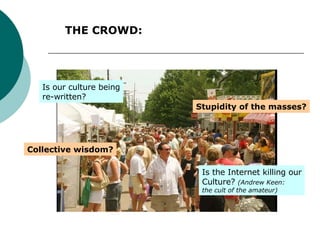
THE CROWD: Collective wisdom? Stupidity of the masses? Is our culture being re-written? Is the Internet killing our Culture?  (Andrew Keen: the cult of the amateur)
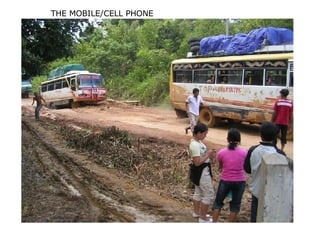
THE MOBILE/CELL PHONE
 
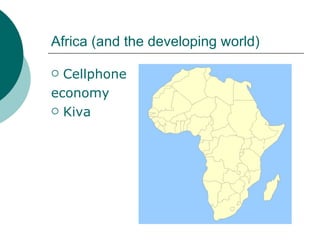
Africa (and the developing world) Cellphone 	economy Kiva
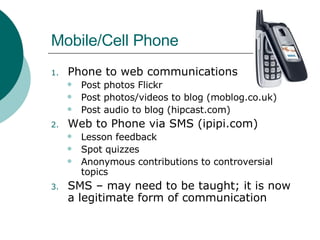
Mobile/Cell Phone Phone to web communications Post photos Flickr Post photos/videos to blog (moblog.co.uk) Post audio to blog (hipcast.com) Web to Phone via SMS (ipipi.com) Lesson feedback Spot quizzes Anonymous contributions to controversial topics SMS – may need to be taught; it is now a legitimate form of communication
Check: http://flickr.com/mikecogh  (to see photos uploaded from cell phone) http://mikecogh.blogspot.com  (to hear audio posted from cell phone)
http://flickr.com/photos/32912387@N00/171506548/
SLOW LEARNING "It is going to become very fashionable at some point to be disconnected," Silicon Valley futurist Paul Saffo predicts. "There are going to be people who wear their disconnectivity like a badge.“ ( http://www.usatoday.com/printedition/news/20070111/1a_tech-noxx.art.htm )
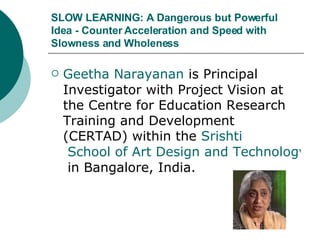
SLOW LEARNING: A Dangerous but Powerful Idea - Counter Acceleration and Speed with Slowness and Wholeness Geetha  Narayanan  is Principal Investigator with Project Vision at the Centre for Education Research Training and Development (CERTAD) within the  Srishti  School of Art Design and Technology  in Bangalore, India.
Geetha  Narayanan  -  Slowness as a pedagogy consciously embrace the core value of slowness  – both as way of being and as a way of learning culture of immediacy  values fast knowledge which in turn runs counter to the development of both the self and the mind. The  thoughtless and widespread use of technology  as the universal solution to the rising need for fast knowledge is wrong and must be questioned. Often in developing countries, such as India, the term ‘digital divide’ is used to support the argument that the use of new technologies, alone, will create conditions of learning … That is not true the new digital technologies are  tools that allow for learners to develop their imaginations, to be able to play and to have fun, to be able to tell stories in different and exciting ways.  But in order to generate value they need to be integrated into new forms and structures in an invisible and contextual manner - one where  new media arts can sustain social change . Slowness promotes “wellness of being”
HOW DO YOU TRANSLATE ALL THIS INTO CLASSROOM PRACTICE?


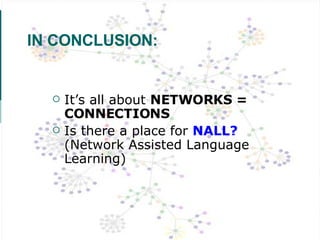
IN CONCLUSION: It’s all about  NETWORKS = CONNECTIONS Is there a place for  NALL?  (Network Assisted Language Learning)
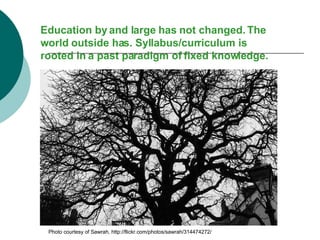
Education by and large has not changed. The world outside has. Syllabus/curriculum is rooted in a past paradigm of fixed knowledge. Photo courtesy of Sawrah, http://flickr.com/photos/sawrah/314474272/
IN CONCLUSION: a connected classroom, connected living  (Nancy White: ‘eliving’) DOES  reduce the time you have available to attend to relationships locally. And THAT is a very interesting and confronting thought…….
Resources Vance Stevens: ESL Skill Areas: Writing and the Internet http://www.geocities.com/vance_stevens/writing.htm
THANK YOU This presentation on the web at  http:// www.slideshare.net/michaelc/chennai Email:  [email_address]

Chennai

  • 1.
    Teachers have tokeep learning to be effective teachers Use your creative input Technology is not a magic bullet Don’t be too serious Technological determinism and the wow factor Learning is a social activity Choose one thing you may able to use (for your bag of tricks) Take your classroom to the World or bring the world to your classroom Technology does not of itself promote Language learning Continual Partial Attention
  • 2.
  • 3.
  • 4.
  • 5.
  • 6.
  • 7.
  • 8.
    Language learning ina connected world Michael Coghlan IATEFL Conference (Chennai) August 4, 2007 This presentation on the web at http:// www.slideshare.net/michaelc/chennai
  • 9.
  • 10.
  • 11.
    “ technology” “future” TAGS
  • 12.
  • 13.
    A GLOBAL AUDIENCE?YouTube - http:// www.youtube.com/watch?v =QjA5faZF1A8 Performance by a 13 yr old Korean boy July 23rd: 24,510,118 million views; 90006 comments That’s more than the populations of Israel 5.7m Denmark 5.3m Finland 5.1m New Zealand 3.6m Ireland 3.6m Holland 16.4m Australia 20.4m
  • 14.
    DIGITAL STORY PLAYEDAT THIS POINT AVAILABLE AT http:// www.youtube.com/watch?v =Pue4FtOb3HM
  • 15.
    WHAT’S ALL THEFUSS ABOUT? Is it real? Who are these 24.5 million people? Copyright implications? – I can reuse the content for my own purposes Who is exercising editorial control? Disintermediation – the decline of the gatekeepers of content Should students have access to sites like this? (see ‘ YouTube – a Class Act’) How do students like this feel at school? Should we be encouraging our students to create content Publish to these kinds of sites Empowerment and realisation of identity through personal publishing to social networking sites MIT; Jason and TV shows…..
  • 16.
    IN A CONNECTEDWORLD: Daily contact with the planet In the supermarket…..Australian made products are made offshore My neighbours may not be my closest companions Overseas call centres
  • 17.
  • 18.
    LOCAL GLOBAL LOCAL = (GLOCAL?)
  • 19.
    Implications for theClassroom? The Local, Unconnected Pre-Global World all dialogue was between teacher and students with some communication between students (but who was really listening?) Internet enter Internet tools: writing/speaking for an audience other than just your teacher ie authentic contexts for language learning The Global, Connected World Personal publishing tools Teachers and students can now reach a global audience Moot point : does everyone find this idea appealing?
  • 20.
    The Internet – more than just a book
  • 21.
    eLearning 2.0/Web 2.0(Stephen Downes) Elearning 1.0: static packaged content little true interactivity and learner input and very little contact with teacher represented by Learner Management Systems. (eg WebCT, Blackboard) Elearning 2.0: more student-centred students generate and share content . they interact not only with teachers and their peers, but with anyone in the world they can learn from . (this description courtesy of Sean Fitzgerald)
  • 22.
    PERSONAL PUBLISHING TOOLSBlogs Digital story telling Podcasts Flickr (photo sharing) Wikis (Wikispaces.com) – collaborative workspace MySpace, Facebook, Friendster, Bebo Video repositories: YouTube, Google Video, BlipTV
  • 23.
    Indian YouTube Equivalentshttp:// meravideo.com / http:// apnatube.com / http://layfile.com/ http:// www.aapkavideo.com
  • 24.
    Facebook in India… .these people are not your average Indian young people; they are from upper socio-economic tier of Mumbai.  But one thing is clear, there is a revolution brewing in the Internet space.  Environments like Facebook and MySpace offer easy publishing tools, powerful communication mechanisms using multimedia experience… http:// ngs.ics.uci.edu/blog/?p =779
  • 25.
  • 26.
    Why might teacherscreate an online presence? You will get wider recognition Wider network of professional and personal contacts Greater variety of options for learning activities Place to store and record resources
  • 27.
    Who are theWebheads? “an experiment in world friendship through online language learning” 300 + members
  • 28.
    Where are theWebheads? in approximately 50 countries To join the Webhead community send an email to [email_address]
  • 29.
  • 30.
    Why might studentscreate an online presence? For students: Developing skills for the knowledge era (facility with technology, collaboration, conflict negotiation, problem solving, communication, adjusting to rapid change: ‘employability skills’) Access to personal publishing tools for self-expression and realisation of identity Excitement at publishing for a wider audience: “ Thank you so much for being such supportive, all of you! I hope to continue my learning process and get ready to speak and write in English. I was really surprised to see all the people who wrote about our wiki. It's so cool because it was from all different places of the world... I think that's so great! :)” (Maria, Venezuela)
  • 31.
    It’s a WildWorld http:// youtube.com/watch?v =T-t8tUED9MI “ Just remember there’s a lot of bad and beware.”
  • 32.
  • 33.
    Are we sociologicallyready? What are ethical responsibilities as educators?
  • 34.
  • 35.
  • 36.
    ONLINE PRESENCE “ I blog therefore I am.” Weblog search engine Technorati: 8,000 -17,000 new blogs created every single day. a new weblog is created somewhere in the world every 5.8 seconds . On average, approx 3 blogs are updated every second. http://www.theregister.co.uk/2004/07/13/8000_bloggers_per_day/ (13/4/06)
  • 37.
    From a studentof Konrad Glogowski: “ Hello Mr. Glogowski It’s Phil, just in case you haven’t guessed already. I’d just like to thank you for a great year of blogging, and to wish you luck in the years ahead. You really managed to make a few of us into writers. I think writing/blogging will be something I’ll carry with me my whole life.” (http://www.teachandlearn.ca/blog/)
  • 38.
    MEDIA RICH BLOGShttp://english-ad.blogspot.com / by students of Aiden Yeh Aiden is an EFL Lecturer, Wenzao Ursuline College of Languages Kaohsiung, Taiwan MOVIE MULTILITERACY DIGITAL LITERACY ELITERACY
  • 39.
    ORAL PRESENTATIONS FORA GLOBAL AUDIENCE From Buthaina al Othman (Kuwait) http://alothman-b.tripod.com/present_162.htm
  • 40.
    CONNECTIVISM: ALearning Theory for the Digital Age (George Siemens, Red River Community College, Canada) Principles of Connectivism: Nurturing and maintaining connections is needed to facilitate continual learning. Currency (accurate, up-to-date knowledge) is the intent of all connectivist learning activities. Choosing what to learn and the meaning of incoming information is seen through the lens of a shifting reality. While there is a right answer now, it may be wrong tomorrow due to alterations in the information climate affecting the decision.
  • 41.
    THE CULTURAL CONTEXT Does teacher know best? Image courtesy of http://www.sussex.ac.uk/USIS/test/education/1-2-14.html
  • 42.
    THE CROWD: Collectivewisdom? Stupidity of the masses? Is our culture being re-written? Is the Internet killing our Culture? (Andrew Keen: the cult of the amateur)
  • 43.
  • 44.
  • 45.
    Africa (and thedeveloping world) Cellphone economy Kiva
  • 46.
    Mobile/Cell Phone Phoneto web communications Post photos Flickr Post photos/videos to blog (moblog.co.uk) Post audio to blog (hipcast.com) Web to Phone via SMS (ipipi.com) Lesson feedback Spot quizzes Anonymous contributions to controversial topics SMS – may need to be taught; it is now a legitimate form of communication
  • 47.
    Check: http://flickr.com/mikecogh (to see photos uploaded from cell phone) http://mikecogh.blogspot.com (to hear audio posted from cell phone)
  • 48.
  • 49.
    SLOW LEARNING "Itis going to become very fashionable at some point to be disconnected," Silicon Valley futurist Paul Saffo predicts. "There are going to be people who wear their disconnectivity like a badge.“ ( http://www.usatoday.com/printedition/news/20070111/1a_tech-noxx.art.htm )
  • 50.
    SLOW LEARNING: ADangerous but Powerful Idea - Counter Acceleration and Speed with Slowness and Wholeness Geetha Narayanan is Principal Investigator with Project Vision at the Centre for Education Research Training and Development (CERTAD) within the Srishti School of Art Design and Technology in Bangalore, India.
  • 51.
    Geetha Narayanan - Slowness as a pedagogy consciously embrace the core value of slowness – both as way of being and as a way of learning culture of immediacy values fast knowledge which in turn runs counter to the development of both the self and the mind. The thoughtless and widespread use of technology as the universal solution to the rising need for fast knowledge is wrong and must be questioned. Often in developing countries, such as India, the term ‘digital divide’ is used to support the argument that the use of new technologies, alone, will create conditions of learning … That is not true the new digital technologies are tools that allow for learners to develop their imaginations, to be able to play and to have fun, to be able to tell stories in different and exciting ways. But in order to generate value they need to be integrated into new forms and structures in an invisible and contextual manner - one where new media arts can sustain social change . Slowness promotes “wellness of being”
  • 52.
    HOW DO YOUTRANSLATE ALL THIS INTO CLASSROOM PRACTICE?
  • 53.
  • 54.
  • 55.
  • 56.
    IN CONCLUSION: It’sall about NETWORKS = CONNECTIONS Is there a place for NALL? (Network Assisted Language Learning)
  • 57.
    Education by andlarge has not changed. The world outside has. Syllabus/curriculum is rooted in a past paradigm of fixed knowledge. Photo courtesy of Sawrah, http://flickr.com/photos/sawrah/314474272/
  • 58.
    IN CONCLUSION: aconnected classroom, connected living (Nancy White: ‘eliving’) DOES reduce the time you have available to attend to relationships locally. And THAT is a very interesting and confronting thought…….
  • 59.
    Resources Vance Stevens:ESL Skill Areas: Writing and the Internet http://www.geocities.com/vance_stevens/writing.htm
  • 60.
    THANK YOU Thispresentation on the web at http:// www.slideshare.net/michaelc/chennai Email: [email_address]