
#DLDA


        Learning2gether
               23/12/12
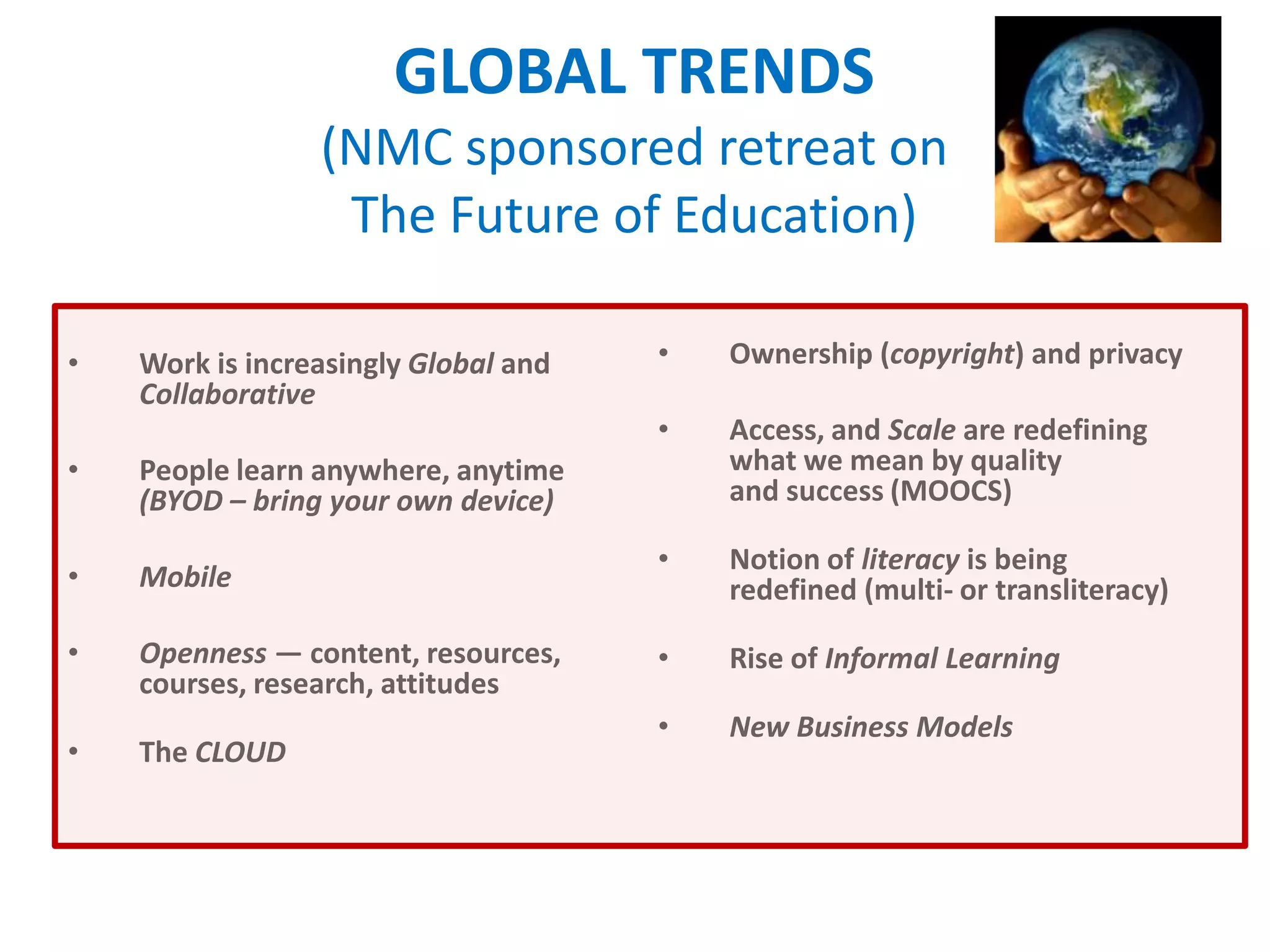
GLOBAL TRENDS
                 (NMC sponsored retreat on
                  The Future of Education)

•   Work is increasingly Global and   •   Ownership (copyright) and privacy
    Collaborative
                                      •   Access, and Scale are redefining
•   People learn anywhere, anytime        what we mean by quality
    (BYOD – bring your own device)        and success (MOOCS)

                                      •   Notion of literacy is being
•   Mobile                                redefined (multi- or transliteracy)
•   Openness — content, resources,    •   Rise of Informal Learning
    courses, research, attitudes
                                      •   New Business Models
•   The CLOUD
Employability Skills (VET sector)
•   Communication
•   Teamwork
•   Problem Solving
•   Initiative and Enterprise
•   Planning and Organising
•   Self-management
•   Learning
•   Technology
Graduate Attributes (Higher Ed)
•   Creativity
•   Communication
•   Teamwork
•   Leadership
•   Collaboration
•   Information Literate
•   Initiative
•   Problem solving
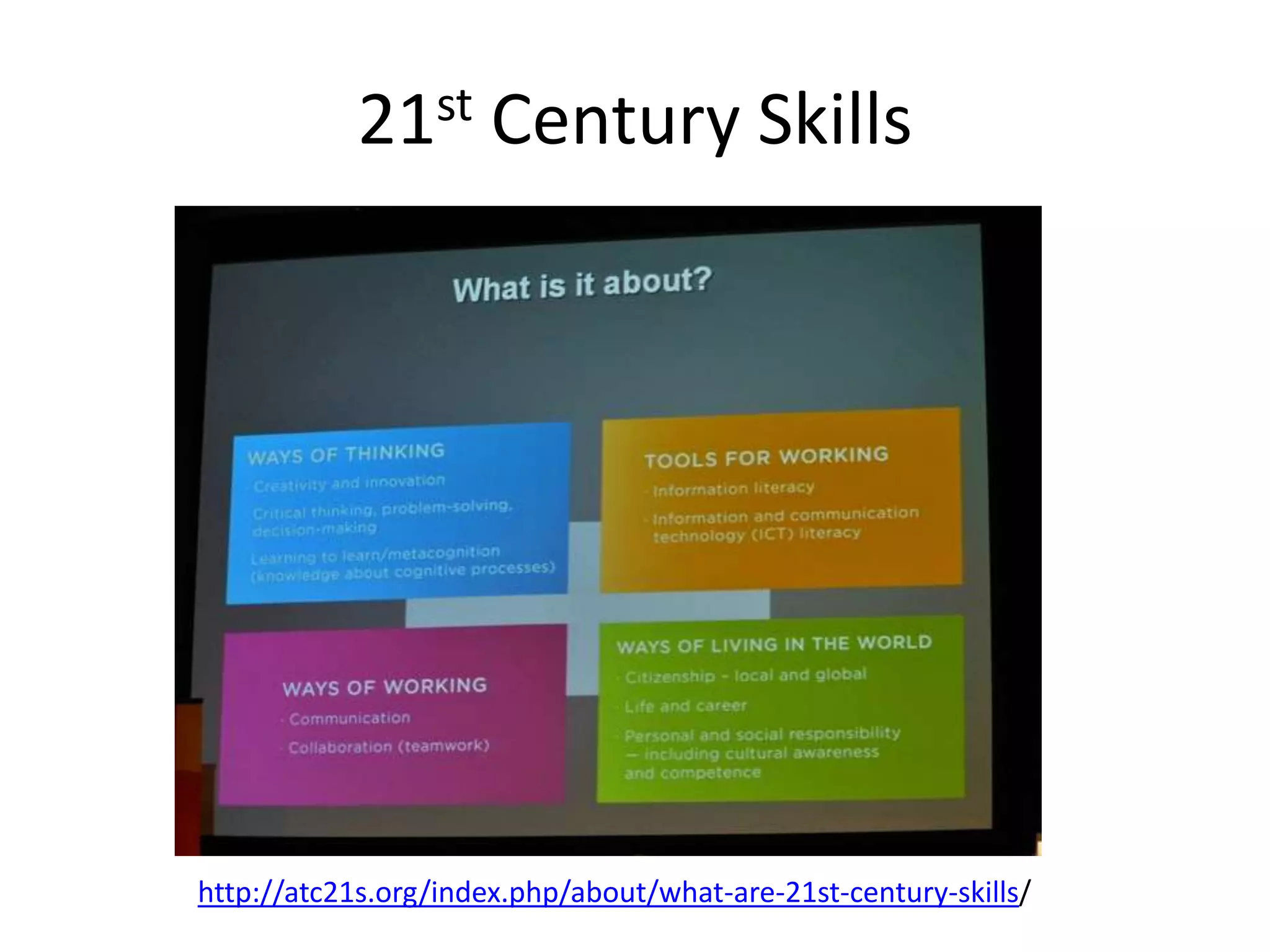
21st Century Skills


http://atc21s.org/index.php/about/what-are-21st-century-skills/
21st Century Skills
• Decentralized decision-making, information
  sharing, teamwork and innovation are key in
  today’s enterprises
• Whether a technician or a professional person,
  success lies in being able to communicate, share,
  and use information to solve complex problems,
  in being able to adapt and innovate in response
  to new demands and changing circumstances, in
  being able to marshal and expand the power of
  technology to create new knowledge and expand
  human capacity and productivity.
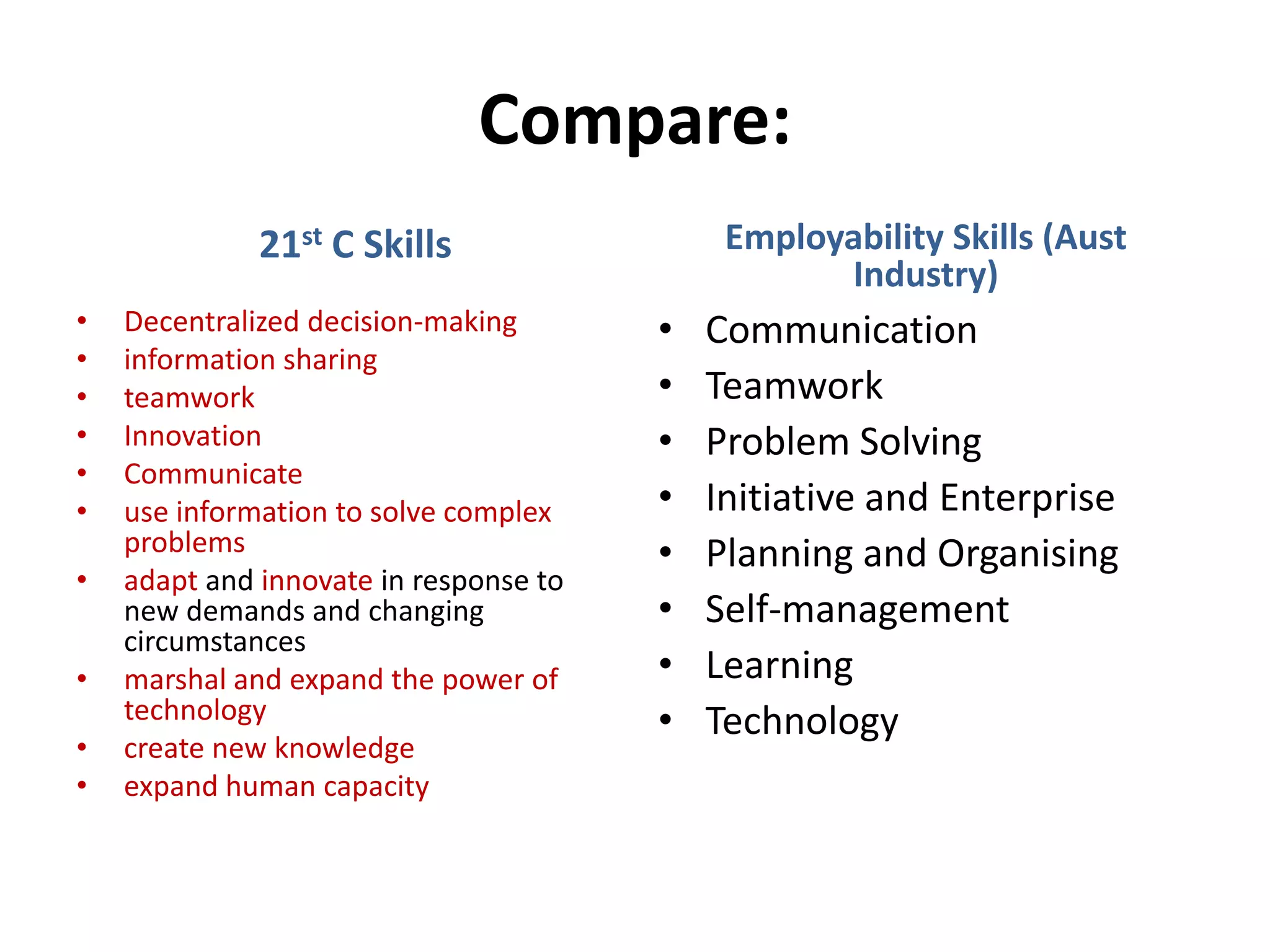
Compare:
              21st C Skills                  Employability Skills (Aust
                                                   Industry)
•   Decentralized decision-making       •   Communication
•   information sharing
•   teamwork                            •   Teamwork
•   Innovation                          •   Problem Solving
•   Communicate
•   use information to solve complex    •   Initiative and Enterprise
    problems                            •   Planning and Organising
•   adapt and innovate in response to
    new demands and changing            •   Self-management
    circumstances
•   marshal and expand the power of     •   Learning
    technology                          •   Technology
•   create new knowledge
•   expand human capacity
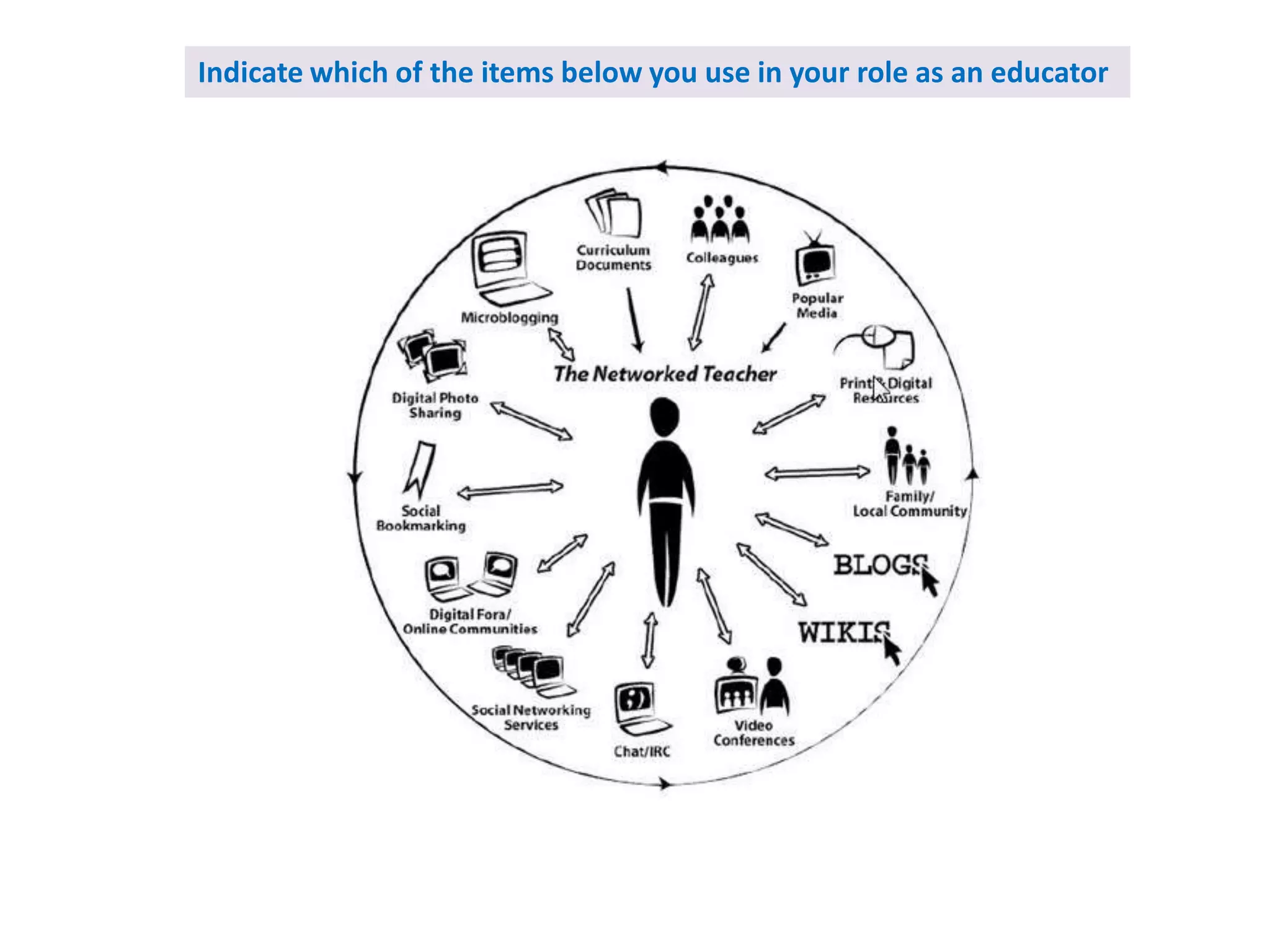
Indicate which of the items below you use in your role as an educator
I would contend that the abundance of content and
connections is as fundamental shift in education as
any we are likely to encounter, and there has, to
date, been little attempt to really place this at the
centre of a model of teaching. (Martin Weller –
referring to A Pedagogy of Abundance)
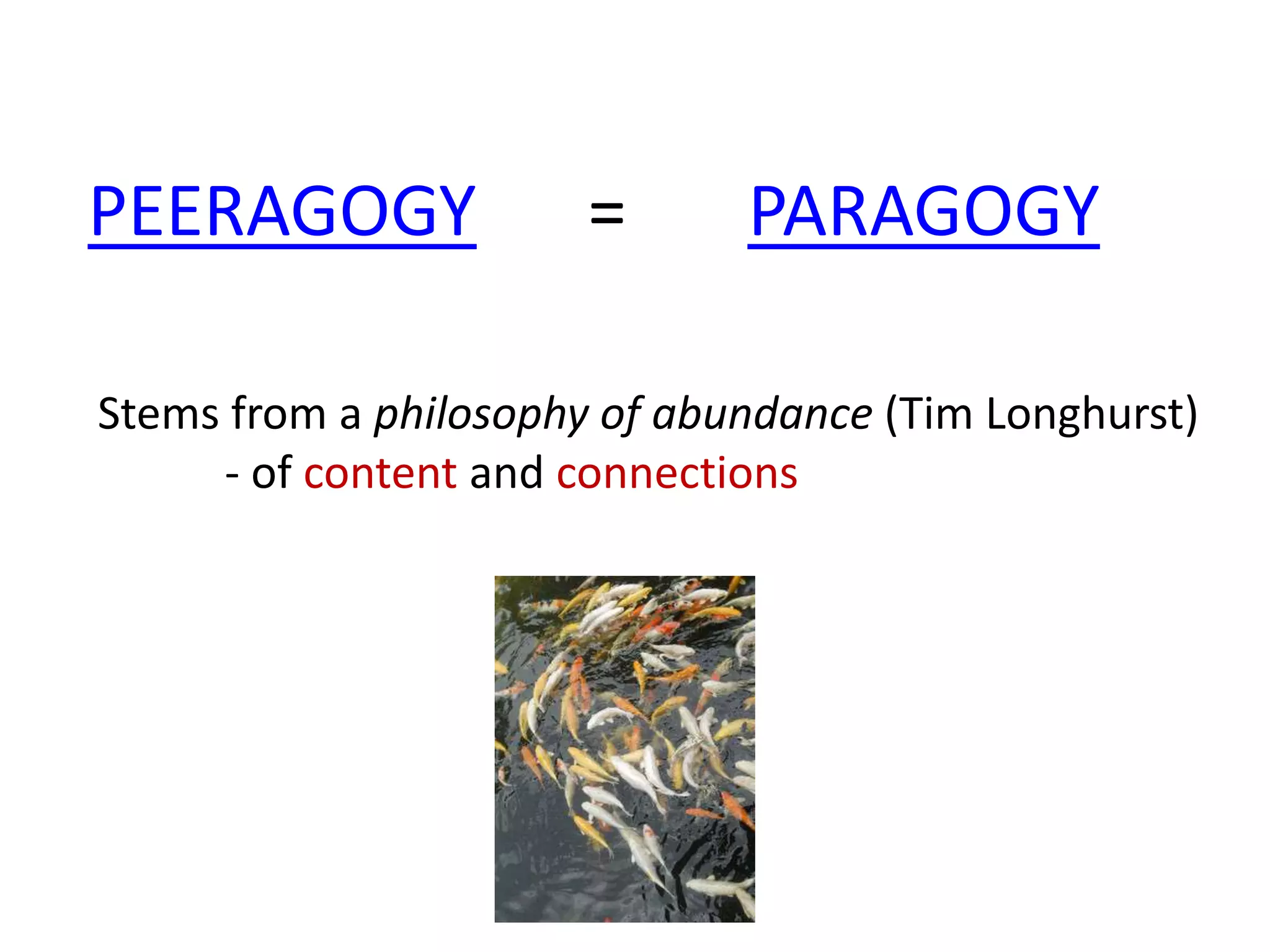
PEERAGOGY              =      PARAGOGY

Stems from a philosophy of abundance (Tim Longhurst)
     - of content and connections
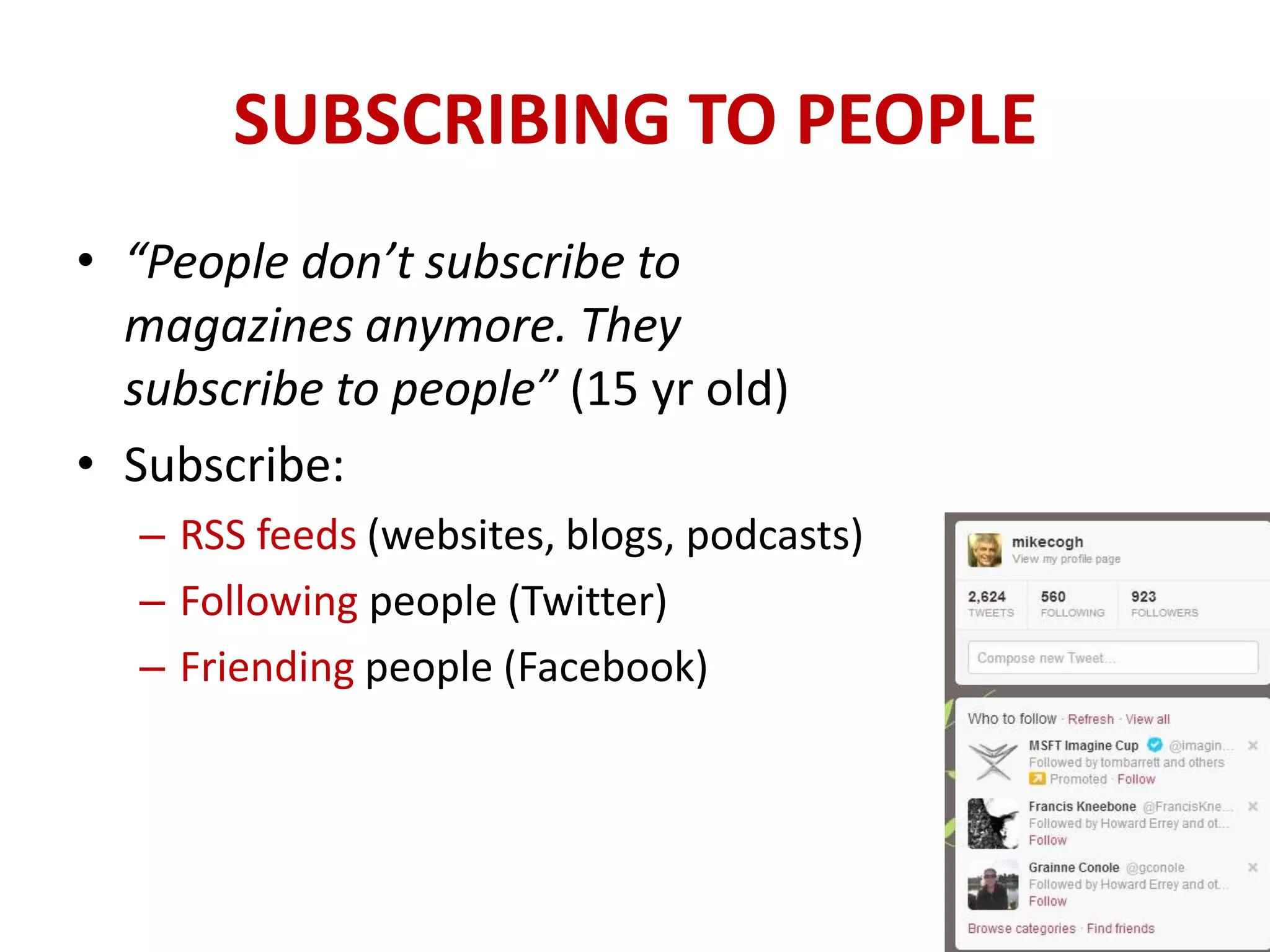
SUBSCRIBING TO PEOPLE
• “People don’t subscribe to
  magazines anymore. They
  subscribe to people” (15 yr old)
• Subscribe:
   – RSS feeds (websites, blogs, podcasts)
   – Following people (Twitter)
   – Friending people (Facebook)
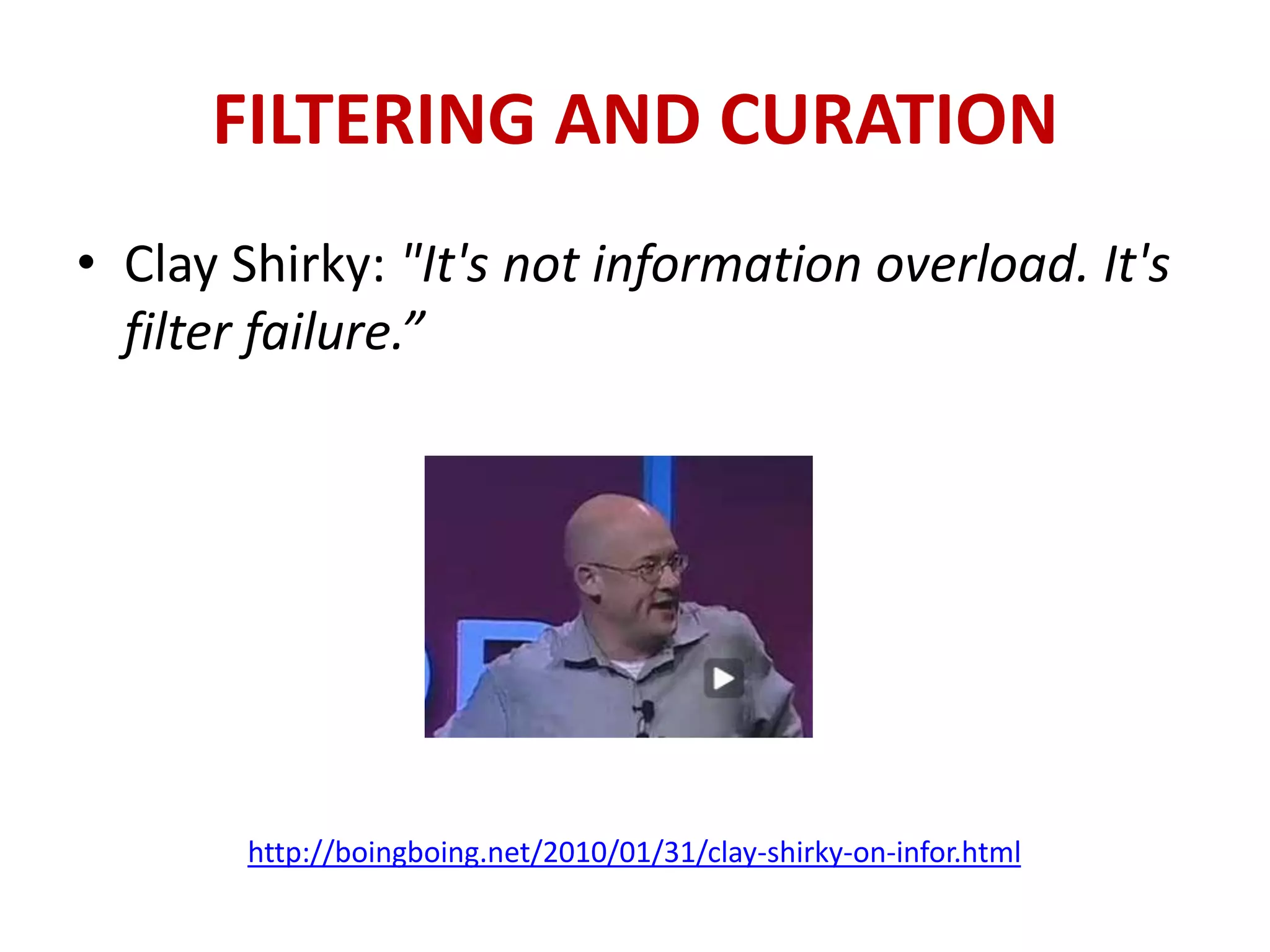
FILTERING AND CURATION
• Clay Shirky: "It's not information overload. It's
  filter failure.”


       http://boingboing.net/2010/01/31/clay-shirky-on-infor.html
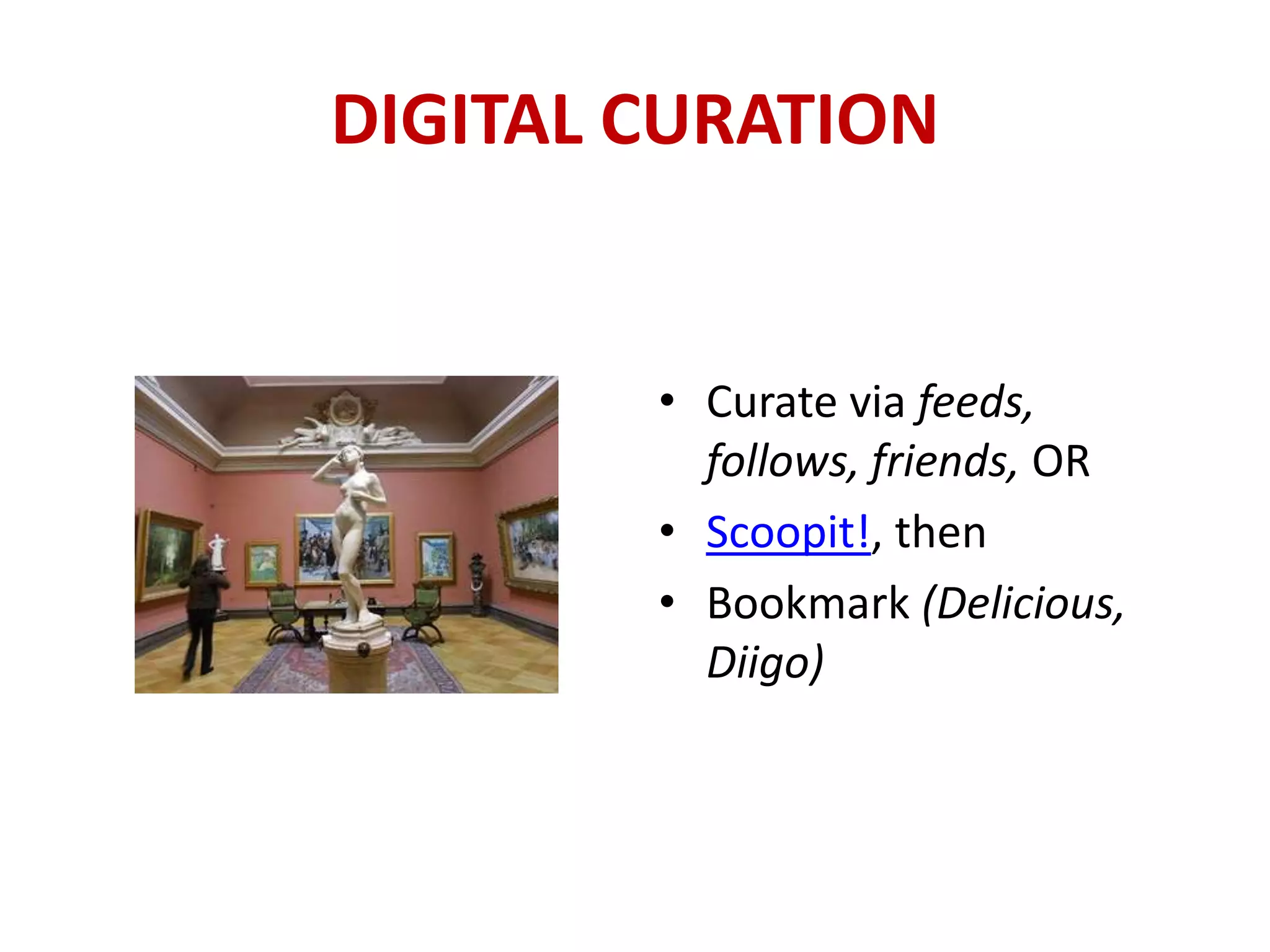
DIGITAL CURATION


        • Curate via feeds,
          follows, friends, OR
        • Scoopit!, then
        • Bookmark (Delicious,
          Diigo)
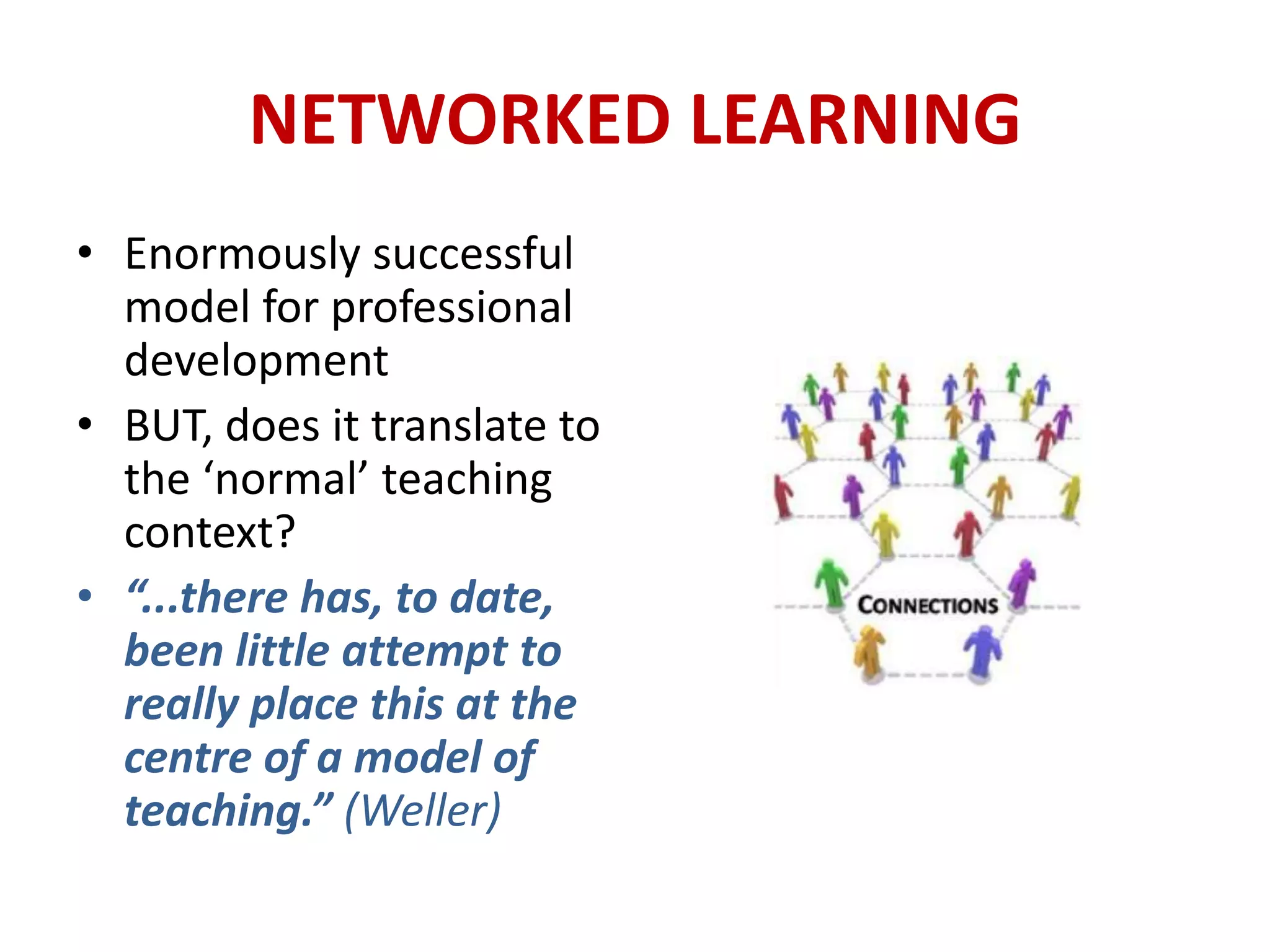
NETWORKED LEARNING
• Enormously successful
  model for professional
  development
• BUT, does it translate to
  the ‘normal’ teaching
  context?
• “...there has, to date,
  been little attempt to
  really place this at the
  centre of a model of
  teaching.” (Weller)
NETWORKED LEARNING
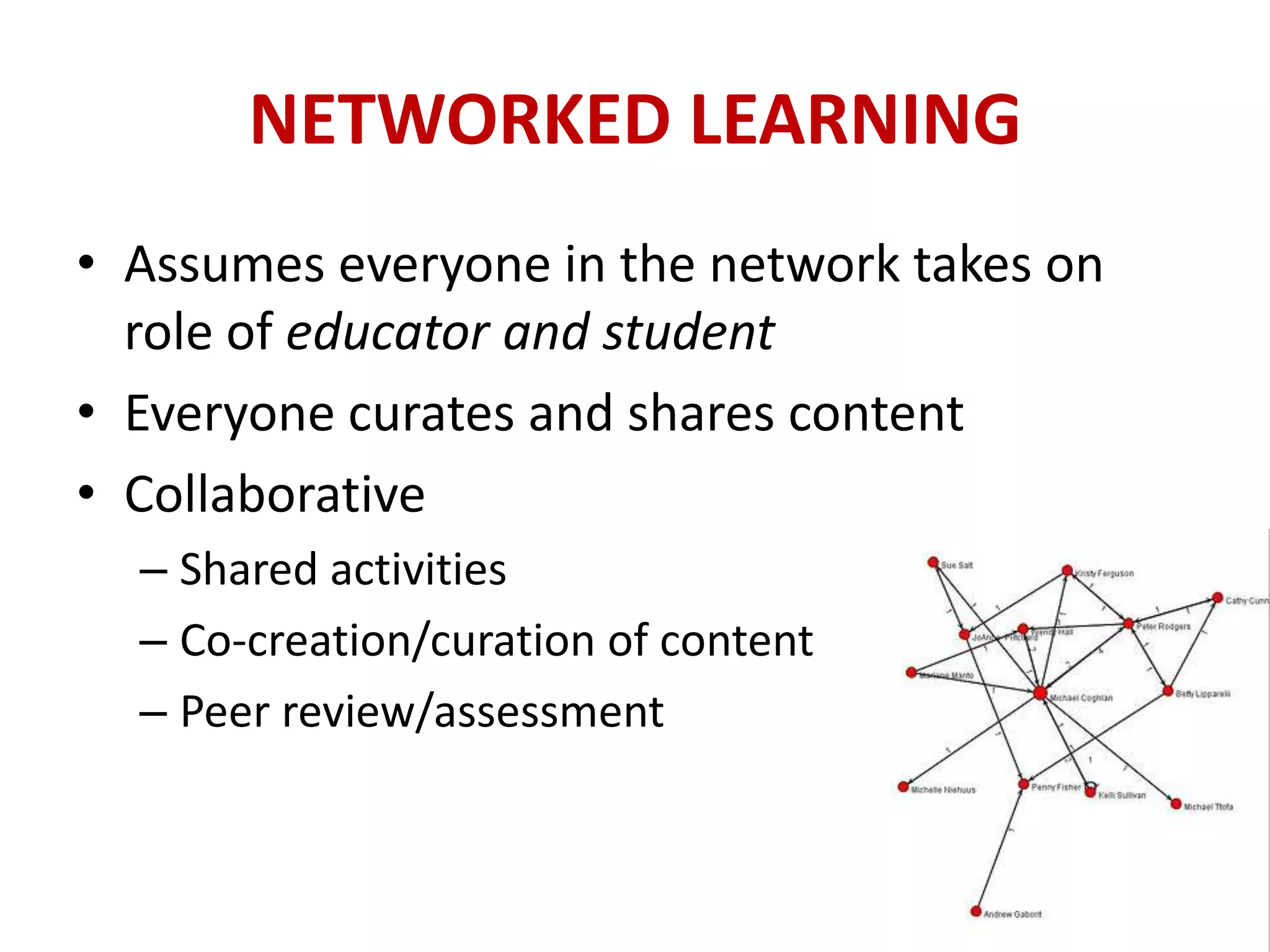
• Assumes everyone in the network takes on
  role of educator and student
• Everyone curates and shares content
• Collaborative
  – Shared activities
  – Co-creation/curation of content
  – Peer review/assessment
NETWORKED LEARNING IS
             IMPORTANT:


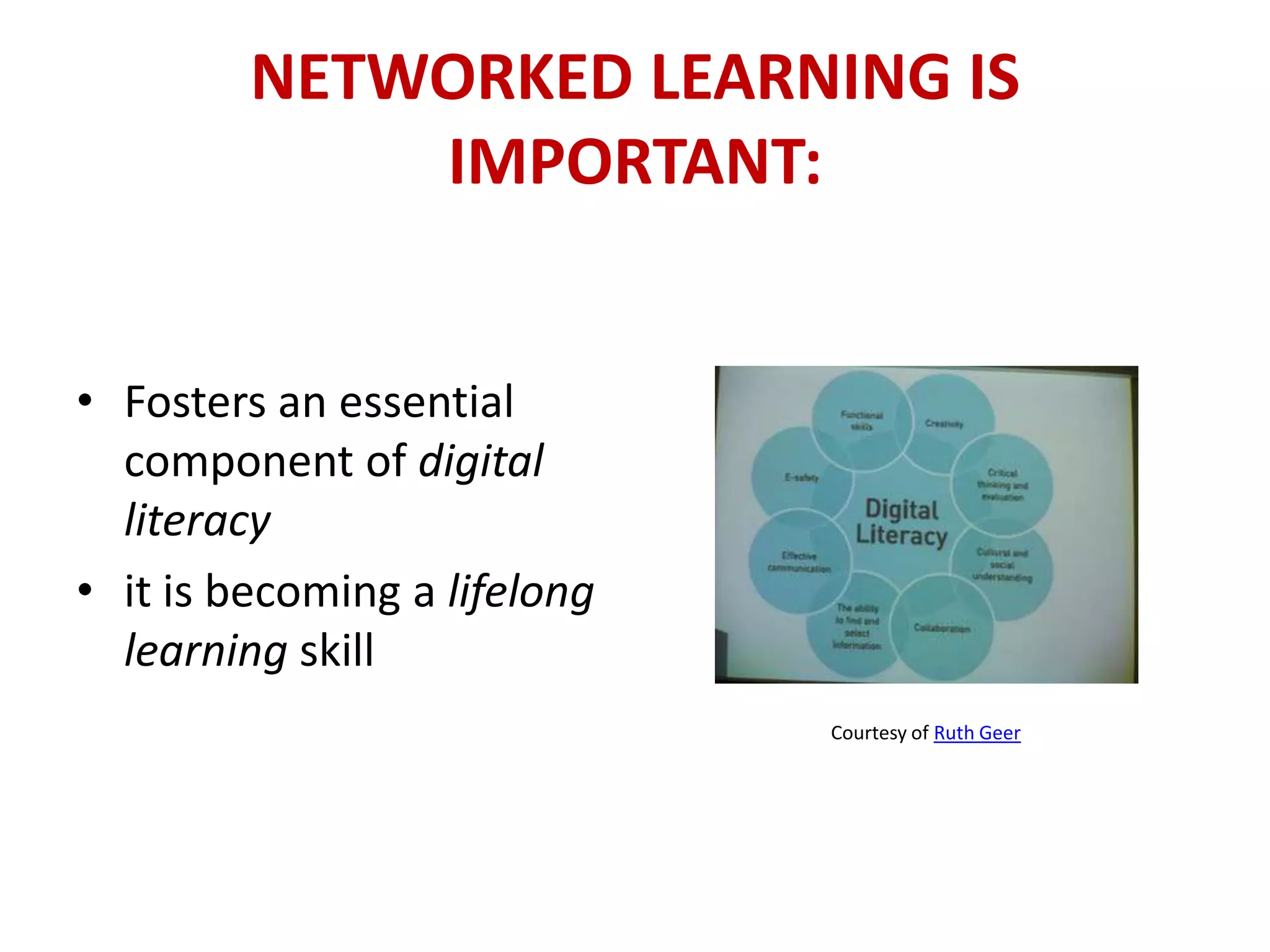
• Fosters an essential
  component of digital
  literacy
• it is becoming a lifelong
  learning skill
                              Courtesy of Ruth Geer
NETWORKED LEARNING IS HARD!
•   Requires advanced Internet skills
•   You need to manage multiple accounts
•   You have to work out who to follow!
•   Involves sharing and being open with and
    about what you know (against the
    culture/values of many)
DOUBTS/SUSPICION
• Information generated
  and curated from
  networks is not from
  recognised
  authority/experts
• Not officially sanctioned
  ie it isn’t in a textbook
• It’s INFORMAL
POSITIVE                              NEGATIVE
• Current                             • Tendency to want to know
• Digital literacy/lifelong             everything
  learning                            • The information flow never
• You have a gang (network)             stops
  to help you navigate, curate,       • Can be distracting.
  and create content                    (Multitasking is inefficient.)
• You’re never alone!                 • Information often comes in
                                        byte-sized grabs > lack of
                                        discourse of any substance
                                      • Everything you do is tracked
                                        and monitored (and
                                        probably sold to a third
                                        party for some commercial
                                        advantage.)
            So you need to be smart AND disciplined >>>>>
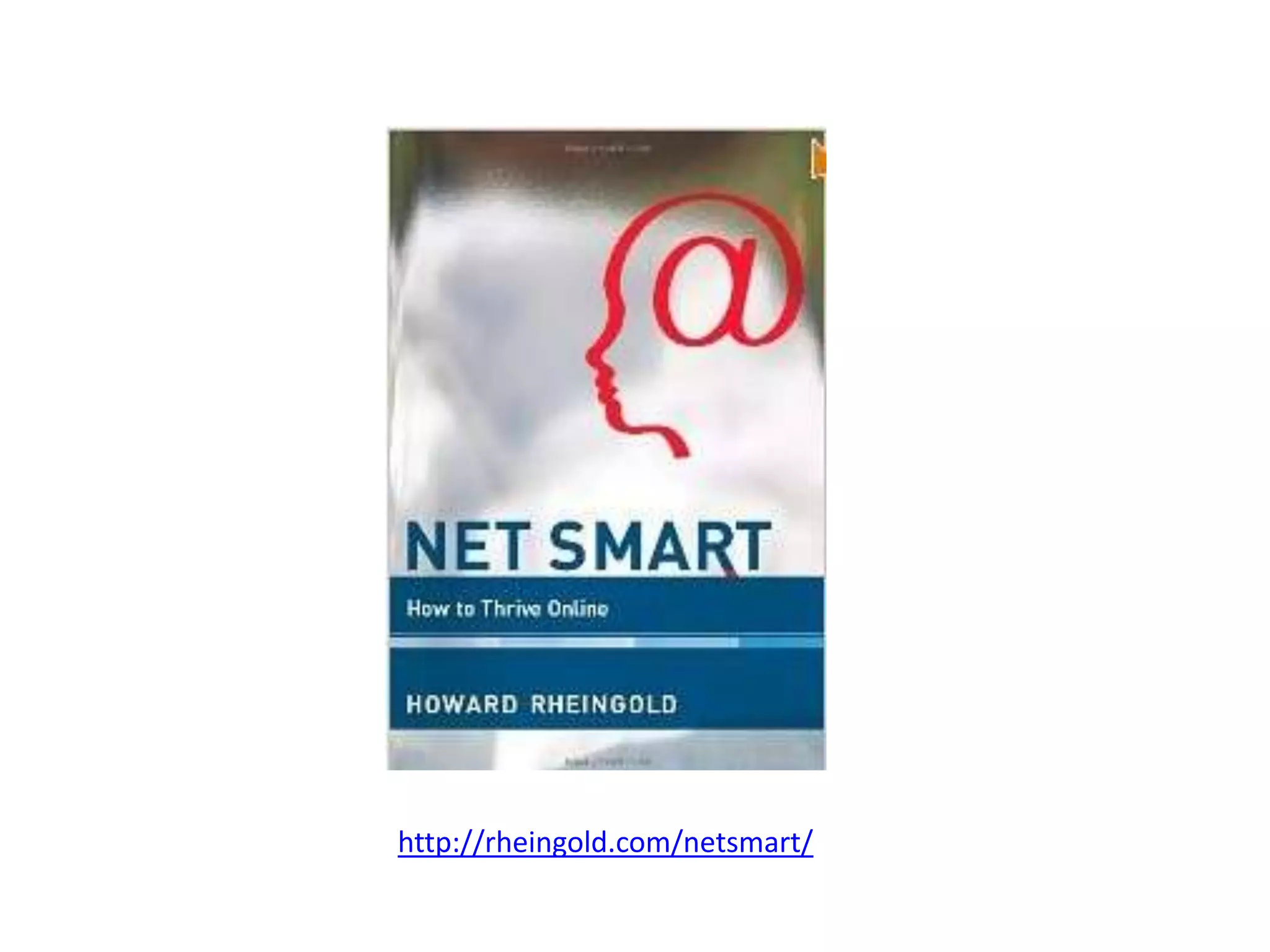
http://rheingold.com/netsmart/
michaelc@chariot.net.au

Designing Learning in the Digital Age - A Discussion

  • 1.
    #DLDA Learning2gether 23/12/12
  • 4.
    GLOBAL TRENDS (NMC sponsored retreat on The Future of Education) • Work is increasingly Global and • Ownership (copyright) and privacy Collaborative • Access, and Scale are redefining • People learn anywhere, anytime what we mean by quality (BYOD – bring your own device) and success (MOOCS) • Notion of literacy is being • Mobile redefined (multi- or transliteracy) • Openness — content, resources, • Rise of Informal Learning courses, research, attitudes • New Business Models • The CLOUD
  • 5.
    Employability Skills (VETsector) • Communication • Teamwork • Problem Solving • Initiative and Enterprise • Planning and Organising • Self-management • Learning • Technology
  • 6.
    Graduate Attributes (HigherEd) • Creativity • Communication • Teamwork • Leadership • Collaboration • Information Literate • Initiative • Problem solving
  • 7.
  • 8.
    21st Century Skills •Decentralized decision-making, information sharing, teamwork and innovation are key in today’s enterprises • Whether a technician or a professional person, success lies in being able to communicate, share, and use information to solve complex problems, in being able to adapt and innovate in response to new demands and changing circumstances, in being able to marshal and expand the power of technology to create new knowledge and expand human capacity and productivity.
  • 9.
    Compare: 21st C Skills Employability Skills (Aust Industry) • Decentralized decision-making • Communication • information sharing • teamwork • Teamwork • Innovation • Problem Solving • Communicate • use information to solve complex • Initiative and Enterprise problems • Planning and Organising • adapt and innovate in response to new demands and changing • Self-management circumstances • marshal and expand the power of • Learning technology • Technology • create new knowledge • expand human capacity
  • 10.
    Indicate which ofthe items below you use in your role as an educator
  • 11.
    I would contendthat the abundance of content and connections is as fundamental shift in education as any we are likely to encounter, and there has, to date, been little attempt to really place this at the centre of a model of teaching. (Martin Weller – referring to A Pedagogy of Abundance)
  • 12.
    PEERAGOGY = PARAGOGY Stems from a philosophy of abundance (Tim Longhurst) - of content and connections
  • 13.
    SUBSCRIBING TO PEOPLE •“People don’t subscribe to magazines anymore. They subscribe to people” (15 yr old) • Subscribe: – RSS feeds (websites, blogs, podcasts) – Following people (Twitter) – Friending people (Facebook)
  • 14.
    FILTERING AND CURATION •Clay Shirky: "It's not information overload. It's filter failure.” http://boingboing.net/2010/01/31/clay-shirky-on-infor.html
  • 15.
    DIGITAL CURATION • Curate via feeds, follows, friends, OR • Scoopit!, then • Bookmark (Delicious, Diigo)
  • 16.
    NETWORKED LEARNING • Enormouslysuccessful model for professional development • BUT, does it translate to the ‘normal’ teaching context? • “...there has, to date, been little attempt to really place this at the centre of a model of teaching.” (Weller)
  • 17.
    NETWORKED LEARNING • Assumeseveryone in the network takes on role of educator and student • Everyone curates and shares content • Collaborative – Shared activities – Co-creation/curation of content – Peer review/assessment
  • 18.
    NETWORKED LEARNING IS IMPORTANT: • Fosters an essential component of digital literacy • it is becoming a lifelong learning skill Courtesy of Ruth Geer
  • 19.
    NETWORKED LEARNING ISHARD! • Requires advanced Internet skills • You need to manage multiple accounts • You have to work out who to follow! • Involves sharing and being open with and about what you know (against the culture/values of many)
  • 20.
    DOUBTS/SUSPICION • Information generated and curated from networks is not from recognised authority/experts • Not officially sanctioned ie it isn’t in a textbook • It’s INFORMAL
  • 21.
    POSITIVE NEGATIVE • Current • Tendency to want to know • Digital literacy/lifelong everything learning • The information flow never • You have a gang (network) stops to help you navigate, curate, • Can be distracting. and create content (Multitasking is inefficient.) • You’re never alone! • Information often comes in byte-sized grabs > lack of discourse of any substance • Everything you do is tracked and monitored (and probably sold to a third party for some commercial advantage.) So you need to be smart AND disciplined >>>>>
  • 22.
  • 23.