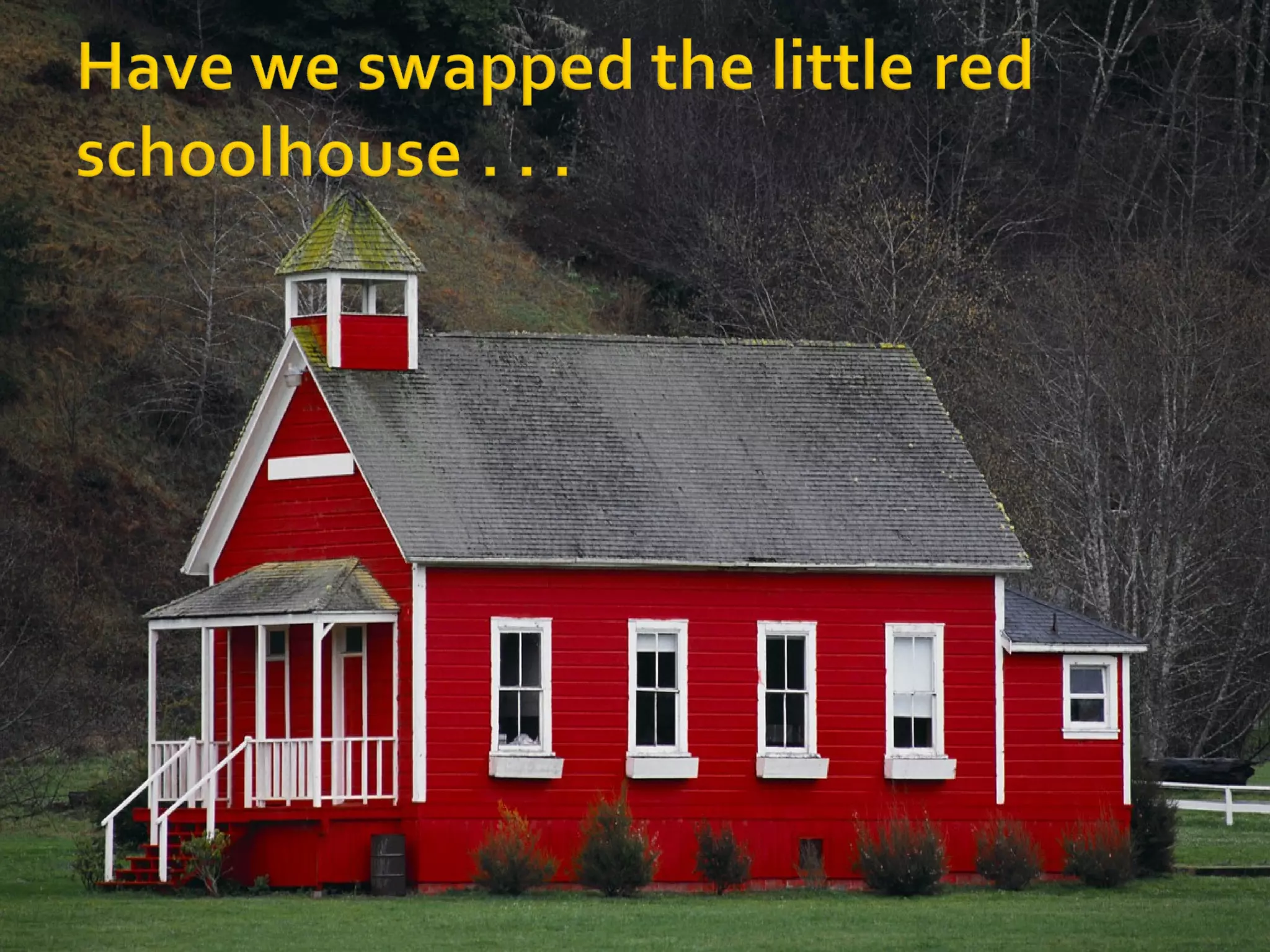

That was then… This is now…


“ If you’re not on MySpace, you don’t exist” Skyler, 18, to her mom


Birth Cohorts 20-25 years GI’s (WWI) 1901-1924 Silent Generation 1925-1942 Baby Boomer 1943-1960 Generation X 1961-1981  Millennials 1982- Present
Baby Boomers  TV generation Typewriters Memos Generation X Video games Computers Email Millennials  The Web Mobile devices IM Text Messaging Online communities
Baby Boomers Generation X Millennials Build a stellar career Build a portable career  Build parallel careers Money, title, recognition etc Freedom is the ultimate reward Work that has meaning for me Help me balance everyone else and find meaning myself Give me balance now, not when I’m 65 Work isn’t everything; I need flexibility so I can balance all my activities Feedback once a year, with lots of documentation Sorry to interrupt, but how am I doing? Feedback whenever I want it at the push of a button Train them too much and they’ll leave The more they learn the more they stay Continuous learning is a way of life
Information must be individually tailored Portability of information is critical Content must be dynamically generated ‘ Lag Time’ is a foreign concept Web Surfing is passé Bored Pass the test, pass the course, get the degree Surface learning; multitasking Stressed Rules are irrelevant Large career aspirations
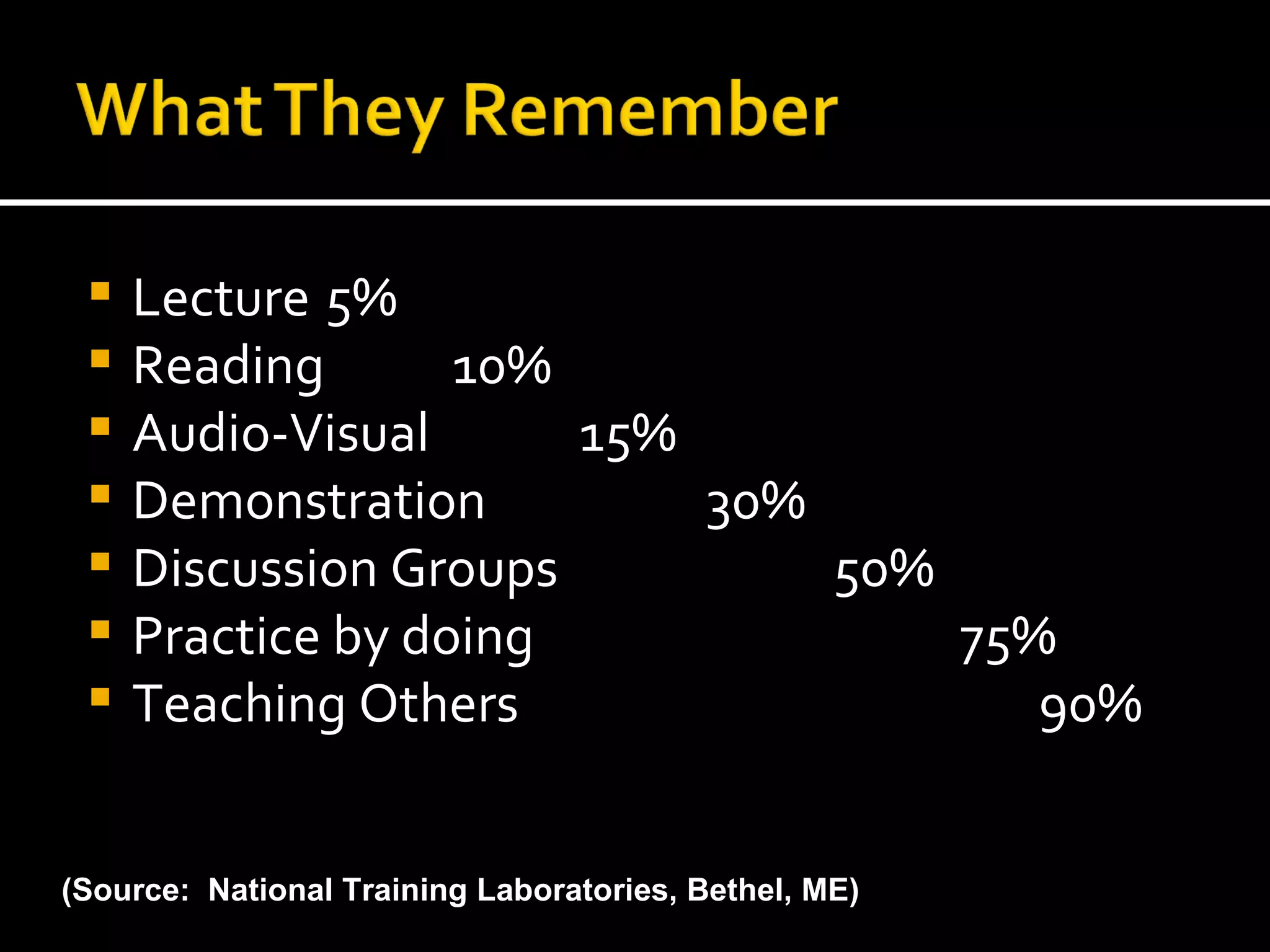
Lecture 5% Reading 10% Audio-Visual 15% Demonstration 30% Discussion Groups 50% Practice by doing 75% Teaching Others     90% (Source:  National Training Laboratories, Bethel, ME)
Case Based Learning; real-world examples Learning must be relevant, engaging, and meaningful Learning must expand beyond classroom walls Portability of information is critical (easy, online access) Content must be dynamically generated (just in time; web) Many and varied activities (experiential; authentic)  High expectations  (goals and frequent feedback) Interaction (with the “teacher”, the material, and peers) Respect for diversity Student responsibility
“ The number one thing to realize with the Millennials is that as a whole they reflect much more parental perfectionism than any generation in living memory.  Colleges and universities should know that they are not just getting a kid,  but they are also getting a parent .” Howe, N. & Strauss, B. (2000).  Millennials Rising: The Next Great Generation. New York: Vintage Books


Second generation of web-based communities and online services Social networking sites, wikis, social indexing sites Collaboration, creativity, sharing between users Changes web sites from isolated information silos to interlinked computing platforms
Users generate and distribute content, often with freedom to share and re-use, and allows the user to do more than just download information. Users own and exercise control over the data on a Web 2.0 site Architecture of participation that encourages users to add value ot the site as they use it.
One-to-Many Blogs RSS Feeds Many-to-Many GoogleGroups One-to-One E mail Skype


Participants set up their own blog and create at least one post (every week or every two weeks) that covers the content of the course. Participants send a message to the class Google Group to provide their published blog address for the rest of the class.  Participants will set up an RSS feed reader (Google Reader)  to follow the postings of other class members . Go to:  E Blogger ,  Google Reader
Set up a Google group for the class Each participant requests membership in the class (with their GMail account) Participants send messages to group with their published blog address All class members visit each blog and subscribe to the RSS feed for that blog Class members are notified of all postings in their RSS feed reader. The Google Group site will host discussions, other documents, and a few pages to support the class.
Private email messages will be used to provide private feedback to participants.  Go to:  GMail
Use the free Skype software to collaborate with the instructor or other students in real time to facilitate the learning in class.  Go to:  Skype
Participants will also add a special course "tag" which can be used with del.icio.us or Google Reader. Go to:  del.icio.us
 
Flickr  is a photo sharing website and web services suite, and an online community platform, which is generally considered an early example of a Web 2.0 application.


Social Studies :  NewsHour
 
Personal Learning Environments Employ social software and Web 2.0 tools outside of the confines of a learning management system to enable learners to develop their own preferred learning environment Ownership of both the content and the tools which comprise the PLE enables learners to sustain learning after formal courses have ended, and allows life-long learning
By offering a choice of tools, learners personalize the PLE by following their preferred styles and patterns of learning. Loosely Coupled Teaching Blends the advantages of institutional systems while leveraging the power of contemporary social software and Web 2.0 tools.
Source:  http://electronicportfolios.com/web2/class/index.html
Bridging the Generational Divide: Strategies for Engaging the Millennials, Dr Joy Mighty, Queen’s University Understanding the Millennial Student by  Angela D. Taylor, Ph.D., LPC, Associate Dean of Student Development Student Affairs, TCU

The Millennial Generation

  • 1.
    That was then…This is now…
  • 2.
  • 3.
  • 4.
  • 5.
  • 6.
    “ If you’renot on MySpace, you don’t exist” Skyler, 18, to her mom
  • 7.
  • 8.
  • 9.
  • 10.
  • 11.
  • 12.
  • 13.
  • 14.
    Birth Cohorts 20-25years GI’s (WWI) 1901-1924 Silent Generation 1925-1942 Baby Boomer 1943-1960 Generation X 1961-1981 Millennials 1982- Present
  • 15.
    Baby Boomers TV generation Typewriters Memos Generation X Video games Computers Email Millennials The Web Mobile devices IM Text Messaging Online communities
  • 16.
    Baby Boomers GenerationX Millennials Build a stellar career Build a portable career Build parallel careers Money, title, recognition etc Freedom is the ultimate reward Work that has meaning for me Help me balance everyone else and find meaning myself Give me balance now, not when I’m 65 Work isn’t everything; I need flexibility so I can balance all my activities Feedback once a year, with lots of documentation Sorry to interrupt, but how am I doing? Feedback whenever I want it at the push of a button Train them too much and they’ll leave The more they learn the more they stay Continuous learning is a way of life
  • 17.
    Information must beindividually tailored Portability of information is critical Content must be dynamically generated ‘ Lag Time’ is a foreign concept Web Surfing is passé Bored Pass the test, pass the course, get the degree Surface learning; multitasking Stressed Rules are irrelevant Large career aspirations
  • 18.
    Lecture 5% Reading10% Audio-Visual 15% Demonstration 30% Discussion Groups 50% Practice by doing 75% Teaching Others 90% (Source: National Training Laboratories, Bethel, ME)
  • 19.
    Case Based Learning;real-world examples Learning must be relevant, engaging, and meaningful Learning must expand beyond classroom walls Portability of information is critical (easy, online access) Content must be dynamically generated (just in time; web) Many and varied activities (experiential; authentic) High expectations (goals and frequent feedback) Interaction (with the “teacher”, the material, and peers) Respect for diversity Student responsibility
  • 20.
    “ The numberone thing to realize with the Millennials is that as a whole they reflect much more parental perfectionism than any generation in living memory. Colleges and universities should know that they are not just getting a kid, but they are also getting a parent .” Howe, N. & Strauss, B. (2000). Millennials Rising: The Next Great Generation. New York: Vintage Books
  • 21.
  • 22.
  • 23.
  • 24.
  • 25.
  • 26.
    Second generation ofweb-based communities and online services Social networking sites, wikis, social indexing sites Collaboration, creativity, sharing between users Changes web sites from isolated information silos to interlinked computing platforms
  • 27.
    Users generate anddistribute content, often with freedom to share and re-use, and allows the user to do more than just download information. Users own and exercise control over the data on a Web 2.0 site Architecture of participation that encourages users to add value ot the site as they use it.
  • 28.
    One-to-Many Blogs RSSFeeds Many-to-Many GoogleGroups One-to-One E mail Skype
  • 29.
  • 30.
  • 31.
  • 32.
  • 33.
    Participants set uptheir own blog and create at least one post (every week or every two weeks) that covers the content of the course. Participants send a message to the class Google Group to provide their published blog address for the rest of the class. Participants will set up an RSS feed reader (Google Reader) to follow the postings of other class members . Go to: E Blogger , Google Reader
  • 34.
    Set up aGoogle group for the class Each participant requests membership in the class (with their GMail account) Participants send messages to group with their published blog address All class members visit each blog and subscribe to the RSS feed for that blog Class members are notified of all postings in their RSS feed reader. The Google Group site will host discussions, other documents, and a few pages to support the class.
  • 35.
    Private email messageswill be used to provide private feedback to participants. Go to: GMail
  • 36.
    Use the freeSkype software to collaborate with the instructor or other students in real time to facilitate the learning in class. Go to: Skype
  • 37.
    Participants will alsoadd a special course "tag" which can be used with del.icio.us or Google Reader. Go to: del.icio.us
  • 38.
  • 39.
    Flickr isa photo sharing website and web services suite, and an online community platform, which is generally considered an early example of a Web 2.0 application.
  • 40.
  • 41.
  • 42.
  • 43.
  • 44.
  • 45.
    Personal Learning EnvironmentsEmploy social software and Web 2.0 tools outside of the confines of a learning management system to enable learners to develop their own preferred learning environment Ownership of both the content and the tools which comprise the PLE enables learners to sustain learning after formal courses have ended, and allows life-long learning
  • 46.
    By offering achoice of tools, learners personalize the PLE by following their preferred styles and patterns of learning. Loosely Coupled Teaching Blends the advantages of institutional systems while leveraging the power of contemporary social software and Web 2.0 tools.
  • 47.
  • 48.
    Bridging the GenerationalDivide: Strategies for Engaging the Millennials, Dr Joy Mighty, Queen’s University Understanding the Millennial Student by Angela D. Taylor, Ph.D., LPC, Associate Dean of Student Development Student Affairs, TCU