Social Networking in the Classroom:
Facebook, Twitter and Edmodo at
the University
Northwest eLearning Conference
Portland, Oregon, October 17-19

Teresa Fernández-Ulloa
California State University,
Bakersfield
tfernandez_ulloa@csub.edu
• Since their emergence in 2004, Web 2.0
  technologies have been advanced as potentially
  transformative in the area of education in general
  and foreign language learning in particular. Web 2.0
  technologies are presenting new opportunities for
  developing diverse online learning environments
  and enhancing interactivity, participation and
  feedback between students, their peer groups and
  teachers.
• Early forms of social networking: sixdegrees.com
match.com, classmates.com, friendster.com.
For language learning: iKnow.jp, Livemocha.com
• Access to Web 2.0 tools, such as blogs and podcasts,
  are often blocked by districts, suggesting a need to
  revise current policies to keep abreast of technology
  developments and new applications. AUPs
  (Acceptable Uses Policies) protect districts from
  liability but do little or nothing to inform and
  educate users (teachers and students) or parents
  about what they are signing. For example, a
  prerequisite tutorial would be appropriate before
  signing an annual AUP.
• California ICT Digital Literacy Assessments and
  Curriculum Framework.
• We also have to consider our students'
  expectations and competences. If not, an abyss
  may be opened between communication inside
  school and outside. Discussion boards and chats
  on some educative platforms are a little too
  different from the ones they use in normal life.
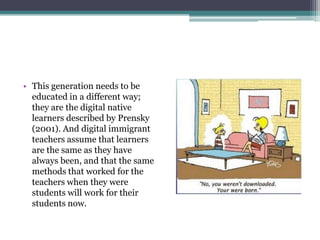
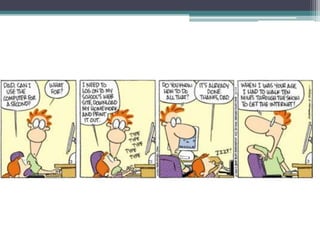
• This generation needs to be
  educated in a different way;
  they are the digital native
  learners described by Prensky
  (2001). And digital immigrant
  teachers assume that learners
  are the same as they have
  always been, and that the same
  methods that worked for the
  teachers when they were
  students will work for their
  students now.
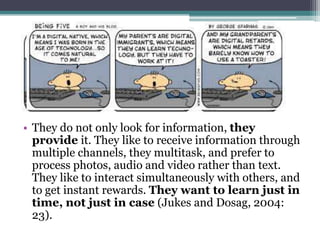
• They do not only look for information, they
  provide it. They like to receive information through
  multiple channels, they multitask, and prefer to
  process photos, audio and video rather than text.
  They like to interact simultaneously with others, and
  to get instant rewards. They want to learn just in
  time, not just in case (Jukes and Dosag, 2004:
  23).
UNESCO ICT Competency Standards for
Teachers
• Traditional educational practices no longer provide
  prospective teachers with all the necessary skills for
  teaching students to survive economically in today’s
  workplace.
• Classroom structure is different with the new
  student-centered approach. In their new role,
  teachers help students create, implement, and
  monitor project plans and solutions. Class periods
  and classroom structure are more dynamic, with
  students working in groups.
• 21st century skills: problem solving, communication,
  collaboration, and critical thinking. Determine their
  own learning goals and plans.
Constructivism
• Social constructivism attempts to address the problem of how students
  naturally learn best. Today's technology can support these attempts. When
  used appropriately by an instructor, social software applications and
  Web 2.0 tools can effectively assist in creating a social
  constructivist learning environment.

• An environment of multidirectional interaction among instructors,
  learners and others in cyberspace allows the learners to enter into a cycle of
  constructing their own truths, testing them against the truths of others and
  their environment to see if they hold up, and reconstructing where
  necessary.

• Individuals exchange constructed knowledge with others in their context.
  Over time, both the learner and the cultural context are
  transformed. As a result, collaboration through a culture's language and
  subsequent communication is key to understanding a social
  constructivist model of learning.
• Social constructivism stresses the fact that learning
  is a social activity, ocurring when people
  work collaboratively. Learners gather knowledge
  to be internalized from a variety of sources in their
  environment. Sources can include electronic and
  print sources, first hand experiences and even a
  teacher in the traditional role of knowledge
  provider. However, a teacher's role should not
  be limited to that of knowledge provider, but
  should also include facets of coaching,
  guiding and facilitating.
Conectivism
• Conectivism. Learning is the creation and removal of
  connections between the entities, or the adjustment of
  the strengths of those connections. A learning theory is,
  literally, a theory describing how these connections are
  created or adjusted.
• The constructions of meaning and the creation of
  connections among specialized communities are
  important activities.
• Taking decissions is a learning process. Choosing what
  to learn, and the meaning of the information received, is
  basic in this changing reality.
• Future leaders will be the ones able to be nodes in these
  knowledge webs.
Expanded School (as it is shown in this
documentary about a particular
experience in Spain)
 • Expanded school. Education may happen in any
   place, at any time. Human approach, integral
   formation, implication on people’s lives…
   Interdisciplinarity. Expanded School is an alive
   organism, settled on two basis: school and the
   community or learners and instructors (home). It
   has always existed, but now it travels on
   technological rails.
 • School does not have the monopoly on education.
 • Before it had the pedagogical tools.
Invisible learning        (concept explained in a book by
Cobo, Univ. of Oxford, and Moravec, Univ. of Minnesota)
• Formal learning-Informal learning-fortuitous learning
• Informal learning is different from the formal contexts of
  school and universities, being described as:
       • occurring outside of the formal, structured school
or university environment
       • a lifelong process, given that humans spend more
time outside, than inside, school
       • happening across a variety of mediums, such as
television, the internet and museums
       • linking to formal learning in an unplanned way
       • voluntary
• We need to “remix” ways of learning, including
  creativity, innovation, colaborative learning…
• Do it yourself. Contents generated by the user,
  problem based learning, permanent learning…
• Learning inside a wide frame of abilities in this
  globalized world.
• This proposal includes a wide range of
  competences, knowledges and skills.
Content and language integrated
learning. Content-based instruction
• Effective opportunities to use the new language
  skills, rather than learn them now for use later.
• Stimulating content.
• Delivering information at the right time &
  situation, compelling the students to learn out of
  passion.
• Class is learner center rather than teacher
  centered. Students are actively engaged in the
  learning process.
Other…
• Edupunk.
• Edupop.
•…
DATA                                                             WHY USE THEM?

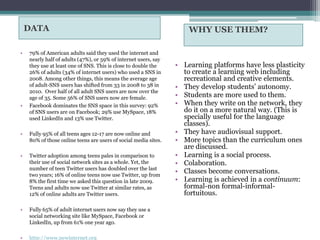
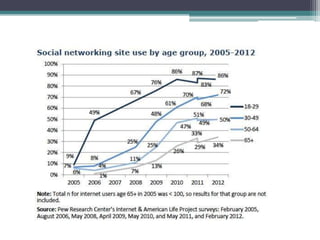
•   79% of American adults said they used the internet and
    nearly half of adults (47%), or 59% of internet users, say
    they use at least one of SNS. This is close to double the    • Learning platforms have less plasticity
    26% of adults (34% of internet users) who used a SNS in        to create a learning web including
    2008. Among other things, this means the average age           recreational and creative elements.
    of adult-SNS users has shifted from 33 in 2008 to 38 in      • They develop students’ autonomy.
    2010. Over half of all adult SNS users are now over the
    age of 35. Some 56% of SNS users now are female.             • Students are more used to them.
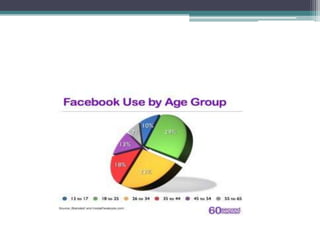
•   Facebook dominates the SNS space in this survey: 92%         • When they write on the network, they
    of SNS users are on Facebook; 29% use MySpace, 18%             do it on a more natural way. (This is
    used LinkedIn and 13% use Twitter.                             specially useful for the language
                                                                   classes).
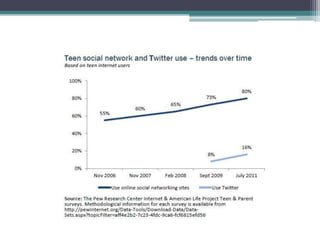
•   Fully 95% of all teens ages 12-17 are now online and         • They have audiovisual support.
    80% of those online teens are users of social media sites.   • More topics than the curriculum ones
                                                                   are discussed.
•   Twitter adoption among teens pales in comparison to          • Learning is a social process.
    their use of social network sites as a whole. Yet, the       • Colaboration.
    number of teen Twitter users has doubled over the last
    two years; 16% of online teens now use Twitter, up from
                                                                 • Classes become conversations.
    8% the first time we asked this question in late 2009.       • Learning is achieved in a continuum:
    Teens and adults now use Twitter at similar rates, as          formal-non formal-informal-
    12% of online adults are Twitter users.                        fortuitous.

•   Fully 65% of adult internet users now say they use a
    social networking site like MySpace, Facebook or
    LinkedIn, up from 61% one year ago.

•   http://www.pewinternet.org
• Social impact of widespread use of social networking sites like
  Facebook, LinkedIn, MySpace, and Twitter. Do these
  technologies isolate people and truncate their
  relationships? Or are there benefits associated with being
  connected to others in this way? Pew Research Center
  found that social networking sites are increasingly used to
  keep up with close social ties.
• The average user of a social networking site has more close ties and
  is half as likely to be socially isolated as the average American
• Facebook users are more trusting than others.
• Facebook users have more close relationships.
• Internet users get more support from their social ties and Facebook
  users get the most support.
• Facebook users are much more politically engaged than most people
• Facebook revives “dormant” relationships.
• MySpace users are more likely to be open to opposing points of
  view.
GENERAL OBJECTIVES THAT WE MAY
INCLUDE, RELATED TO THESE TOOLS:
• To learn how to use Facebook , Twitter and
  Edmodo.
• To develop and reinforce collaborative abilities.
• To create a learning community and interact with
  the rest of mates.
• To generate a climate of trust and motivation.
• To use the language and to discuss about the
  content outside the class time.
• Be more conscious of the importance of
  autonomous learning.
INSTRUCTOR,                  BEAR IN MIND THE
A RE YOU AFRAID OF…?         ADVANTAGES…

• Losing the control (too    • Motivation.
  many messages and of       • Team work.
  non scholar topics).       • Autonomous learning,
                               interacting with others.
• Lack of preparation.       • Fostering of communication
• Don’t cover the content.     and mutual knowledge.
                             • Fostering of retentio; students
• Lack of prepared             learng by doing.
  materials.                 • Writing skills and new
                               technologies use.
• Intrusion of people not    • More time and space to learn.
  belonging to the class.    • Integration of contents
                               (various disciplines and
                               origins).
                             • Specialized groups.
                             • Free resource.
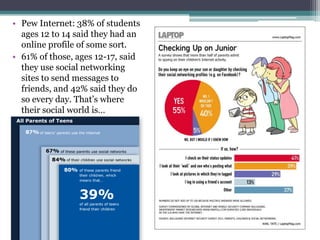
• Pew Internet: 38% of students
  ages 12 to 14 said they had an
  online profile of some sort.
• 61% of those, ages 12-17, said
  they use social networking
  sites to send messages to
  friends, and 42% said they do
  so every day. That’s where
  their social world is…
• Although most of our students, especially in
  secondary schools, colleges and universities are
  permanently connected to the Internet, and
  most of them use or will use social networks, it is
  a common mistake to assume that they are
  competent users of these tools. They lack
  information, they are not cautious when they
  interact on the net, and sometimes they feel
  frustrated because technology do not always
  keep its promises.
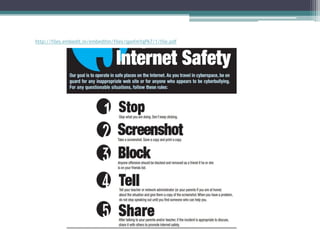
http://files.embedit.in/embeditin/files/qpofmYgPk7/1/file.pdf
FACEBOOK
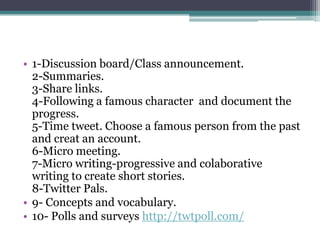
• 1-Discussion board/Class announcement.
  2-Summaries.
  3-Share links.
  4-Following a famous character and document the
  progress.
  5-Time tweet. Choose a famous person from the past
  and creat an account.
  6-Micro meeting.
  7-Micro writing-progressive and colaborative
  writing to create short stories.
  8-Twitter Pals.
• 9- Concepts and vocabulary.
• 10- Polls and surveys http://twtpoll.com/
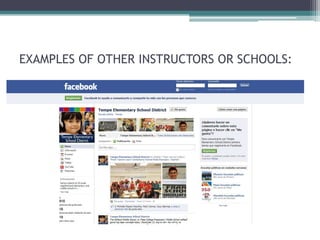
EXAMPLES OF OTHER INSTRUCTORS OR SCHOOLS:
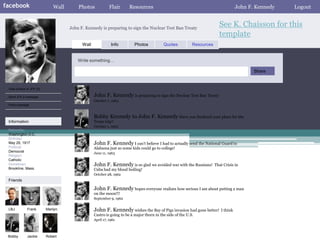
facebook                      Wall       Photos             Flair      Resources                                                     John F. Kennedy   Logout


                                     John F. Kennedy is preparing to sign the Nuclear Test Ban Treaty
                                                                                                                          See K. Chaisson for this
                                                                                                                          template
                                           Wall              Info         Photos           Quotes           Resources


                                         Write something…

                                                                                                                                            Share


 View photos of JFK (5)

 Send JFK a message                               John F. Kennedy is preparing to sign the Nuclear Test Ban Treaty
                                                  October 7, 1963
 Poke message


                                                  Bobby Kennedy to John F. Kennedy Have you finalized your plans for the
 Information                                      Texas trip?
                                                  October 1, 1963
 Networks:
 Washington D.C.
 Birthday:
 May 29, 1917                                     John F. Kennedy I can’t believe I had to actually send the National Guard to
 Political:                                       Alabama just so some kids could go to college!
 Democrat                                         June 11, 1963
 Religion:
 Catholic
 Hometown:                                        John F. Kennedy is so glad we avoided war with the Russians!          That Crisis in
 Brookline, Mass.                                 Cuba had my blood boiling!
                                                  October 28, 1962
 Friends

                                                  John F. Kennedy hopes everyone realizes how serious I am about putting a man
                                                  on the moon!!!
                                                  September 9, 1962


 LBJ          Frank       Marilyn                 John F. Kennedy wishes the Bay of Pigs invasion had gone better!         I think
                                                  Castro is going to be a major thorn in the side of the U.S.
                                                  April 17, 1961


 Bobby        Jackie      Robert
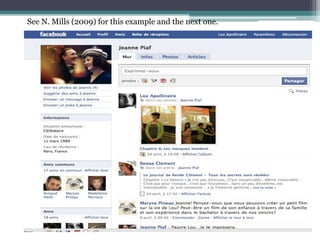
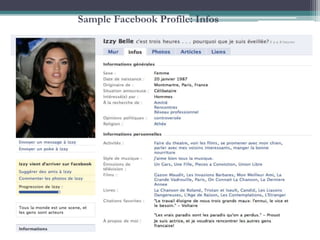
See N. Mills (2009) for this example and the next one.


      Sample Facebook Profile: Wall
Sample Facebook Profile: Infos
Spanish linguistics clases (graduate course,
California State University, Bakersfield).
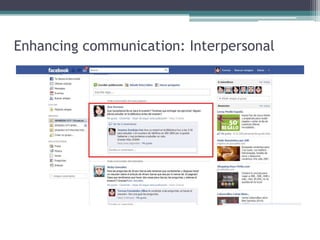
Enhancing communication: Interpersonal
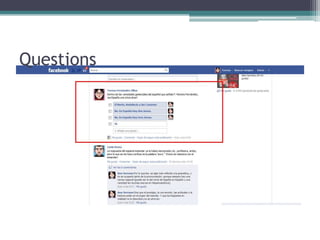
Questions
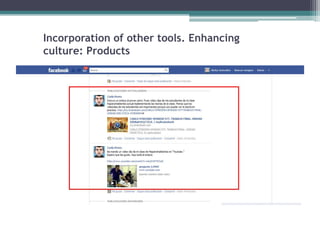
Incorporation of other tools. Enhancing
culture: Products
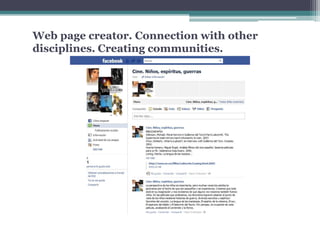
Web page creator. Connection with other
disciplines. Creating communities.
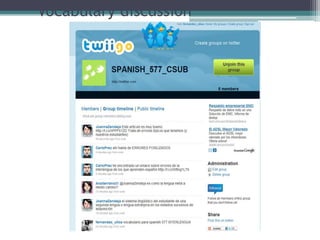
• Twiigo, a tool to creat groups in Twitter.
• (Examples from graduate Spanish linguistics
  class, and undergraduate Spanish language
  class)
Vocabulary discussion
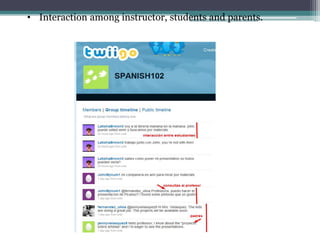
• Interaction among instructor, students and parents.
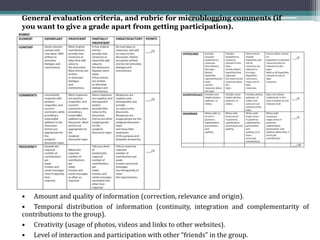
General evaluation criteria, and rubric for microblogging comments (if
you want to give a grade apart from getting participation).


• Amount and quality of information (correction, relevance and origin).
• Temporal distribution of information (continuity, integration and complementarity of
contributions to the group).
• Creativity (usage of photos, videos and links to other websites).
• Level of interaction and participation with other “friends” in the group.
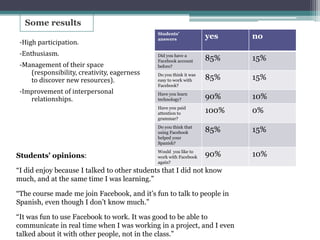
Some results
                                              Students’
                                              answers               yes    no
 -High participation.
 -Enthusiasm.                                 Did you have a
                                              Facebook account      85%    15%
 -Management of their space                   before?
    (responsibility, creativity, eagerness    Do you think it was
    to discover new resources).               easy to work with     85%    15%
                                              Facebook?
 -Improvement of interpersonal                Have you learn
    relationships.                            technology?           90%    10%
                                              Have you paid
                                              attention to          100%   0%
                                              grammar?
                                              Do you think that
                                              using Facebook        85%    15%
                                              helped your
                                              Spanish?
                                              Would you like to
Students’ opinions:                           work with Facebook    90%    10%
                                              again?
“I did enjoy because I talked to other students that I did not know
much, and at the same time I was learning.”

“The course made me join Facebook, and it’s fun to talk to people in
Spanish, even though I don’t know much.”

“It was fun to use Facebook to work. It was good to be able to
communicate in real time when I was working in a project, and I even
talked about it with other people, not in the class.”
It is a social learning platform for teachers, students, and parents.

Teachers are also able to post grades, assignments and quizzes to students. Students can
submit homework and view their grades and any comments the teacher may have posted
about their assignment. Teachers can also create polls and post topics for discussion
among the students. Teachers can differentiate and individualize learning through the
creation of sub-groups within a course. After each course period is completed; the teacher
closes out the network and creates a new one for the next course.

Edmodo also has iOS and Android apps available through the Apple App Store and
Google Play (respectively).
Teaching (primary educ.) undergraduate and graduate
  students (Universidad de Cantabria, Santander, Spain),
  and undergraduate students (First Year Experience
  Course, CSUB)

Edmodo user guide
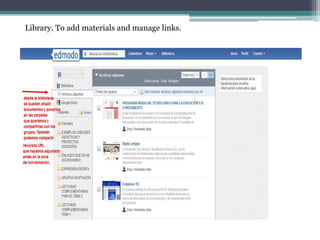
Library. To add materials and manage links.
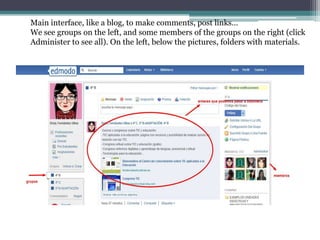
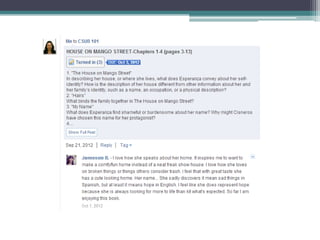
Main interface, like a blog, to make comments, post links…
We see groups on the left, and some members of the groups on the right (click
Administer to see all). On the left, below the pictures, folders with materials.
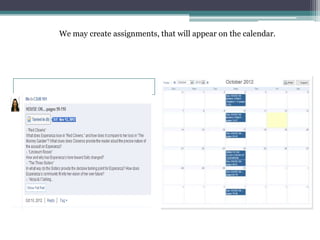
We may create assignments, that will appear on the calendar.
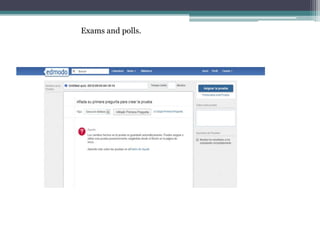
Exams and polls.
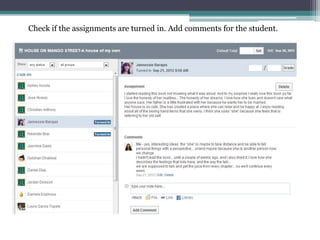
Check if the assignments are turned in. Add comments for the student.
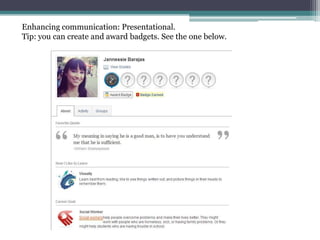
Enhancing communication: Presentational.
Tip: you can create and award badgets. See the one below.
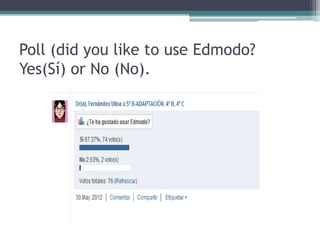
Poll (did you like to use Edmodo?
Yes(Sí) or No (No).
Generation Y students learn
differently to previous learners…
• With these social media you can fuel your classes, because
  they enable you to chat about the subject (but also
  about life).
• Students connect with their peers in a personal way, what is
  good for the collaborative learning that we try to foster.
• Students relax in these social rooms and tend to use the
  language in a "real" way. They do not have the pressure of
  having to write a lot, and they are able to communicate in real
  time when they are working in a project.
• They are more used to these tools, and they participate
  more than in the learning platforms. Technology is part of
  these social networks, and it serves to create innovative
  assignments.
• Classroom modes of delivering information are repositioned.
  We are not the experts, nor the only providers.
THANKS
• Fernández Ulloa, Teresa (2012): “Facebook y Twitter en la enseñanza del
  español como lengua extranjera”. In Catalina M. Alonso García and
  Domingo J. Gallego Gil: Tecnologías emergentes, Madrid: UNED.
• Harrison, Richard and Michael Thomas (2009). “Identity in online
  communities: Social networking sites and language learning”. International
  Journal of Emerging Technologies. 7/2: 109-124.
• Jukes, Ian and Anita Dosaj (2004): “Understanding digital kids (DKs).
  Teaching & Learning in the new digital landscape”. The InfoSavy Group.
• Miles, Nicole (2009): “Facebook and the Use of Social Networking Tools
  to Enhance Language Learner Engagement”. NEALLT conference, Yale
  University. New Haven, CT.
  Available at: Prensky, Marc (2001): “Digital natives, digital immigrants”.
  On the horizon (MCB University Press, 9/5).
• Siemens, George (2007): “Conectivismo. Una teoría de aprendizaje para la
  era digital”. Trad. by Diego E. Leal Fonseca.
• ---- “Connectivism: Socializing open learning”
• Yellowlees, John (2008): “Making late elementary classrooms natural
  places for learning: social constructivism via social software and Web 2.0
  tools”