
New Technologies = New Learning
Who am I? ESL classroom teacher 1987 – 1997 1997 – went online Blended ESL teaching 1997 – 2000 Volunteer teaching for EFI (English for the Internet) founded by David Winet ESL online 1997 – 2004 Founding member of the  Webheads  online English teaching and learning community From 2005 fully employed as an elearning educator (adults) for the Australian VET sector  (VET: Vocation Education and Training) TAFE SA Australian Flexible Learning Framework Independent elearning/new learning consultant On the web at  http://users.sa.chariot.net.au/~michaelc/
Progression…… Online learning E learning Flexible learning M (mobile) learning E+M = U (ubiquitous) learning (Janet Fraser, Monash Uni  ( http://infotech.monash.edu/promotion/coolcampus/workshop/3rdworkshop/walkaboutlearning.pdf )
Does Mobile Technology equate with Mobile Learning? Stephen Downes: “ Leonard Low clarifies his thoughts on the definition of 'mobile learning', concentrating more on social factors (ubiquity, ease of use, appropriateness of use in public places, cost) rather than on the device itself.” Leonard Low: (Mar 7, 2007) “ Mobile learning is, after all, about the mobility of  learning , and not merely the mobility of technology….. how we achieve that mobility of learning must consider the context of the learning, and not just the use of mobile technology, if it is to achieve its full potential.”
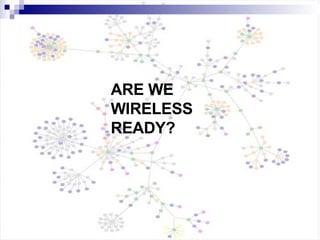
ARE WE  WIRELESS  READY?
 
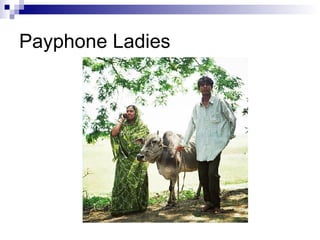
Payphone Ladies
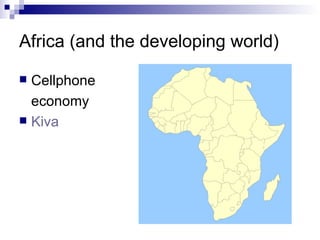
Africa (and the developing world) Cellphone economy Kiva
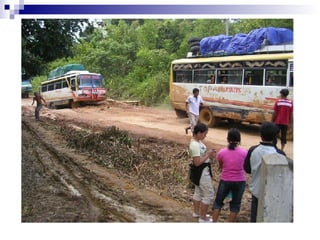
Are we wireless ready? Are we sociologically ready?
Online without a guide
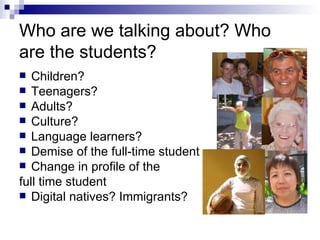
Who are we talking about? Who are the students? Children? Teenagers? Adults? Culture? Language learners? Demise of the full-time student Change in profile of the  full time student Digital natives? Immigrants?
THE VET CONTEXT The average age of a TAFE student has been about 31 for the last three years. The largest group of TAFE NSW students is aged between 20 and 29 but the fastest growing group of students is aged between 40 and 49. The number of students aged 50 to 64 has also grown quickly and this trend is expected to continue.  (Issues paper, NSW DET,2004)
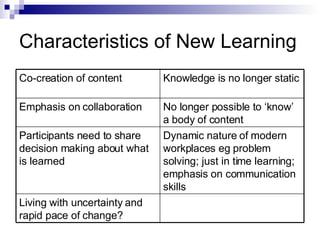
Characteristics of New Learning Living with uncertainty and rapid pace of change? Dynamic nature of modern workplaces eg problem solving; just in time learning; emphasis on communication skills Participants need to share decision making about what is learned No longer possible to ‘know’ a body of content Emphasis on collaboration Knowledge is no longer static Co-creation of content
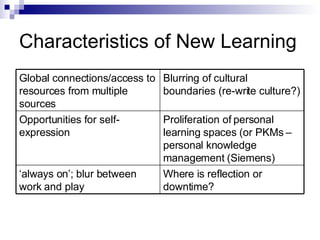
Characteristics of New Learning Where is reflection or downtime? ‘ always on’; blur between work and play Proliferation of personal learning spaces (or PKMs – personal knowledge management (Siemens) Opportunities for self-expression Blurring of cultural boundaries (re-write culture?) Global connections/access to resources from multiple sources
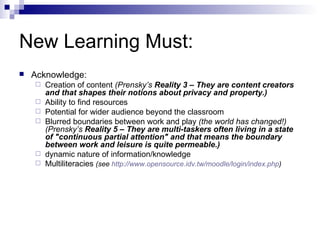
New Learning Must: Acknowledge: Creation of content  (Prensky’s  Reality 3 – They are content creators and that shapes their notions about privacy and property.) Ability to find resources Potential for wider audience beyond the classroom Blurred boundaries between work and play  (the world has changed!) (Prensky’s  Reality 5 – They are multi-taskers often living in a state of "continuous partial attention" and that means the boundary between work and leisure is quite permeable.) dynamic nature of information/knowledge Multiliteracies  (see  http:// www.opensource.idv.tw/moodle/login/index.php )
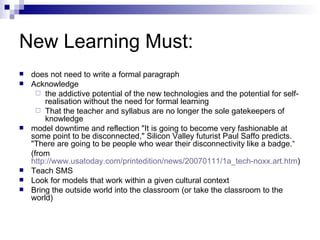
New Learning Must: does not need to write a formal paragraph Acknowledge  the addictive potential of the new technologies and the potential for self-realisation without the need for formal learning That the teacher and syllabus are no longer the sole gatekeepers of knowledge model downtime and reflection "It is going to become very fashionable at some point to be disconnected," Silicon Valley futurist Paul Saffo predicts. "There are going to be people who wear their disconnectivity like a badge.“ (from  http://www.usatoday.com/printedition/news/20070111/1a_tech-noxx.art.htm ) Teach SMS Look for models that work within a given cultural context Bring the outside world into the classroom (or take the classroom to the world)
New Learning! I am preparing a Power Point with audio for my 75 Th  birthday.  I recited poetry in a coffee house and I want to recreate it with music in the background. It was flutes and bongos, but that’s not important. What is important is for one of you experts to tell me how to do it. Please 1-2-3 Keep it simple. Allen Meyers, CEC March 6th
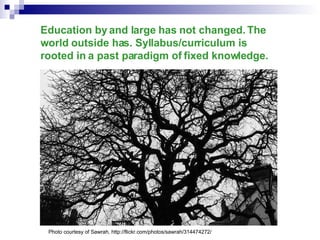
Education by and large has not changed. The world outside has. Syllabus/curriculum is rooted in a past paradigm of fixed knowledge. Photo courtesy of Sawrah, http://flickr.com/photos/sawrah/314474272/
Connectivism in Practice (Feb 2 nd ) plethora of non peer reviewed articles on Net on medical conditions I need Skills to evaluate/validate articles Connections with reliable (human) filters – the trained medical experts
How do I work? I know from my own life that something has changed. I am now a much more social learner. I like to draw on the knowledge of others who I can contact and with whom I can discuss issues - just like what we are doing here. I have definitely changed the way I learn, and have found a better more enjoyable way of learning. Technology, and the connections it has afforded, has made that possible. But the question remains - is anything cognitively different going on learning in this connected manner?  (see  http://newlearning.wikispaces.com/  for collaborative discussion) I doubt that I could study a formal ‘course’ anymore….

Newtech Newlearn B

  • 1.
    New Technologies =New Learning
  • 2.
    Who am I?ESL classroom teacher 1987 – 1997 1997 – went online Blended ESL teaching 1997 – 2000 Volunteer teaching for EFI (English for the Internet) founded by David Winet ESL online 1997 – 2004 Founding member of the Webheads online English teaching and learning community From 2005 fully employed as an elearning educator (adults) for the Australian VET sector (VET: Vocation Education and Training) TAFE SA Australian Flexible Learning Framework Independent elearning/new learning consultant On the web at http://users.sa.chariot.net.au/~michaelc/
  • 3.
    Progression…… Online learningE learning Flexible learning M (mobile) learning E+M = U (ubiquitous) learning (Janet Fraser, Monash Uni ( http://infotech.monash.edu/promotion/coolcampus/workshop/3rdworkshop/walkaboutlearning.pdf )
  • 4.
    Does Mobile Technologyequate with Mobile Learning? Stephen Downes: “ Leonard Low clarifies his thoughts on the definition of 'mobile learning', concentrating more on social factors (ubiquity, ease of use, appropriateness of use in public places, cost) rather than on the device itself.” Leonard Low: (Mar 7, 2007) “ Mobile learning is, after all, about the mobility of learning , and not merely the mobility of technology….. how we achieve that mobility of learning must consider the context of the learning, and not just the use of mobile technology, if it is to achieve its full potential.”
  • 5.
    ARE WE WIRELESS READY?
  • 6.
  • 7.
  • 8.
    Africa (and thedeveloping world) Cellphone economy Kiva
  • 9.
    Are we wirelessready? Are we sociologically ready?
  • 10.
  • 11.
    Who are wetalking about? Who are the students? Children? Teenagers? Adults? Culture? Language learners? Demise of the full-time student Change in profile of the full time student Digital natives? Immigrants?
  • 12.
    THE VET CONTEXTThe average age of a TAFE student has been about 31 for the last three years. The largest group of TAFE NSW students is aged between 20 and 29 but the fastest growing group of students is aged between 40 and 49. The number of students aged 50 to 64 has also grown quickly and this trend is expected to continue. (Issues paper, NSW DET,2004)
  • 13.
    Characteristics of NewLearning Living with uncertainty and rapid pace of change? Dynamic nature of modern workplaces eg problem solving; just in time learning; emphasis on communication skills Participants need to share decision making about what is learned No longer possible to ‘know’ a body of content Emphasis on collaboration Knowledge is no longer static Co-creation of content
  • 14.
    Characteristics of NewLearning Where is reflection or downtime? ‘ always on’; blur between work and play Proliferation of personal learning spaces (or PKMs – personal knowledge management (Siemens) Opportunities for self-expression Blurring of cultural boundaries (re-write culture?) Global connections/access to resources from multiple sources
  • 15.
    New Learning Must:Acknowledge: Creation of content (Prensky’s Reality 3 – They are content creators and that shapes their notions about privacy and property.) Ability to find resources Potential for wider audience beyond the classroom Blurred boundaries between work and play (the world has changed!) (Prensky’s Reality 5 – They are multi-taskers often living in a state of "continuous partial attention" and that means the boundary between work and leisure is quite permeable.) dynamic nature of information/knowledge Multiliteracies (see http:// www.opensource.idv.tw/moodle/login/index.php )
  • 16.
    New Learning Must:does not need to write a formal paragraph Acknowledge the addictive potential of the new technologies and the potential for self-realisation without the need for formal learning That the teacher and syllabus are no longer the sole gatekeepers of knowledge model downtime and reflection "It is going to become very fashionable at some point to be disconnected," Silicon Valley futurist Paul Saffo predicts. "There are going to be people who wear their disconnectivity like a badge.“ (from http://www.usatoday.com/printedition/news/20070111/1a_tech-noxx.art.htm ) Teach SMS Look for models that work within a given cultural context Bring the outside world into the classroom (or take the classroom to the world)
  • 17.
    New Learning! Iam preparing a Power Point with audio for my 75 Th birthday. I recited poetry in a coffee house and I want to recreate it with music in the background. It was flutes and bongos, but that’s not important. What is important is for one of you experts to tell me how to do it. Please 1-2-3 Keep it simple. Allen Meyers, CEC March 6th
  • 18.
    Education by andlarge has not changed. The world outside has. Syllabus/curriculum is rooted in a past paradigm of fixed knowledge. Photo courtesy of Sawrah, http://flickr.com/photos/sawrah/314474272/
  • 19.
    Connectivism in Practice(Feb 2 nd ) plethora of non peer reviewed articles on Net on medical conditions I need Skills to evaluate/validate articles Connections with reliable (human) filters – the trained medical experts
  • 20.
    How do Iwork? I know from my own life that something has changed. I am now a much more social learner. I like to draw on the knowledge of others who I can contact and with whom I can discuss issues - just like what we are doing here. I have definitely changed the way I learn, and have found a better more enjoyable way of learning. Technology, and the connections it has afforded, has made that possible. But the question remains - is anything cognitively different going on learning in this connected manner? (see http://newlearning.wikispaces.com/ for collaborative discussion) I doubt that I could study a formal ‘course’ anymore….