DIGITAL DELIVERY FOR LOW
LEVEL LITERACY STUDENTS
CC image from Peter Shanks
Is it so
different to
what other
learners
need?
Michael Coghlan
NewLearning
5/5/15
WHERE DOES AUSTRALIA RATE?
http://en.wikipedia.org/wiki/List_of_countries_by_literacy_rate
BACKGROUND
• The Australian Bureau of Statistics estimates that 7.3 million
Australians - almost half the adult population - have problems with
literacy. These people often struggle to hold down jobs, balance their
household budget and just make their way through each day.
(Australian, April 9th, 2013)
• The 2006/7 Adult Literacy and Lifeskills Survey (ALLS) indicated that
between 46% and 70% of adults in Australia had “poor” or “very
poor” skills across one or more of the five skill domains of prose
literacy, document literacy, numeracy, problem-solving and health
literacy.
https://ala.asn.au/wp-content/uploads/2011/02/LLN_paper.pdf
“So many literacies are there!”
(Can we list some?)
TYPES OF LITERACY
• Media literacy
• Critical literacy
• Visual literacy
• Information literacy
• Digital literacy
• Eliteracy
• Transliteracy
• Multiliteracy
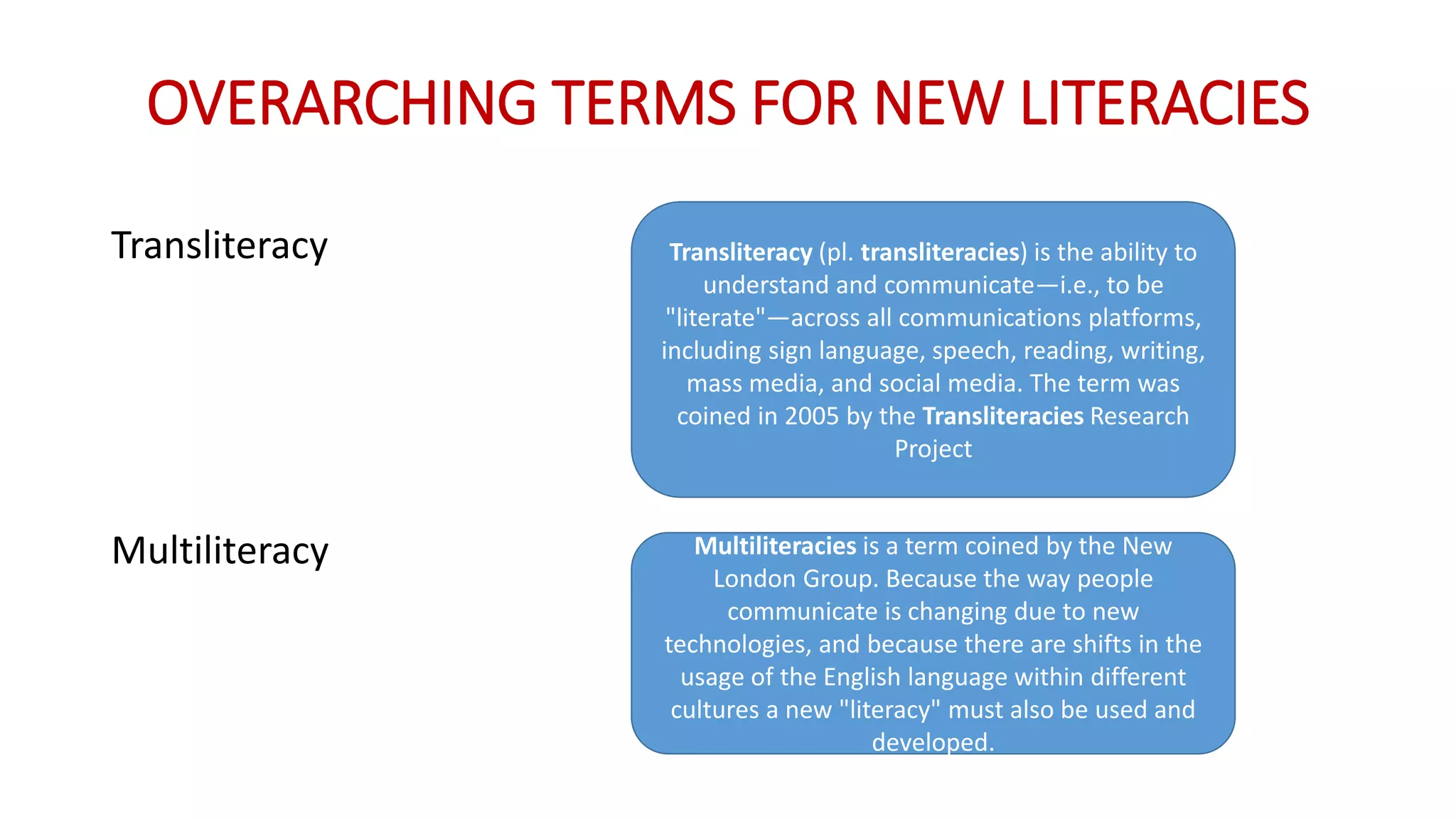
OVERARCHING TERMS FOR NEW LITERACIES
Transliteracy
Multiliteracy
Transliteracy (pl. transliteracies) is the ability to
understand and communicate—i.e., to be
"literate"—across all communications platforms,
including sign language, speech, reading, writing,
mass media, and social media. The term was
coined in 2005 by the Transliteracies Research
Project
Multiliteracies is a term coined by the New
London Group. Because the way people
communicate is changing due to new
technologies, and because there are shifts in the
usage of the English language within different
cultures a new "literacy" must also be used and
developed.
“For years at school I was asked to
do things I wasn’t good at and that I
wasn’t interested in.”
Appointed editor of the
new media based school
magazine.
“Finally after several years I was
able to spend time at school doing
things I enjoyed and that I was good at!”
MORE ON MULTILITERACY:
• while eating breakfast, students may be listening and speaking at the table while watching a morning news
program that requires them to attend to print, view both still and moving images, interact with a website or
view a film clip, and at the same time interpret the behaviour of the news broadcasters interviewing
someone from another country on a split screen.
• To learn within this environment, students need to be able to understand and use the grammars of
language, still and moving images, music and sound. These grammars are often referred to as semiotic
systems. Five semiotic systems have been identified; the linguistic (ie the traditional system of producing
shared meaning using sounds, words, sentences, paragraphs etc), the visual (eg line, colour, vector, texture),
the gestural (eg facial expression, body position and posture), the spatial (eg the organisation of people and
objects in space) and the aural (eg sound, music and silence).
• A 21st-century multiliterate individual needs to have the skills to consume all five semiotic systems.
Conversely, they will be required to produce texts that use all five systems such as play scripts, email, video
and PowerPoint presentations. The terms ‘consuming’ and ‘producing’ are used here because they more
accurately describe the knowledge, skills and processes employed in constructing print and digital texts than
the traditional terms reading, listening, writing and speaking.
• Exposure to all these forms of text must go hand in hand with the realisation that all texts are consciously
constructed in order to share information in particular ways – that texts can shape attitudes, values and
behaviours.
MULTILITERACIES RESOURCE
• Victorian Department of
Education Series Videos –
Considering Multiliteracies -
http://newlearningonline.com/
multiliteracies/videos
(thank you Mark Pegrum!)
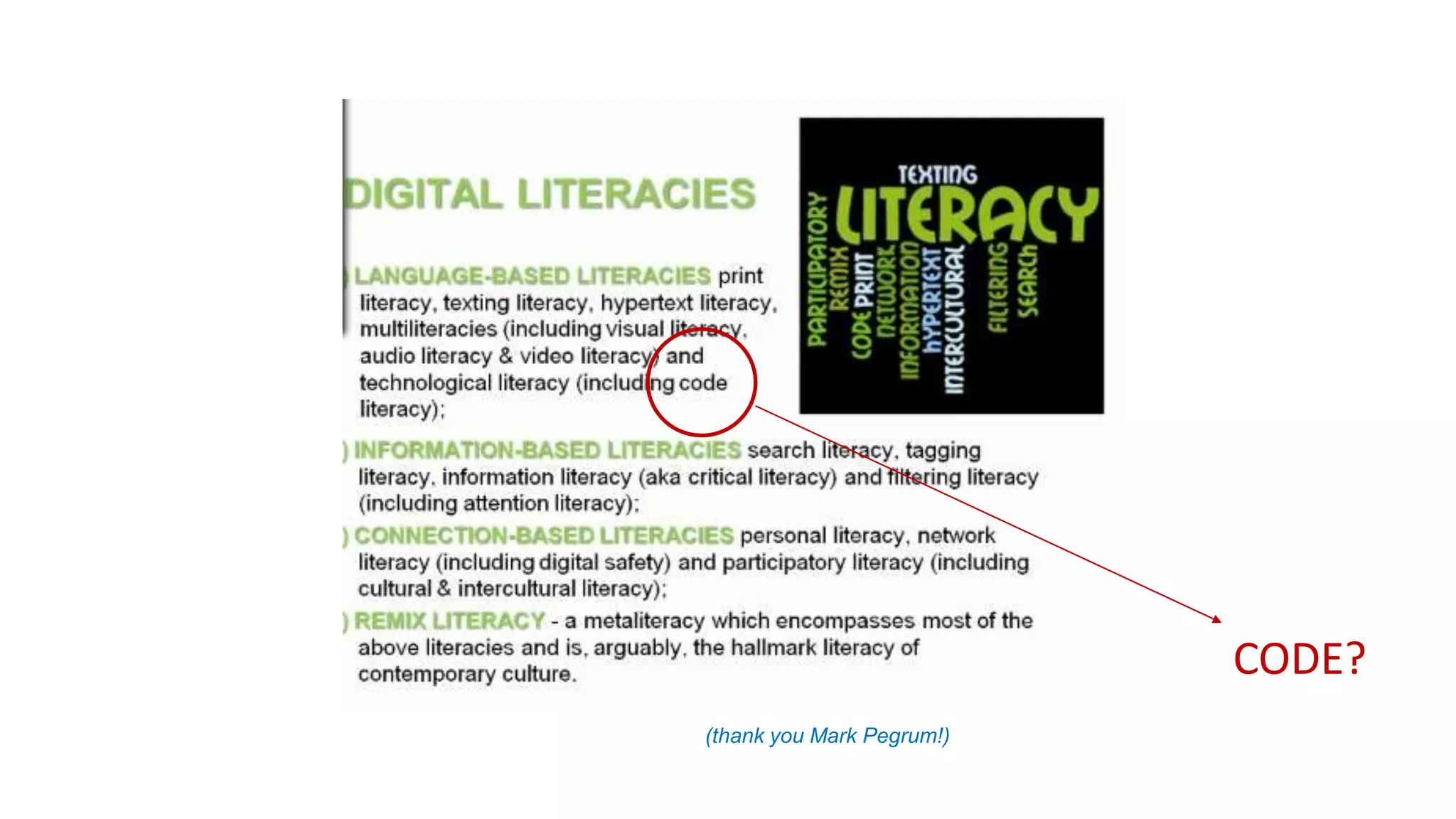
CODE?
LITERACY OVERKILL?
Is it a case of literacy overkill?
Literacy simply has come to
mean the ability to do
something effectively eg sing
(musical literacy?)
Low Level Literacy
ACSF: pre-level 1 and level 1
SUPPORT CONTEXT TEXT COMPLEXITY TASK COMPLEXITY
Significant support
Works alongside an
expert/
mentor
Prompting, advice and
modelling provided
Highly familiar contexts only
Concrete and immediate
Extremely restricted range of
contexts
Short and simple
Highly explicit purpose
Limited, highly familiar
vocabulary
Single step, concrete tasks
Processes include copying,
naming, matching, ordering
Works alongside an
expert/mentor where
prompting and advice
can be provided
Highly familiar contexts
Concrete and immediate
Very restricted range of
contexts
Short and simple
Highly explicit purpose
Limited, highly familiar
vocabulary
Concrete tasks of 1 or 2 steps
Processes include locating,
recognising
Pre
Level 1
1
“Keep It Real” (ie authentic)
1998
Your students want to discuss real issues
DON’T LOWER (Intellectual)
STANDARDS
Language focus here
(dog, beach, walking)
Mind focus here
WHAT IS YOUR/THEIR PURPOSE?
Why do they want to read and write? What do they want to
accomplish? AND … what are YOU trying to achieve?
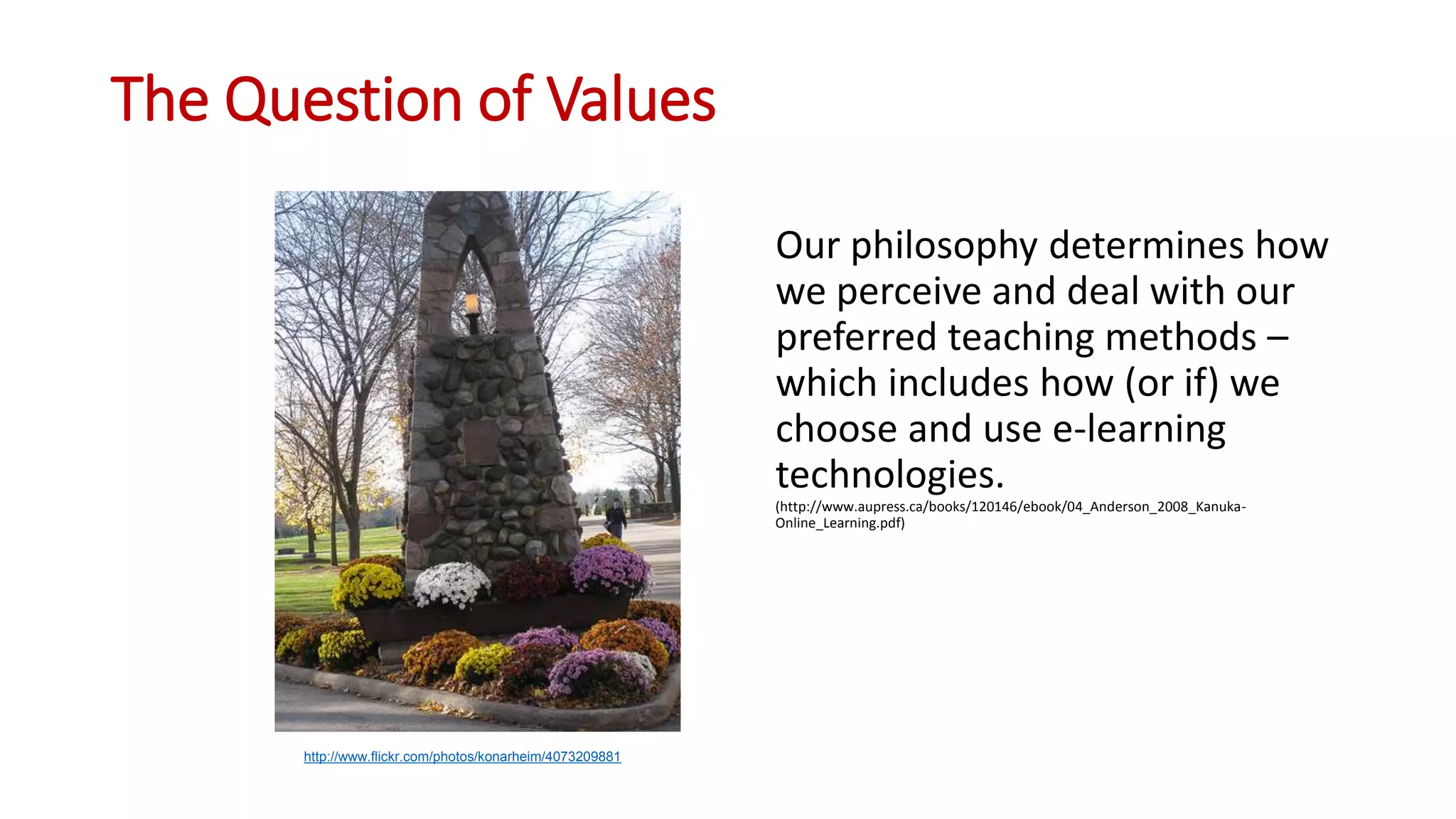
The Question of Values
Our philosophy determines how
we perceive and deal with our
preferred teaching methods –
which includes how (or if) we
choose and use e-learning
technologies.
(http://www.aupress.ca/books/120146/ebook/04_Anderson_2008_Kanuka-
Online_Learning.pdf)
http://www.flickr.com/photos/konarheim/4073209881
TEHRAN
https://www.flickr.com/photos/kamshots/6299604013/
1968
2010
PEOPLE NEED A PURPOSE AND THEY MIGHT
NOT KNOW
WHAT THAT IS - YET
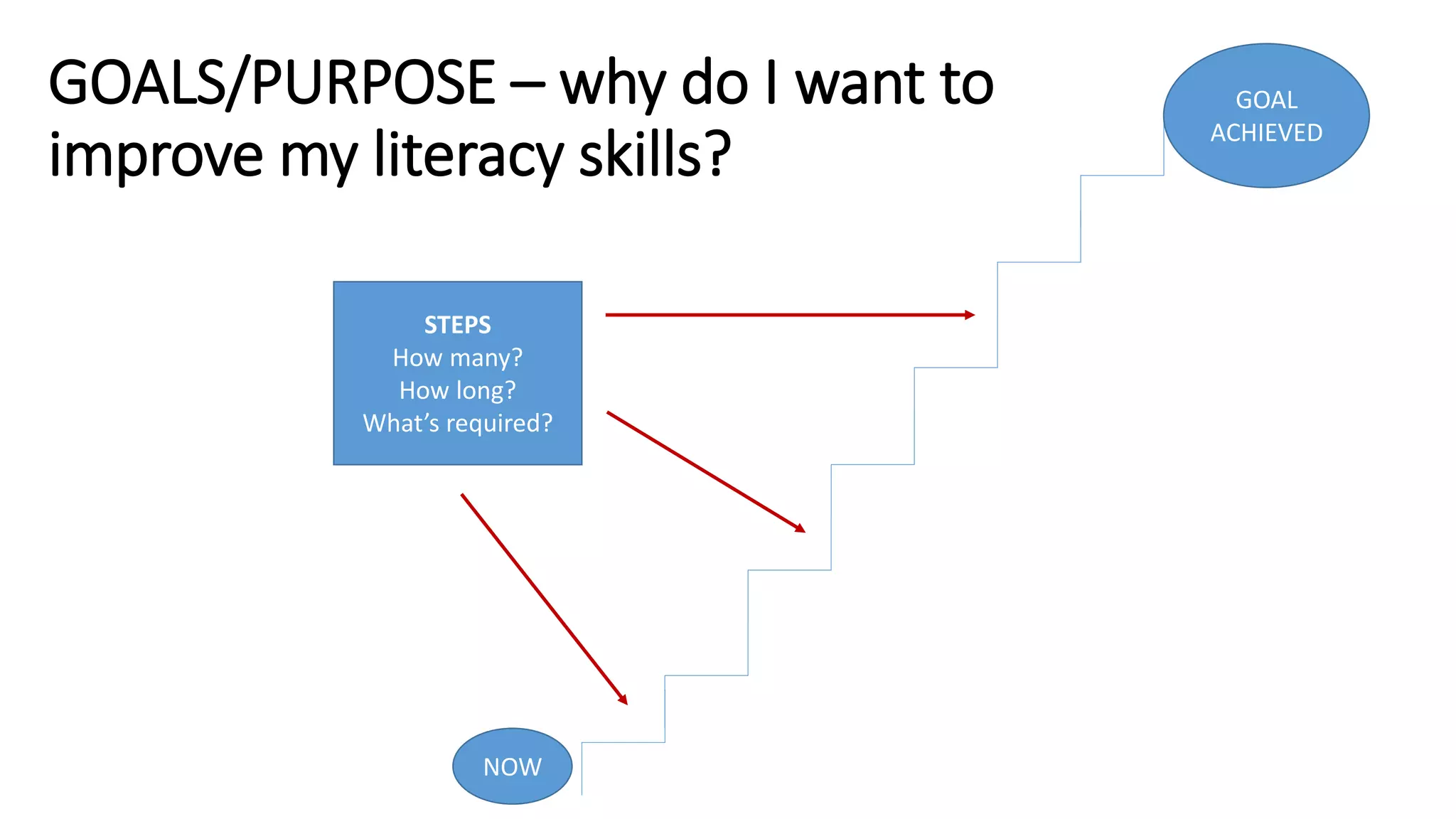
GOALS/PURPOSE – why do I want to
improve my literacy skills?
NOW
GOAL
ACHIEVED
STEPS
How many?
How long?
What’s required?
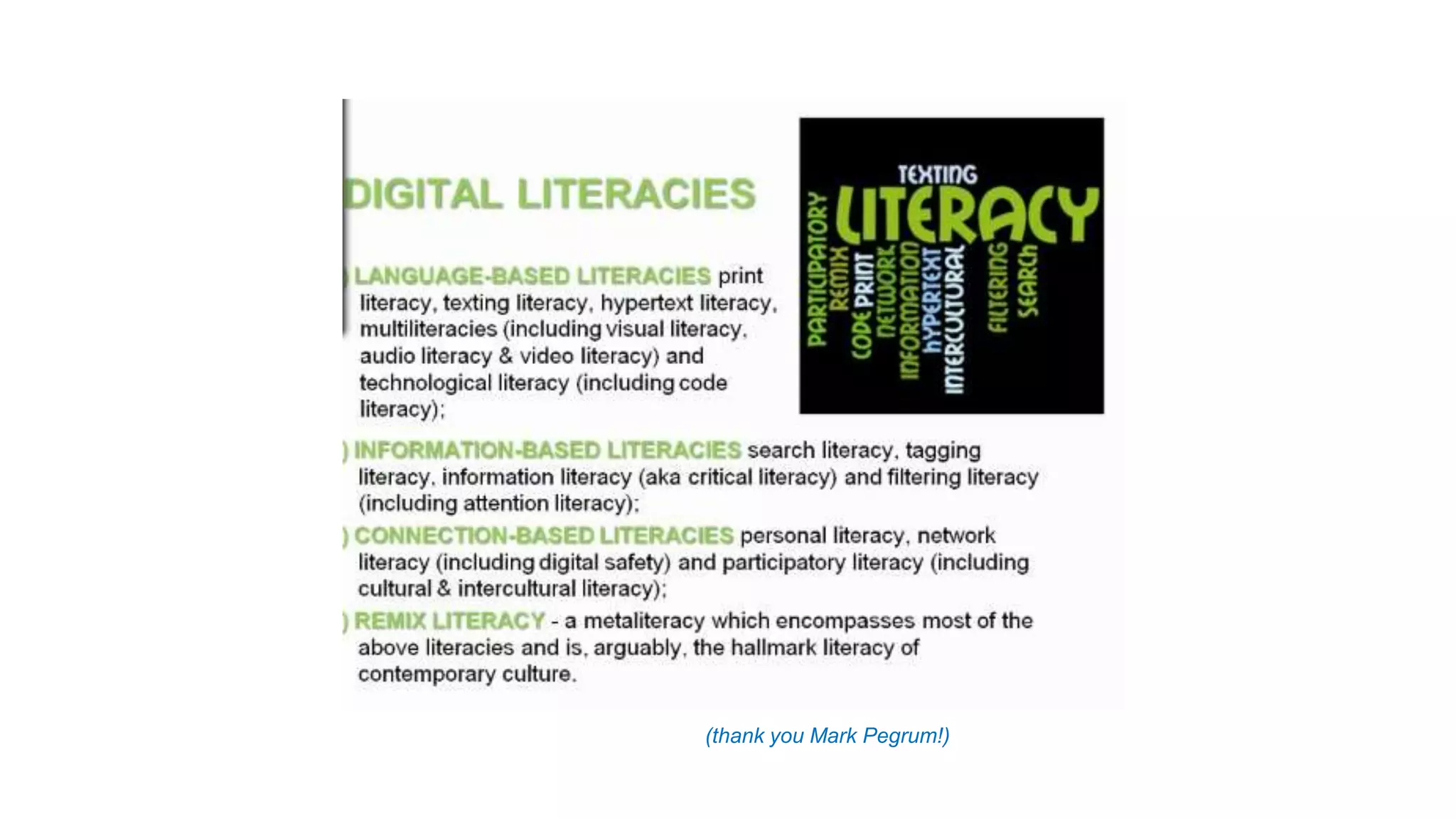
(thank you Mark Pegrum!)
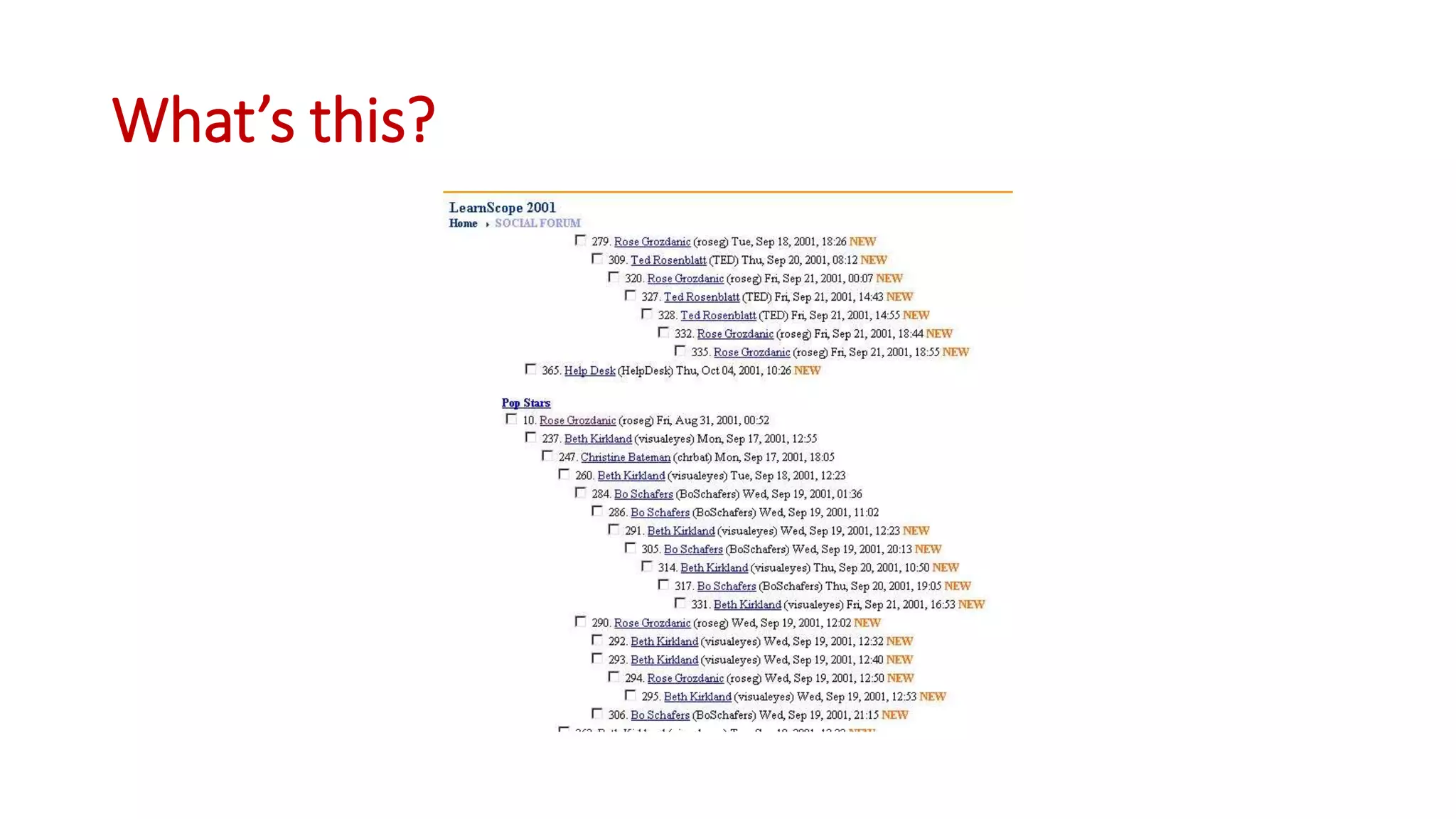
What’s this?
What’s this?
What’s this?
What’s this?
MANY CHANNELS
How I communicate with people I know:
• Person B – SMS OR Facebook
• Person C – Facebook
• Person D – email or SMS
• Person BE – FB or email
• Person T – SMS
• Person A – SMS or Facebook
• Person J – email
• Person E - phone
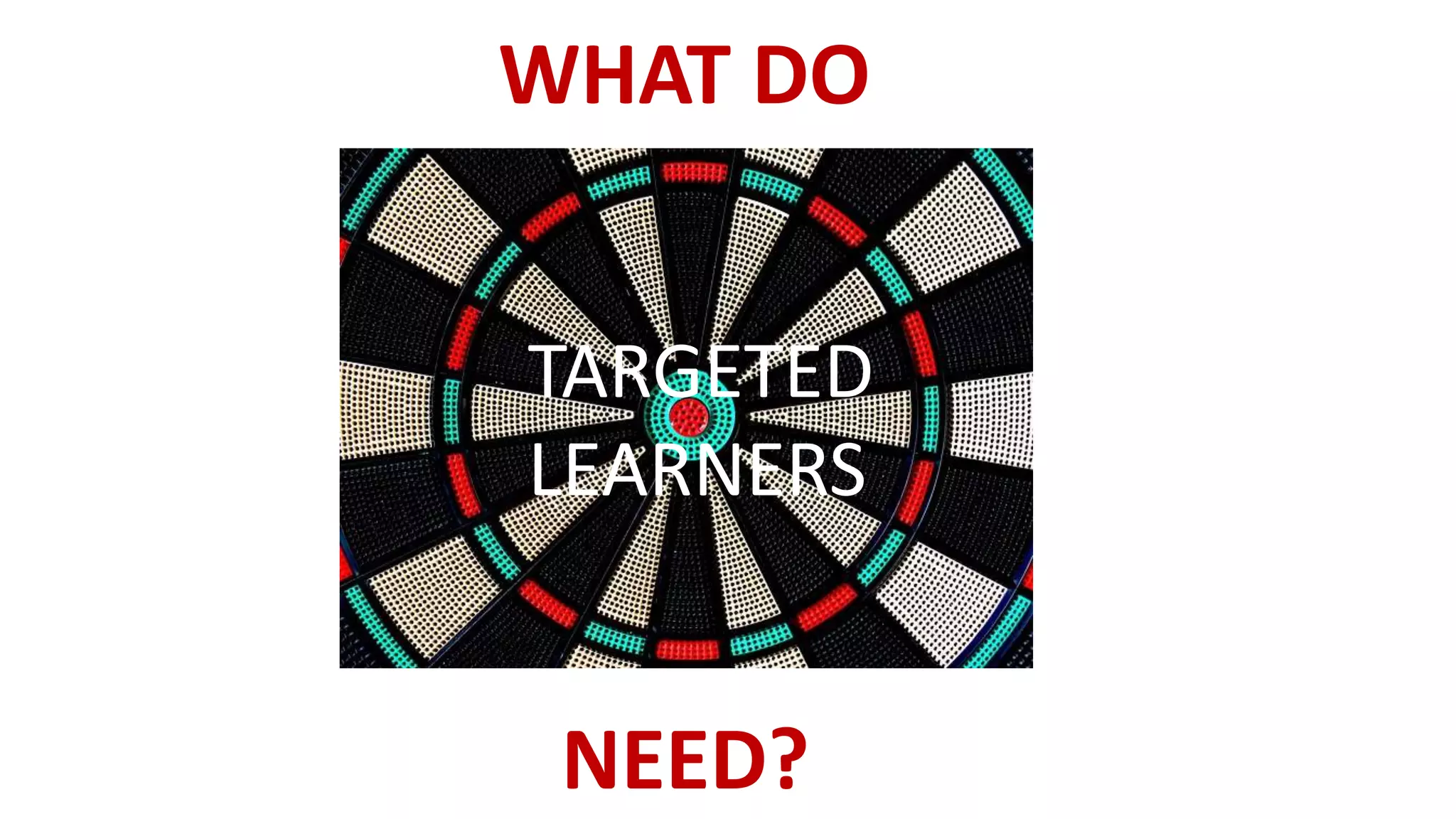
TARGETED
LEARNERS
WHAT DO
NEED?
ALL ‘TARGETED’ LEARNERS REQUIRE:
• Clear context (why am I here?)
• Clear purpose (why am I doing this?)
• Opportunity to create, interpret (make meaning)
• That they be given a voice > a sense of self-worth/value
= feeling successful > motivation
• Support
• Patience
CONDITIONS THAT PROMOTE LEARNING
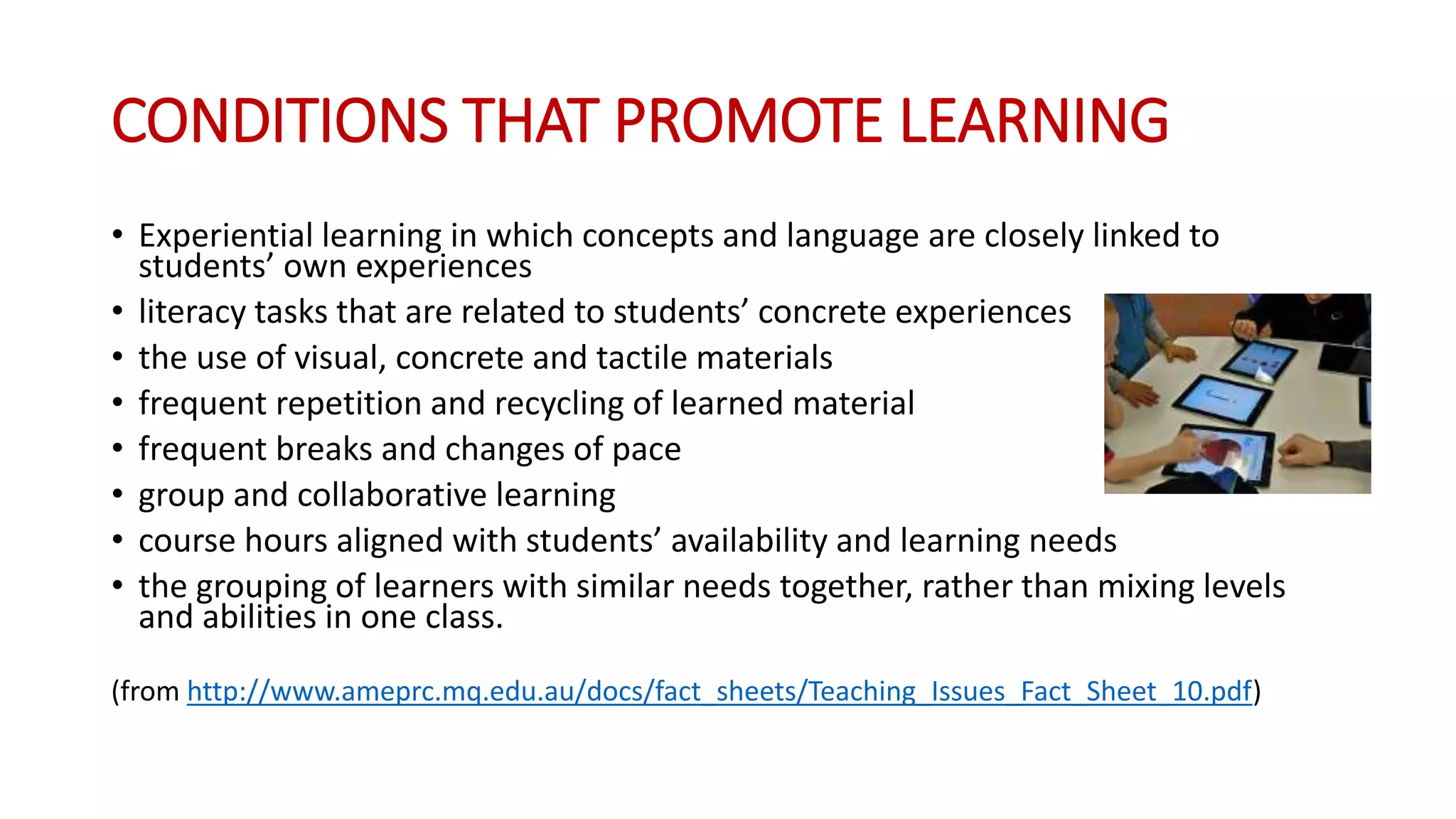
• Experiential learning in which concepts and language are closely linked to
students’ own experiences
• literacy tasks that are related to students’ concrete experiences
• the use of visual, concrete and tactile materials
• frequent repetition and recycling of learned material
• frequent breaks and changes of pace
• group and collaborative learning
• course hours aligned with students’ availability and learning needs
• the grouping of learners with similar needs together, rather than mixing levels
and abilities in one class.
(from http://www.ameprc.mq.edu.au/docs/fact_sheets/Teaching_Issues_Fact_Sheet_10.pdf)
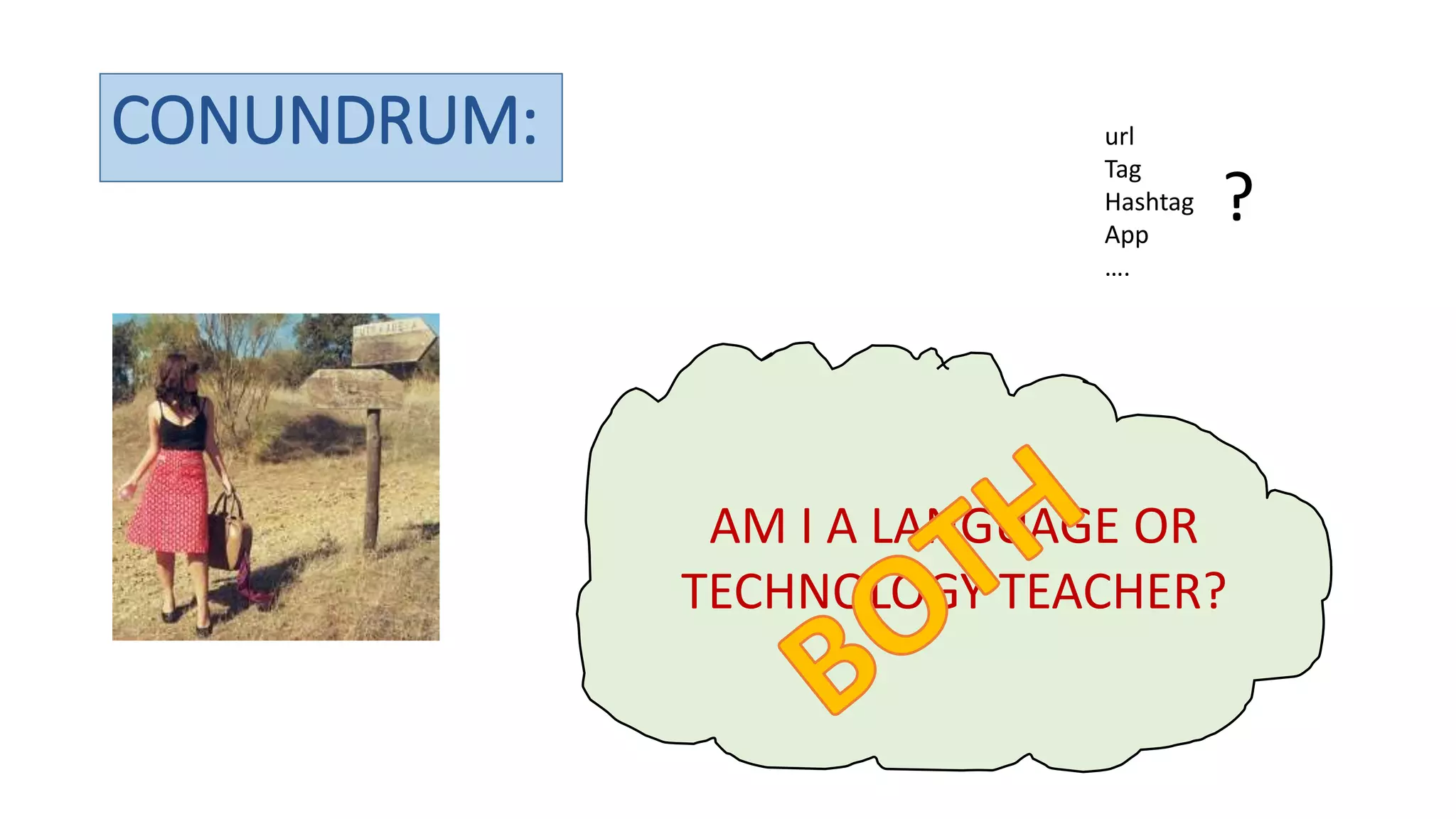
CONUNDRUM:
AM I A LANGUAGE OR
TECHNOLOGY TEACHER?
url
Tag
Hashtag
App
….
?
AM I A LANGUAGE OR
TECHNOLOGY TEACHER?
CONUNDRUM:
AM I A LANGUAGE OR
TECHNOLOGY TEACHER?
url
Tag
Hashtag
App
….
?
AM I A LANGUAGE OR
TECHNOLOGY TEACHER?
POSSIBLE ACTIVITIES
• Streets of Tehran (or similar)
• Bruce’s students – cleaning up vacant lot/planting stuff > website
(tactile, concrete)
• Solving authentic problems (keeping it real/relevant; linked to
students’ own experiences)
• Working with community (“take the classroom to the world OR bring
the world into your classroom”)
• Flickr (for tagging)
TEACHING ABOUT TAGS WITH FLICKR (or
Instagram)
• Choose an image
• Brainstorm possible tags
• Search for other images with
these same tags
• Have students create images and
tag them
• Upload to Flickr via class account
Skills: tagging, searching,
vocabulary, content creation
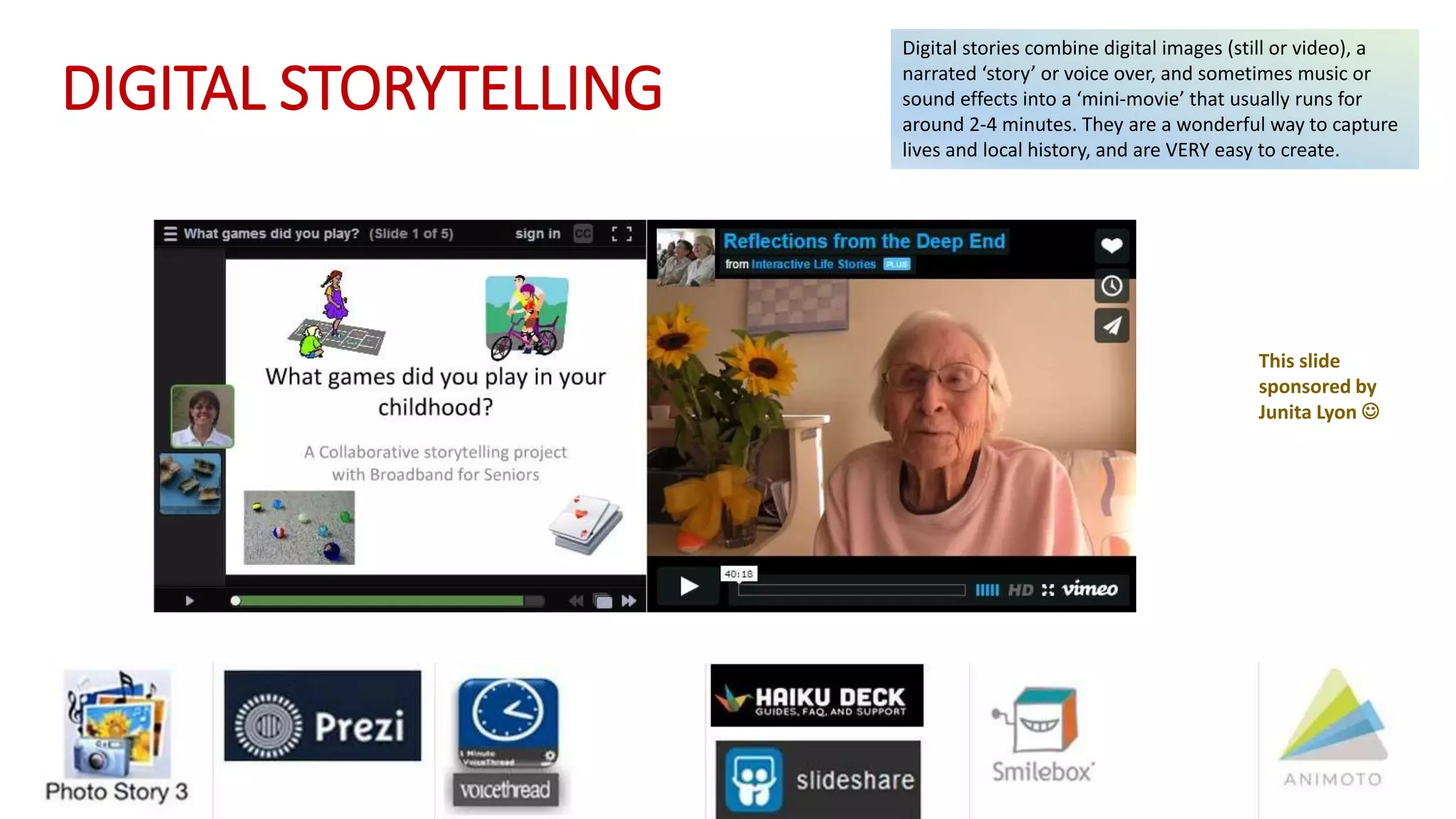
DIGITAL STORYTELLING
Digital stories combine digital images (still or video), a
narrated ‘story’ or voice over, and sometimes music or
sound effects into a ‘mini-movie’ that usually runs for
around 2-4 minutes. They are a wonderful way to capture
lives and local history, and are VERY easy to create.
This slide
sponsored by
Junita Lyon 
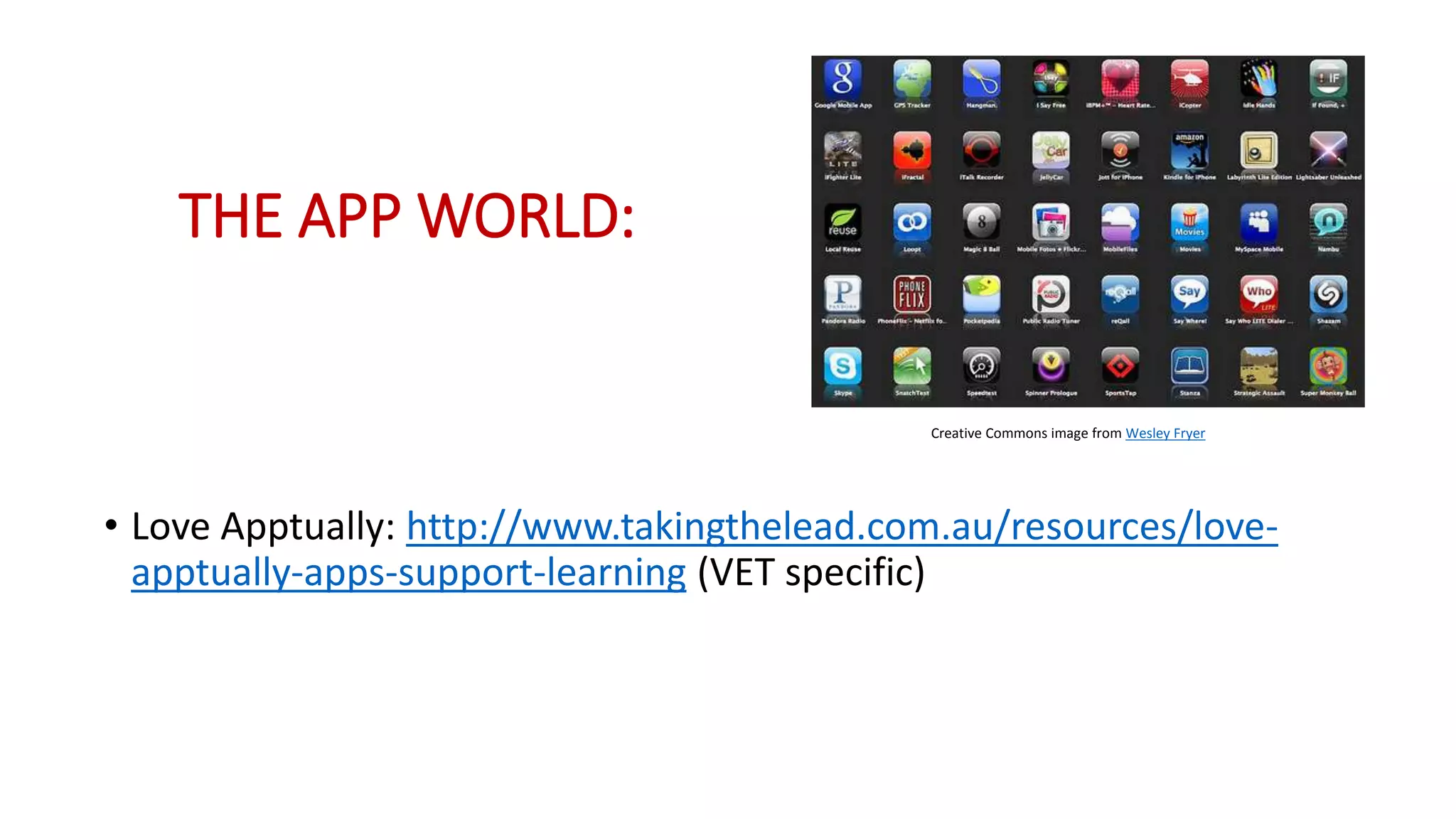
THE APP WORLD:
• Love Apptually: http://www.takingthelead.com.au/resources/love-
apptually-apps-support-learning (VET specific)
Creative Commons image from Wesley Fryer
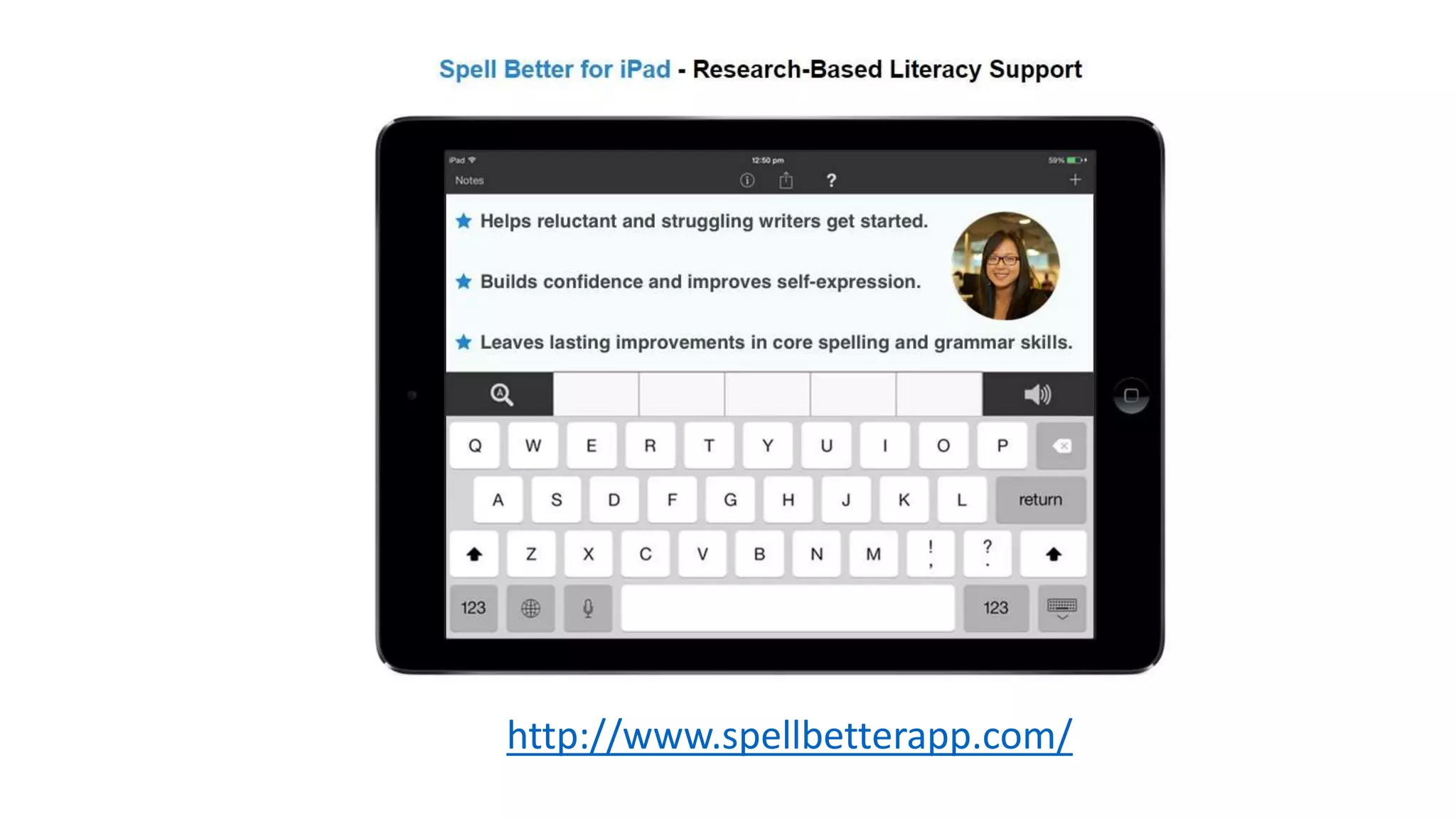
http://www.spellbetterapp.com/
(idea borrowed from Jonathan Finkelstein)
FURTHER RESOURCES
1. Keystrokes to Literacy: Using the Computer As a Learning Tool for Adult
Beginning Readers - http://www.amazon.com/Keystrokes-Literacy-Computer-
Learning-Beginning/dp/0844206792 ($10)
2. What is Digital Literacy? https://www.commoncraft.com/video/digital-literacy?
3. Building Strength with Numeracy - http://www.valbec.org.au/building-
strength-with-numeracy/
4. SEN Teacher – Free Learning Resources -
http://www.senteacher.org/print/literacy/
5. The Body in Audio - http://www.languageguide.org/english/vocabulary/body/
6. Basic English Vocabulary Pronounced Aloud -
http://www.languageguide.org/english/
QUESTIONS/COMMENTS?
END OF
TODAY’S
SESSION
michaelc@chariot.net.au

Digital delivery for low level literacy students

  • 1.
    DIGITAL DELIVERY FORLOW LEVEL LITERACY STUDENTS CC image from Peter Shanks Is it so different to what other learners need? Michael Coghlan NewLearning 5/5/15
  • 2.
    WHERE DOES AUSTRALIARATE? http://en.wikipedia.org/wiki/List_of_countries_by_literacy_rate
  • 3.
    BACKGROUND • The AustralianBureau of Statistics estimates that 7.3 million Australians - almost half the adult population - have problems with literacy. These people often struggle to hold down jobs, balance their household budget and just make their way through each day. (Australian, April 9th, 2013) • The 2006/7 Adult Literacy and Lifeskills Survey (ALLS) indicated that between 46% and 70% of adults in Australia had “poor” or “very poor” skills across one or more of the five skill domains of prose literacy, document literacy, numeracy, problem-solving and health literacy. https://ala.asn.au/wp-content/uploads/2011/02/LLN_paper.pdf

  • 4.
    “So many literaciesare there!” (Can we list some?)
  • 5.
    TYPES OF LITERACY •Media literacy • Critical literacy • Visual literacy • Information literacy • Digital literacy • Eliteracy • Transliteracy • Multiliteracy
  • 6.
    OVERARCHING TERMS FORNEW LITERACIES Transliteracy Multiliteracy Transliteracy (pl. transliteracies) is the ability to understand and communicate—i.e., to be "literate"—across all communications platforms, including sign language, speech, reading, writing, mass media, and social media. The term was coined in 2005 by the Transliteracies Research Project Multiliteracies is a term coined by the New London Group. Because the way people communicate is changing due to new technologies, and because there are shifts in the usage of the English language within different cultures a new "literacy" must also be used and developed.
  • 7.
    “For years atschool I was asked to do things I wasn’t good at and that I wasn’t interested in.” Appointed editor of the new media based school magazine. “Finally after several years I was able to spend time at school doing things I enjoyed and that I was good at!”
  • 8.
    MORE ON MULTILITERACY: •while eating breakfast, students may be listening and speaking at the table while watching a morning news program that requires them to attend to print, view both still and moving images, interact with a website or view a film clip, and at the same time interpret the behaviour of the news broadcasters interviewing someone from another country on a split screen. • To learn within this environment, students need to be able to understand and use the grammars of language, still and moving images, music and sound. These grammars are often referred to as semiotic systems. Five semiotic systems have been identified; the linguistic (ie the traditional system of producing shared meaning using sounds, words, sentences, paragraphs etc), the visual (eg line, colour, vector, texture), the gestural (eg facial expression, body position and posture), the spatial (eg the organisation of people and objects in space) and the aural (eg sound, music and silence). • A 21st-century multiliterate individual needs to have the skills to consume all five semiotic systems. Conversely, they will be required to produce texts that use all five systems such as play scripts, email, video and PowerPoint presentations. The terms ‘consuming’ and ‘producing’ are used here because they more accurately describe the knowledge, skills and processes employed in constructing print and digital texts than the traditional terms reading, listening, writing and speaking. • Exposure to all these forms of text must go hand in hand with the realisation that all texts are consciously constructed in order to share information in particular ways – that texts can shape attitudes, values and behaviours.
  • 9.
    MULTILITERACIES RESOURCE • VictorianDepartment of Education Series Videos – Considering Multiliteracies - http://newlearningonline.com/ multiliteracies/videos
  • 10.
    (thank you MarkPegrum!) CODE?
  • 11.
    LITERACY OVERKILL? Is ita case of literacy overkill? Literacy simply has come to mean the ability to do something effectively eg sing (musical literacy?)
  • 12.
    Low Level Literacy ACSF:pre-level 1 and level 1 SUPPORT CONTEXT TEXT COMPLEXITY TASK COMPLEXITY Significant support Works alongside an expert/ mentor Prompting, advice and modelling provided Highly familiar contexts only Concrete and immediate Extremely restricted range of contexts Short and simple Highly explicit purpose Limited, highly familiar vocabulary Single step, concrete tasks Processes include copying, naming, matching, ordering Works alongside an expert/mentor where prompting and advice can be provided Highly familiar contexts Concrete and immediate Very restricted range of contexts Short and simple Highly explicit purpose Limited, highly familiar vocabulary Concrete tasks of 1 or 2 steps Processes include locating, recognising Pre Level 1 1
  • 13.
    “Keep It Real”(ie authentic) 1998 Your students want to discuss real issues
  • 14.
    DON’T LOWER (Intellectual) STANDARDS Languagefocus here (dog, beach, walking) Mind focus here
  • 15.
    WHAT IS YOUR/THEIRPURPOSE? Why do they want to read and write? What do they want to accomplish? AND … what are YOU trying to achieve?
  • 16.
    The Question ofValues Our philosophy determines how we perceive and deal with our preferred teaching methods – which includes how (or if) we choose and use e-learning technologies. (http://www.aupress.ca/books/120146/ebook/04_Anderson_2008_Kanuka- Online_Learning.pdf) http://www.flickr.com/photos/konarheim/4073209881
  • 17.
  • 18.
    1968 2010 PEOPLE NEED APURPOSE AND THEY MIGHT NOT KNOW WHAT THAT IS - YET
  • 19.
    GOALS/PURPOSE – whydo I want to improve my literacy skills? NOW GOAL ACHIEVED STEPS How many? How long? What’s required?
  • 20.
  • 21.
  • 22.
  • 23.
  • 24.
  • 25.
    MANY CHANNELS How Icommunicate with people I know: • Person B – SMS OR Facebook • Person C – Facebook • Person D – email or SMS • Person BE – FB or email • Person T – SMS • Person A – SMS or Facebook • Person J – email • Person E - phone
  • 26.
  • 27.
    ALL ‘TARGETED’ LEARNERSREQUIRE: • Clear context (why am I here?) • Clear purpose (why am I doing this?) • Opportunity to create, interpret (make meaning) • That they be given a voice > a sense of self-worth/value = feeling successful > motivation • Support • Patience
  • 28.
    CONDITIONS THAT PROMOTELEARNING • Experiential learning in which concepts and language are closely linked to students’ own experiences • literacy tasks that are related to students’ concrete experiences • the use of visual, concrete and tactile materials • frequent repetition and recycling of learned material • frequent breaks and changes of pace • group and collaborative learning • course hours aligned with students’ availability and learning needs • the grouping of learners with similar needs together, rather than mixing levels and abilities in one class. (from http://www.ameprc.mq.edu.au/docs/fact_sheets/Teaching_Issues_Fact_Sheet_10.pdf)
  • 30.
    CONUNDRUM: AM I ALANGUAGE OR TECHNOLOGY TEACHER? url Tag Hashtag App …. ? AM I A LANGUAGE OR TECHNOLOGY TEACHER?
  • 31.
    CONUNDRUM: AM I ALANGUAGE OR TECHNOLOGY TEACHER? url Tag Hashtag App …. ? AM I A LANGUAGE OR TECHNOLOGY TEACHER?
  • 32.
    POSSIBLE ACTIVITIES • Streetsof Tehran (or similar) • Bruce’s students – cleaning up vacant lot/planting stuff > website (tactile, concrete) • Solving authentic problems (keeping it real/relevant; linked to students’ own experiences) • Working with community (“take the classroom to the world OR bring the world into your classroom”) • Flickr (for tagging)
  • 33.
    TEACHING ABOUT TAGSWITH FLICKR (or Instagram) • Choose an image • Brainstorm possible tags • Search for other images with these same tags • Have students create images and tag them • Upload to Flickr via class account Skills: tagging, searching, vocabulary, content creation
  • 34.
    DIGITAL STORYTELLING Digital storiescombine digital images (still or video), a narrated ‘story’ or voice over, and sometimes music or sound effects into a ‘mini-movie’ that usually runs for around 2-4 minutes. They are a wonderful way to capture lives and local history, and are VERY easy to create. This slide sponsored by Junita Lyon 
  • 35.
    THE APP WORLD: •Love Apptually: http://www.takingthelead.com.au/resources/love- apptually-apps-support-learning (VET specific) Creative Commons image from Wesley Fryer
  • 36.
  • 37.
    (idea borrowed fromJonathan Finkelstein)
  • 38.
    FURTHER RESOURCES 1. Keystrokesto Literacy: Using the Computer As a Learning Tool for Adult Beginning Readers - http://www.amazon.com/Keystrokes-Literacy-Computer- Learning-Beginning/dp/0844206792 ($10) 2. What is Digital Literacy? https://www.commoncraft.com/video/digital-literacy? 3. Building Strength with Numeracy - http://www.valbec.org.au/building- strength-with-numeracy/ 4. SEN Teacher – Free Learning Resources - http://www.senteacher.org/print/literacy/ 5. The Body in Audio - http://www.languageguide.org/english/vocabulary/body/ 6. Basic English Vocabulary Pronounced Aloud - http://www.languageguide.org/english/
  • 39.
  • 40.