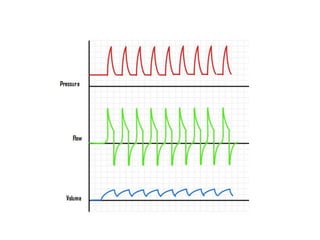
Patient-ventilator dyssynchrony
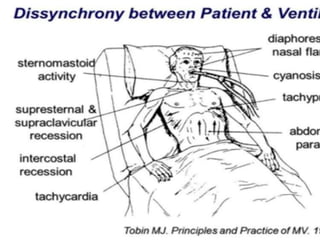
• Dyssynchrony is the effect of the patients
respiratory demands not being appropriately
met by the ventilator. The patient has their
own idea about how to breathe, and the
machinery supporting them, instead of
making breathing easier, interferes with
respiration and increases the work of
breathing.
• PVA id defined mismatchimg between the
patients breaths (neural) and ventilator
assisted breaths and the inability of the
ventilators flow delvery to match the patients
flow demand.
Why is it bad..!!
• The work of breathing increases: which is what you don't want
with mechanical ventilation (remember, the point is to make
breathing EASIER.)
• Thus oxygen demand increases, tachycardia develops, and bad
hearts get worse.
• The patient becomes distressed (the experience of being
dyssynchronous with one's ventilator resembles asphyxiation)
• The patient begins to cough and/or vomit, which is a sub-optimal
level of comfort.
• Increases Hypoxemia and brotrauma, prolongs mechanical
vemtilation and hospital stay in critically ill patients.
• If there was an intracranial pressure problem, it will get worse with
all this straining. Then, your nurse will bolus the patient with a
massive amount of propofol, and their blood pressure will
plummet, which does nothing to improve their cerebral perfusion.
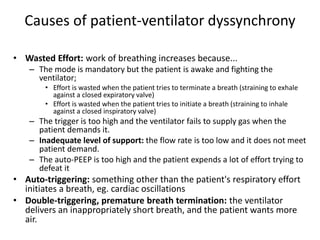
Causes of patient-ventilator dyssynchrony
• Wasted Effort: work of breathing increases because...
– The mode is mandatory but the patient is awake and fighting the
ventilator;
• Effort is wasted when the patient tries to terminate a breath (straining to exhale
against a closed expiratory valve)
• Effort is wasted when the patient tries to initiate a breath (straining to inhale
against a closed inspiratory valve)
– The trigger is too high and the ventilator fails to supply gas when the
patient demands it.
– Inadequate level of support: the flow rate is too low and it does not meet
patient demand.
– The auto-PEEP is too high and the patient expends a lot of effort trying to
defeat it
• Auto-triggering: something other than the patient's respiratory effort
initiates a breath, eg. cardiac oscillations
• Double-triggering, premature breath termination: the ventilator
delivers an inappropriately short breath, and the patient wants more
air.
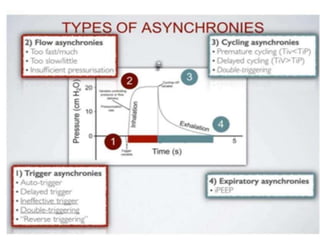
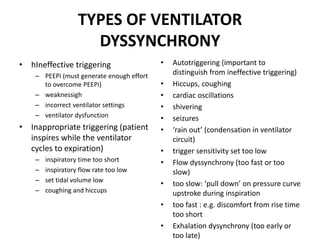
TYPES OF VENTILATOR
DYSSYNCHRONY
• hIneffective triggering
– PEEPi (must generate enough effort
to overcome PEEPi)
– weaknessigh
– incorrect ventilator settings
– ventilator dysfunction
• Inappropriate triggering (patient
inspires while the ventilator
cycles to expiration)
– inspiratory time too short
– inspiratory flow rate too low
– set tidal volume low
– coughing and hiccups
• Autotriggering (important to
distinguish from ineffective triggering)
• Hiccups, coughing
• cardiac oscillations
• shivering
• seizures
• ‘rain out’ (condensation in ventilator
circuit)
• trigger sensitivity set too low
• Flow dyssynchrony (too fast or too
slow)
• too slow: ‘pull down’ on pressure curve
upstroke during inspiration
• too fast : e.g. discomfort from rise time
too short
• Exhalation dysynchrony (too early or
too late)
Factors that may Increase Respiratory
• Hypoxemia, Hyp
Patient-ventilator dyssynchrony.pptx

Patient-ventilator dyssynchrony.pptx

  • 1.
  • 2.
    • Dyssynchrony isthe effect of the patients respiratory demands not being appropriately met by the ventilator. The patient has their own idea about how to breathe, and the machinery supporting them, instead of making breathing easier, interferes with respiration and increases the work of breathing.
  • 3.
    • PVA iddefined mismatchimg between the patients breaths (neural) and ventilator assisted breaths and the inability of the ventilators flow delvery to match the patients flow demand.
  • 4.
    Why is itbad..!! • The work of breathing increases: which is what you don't want with mechanical ventilation (remember, the point is to make breathing EASIER.) • Thus oxygen demand increases, tachycardia develops, and bad hearts get worse. • The patient becomes distressed (the experience of being dyssynchronous with one's ventilator resembles asphyxiation) • The patient begins to cough and/or vomit, which is a sub-optimal level of comfort. • Increases Hypoxemia and brotrauma, prolongs mechanical vemtilation and hospital stay in critically ill patients. • If there was an intracranial pressure problem, it will get worse with all this straining. Then, your nurse will bolus the patient with a massive amount of propofol, and their blood pressure will plummet, which does nothing to improve their cerebral perfusion.
  • 6.
    Causes of patient-ventilatordyssynchrony • Wasted Effort: work of breathing increases because... – The mode is mandatory but the patient is awake and fighting the ventilator; • Effort is wasted when the patient tries to terminate a breath (straining to exhale against a closed expiratory valve) • Effort is wasted when the patient tries to initiate a breath (straining to inhale against a closed inspiratory valve) – The trigger is too high and the ventilator fails to supply gas when the patient demands it. – Inadequate level of support: the flow rate is too low and it does not meet patient demand. – The auto-PEEP is too high and the patient expends a lot of effort trying to defeat it • Auto-triggering: something other than the patient's respiratory effort initiates a breath, eg. cardiac oscillations • Double-triggering, premature breath termination: the ventilator delivers an inappropriately short breath, and the patient wants more air.
  • 8.
    TYPES OF VENTILATOR DYSSYNCHRONY •hIneffective triggering – PEEPi (must generate enough effort to overcome PEEPi) – weaknessigh – incorrect ventilator settings – ventilator dysfunction • Inappropriate triggering (patient inspires while the ventilator cycles to expiration) – inspiratory time too short – inspiratory flow rate too low – set tidal volume low – coughing and hiccups • Autotriggering (important to distinguish from ineffective triggering) • Hiccups, coughing • cardiac oscillations • shivering • seizures • ‘rain out’ (condensation in ventilator circuit) • trigger sensitivity set too low • Flow dyssynchrony (too fast or too slow) • too slow: ‘pull down’ on pressure curve upstroke during inspiration • too fast : e.g. discomfort from rise time too short • Exhalation dysynchrony (too early or too late)
  • 9.
    Factors that mayIncrease Respiratory • Hypoxemia, Hyp