weaning predictors
BY SINTAYEHU( GSR-II)
1
Objectives
 Discuss physiologic variables that are used to indicate readiness to wean
from mechanical ventilation
 Contrast the approaches used to wean patients from mechanical
ventilation
 Discuss the use of protocols to wean patients from ventilatory support
 Discuss the criteria used to indicate readiness for extubation
 Describe the most common reasons why patients fail to wean from
mechanical ventilation
2
Outline
 Introduction
 Assessment of readiness to wean
 Predictors of weaning
 Approach to weaning
 Weaning failure and management
 Predictors of extubation failure
 Management of extubation failure
3
Introduction
 Weaning is the progressive decrease of the amount
of support that a patient receives from the
mechanical ventilator
 more commonly used to describe
 the entire process of decreasing the amount of support
that a patient receives from the mechanical ventilator,
 assessing the patient's clinical response, and
 discontinuing mechanical ventilation.
4
Introduction contd.
 Of mechanically ventilated patients:
 75% are easy to be weaned off the ventilator with simple process
 10-15% require a use of a weaning protocol over a 24-72 hours
 5-10% require a gradual weaning over longer time
 6% prolonged MV (consume 37% of intensive care unit (ICU) resources)
 1% of patients become chronically dependent on MV
5
Contd.
 Incidence of unplanned extubation 0.3-16%
 83% self extubated
 17% accidental
 Almost half of patients with self-extubation during the weaning period do
not require reintubation.
 suggesting that many patients are maintained on mechanical ventilation
longer than is necessary
6
Contd
 Weaning is a process of liberating the patient from MV
 It involves six series of stages
7
contd.
 Delay in reaching stage 2 is a common cause of delayed weaning
 Delay of weaning results in:
 unnecessary discomfort
 increased risk of complications (mortality increases)
 increasing the cost of care (US$2,000 per day)
 40–50% of the total duration of mechanical ventilation is spent in the
weaning process
 The weaning process begins with the first SBT, defined as a T-tube trial or
a low-level pressure support ≤8 cmH2O
8
Clinical Assessment of readiness to
wean
 Improvement of respiratory failure
 Absence of major organ system failure
 Appropriate level of oxygenation
 Adequate ventilatory status
 Intact airway protective mechanism (needed for extubation)
9
Contd.
 Oxygenation Status
 PaO2 ≥ 60 mm Hg
 FiO2 ≤ 0.40
 PEEP ≤ 5 cm H2O
 Ventilation Status
 Intact ventilatory drive(control): ability to control their own level of ventilation
 Respiratory rate < 30
 Minute ventilation of < 12 L to maintain PaCO2 in normal range
 Vt>5ml/kg, vital capacity >10ml/kg
 VD/VT < 60%
 Hemoglobin ≥7 to 10 mg/dL
10
Contd.
 Intact Airway Protective Mechanism
 Appropriate level of consciousness
 Cooperation
 Intact cough reflex
 Intact gag reflex
 Functional respiratory muscles with ability to support a strong and effective cough
11
Functions of Other Organ Systems
 Optimized cardiovascular function
 Arrhythmias
 Fluid overload
 Myocardial contractility, no active myocardial infarction
 Body temperature
 1◦ degree increases CO2 production and O2 consumption by 5%
 Normal electrolytes
 Potassium, magnesium, phosphate and calcium
 Adequate nutritional status
 Under- or over-feeding
 Optimized renal, Acid-base, liver and GI functions
12
weaning predictors
Are physiological tests used to predict weaning
Importance
1, clinicians tend to underestimate readiness to wean.
2, help to identify the earliest time that a patient is able to resume and sustain
spontaneous ventilation and prevent unnecessary prolongation of MV
3, can prevent a premature weaning attempt that could result in cardiovascular,
respiratory, or psychological distress identifying patients who are likely to fail
weaning.
4, may provide insight into the reasons for ongoing ventilator dependence
13
Rapid shallow breathing index (RSBI)
 Ratio of respiratory frequency to tidal volume (RSBI = f/VT).
 Most studied and commonly used predictor
 Likelihood of weaning failure increases as the RSBI increases.
 RSBI >105) breaths/min/L was associated with weaning failure,
 RSBI <105(<130 inelderly) breaths/min/L predicted weaning success
 Factors that decrease RSBI: measuring RSBI when the patient is on MV,
unmeasured inspiratory efforts ,
 Factors that increase RSBI: narrow endotracheal tube, female gender,
sepsis, fever, supine position, anxiety, suctioning, and chronic restrictive
lung disease
14
Maximal inspiratory pressure(MIP)
 is the maximum pressure that can be generated against an occluded airway.
 a marker of respiratory muscle function and strength.
 Non invasive index of diaphragm strength.
 MIP of ≤-30 cmH2O predicted successful weaning
 MIP >-20 cmH2O predicted weaning failure.
 Oxygenation: poor predictor when used alone
 Minute ventilation: elevated total minute ventilation is indicative of
increased respiratory demand. Normally 5 to 6 liters/min at rest. Poor
predictor.
15
Compliance
 Respiratory system compliance is estimated during condition of zero gas flow
Compliance = VT / (plateau pressure - PEEP)
 a decreased Cst,rs of 33 mL/cm H 2 O (normal 60 to 100 mL/cm H 2 O) had a poor
predictive capacity
 Occlusion pressure(P0.1):
 The airway pressure that is measured 0.1 sec after the initiation of an inspiratory
effort against an occluded airway
It is a measure of respiratory drive whose usefulness as a predictor of weaning
outcome is uncertain due to conflicting data
In normal subjects, P0.1 values are < 2 cmH2O
patients who have a P0.1 >4 to 6 cmH2O usually fail weaning,
16
Work of breathing
 calculated from the intrathoracic pressure that is generated by
contraction of the respiratory muscles (or a ventilator) and the VT.
 Normally, at rest, the average work per liter is 0.47 J/L and
 the average work per minute of ventilation is 4.33 J/min.
 increased work of breathing (eg, >1.0 J/L or >13 J/min) predicts weaning
failure.
 Remains confined to research settings due to technical difficulties
 Gastric mucosal acidosis: during weaning blood shift from
splan.circulation to resp ms to meet O2 demand
 may be an indicator of weaning failure
 lower gastric mucosal pH,
 higher intraluminal gastric carbon dioxide (PgCO 2 )
17
Oxygen cost of breathing:
 difference between total O 2 consumption during spontaneous breathing
and during relaxed mechanical ventilation
 Its measurement requires special equipment (ie, a metabolic cart)
 <5 percent of the total O 2 consumption in most healthy subjects
 exceed 50 percent in patients who are being weaned and tends to be
highest among patients who are failing weaning
 No threshold value that accurately discriminates patients who are at
increased risk for weaning failure
18
Integrative indices
 Weaning failure is usually multifactorial; single measures tend to be unreliable.
 Indices that integrate several physiologic mechanisms were developed in an attempt
to further improve the accuracy of prediction.
 The CROP index =[Cdyn x MIP x (PaO2 ÷ PAO2)] ÷ Respiratory Rate
 CROP index >13 mL/breath per min is generally considered to predict weaning
success
 weaning index = PTI x (VE40 ÷ VTsb)
 An index <4 units per minute is generally considered to predict weaning success.
 Integrative weaning index: [(Cst,rs)*SaO 2 ] / [f/VT],
 An IWI ≥25 ml/cm H 2 O/breaths/min/liter predicted successful weaning with a
sensitivity and specificity of 0.97 and 0.94, respectively
 Limitation is difficulty of measuring Cst,rs in spontaneously breathing pts
19
Contd.
 Inspiratory effort quotient (IEQ) = [(0.75VT/Cdyn) x (TI/TTOT)] / MIP,
where VT is the tidal volume, Cdyn is the dynamic compliance, TI is the inspiratory
time, TTOT is time of the respiratory cycle, and MIP is the maximal inspiratory
pressure.
 An IEQ >0.15 has been suggested as the fatiguing threshold that
predicts weaning failure
20
Approaches to weaning
SBT refers breathing through the endotracheal tube
 either without any ventilator support (eg, through a T-piece) or
 with minimal ventilator support (eg, a low level of pressure support, automatic tube
compensation (ATC), or CPAP)
 Alerm, prevent iatrogenic weaning failure from ETT resistance
 Involves one of these methods:
 Setting the ventilator to CPAP, generally at 5cmH2O
 Pressure support (PS) of 5cmH2O over PEEP
 Remove the ventilator and use T-piece( lack of respiratory monitoring)
 ≥ 80-90% patients passing SBT are successfully extubated ( provided ETT is not
needed for other problem)
 If a patient tolerates 30-120 minutes of SBT, can be extubated
 Is an initial, safe, simple and effective method
21
Objective criteria indicating SBT success
Criteria value
Oxygenation/ventilation
SpO2≥85–90% or
PaO2≥50–60
pH≥7.32,
increase in PaCO2≤10
Hemodynamic stability
Not requiring significant vasopressors
Heart rate (HR) <120–140 bpm,
change <20%
SBP<180–200, but >90, and no change
>20%
Breathing pattern RR≤30–35
Not increased by >50%
22
Subjective criteria used to indicate “success” during
the SBT include
 No mental status changes (agitation, anxiety, lethargy, or somnolence)
 No visible onset or worsening of discomfort
 No diaphoresis
 No signs of dramatically increased work of breathing (accessory muscles,
abdominal paradox, respiratory alternans)
23
Management of failed SBT
 SBT failure is defined by objective and subjective indices
 Put the patient back on MV ps mode
 Identify and treat underlying cause
 Diuretics
 Antibiotics
 Adequate pressure support in COPD
 SBT every 24hrs with alternative methods (T-piece vs PS )
 Stable no fatiguing methods( e.g volume assisted control or sufficient PS),
no role for SIMV
24
Pressure Support
 PSV decreased from mean of 19cmH2O by 2or 4cm/day to minimum level
of 5-8 cm H2O
 PSV that prevents activation of accessory muscles
 Once the patient is capable of maintaining the target ventilatory pattern
and gas exchange at this level, MV is discontinued
 Comparable to SBT, after SBT failed we can use progressively increased
time on SBT via T-piece.
25
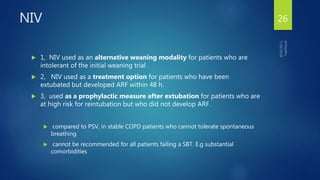
NIV
 1, NIV used as an alternative weaning modality for patients who are
intolerant of the initial weaning trial
 2, NIV used as a treatment option for patients who have been
extubated but developed ARF within 48 h.
 3, used as a prophylactic measure after extubation for patients who are
at high risk for reintubation but who did not develop ARF.
 compared to PSV, in stable COPD patients who cannot tolerate spontaneous
breathing
 cannot be recommended for all patients failing a SBT. E.g substantial
comorbidities
26
Continuous positive airway pressure
 may be an alternative to standard weaning modes
reduces mean intrathoracic pressure,
has beneficial effects on right and left ventricular
performance ,
improves oxygenation and reduces the WOB
additional application of PEEP either alone or with PSV
seems logical for weaning
27
Protocols
 promote the application of evidence-based weaning strategies
 Implemented by respiratory therapists and nurses to make clinical
decisions
 Results in shorter weaning times and shorter length of mechanical
ventilation than physician-directed weaning
 Not shown to be superior to usual care in highly staffed, closed ICUs in an
academic hospital,
28
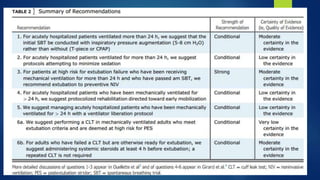
29
Failure to Wean
 defined as either the failure of SBT or the need for reintubation within 48 h
following extubation
 Possible causes
 Excessive work of breathing
 Poor nutritional status
 Overfeeding
 Left heart failure
 Electrolyte imbalance
 Infection/fever
 Major organ failure
 Technical limitation
30
Predictors of extubation failure
1, demographic factors
 Old age
 Preoperative comorbidities
 Need for preoperative intra aortic ballood pump
 Multiple transfusions (>10 units)
 Surgery of thoracic aorta
 Prolonged cardiopulmonary bypass
 Severity of illness at ICU admission…..high APACHE II
 Prolonged duration of ventilation
Exclude from routine
“Fast track” extubation
protocol
31
2, Respiratory mechanics
Only for predicting successful SBT, poor extubation prediction
 1, RSBI: between 57 and 105
 2, occlusion pressure (P0.1): less than 2 cmH2O
 3,MIP assesses strength of all respiratory muscles
 4,VE Recovery time. Assesses work imposed after SBT. identify pts with
better respiratory muscle reserve.
 3.6 plus or minus 2.7min predicts successful extubation
 9.6+/-5.8 fail extubation
 5, WOB: >1.0 J/L or >13 J/min predicts extubation failure
32
3, Parametres assessing airway protection, cough
strength, airway secretion
 White card test: patient asked to cough on to white card through ETT
 Cough strength (0-5)
 Secretion (none- abundant)
 Weak cough plus abundant secretion indicates likely extubation failure
 Negative WCT also predicts extubation failure
 Impaired neurologic function
 Secretion>2.5ml/hr
 Neurologic dysfunction
 GCS≥8 is a prerequisite for successful extubation
33
4,Parametres assessing airway patency
 Cuff leak test:
 refers to normal air flow around ETT after cuff deflated
 Assesses stridor not the need for re-intubation
1. Listen to air movement with stethoscope placed over the upper trachea
2. measuring the difference b/n the inspired and expired Vts of ventilator-delivered
breaths during volume-cycled mechanical ventilation
 Cuff leak volume<110ml(<12 to 24%of the delivered Vt has significant risk of
post extubation stridor
 Laryngeal ultrasound
 Requires an expert hand
 Assesses air column width during cuff deflation
 Reliable ,rapid, non invasive and safe
34
5, Parametres assessing hemodynamics and tissue
perfusion
 The Change from assisted to spontaneous breathing acts as
cardiovascular stress test
 Normal cardiac reserve, responds by increasing CO
 Diminished cardiac reserve, responds by increasing O2 extraction
 Gastric arterial CO2 difference >10mmhg indicates splanchnic
hypoperfusion. Higher in pts who failed extubation
 Positive fluid balance in 24hrs before extubation is associated with the
need for reintubation more frequently.
 Persistent vascular permeability from unresolved illness
 Pulmonary edema cannot be ruled out
35
Management of failed extubation
 Prevention
 Two options
 NIV
 Decreases the need for reintubation and hence associated complications
 Also used for acute exacerbation of COPD
 Prophylactic steroids
 Re-intubation
36
summery
 The primary prerequisite for weaning is reversal of the indication of MV
 Adequate gas exchange should be present with minimal oxygenation and ventilatory
support before weaning is attempted
 The function of all organ systems should be optimized, electrolytes should be
normal, and nutrition should be adequate before weaning is attempted
 The most successful predictor of weaning is RSBI < 100
 Ventilatory discontinuation should be done if patient tolerates SBT for 30-120’
 Patients who fail an SBT should receive a stable, non-fatiguing, comfortable form of
ventilatory support
 Use weaning protocol facilitates the process and decreases the ventilator length of
stay
37
Refences
 Upto date 21.6
 EUROPEAN RESPIRATORY JOURNAL VOLUME 29 NUMBER 5
 CHESTJANUARY 2017
 RESPIRATORYCARE•JULY2014 VOL59 NO7
 Mechanical ventilation clinical application and pathophysiology
38
39

mechanical ventilation Weaning predictors

  • 1.
  • 2.
    Objectives  Discuss physiologicvariables that are used to indicate readiness to wean from mechanical ventilation  Contrast the approaches used to wean patients from mechanical ventilation  Discuss the use of protocols to wean patients from ventilatory support  Discuss the criteria used to indicate readiness for extubation  Describe the most common reasons why patients fail to wean from mechanical ventilation 2
  • 3.
    Outline  Introduction  Assessmentof readiness to wean  Predictors of weaning  Approach to weaning  Weaning failure and management  Predictors of extubation failure  Management of extubation failure 3
  • 4.
    Introduction  Weaning isthe progressive decrease of the amount of support that a patient receives from the mechanical ventilator  more commonly used to describe  the entire process of decreasing the amount of support that a patient receives from the mechanical ventilator,  assessing the patient's clinical response, and  discontinuing mechanical ventilation. 4
  • 5.
    Introduction contd.  Ofmechanically ventilated patients:  75% are easy to be weaned off the ventilator with simple process  10-15% require a use of a weaning protocol over a 24-72 hours  5-10% require a gradual weaning over longer time  6% prolonged MV (consume 37% of intensive care unit (ICU) resources)  1% of patients become chronically dependent on MV 5
  • 6.
    Contd.  Incidence ofunplanned extubation 0.3-16%  83% self extubated  17% accidental  Almost half of patients with self-extubation during the weaning period do not require reintubation.  suggesting that many patients are maintained on mechanical ventilation longer than is necessary 6
  • 7.
    Contd  Weaning isa process of liberating the patient from MV  It involves six series of stages 7
  • 8.
    contd.  Delay inreaching stage 2 is a common cause of delayed weaning  Delay of weaning results in:  unnecessary discomfort  increased risk of complications (mortality increases)  increasing the cost of care (US$2,000 per day)  40–50% of the total duration of mechanical ventilation is spent in the weaning process  The weaning process begins with the first SBT, defined as a T-tube trial or a low-level pressure support ≤8 cmH2O 8
  • 9.
    Clinical Assessment ofreadiness to wean  Improvement of respiratory failure  Absence of major organ system failure  Appropriate level of oxygenation  Adequate ventilatory status  Intact airway protective mechanism (needed for extubation) 9
  • 10.
    Contd.  Oxygenation Status PaO2 ≥ 60 mm Hg  FiO2 ≤ 0.40  PEEP ≤ 5 cm H2O  Ventilation Status  Intact ventilatory drive(control): ability to control their own level of ventilation  Respiratory rate < 30  Minute ventilation of < 12 L to maintain PaCO2 in normal range  Vt>5ml/kg, vital capacity >10ml/kg  VD/VT < 60%  Hemoglobin ≥7 to 10 mg/dL 10
  • 11.
    Contd.  Intact AirwayProtective Mechanism  Appropriate level of consciousness  Cooperation  Intact cough reflex  Intact gag reflex  Functional respiratory muscles with ability to support a strong and effective cough 11
  • 12.
    Functions of OtherOrgan Systems  Optimized cardiovascular function  Arrhythmias  Fluid overload  Myocardial contractility, no active myocardial infarction  Body temperature  1◦ degree increases CO2 production and O2 consumption by 5%  Normal electrolytes  Potassium, magnesium, phosphate and calcium  Adequate nutritional status  Under- or over-feeding  Optimized renal, Acid-base, liver and GI functions 12
  • 13.
    weaning predictors Are physiologicaltests used to predict weaning Importance 1, clinicians tend to underestimate readiness to wean. 2, help to identify the earliest time that a patient is able to resume and sustain spontaneous ventilation and prevent unnecessary prolongation of MV 3, can prevent a premature weaning attempt that could result in cardiovascular, respiratory, or psychological distress identifying patients who are likely to fail weaning. 4, may provide insight into the reasons for ongoing ventilator dependence 13
  • 14.
    Rapid shallow breathingindex (RSBI)  Ratio of respiratory frequency to tidal volume (RSBI = f/VT).  Most studied and commonly used predictor  Likelihood of weaning failure increases as the RSBI increases.  RSBI >105) breaths/min/L was associated with weaning failure,  RSBI <105(<130 inelderly) breaths/min/L predicted weaning success  Factors that decrease RSBI: measuring RSBI when the patient is on MV, unmeasured inspiratory efforts ,  Factors that increase RSBI: narrow endotracheal tube, female gender, sepsis, fever, supine position, anxiety, suctioning, and chronic restrictive lung disease 14
  • 15.
    Maximal inspiratory pressure(MIP) is the maximum pressure that can be generated against an occluded airway.  a marker of respiratory muscle function and strength.  Non invasive index of diaphragm strength.  MIP of ≤-30 cmH2O predicted successful weaning  MIP >-20 cmH2O predicted weaning failure.  Oxygenation: poor predictor when used alone  Minute ventilation: elevated total minute ventilation is indicative of increased respiratory demand. Normally 5 to 6 liters/min at rest. Poor predictor. 15
  • 16.
    Compliance  Respiratory systemcompliance is estimated during condition of zero gas flow Compliance = VT / (plateau pressure - PEEP)  a decreased Cst,rs of 33 mL/cm H 2 O (normal 60 to 100 mL/cm H 2 O) had a poor predictive capacity  Occlusion pressure(P0.1):  The airway pressure that is measured 0.1 sec after the initiation of an inspiratory effort against an occluded airway It is a measure of respiratory drive whose usefulness as a predictor of weaning outcome is uncertain due to conflicting data In normal subjects, P0.1 values are < 2 cmH2O patients who have a P0.1 >4 to 6 cmH2O usually fail weaning, 16
  • 17.
    Work of breathing calculated from the intrathoracic pressure that is generated by contraction of the respiratory muscles (or a ventilator) and the VT.  Normally, at rest, the average work per liter is 0.47 J/L and  the average work per minute of ventilation is 4.33 J/min.  increased work of breathing (eg, >1.0 J/L or >13 J/min) predicts weaning failure.  Remains confined to research settings due to technical difficulties  Gastric mucosal acidosis: during weaning blood shift from splan.circulation to resp ms to meet O2 demand  may be an indicator of weaning failure  lower gastric mucosal pH,  higher intraluminal gastric carbon dioxide (PgCO 2 ) 17
  • 18.
    Oxygen cost ofbreathing:  difference between total O 2 consumption during spontaneous breathing and during relaxed mechanical ventilation  Its measurement requires special equipment (ie, a metabolic cart)  <5 percent of the total O 2 consumption in most healthy subjects  exceed 50 percent in patients who are being weaned and tends to be highest among patients who are failing weaning  No threshold value that accurately discriminates patients who are at increased risk for weaning failure 18
  • 19.
    Integrative indices  Weaningfailure is usually multifactorial; single measures tend to be unreliable.  Indices that integrate several physiologic mechanisms were developed in an attempt to further improve the accuracy of prediction.  The CROP index =[Cdyn x MIP x (PaO2 ÷ PAO2)] ÷ Respiratory Rate  CROP index >13 mL/breath per min is generally considered to predict weaning success  weaning index = PTI x (VE40 ÷ VTsb)  An index <4 units per minute is generally considered to predict weaning success.  Integrative weaning index: [(Cst,rs)*SaO 2 ] / [f/VT],  An IWI ≥25 ml/cm H 2 O/breaths/min/liter predicted successful weaning with a sensitivity and specificity of 0.97 and 0.94, respectively  Limitation is difficulty of measuring Cst,rs in spontaneously breathing pts 19
  • 20.
    Contd.  Inspiratory effortquotient (IEQ) = [(0.75VT/Cdyn) x (TI/TTOT)] / MIP, where VT is the tidal volume, Cdyn is the dynamic compliance, TI is the inspiratory time, TTOT is time of the respiratory cycle, and MIP is the maximal inspiratory pressure.  An IEQ >0.15 has been suggested as the fatiguing threshold that predicts weaning failure 20
  • 21.
    Approaches to weaning SBTrefers breathing through the endotracheal tube  either without any ventilator support (eg, through a T-piece) or  with minimal ventilator support (eg, a low level of pressure support, automatic tube compensation (ATC), or CPAP)  Alerm, prevent iatrogenic weaning failure from ETT resistance  Involves one of these methods:  Setting the ventilator to CPAP, generally at 5cmH2O  Pressure support (PS) of 5cmH2O over PEEP  Remove the ventilator and use T-piece( lack of respiratory monitoring)  ≥ 80-90% patients passing SBT are successfully extubated ( provided ETT is not needed for other problem)  If a patient tolerates 30-120 minutes of SBT, can be extubated  Is an initial, safe, simple and effective method 21
  • 22.
    Objective criteria indicatingSBT success Criteria value Oxygenation/ventilation SpO2≥85–90% or PaO2≥50–60 pH≥7.32, increase in PaCO2≤10 Hemodynamic stability Not requiring significant vasopressors Heart rate (HR) <120–140 bpm, change <20% SBP<180–200, but >90, and no change >20% Breathing pattern RR≤30–35 Not increased by >50% 22
  • 23.
    Subjective criteria usedto indicate “success” during the SBT include  No mental status changes (agitation, anxiety, lethargy, or somnolence)  No visible onset or worsening of discomfort  No diaphoresis  No signs of dramatically increased work of breathing (accessory muscles, abdominal paradox, respiratory alternans) 23
  • 24.
    Management of failedSBT  SBT failure is defined by objective and subjective indices  Put the patient back on MV ps mode  Identify and treat underlying cause  Diuretics  Antibiotics  Adequate pressure support in COPD  SBT every 24hrs with alternative methods (T-piece vs PS )  Stable no fatiguing methods( e.g volume assisted control or sufficient PS), no role for SIMV 24
  • 25.
    Pressure Support  PSVdecreased from mean of 19cmH2O by 2or 4cm/day to minimum level of 5-8 cm H2O  PSV that prevents activation of accessory muscles  Once the patient is capable of maintaining the target ventilatory pattern and gas exchange at this level, MV is discontinued  Comparable to SBT, after SBT failed we can use progressively increased time on SBT via T-piece. 25
  • 26.
    NIV  1, NIVused as an alternative weaning modality for patients who are intolerant of the initial weaning trial  2, NIV used as a treatment option for patients who have been extubated but developed ARF within 48 h.  3, used as a prophylactic measure after extubation for patients who are at high risk for reintubation but who did not develop ARF.  compared to PSV, in stable COPD patients who cannot tolerate spontaneous breathing  cannot be recommended for all patients failing a SBT. E.g substantial comorbidities 26
  • 27.
    Continuous positive airwaypressure  may be an alternative to standard weaning modes reduces mean intrathoracic pressure, has beneficial effects on right and left ventricular performance , improves oxygenation and reduces the WOB additional application of PEEP either alone or with PSV seems logical for weaning 27
  • 28.
    Protocols  promote theapplication of evidence-based weaning strategies  Implemented by respiratory therapists and nurses to make clinical decisions  Results in shorter weaning times and shorter length of mechanical ventilation than physician-directed weaning  Not shown to be superior to usual care in highly staffed, closed ICUs in an academic hospital, 28
  • 29.
  • 30.
    Failure to Wean defined as either the failure of SBT or the need for reintubation within 48 h following extubation  Possible causes  Excessive work of breathing  Poor nutritional status  Overfeeding  Left heart failure  Electrolyte imbalance  Infection/fever  Major organ failure  Technical limitation 30
  • 31.
    Predictors of extubationfailure 1, demographic factors  Old age  Preoperative comorbidities  Need for preoperative intra aortic ballood pump  Multiple transfusions (>10 units)  Surgery of thoracic aorta  Prolonged cardiopulmonary bypass  Severity of illness at ICU admission…..high APACHE II  Prolonged duration of ventilation Exclude from routine “Fast track” extubation protocol 31
  • 32.
    2, Respiratory mechanics Onlyfor predicting successful SBT, poor extubation prediction  1, RSBI: between 57 and 105  2, occlusion pressure (P0.1): less than 2 cmH2O  3,MIP assesses strength of all respiratory muscles  4,VE Recovery time. Assesses work imposed after SBT. identify pts with better respiratory muscle reserve.  3.6 plus or minus 2.7min predicts successful extubation  9.6+/-5.8 fail extubation  5, WOB: >1.0 J/L or >13 J/min predicts extubation failure 32
  • 33.
    3, Parametres assessingairway protection, cough strength, airway secretion  White card test: patient asked to cough on to white card through ETT  Cough strength (0-5)  Secretion (none- abundant)  Weak cough plus abundant secretion indicates likely extubation failure  Negative WCT also predicts extubation failure  Impaired neurologic function  Secretion>2.5ml/hr  Neurologic dysfunction  GCS≥8 is a prerequisite for successful extubation 33
  • 34.
    4,Parametres assessing airwaypatency  Cuff leak test:  refers to normal air flow around ETT after cuff deflated  Assesses stridor not the need for re-intubation 1. Listen to air movement with stethoscope placed over the upper trachea 2. measuring the difference b/n the inspired and expired Vts of ventilator-delivered breaths during volume-cycled mechanical ventilation  Cuff leak volume<110ml(<12 to 24%of the delivered Vt has significant risk of post extubation stridor  Laryngeal ultrasound  Requires an expert hand  Assesses air column width during cuff deflation  Reliable ,rapid, non invasive and safe 34
  • 35.
    5, Parametres assessinghemodynamics and tissue perfusion  The Change from assisted to spontaneous breathing acts as cardiovascular stress test  Normal cardiac reserve, responds by increasing CO  Diminished cardiac reserve, responds by increasing O2 extraction  Gastric arterial CO2 difference >10mmhg indicates splanchnic hypoperfusion. Higher in pts who failed extubation  Positive fluid balance in 24hrs before extubation is associated with the need for reintubation more frequently.  Persistent vascular permeability from unresolved illness  Pulmonary edema cannot be ruled out 35
  • 36.
    Management of failedextubation  Prevention  Two options  NIV  Decreases the need for reintubation and hence associated complications  Also used for acute exacerbation of COPD  Prophylactic steroids  Re-intubation 36
  • 37.
    summery  The primaryprerequisite for weaning is reversal of the indication of MV  Adequate gas exchange should be present with minimal oxygenation and ventilatory support before weaning is attempted  The function of all organ systems should be optimized, electrolytes should be normal, and nutrition should be adequate before weaning is attempted  The most successful predictor of weaning is RSBI < 100  Ventilatory discontinuation should be done if patient tolerates SBT for 30-120’  Patients who fail an SBT should receive a stable, non-fatiguing, comfortable form of ventilatory support  Use weaning protocol facilitates the process and decreases the ventilator length of stay 37
  • 38.
    Refences  Upto date21.6  EUROPEAN RESPIRATORY JOURNAL VOLUME 29 NUMBER 5  CHESTJANUARY 2017  RESPIRATORYCARE•JULY2014 VOL59 NO7  Mechanical ventilation clinical application and pathophysiology 38
  • 39.