WEANING FROM
MECHANICAL VENTILATION
Presenter : Dr. Md. Majidul Islam
Phase-B Resident, CVTS
National Institute of Cardiovascular
Diseases (NICVD)
• Weaning is the process of withdrawing
mechanical ventilatory support and
transferring the work of breathing from
the ventilator to the patient.
• Before weaning, the patient should have recovered from
the acute phase of the disease leading to mechanical
ventilation and be able to assume adequate spontaneous
breathing.
• Weaning is gradually started after evaluating the patient’s
clinical condition, pulmonary and cardiovascular status.
• Depending upon these parameters patient may be given
spontaneous breathing trials on air and extubated.
• If SBT unsuccessful patient is taken back on partial
ventilatory support or pressure support and gradually the
settings reduced and SBT repeated.
VENTILATORY MODES USED FOR WEANING
• Conventional Modes used –
 Pressure support ventilation
 Continuous positive airway pressure
 Synchronised Intermittent Mandatory Ventilation
• Advanced Modes used –
 Volume support
 Volume-assured pressure support
 Mandatory minute ventilation
 Airway pressure-release ventilation
 Automatic tube compensation
Weaning criteria
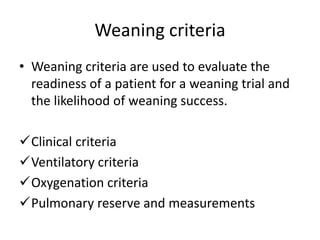
• Weaning criteria are used to evaluate the
readiness of a patient for a weaning trial and
the likelihood of weaning success.
Clinical criteria
Ventilatory criteria
Oxygenation criteria
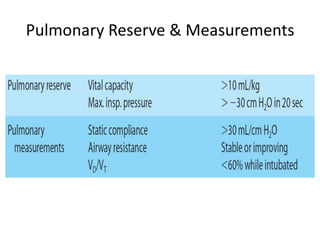
Pulmonary reserve and measurements
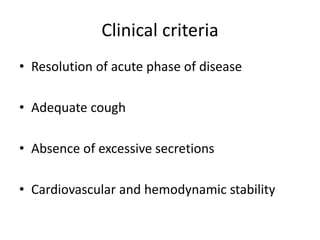
Clinical criteria
• Resolution of acute phase of disease
• Adequate cough
• Absence of excessive secretions
• Cardiovascular and hemodynamic stability
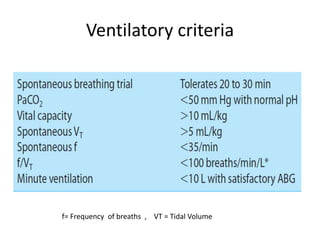
Ventilatory criteria
f= Frequency of breaths , VT = Tidal Volume
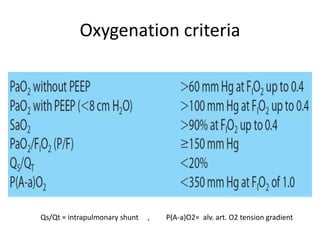
Oxygenation criteria
Qs/Qt = intrapulmonary shunt , P(A-a)O2= alv. art. O2 tension gradient
Pulmonary Reserve & Measurements
Weaning Procedure
• Weaning can be done using : –
Spontaneous breathing trials
Pressure support Ventilation
Synchronised Mandatory Intermittent
Ventilation (SIMV)– Not Recommended alone
Weaning Procedure
• Spontaneous breathing trial (SBT): An evaluation of a
patient’s readiness for weaning from mechanical
ventilation and extubation.
• SBT is the major diagnostic test to determine if patients
can be successfully extubated and weaned from
mechanical ventilation.
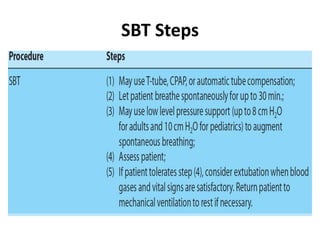
• Spontaneous breathing may be augmented with low-
level (≤ 8 cm H2O) of pressure support, CPAP, or
automatic tube compensation (ATC).
• SBT may last up to 30 minutes.
SBT Steps
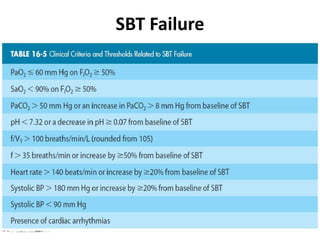
SBT Failure
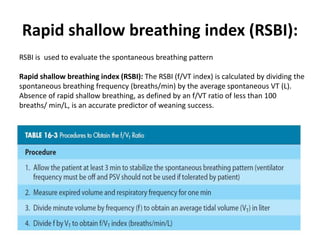
Rapid shallow breathing index (RSBI):
RSBI is used to evaluate the spontaneous breathing pattern
Rapid shallow breathing index (RSBI): The RSBI (f/VT index) is calculated by dividing the
spontaneous breathing frequency (breaths/min) by the average spontaneous VT (L).
Absence of rapid shallow breathing, as defined by an f/VT ratio of less than 100
breaths/ min/L, is an accurate predictor of weaning success.
• When the RSBI or f/VT index is greater than
100 breaths/min/L, it correlates with weaning
failure.
• On the other hand, absence of rapid shallow
breathing (f/VT ratio ,100 breaths/min/L), is
an accurate predictor of weaning success.
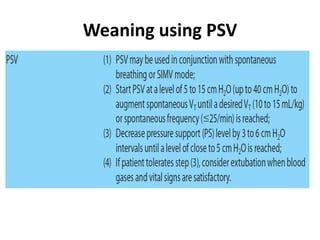
Weaning using PSV
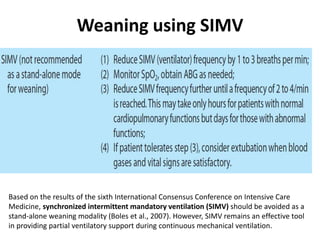
Weaning using SIMV
Based on the results of the sixth International Consensus Conference on Intensive Care
Medicine, synchronized intermittent mandatory ventilation (SIMV) should be avoided as a
stand-alone weaning modality (Boles et al., 2007). However, SIMV remains an effective tool
in providing partial ventilatory support during continuous mechanical ventilation.
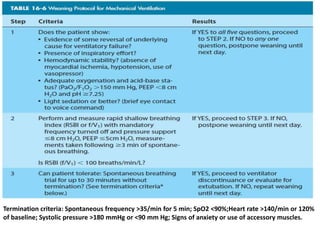
Termination criteria: Spontaneous frequency >35/min for 5 min; SpO2 <90%;Heart rate >140/min or 120%
of baseline; Systolic pressure >180 mmHg or <90 mm Hg; Signs of anxiety or use of accessory muscles.
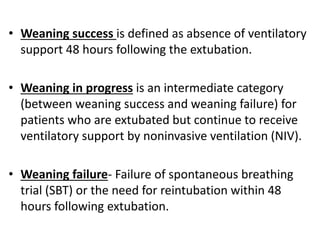
• Weaning success is defined as absence of ventilatory
support 48 hours following the extubation.
• Weaning in progress is an intermediate category
(between weaning success and weaning failure) for
patients who are extubated but continue to receive
ventilatory support by noninvasive ventilation (NIV).
• Weaning failure- Failure of spontaneous breathing
trial (SBT) or the need for reintubation within 48
hours following extubation.
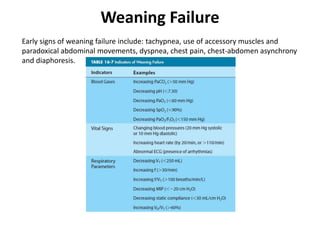
Weaning Failure
Early signs of weaning failure include: tachypnea, use of accessory muscles and
paradoxical abdominal movements, dyspnea, chest pain, chest-abdomen asynchrony
and diaphoresis.
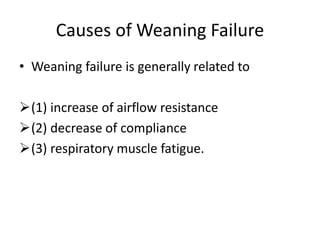
Causes of Weaning Failure
• Weaning failure is generally related to
(1) increase of airflow resistance
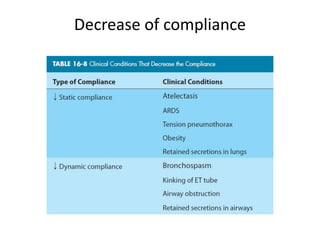
(2) decrease of compliance
(3) respiratory muscle fatigue.
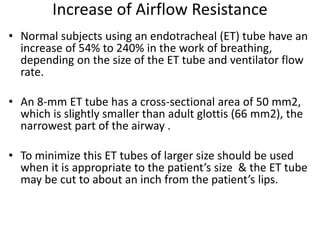
Increase of Airflow Resistance
• Normal subjects using an endotracheal (ET) tube have an
increase of 54% to 240% in the work of breathing,
depending on the size of the ET tube and ventilator flow
rate.
• An 8-mm ET tube has a cross-sectional area of 50 mm2,
which is slightly smaller than adult glottis (66 mm2), the
narrowest part of the airway .
• To minimize this ET tubes of larger size should be used
when it is appropriate to the patient’s size & the ET tube
may be cut to about an inch from the patient’s lips.
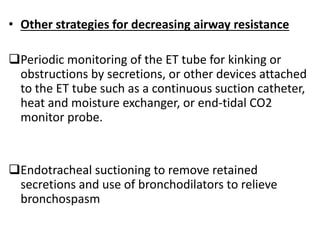
• Other strategies for decreasing airway resistance
Periodic monitoring of the ET tube for kinking or
obstructions by secretions, or other devices attached
to the ET tube such as a continuous suction catheter,
heat and moisture exchanger, or end-tidal CO2
monitor probe.
Endotracheal suctioning to remove retained
secretions and use of bronchodilators to relieve
bronchospasm
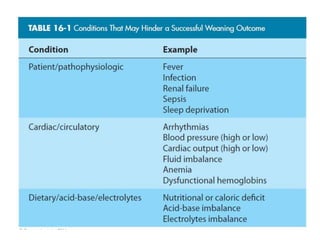
Decrease of compliance
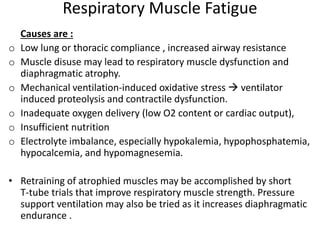
Respiratory Muscle Fatigue
Causes are :
o Low lung or thoracic compliance , increased airway resistance
o Muscle disuse may lead to respiratory muscle dysfunction and
diaphragmatic atrophy.
o Mechanical ventilation-induced oxidative stress  ventilator
induced proteolysis and contractile dysfunction.
o Inadequate oxygen delivery (low O2 content or cardiac output),
o Insufficient nutrition
o Electrolyte imbalance, especially hypokalemia, hypophosphatemia,
hypocalcemia, and hypomagnesemia.
• Retraining of atrophied muscles may be accomplished by short
T-tube trials that improve respiratory muscle strength. Pressure
support ventilation may also be tried as it increases diaphragmatic
endurance .
Terminal Weaning
• Terminal weaning is defined as withdrawal of mechanical ventilation that
results in the death of a patient who is terminally ill or brain dead.
• Different from “EUTHANASIA” or mercy killing as disease is allowed to take its
natural course to death.
• Ethical and moral concerns and legal issues arise before ending mechanical
ventilatory support.
• Only done after detailed discussion with family members and taking their
consent and patient’s consent (conscious patients)when medical intervention
is futile or hopeless in treating the illness.
• In India, terminal weaning only legalised in brain dead or patient in persistent
vegetative state . (On 7 March 2011 Supreme court of India made this decision
as part of verdict in case of Aruna Shanbaug as rarest of rare cases).
• As still there is no clear legislation , such a move requires the permission of
High Court.
THANK YOU

corrected weaningfrommechanicalventilation-.pptx

  • 1.
    WEANING FROM MECHANICAL VENTILATION Presenter: Dr. Md. Majidul Islam Phase-B Resident, CVTS National Institute of Cardiovascular Diseases (NICVD)
  • 2.
    • Weaning isthe process of withdrawing mechanical ventilatory support and transferring the work of breathing from the ventilator to the patient.
  • 3.
    • Before weaning,the patient should have recovered from the acute phase of the disease leading to mechanical ventilation and be able to assume adequate spontaneous breathing. • Weaning is gradually started after evaluating the patient’s clinical condition, pulmonary and cardiovascular status. • Depending upon these parameters patient may be given spontaneous breathing trials on air and extubated. • If SBT unsuccessful patient is taken back on partial ventilatory support or pressure support and gradually the settings reduced and SBT repeated.
  • 4.
    VENTILATORY MODES USEDFOR WEANING • Conventional Modes used –  Pressure support ventilation  Continuous positive airway pressure  Synchronised Intermittent Mandatory Ventilation • Advanced Modes used –  Volume support  Volume-assured pressure support  Mandatory minute ventilation  Airway pressure-release ventilation  Automatic tube compensation
  • 5.
    Weaning criteria • Weaningcriteria are used to evaluate the readiness of a patient for a weaning trial and the likelihood of weaning success. Clinical criteria Ventilatory criteria Oxygenation criteria Pulmonary reserve and measurements
  • 6.
    Clinical criteria • Resolutionof acute phase of disease • Adequate cough • Absence of excessive secretions • Cardiovascular and hemodynamic stability
  • 7.
    Ventilatory criteria f= Frequencyof breaths , VT = Tidal Volume
  • 8.
    Oxygenation criteria Qs/Qt =intrapulmonary shunt , P(A-a)O2= alv. art. O2 tension gradient
  • 9.
    Pulmonary Reserve &Measurements
  • 10.
    Weaning Procedure • Weaningcan be done using : – Spontaneous breathing trials Pressure support Ventilation Synchronised Mandatory Intermittent Ventilation (SIMV)– Not Recommended alone
  • 11.
    Weaning Procedure • Spontaneousbreathing trial (SBT): An evaluation of a patient’s readiness for weaning from mechanical ventilation and extubation. • SBT is the major diagnostic test to determine if patients can be successfully extubated and weaned from mechanical ventilation. • Spontaneous breathing may be augmented with low- level (≤ 8 cm H2O) of pressure support, CPAP, or automatic tube compensation (ATC). • SBT may last up to 30 minutes.
  • 12.
  • 13.
  • 14.
    Rapid shallow breathingindex (RSBI): RSBI is used to evaluate the spontaneous breathing pattern Rapid shallow breathing index (RSBI): The RSBI (f/VT index) is calculated by dividing the spontaneous breathing frequency (breaths/min) by the average spontaneous VT (L). Absence of rapid shallow breathing, as defined by an f/VT ratio of less than 100 breaths/ min/L, is an accurate predictor of weaning success.
  • 15.
    • When theRSBI or f/VT index is greater than 100 breaths/min/L, it correlates with weaning failure. • On the other hand, absence of rapid shallow breathing (f/VT ratio ,100 breaths/min/L), is an accurate predictor of weaning success.
  • 16.
  • 17.
    Weaning using SIMV Basedon the results of the sixth International Consensus Conference on Intensive Care Medicine, synchronized intermittent mandatory ventilation (SIMV) should be avoided as a stand-alone weaning modality (Boles et al., 2007). However, SIMV remains an effective tool in providing partial ventilatory support during continuous mechanical ventilation.
  • 18.
    Termination criteria: Spontaneousfrequency >35/min for 5 min; SpO2 <90%;Heart rate >140/min or 120% of baseline; Systolic pressure >180 mmHg or <90 mm Hg; Signs of anxiety or use of accessory muscles.
  • 19.
    • Weaning successis defined as absence of ventilatory support 48 hours following the extubation. • Weaning in progress is an intermediate category (between weaning success and weaning failure) for patients who are extubated but continue to receive ventilatory support by noninvasive ventilation (NIV). • Weaning failure- Failure of spontaneous breathing trial (SBT) or the need for reintubation within 48 hours following extubation.
  • 20.
    Weaning Failure Early signsof weaning failure include: tachypnea, use of accessory muscles and paradoxical abdominal movements, dyspnea, chest pain, chest-abdomen asynchrony and diaphoresis.
  • 22.
    Causes of WeaningFailure • Weaning failure is generally related to (1) increase of airflow resistance (2) decrease of compliance (3) respiratory muscle fatigue.
  • 23.
    Increase of AirflowResistance • Normal subjects using an endotracheal (ET) tube have an increase of 54% to 240% in the work of breathing, depending on the size of the ET tube and ventilator flow rate. • An 8-mm ET tube has a cross-sectional area of 50 mm2, which is slightly smaller than adult glottis (66 mm2), the narrowest part of the airway . • To minimize this ET tubes of larger size should be used when it is appropriate to the patient’s size & the ET tube may be cut to about an inch from the patient’s lips.
  • 24.
    • Other strategiesfor decreasing airway resistance Periodic monitoring of the ET tube for kinking or obstructions by secretions, or other devices attached to the ET tube such as a continuous suction catheter, heat and moisture exchanger, or end-tidal CO2 monitor probe. Endotracheal suctioning to remove retained secretions and use of bronchodilators to relieve bronchospasm
  • 25.
  • 26.
    Respiratory Muscle Fatigue Causesare : o Low lung or thoracic compliance , increased airway resistance o Muscle disuse may lead to respiratory muscle dysfunction and diaphragmatic atrophy. o Mechanical ventilation-induced oxidative stress  ventilator induced proteolysis and contractile dysfunction. o Inadequate oxygen delivery (low O2 content or cardiac output), o Insufficient nutrition o Electrolyte imbalance, especially hypokalemia, hypophosphatemia, hypocalcemia, and hypomagnesemia. • Retraining of atrophied muscles may be accomplished by short T-tube trials that improve respiratory muscle strength. Pressure support ventilation may also be tried as it increases diaphragmatic endurance .
  • 27.
    Terminal Weaning • Terminalweaning is defined as withdrawal of mechanical ventilation that results in the death of a patient who is terminally ill or brain dead. • Different from “EUTHANASIA” or mercy killing as disease is allowed to take its natural course to death. • Ethical and moral concerns and legal issues arise before ending mechanical ventilatory support. • Only done after detailed discussion with family members and taking their consent and patient’s consent (conscious patients)when medical intervention is futile or hopeless in treating the illness. • In India, terminal weaning only legalised in brain dead or patient in persistent vegetative state . (On 7 March 2011 Supreme court of India made this decision as part of verdict in case of Aruna Shanbaug as rarest of rare cases). • As still there is no clear legislation , such a move requires the permission of High Court.
  • 28.