EROSION CONTROL
(WATERSHED MANAGEMENT)
UNIT – IV
Rambabu Palaka, Assistant ProfessorBVRIT
Learning Objectives
1. Soil Erosion
a) Types of Erosion
b) Factors affecting Erosion
c) Effect of Erosion
d) Estimation of Soil Loss
2. Measures to Control Erosion
a) Contour Techniques
b) Ploughing
c) Furrowing
d) Trenching
e) Bunding
f) Terracing
g) Gully Control
h) Rock-fill Dams
i) Brushwood Dam
j) Gabion
Soil Erosion
Soil erosion is a naturally occurring process that affects all
landforms. In agriculture, soil erosion refers to the wearing away
of a field's topsoil by the natural physical forces of water and
wind or through forces associated with farming activities such as
tillage.
Erosion, whether it is by water, wind or tillage, involves three
distinct actions – soil detachment, movement and deposition.
Types of Erosion
1. Geologic Erosion
2. Accelerated Erosion
a) Wind Erosion
b) Water Erosion
i. Raindrop Erosion
ii. Rill Erosion
iii. Gully Erosion
iv. Bank Erosion
v. Sheet Erosion
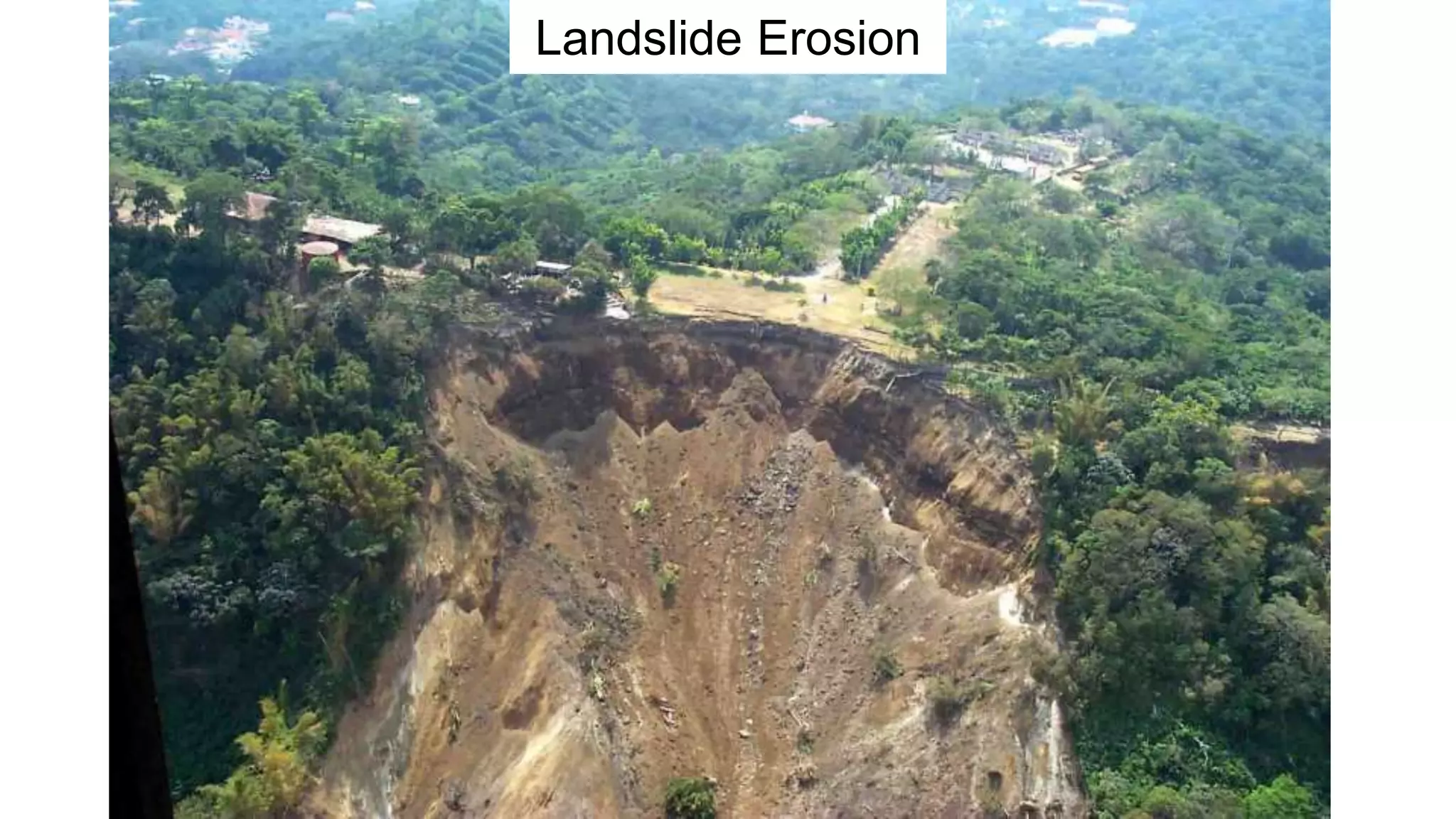
vi. Landslide Erosion
c) Tillage Erosion
Geologic Erosion
It is a normal process, representing erosion of land in natural
environment. It is caused by the effect of
 Rainfall
 Run-off
 Wind
 Topography
 Atmospheric temperatures
 Gravitation Process
Accelerated Erosion
Accelerated erosion is due to man-made activities, which have
brought about changes in natural cover and soil condition. The
activities includes
 Land Preparation for raising crops
 Land Use patterns for building houses, infrastructures,
industries, hill cutting, deforestation, lack of soil conservation and
watershed management
Water Erosion
 The impact of raindrops causes splash erosion
 Run-off water causes scouring, scrapping and transport of
soil particles, leading to sheet, rill and gully erosion.
 Flood water causes erosion of River Banks
 Water waves cause erosion of bank and sides of reservoir,
lakes and oceans.
 Subsurface seepage water causes soil boiling, erosion and
removal by piping.
 Glacial erosion causes heavy landslides
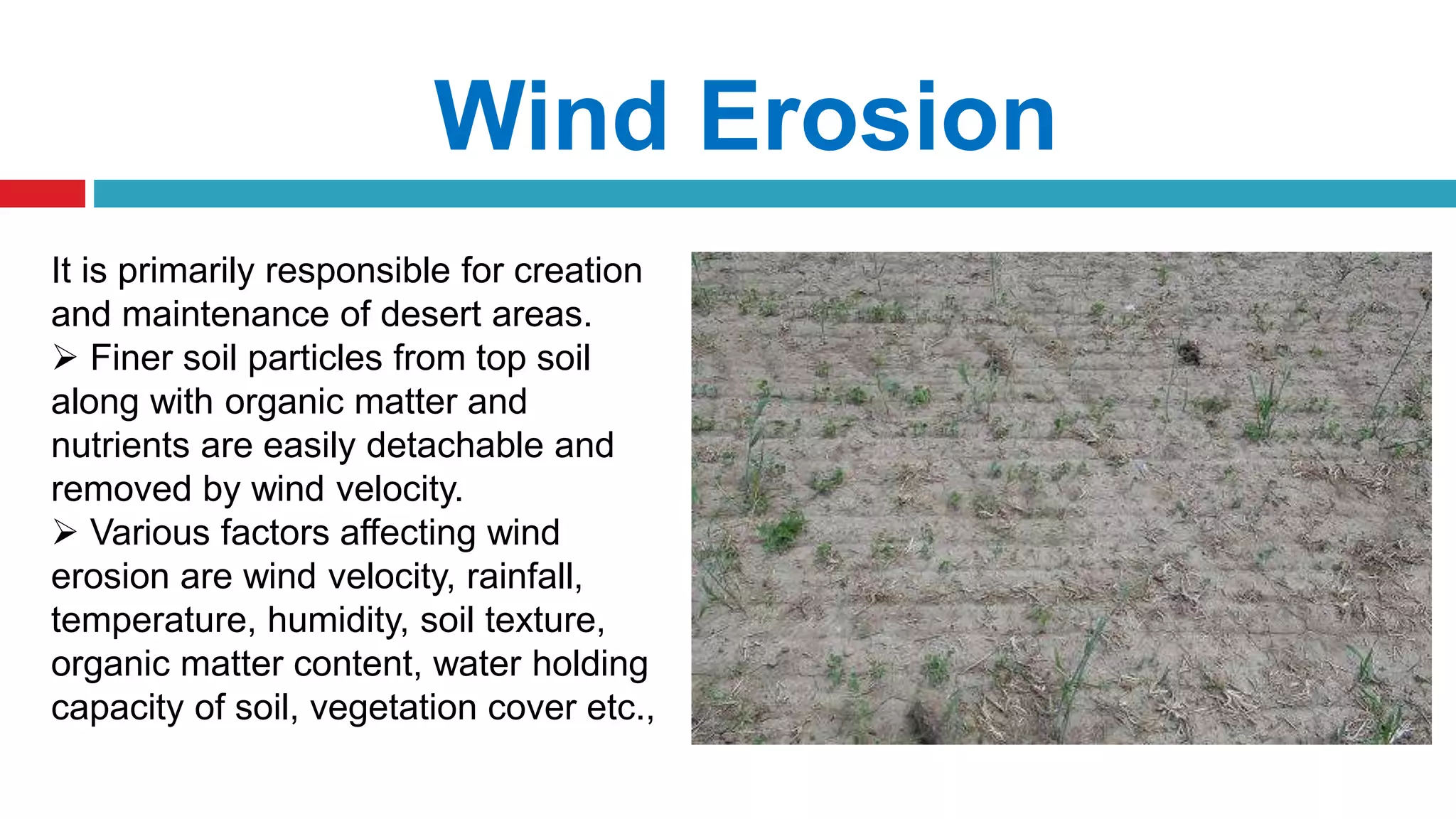
Wind Erosion
It is primarily responsible for creation
and maintenance of desert areas.
 Finer soil particles from top soil
along with organic matter and
nutrients are easily detachable and
removed by wind velocity.
 Various factors affecting wind
erosion are wind velocity, rainfall,
temperature, humidity, soil texture,
organic matter content, water holding
capacity of soil, vegetation cover etc.,
Erosion due to Wind
Erosion due to Surface Runoff
Bank Erosion
Sheet Erosion
 Sheet erosion is the movement
of soil from raindrop splash and
runoff water.
 It typically occurs evenly over a
uniform slope and goes unnoticed
until most of the productive topsoil
has been lost.
 Deposition of the eroded soil
occurs at the bottom of the slope
or in low areas.
Rill Erosion
 In general, the sheet flow is carried out by
very small definable channels called interrill.
 Raindrops detach every layer of soil particles
through splash and the detached particles are
then carried through interrills by a thin layer of
overland lateral flow.
 When the process of soil erosion and
deposition through interrill is prolonged, the
interrills are widened, leading to formation of
small channels called rills.
Raindrop Erosion
Gully Erosion
 Rills are usually smaller in size
and depth. They can be destroyed by
tillage operation.
 If their occurrence is prolonged,
rills become larger in size and can
not be destroyed by tillage operation,
and they are transformed into
Gullies.
 Large gullies and their networks
are called Ravines.
Tillage Erosion
Landslide Erosion
Factors Affecting Erosion
 Climatic Factors
a) Rainfall
b) Rainfall Intensity
c) Runoff
d) Temperature
e) Wind
 Characteristics of Soil
a) Texture
b) Structure & Cohesion
c) Particle Size
d) Organic Content
 Vegetation Cover
 Slope of Watershed
Effect of Erosion
 Loss in Agricultural Production
 Loss of Nutrients
 Reduction of Infiltration Rates
 Reduction in Water holding Capacity
 Increased Cost in Tillage Operation
 Floods may occur in Rivers
 Decrease in useful life of Reservoir
 Survival of Wild Life
 Land Degradation
 Cost of Removal of Sedimentation
 Desertification
Estimation of Soil Loss
 The Universal Soil Loss Equation (USLE) predicts the long-term average annual
rate of erosion on a field slope based on rainfall pattern, soil type, topography,
crop system and management practices.
 USLE only predicts the amount of soil loss that results from sheet or rill erosion
on a single slope and does not account for additional soil losses that might occur
from gully, wind or tillage erosion.
 This erosion model was created for use in selected cropping and management
systems, but is also applicable to non-agricultural conditions such as construction
sites.
 This was developed by United States Department of Agriculture (USDA) in the
Estimation of Soil Loss
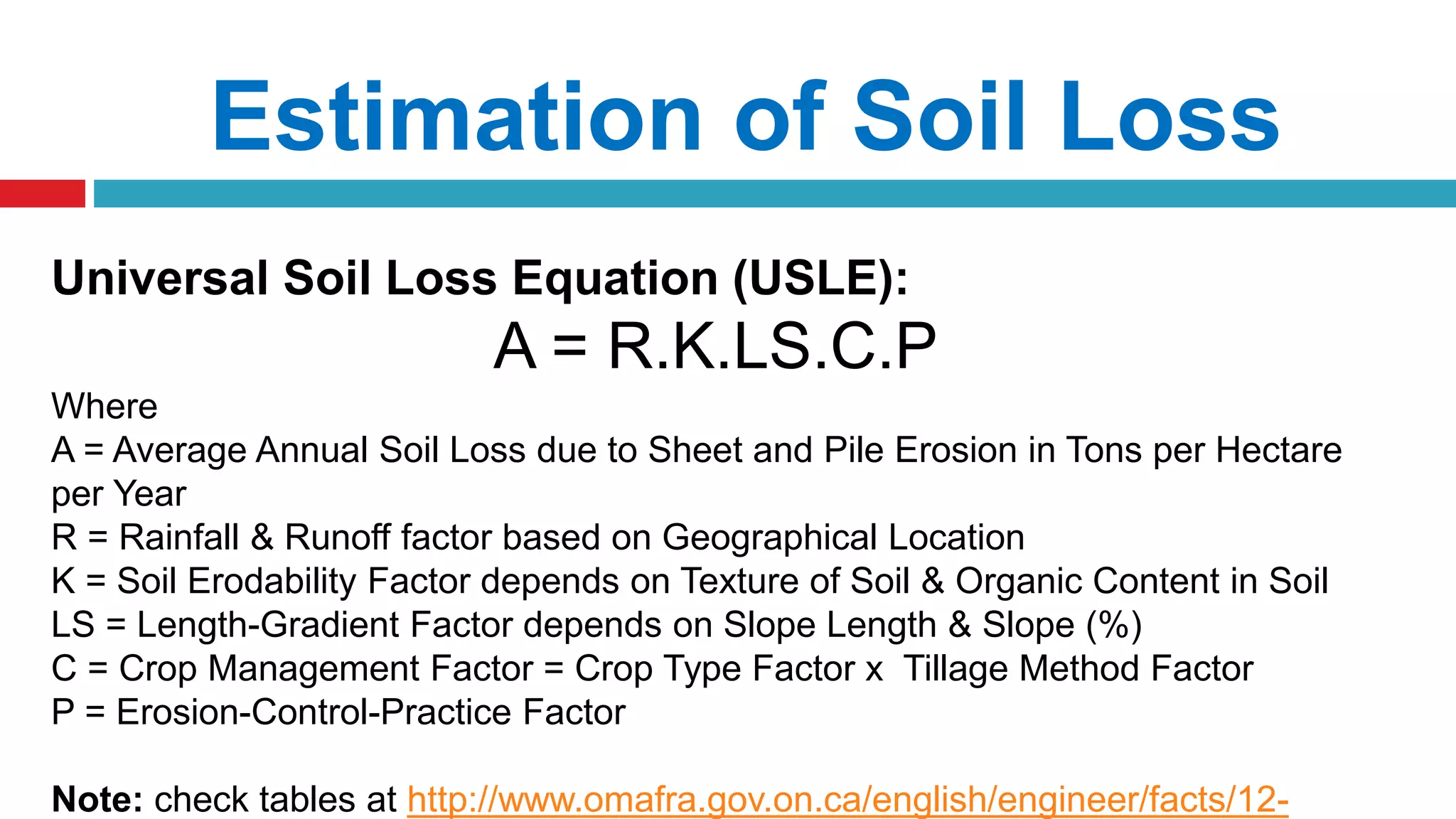
Universal Soil Loss Equation (USLE):
A = R.K.LS.C.P
Where
A = Average Annual Soil Loss due to Sheet and Pile Erosion in Tons per Hectare
per Year
R = Rainfall & Runoff factor based on Geographical Location
K = Soil Erodability Factor depends on Texture of Soil & Organic Content in Soil
LS = Length-Gradient Factor depends on Slope Length & Slope (%)
C = Crop Management Factor = Crop Type Factor x Tillage Method Factor
P = Erosion-Control-Practice Factor
Note: check tables at http://www.omafra.gov.on.ca/english/engineer/facts/12-
Reference
Watershed Management
by
Madan Mohan Das & Mimi Das Saikia,
PHI Learning Private Limited
&
JVS Murty, New Age Publications

Watershed - Principles of Erosion

  • 1.
    EROSION CONTROL (WATERSHED MANAGEMENT) UNIT– IV Rambabu Palaka, Assistant ProfessorBVRIT
  • 2.
    Learning Objectives 1. SoilErosion a) Types of Erosion b) Factors affecting Erosion c) Effect of Erosion d) Estimation of Soil Loss 2. Measures to Control Erosion a) Contour Techniques b) Ploughing c) Furrowing d) Trenching e) Bunding f) Terracing g) Gully Control h) Rock-fill Dams i) Brushwood Dam j) Gabion
  • 3.
    Soil Erosion Soil erosionis a naturally occurring process that affects all landforms. In agriculture, soil erosion refers to the wearing away of a field's topsoil by the natural physical forces of water and wind or through forces associated with farming activities such as tillage. Erosion, whether it is by water, wind or tillage, involves three distinct actions – soil detachment, movement and deposition.
  • 4.
    Types of Erosion 1.Geologic Erosion 2. Accelerated Erosion a) Wind Erosion b) Water Erosion i. Raindrop Erosion ii. Rill Erosion iii. Gully Erosion iv. Bank Erosion v. Sheet Erosion vi. Landslide Erosion c) Tillage Erosion
  • 5.
    Geologic Erosion It isa normal process, representing erosion of land in natural environment. It is caused by the effect of  Rainfall  Run-off  Wind  Topography  Atmospheric temperatures  Gravitation Process
  • 6.
    Accelerated Erosion Accelerated erosionis due to man-made activities, which have brought about changes in natural cover and soil condition. The activities includes  Land Preparation for raising crops  Land Use patterns for building houses, infrastructures, industries, hill cutting, deforestation, lack of soil conservation and watershed management
  • 7.
    Water Erosion  Theimpact of raindrops causes splash erosion  Run-off water causes scouring, scrapping and transport of soil particles, leading to sheet, rill and gully erosion.  Flood water causes erosion of River Banks  Water waves cause erosion of bank and sides of reservoir, lakes and oceans.  Subsurface seepage water causes soil boiling, erosion and removal by piping.  Glacial erosion causes heavy landslides
  • 8.
    Wind Erosion It isprimarily responsible for creation and maintenance of desert areas.  Finer soil particles from top soil along with organic matter and nutrients are easily detachable and removed by wind velocity.  Various factors affecting wind erosion are wind velocity, rainfall, temperature, humidity, soil texture, organic matter content, water holding capacity of soil, vegetation cover etc.,
  • 9.
  • 10.
    Erosion due toSurface Runoff
  • 11.
  • 12.
    Sheet Erosion  Sheeterosion is the movement of soil from raindrop splash and runoff water.  It typically occurs evenly over a uniform slope and goes unnoticed until most of the productive topsoil has been lost.  Deposition of the eroded soil occurs at the bottom of the slope or in low areas.
  • 13.
    Rill Erosion  Ingeneral, the sheet flow is carried out by very small definable channels called interrill.  Raindrops detach every layer of soil particles through splash and the detached particles are then carried through interrills by a thin layer of overland lateral flow.  When the process of soil erosion and deposition through interrill is prolonged, the interrills are widened, leading to formation of small channels called rills. Raindrop Erosion
  • 14.
    Gully Erosion  Rillsare usually smaller in size and depth. They can be destroyed by tillage operation.  If their occurrence is prolonged, rills become larger in size and can not be destroyed by tillage operation, and they are transformed into Gullies.  Large gullies and their networks are called Ravines.
  • 15.
  • 16.
  • 17.
    Factors Affecting Erosion Climatic Factors a) Rainfall b) Rainfall Intensity c) Runoff d) Temperature e) Wind  Characteristics of Soil a) Texture b) Structure & Cohesion c) Particle Size d) Organic Content  Vegetation Cover  Slope of Watershed
  • 18.
    Effect of Erosion Loss in Agricultural Production  Loss of Nutrients  Reduction of Infiltration Rates  Reduction in Water holding Capacity  Increased Cost in Tillage Operation  Floods may occur in Rivers  Decrease in useful life of Reservoir  Survival of Wild Life  Land Degradation  Cost of Removal of Sedimentation  Desertification
  • 19.
    Estimation of SoilLoss  The Universal Soil Loss Equation (USLE) predicts the long-term average annual rate of erosion on a field slope based on rainfall pattern, soil type, topography, crop system and management practices.  USLE only predicts the amount of soil loss that results from sheet or rill erosion on a single slope and does not account for additional soil losses that might occur from gully, wind or tillage erosion.  This erosion model was created for use in selected cropping and management systems, but is also applicable to non-agricultural conditions such as construction sites.  This was developed by United States Department of Agriculture (USDA) in the
  • 20.
    Estimation of SoilLoss Universal Soil Loss Equation (USLE): A = R.K.LS.C.P Where A = Average Annual Soil Loss due to Sheet and Pile Erosion in Tons per Hectare per Year R = Rainfall & Runoff factor based on Geographical Location K = Soil Erodability Factor depends on Texture of Soil & Organic Content in Soil LS = Length-Gradient Factor depends on Slope Length & Slope (%) C = Crop Management Factor = Crop Type Factor x Tillage Method Factor P = Erosion-Control-Practice Factor Note: check tables at http://www.omafra.gov.on.ca/english/engineer/facts/12-
  • 21.
    Reference Watershed Management by Madan MohanDas & Mimi Das Saikia, PHI Learning Private Limited & JVS Murty, New Age Publications