Soil and Water Conservation
Engineering
Topic: Soil Erosion
by
Dr. Sanjay Singh Chouhan
Assistant Professor
College of Agriculture, JNKVV,
Powarkheda, Hoshangabad
1
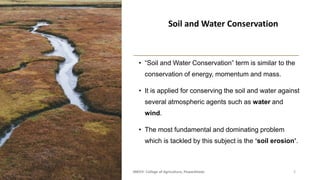
• “Soil and Water Conservation” term is similar to the
conservation of energy, momentum and mass.
• It is applied for conserving the soil and water against
several atmospheric agents such as water and
wind.
• The most fundamental and dominating problem
which is tackled by this subject is the ‘soil erosion’.
JNKVV- College of Agriculture, Powarkheda 2
Soil and Water Conservation
Soil
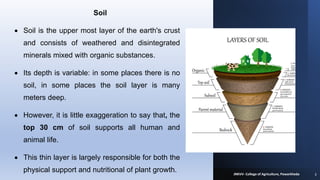
• Soil is the upper most layer of the earth's crust
and consists of weathered and disintegrated
minerals mixed with organic substances.
• Its depth is variable: in some places there is no
soil, in some places the soil layer is many
meters deep.
• However, it is little exaggeration to say that, the
top 30 cm of soil supports all human and
animal life.
• This thin layer is largely responsible for both the
physical support and nutritional of plant growth. 3
JNKVV- College of Agriculture, Powarkheda
Soil Erosion
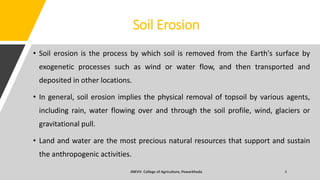
• Soil erosion is the process by which soil is removed from the Earth's surface by
exogenetic processes such as wind or water flow, and then transported and
deposited in other locations.
• In general, soil erosion implies the physical removal of topsoil by various agents,
including rain, water flowing over and through the soil profile, wind, glaciers or
gravitational pull.
• Land and water are the most precious natural resources that support and sustain
the anthropogenic activities.
JNKVV- College of Agriculture, Powarkheda
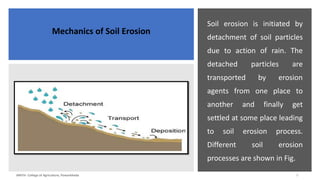
Soil erosion is initiated by
detachment of soil particles
due to action of rain. The
detached particles are
transported by erosion
agents from one place to
another and finally get
settled at some place leading
to soil erosion process.
Different soil erosion
processes are shown in Fig.
5
Mechanics of Soil Erosion
Causes of Soil Erosion
• Indiscriminate cutting of trees,
• Overgrazing of the vegetative cover and
• Forest fires.
(1) Destruction of Natural Protective Cover by
• Keeping the land barren subjecting it to the action of rain and wind,
• Growing of crops that accelerate soil erosion,
• Removal of organic matter and plant nutrients by injudicious cropping
patterns
• Cultivation along the land slope, and
• Faulty methods of irrigation.
(2) Improper Use of the Land
JNKVV- College of Agriculture, Powarkheda 6
Effects of Soil Erosion
• Loss of productive soil
• Deposition of sand on productive fields
• Silting of lakes and reservoirs
• Silting of drainage and irrigation channels.
• Lowering of water table
• Fragmentation of land
• Damage to seacoast and formation of sand dunes.
• Disease and public health hazards.
• Soils eroded by water get deposited on riverbeds, thus increasing their level and
causing floods. These floods sometime have various extreme effects, such as killing
human and animals and damaging various buildings.
JNKVV- College of Agriculture, Powarkheda 7
• Soil erosion decreases the moisture supply by soil to the plants for their growth. It
also affects the activity of soil micro-organisms thus deteriorating the crop yield.
• Top layer of soil contains most of the organic matter and nutrients, loss of this soil
reducing soil fertility and affecting its structure badly.
• Wind erosion is very selective, carrying the finest particles - particularly organic
matter, clay and loam for many kilometres. There the wind erosion causes losses of
fertile soils from highly productive farming areas.
• Sheets of sand travelling close to the ground (30 to 50 meters) can degrade crops.
• Wind erosion reduces the capacity of the soil to store nutrients and water, thus
making the environment drier.
JNKVV- College of Agriculture, Powarkheda 8
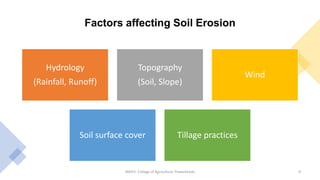
Factors affecting Soil Erosion
JNKVV- College of Agriculture, Powarkheda 9
Hydrology
(Rainfall, Runoff)
Topography
(Soil, Slope)
Wind
Soil surface cover Tillage practices
Soil erosion can broadly be categorized into two types
1. Geologic Erosion
2. Accelerated Erosion.
Types of Soil Erosion
• Under natural undisturbed conditions an equilibrium is established between the climate of
a place and the vegetative cover that protects the soil layer.
• Vegetative covers like trees and forests retard the transportation of soil material and act as
a check against excessive erosion.
• A certain amount of erosion, however, does take place even under the natural cover. This
erosion, called geologic erosion, is a slow process and is compensated by the formation of
soil under the natural weathering process.
• Its effect are not of much consequence so far as agricultural lands are concerned.
JNKVV- College of Agriculture, Powarkheda 11
Geological Erosion
When land is put under cultivation, the natural balance existing between the soil, its
vegetation cover and climate is disturbed. Under such condition, the removal of surface soil
due to natural agencies takes places at faster rate than it can be built by the soil formation
process. Erosion occurring under these condition is referred to as accelerated erosion. Its
rates are higher than geological erosion. Accelerated erosion depletes soil fertility in
agricultural land.
Ex: Water Erosion, Wind Erosion
JNKVV- COLLEGE OF AGRICULTURE, POWARKHEDA 12
Accelerated Erosion
JNKVV-
College
of
Agriculture,
Powarkheda
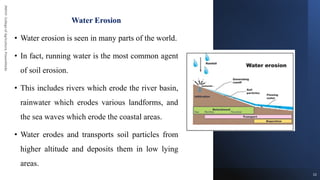
Water Erosion
• Water erosion is seen in many parts of the world.
• In fact, running water is the most common agent
of soil erosion.
• This includes rivers which erode the river basin,
rainwater which erodes various landforms, and
the sea waves which erode the coastal areas.
• Water erodes and transports soil particles from
higher altitude and deposits them in low lying
areas.
13
Factors
Affecting
Water
Erosion
JNKVV-
College
of
Agriculture,
Powarkheda
1. Climatic factors
• Rainfall characterstics include amount, intensity, frequency and
duration of rainfall. All this have great effect of runoff and soil loss.
• Atmospheric temperature
• Wind velocity
2. Soil characteristics (infiltration rate and soil cover)
3. Vegetation: Vegetation create surface obstruction for direct falling of
raindrop on the land surface as well as in the flow path of surface
runoff.
4. Topographic factors: The land slop, length of slope and shape of
slope are the main topographic factors which influence the soil
erosion
14
1. Raindrop or Splash erosion,
2. Sheet erosion,
3. Rill erosion,
4. Gully erosion,
5. Stream bank erosion
6. Costal erosion
JNKVV- COLLEGE OF AGRICULTURE, POWARKHEDA 15
Types of Water Erosion
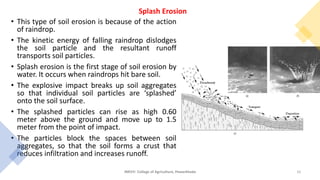
• This type of soil erosion is because of the action
of raindrop.
• The kinetic energy of falling raindrop dislodges
the soil particle and the resultant runoff
transports soil particles.
• Splash erosion is the first stage of soil erosion by
water. It occurs when raindrops hit bare soil.
• The explosive impact breaks up soil aggregates
so that individual soil particles are ‘splashed’
onto the soil surface.
• The splashed particles can rise as high 0.60
meter above the ground and move up to 1.5
meter from the point of impact.
• The particles block the spaces between soil
aggregates, so that the soil forms a crust that
reduces infiltration and increases runoff.
JNKVV- College of Agriculture, Powarkheda 16
Splash Erosion
Sheet Erosion
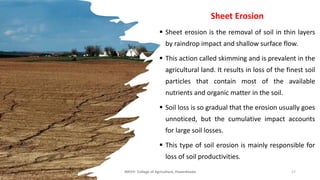
▪ Sheet erosion is the removal of soil in thin layers
by raindrop impact and shallow surface flow.
▪ This action called skimming and is prevalent in the
agricultural land. It results in loss of the finest soil
particles that contain most of the available
nutrients and organic matter in the soil.
▪ Soil loss is so gradual that the erosion usually goes
unnoticed, but the cumulative impact accounts
for large soil losses.
▪ This type of soil erosion is mainly responsible for
loss of soil productivities.
JNKVV- College of Agriculture, Powarkheda 17
JNKVV-
College
of
Agriculture,
Powarkheda
▪ Soils most vulnerable to sheet erosion are
overgrazed and cultivated soils where there is
little vegetation to protect and hold the soil.
▪ Early signs of sheet erosion include bare areas,
water puddling as soon as rain falls, visible grass
roots, exposed tree roots, and exposed subsoil or
stony soils.
▪ Soil deposits on the high side of obstructions such
as fences may indicate active sheet erosion.
18
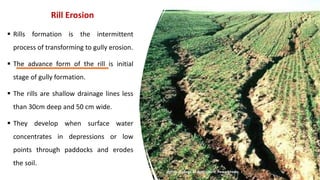
▪ Rills formation is the intermittent
process of transforming to gully erosion.
▪ The advance form of the rill is initial
stage of gully formation.
▪ The rills are shallow drainage lines less
than 30cm deep and 50 cm wide.
▪ They develop when surface water
concentrates in depressions or low
points through paddocks and erodes
the soil.
JNKVV- College of Agriculture, Powarkheda 19
Rill Erosion
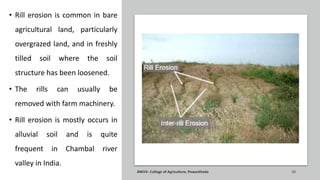
• Rill erosion is common in bare
agricultural land, particularly
overgrazed land, and in freshly
tilled soil where the soil
structure has been loosened.
• The rills can usually be
removed with farm machinery.
• Rill erosion is mostly occurs in
alluvial soil and is quite
frequent in Chambal river
valley in India.
JNKVV- College of Agriculture, Powarkheda 20
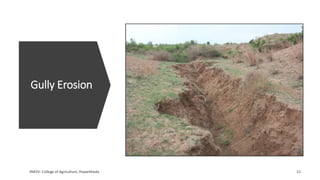
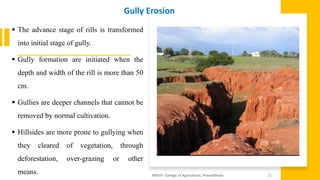
Gully Erosion
▪ The advance stage of rills is transformed
into initial stage of gully.
▪ Gully formation are initiated when the
depth and width of the rill is more than 50
cm.
▪ Gullies are deeper channels that cannot be
removed by normal cultivation.
▪ Hillsides are more prone to gullying when
they cleared of vegetation, through
deforestation, over-grazing or other
means. JNKVV- College of Agriculture, Powarkheda 22
Gully Erosion
Stream Bank
Erosion
JNKVV- College of Agriculture, Powarkheda 23
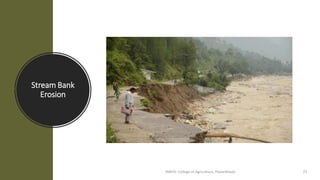
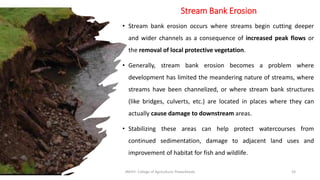
Stream Bank Erosion
• Stream bank erosion occurs where streams begin cutting deeper
and wider channels as a consequence of increased peak flows or
the removal of local protective vegetation.
• Generally, stream bank erosion becomes a problem where
development has limited the meandering nature of streams, where
streams have been channelized, or where stream bank structures
(like bridges, culverts, etc.) are located in places where they can
actually cause damage to downstream areas.
• Stabilizing these areas can help protect watercourses from
continued sedimentation, damage to adjacent land uses and
improvement of habitat for fish and wildlife.
JNKVV- College of Agriculture, Powarkheda 24
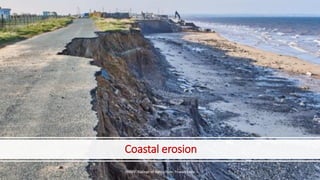
Coastal erosion
JNKVV- College of Agriculture, Powarkheda 25
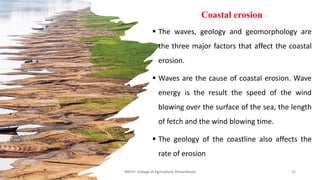
Coastal erosion
▪ The waves, geology and geomorphology are
the three major factors that affect the coastal
erosion.
▪ Waves are the cause of coastal erosion. Wave
energy is the result the speed of the wind
blowing over the surface of the sea, the length
of fetch and the wind blowing time.
▪ The geology of the coastline also affects the
rate of erosion
JNKVV- College of Agriculture, Powarkheda 26
Thanks for listening…..
JNKVV- College of Agriculture, Powarkheda 27

water erosion

  • 1.
    Soil and WaterConservation Engineering Topic: Soil Erosion by Dr. Sanjay Singh Chouhan Assistant Professor College of Agriculture, JNKVV, Powarkheda, Hoshangabad 1
  • 2.
    • “Soil andWater Conservation” term is similar to the conservation of energy, momentum and mass. • It is applied for conserving the soil and water against several atmospheric agents such as water and wind. • The most fundamental and dominating problem which is tackled by this subject is the ‘soil erosion’. JNKVV- College of Agriculture, Powarkheda 2 Soil and Water Conservation
  • 3.
    Soil • Soil isthe upper most layer of the earth's crust and consists of weathered and disintegrated minerals mixed with organic substances. • Its depth is variable: in some places there is no soil, in some places the soil layer is many meters deep. • However, it is little exaggeration to say that, the top 30 cm of soil supports all human and animal life. • This thin layer is largely responsible for both the physical support and nutritional of plant growth. 3 JNKVV- College of Agriculture, Powarkheda
  • 4.
    Soil Erosion • Soilerosion is the process by which soil is removed from the Earth's surface by exogenetic processes such as wind or water flow, and then transported and deposited in other locations. • In general, soil erosion implies the physical removal of topsoil by various agents, including rain, water flowing over and through the soil profile, wind, glaciers or gravitational pull. • Land and water are the most precious natural resources that support and sustain the anthropogenic activities.
  • 5.
    JNKVV- College ofAgriculture, Powarkheda Soil erosion is initiated by detachment of soil particles due to action of rain. The detached particles are transported by erosion agents from one place to another and finally get settled at some place leading to soil erosion process. Different soil erosion processes are shown in Fig. 5 Mechanics of Soil Erosion
  • 6.
    Causes of SoilErosion • Indiscriminate cutting of trees, • Overgrazing of the vegetative cover and • Forest fires. (1) Destruction of Natural Protective Cover by • Keeping the land barren subjecting it to the action of rain and wind, • Growing of crops that accelerate soil erosion, • Removal of organic matter and plant nutrients by injudicious cropping patterns • Cultivation along the land slope, and • Faulty methods of irrigation. (2) Improper Use of the Land JNKVV- College of Agriculture, Powarkheda 6
  • 7.
    Effects of SoilErosion • Loss of productive soil • Deposition of sand on productive fields • Silting of lakes and reservoirs • Silting of drainage and irrigation channels. • Lowering of water table • Fragmentation of land • Damage to seacoast and formation of sand dunes. • Disease and public health hazards. • Soils eroded by water get deposited on riverbeds, thus increasing their level and causing floods. These floods sometime have various extreme effects, such as killing human and animals and damaging various buildings. JNKVV- College of Agriculture, Powarkheda 7
  • 8.
    • Soil erosiondecreases the moisture supply by soil to the plants for their growth. It also affects the activity of soil micro-organisms thus deteriorating the crop yield. • Top layer of soil contains most of the organic matter and nutrients, loss of this soil reducing soil fertility and affecting its structure badly. • Wind erosion is very selective, carrying the finest particles - particularly organic matter, clay and loam for many kilometres. There the wind erosion causes losses of fertile soils from highly productive farming areas. • Sheets of sand travelling close to the ground (30 to 50 meters) can degrade crops. • Wind erosion reduces the capacity of the soil to store nutrients and water, thus making the environment drier. JNKVV- College of Agriculture, Powarkheda 8
  • 9.
    Factors affecting SoilErosion JNKVV- College of Agriculture, Powarkheda 9 Hydrology (Rainfall, Runoff) Topography (Soil, Slope) Wind Soil surface cover Tillage practices
  • 10.
    Soil erosion canbroadly be categorized into two types 1. Geologic Erosion 2. Accelerated Erosion. Types of Soil Erosion
  • 11.
    • Under naturalundisturbed conditions an equilibrium is established between the climate of a place and the vegetative cover that protects the soil layer. • Vegetative covers like trees and forests retard the transportation of soil material and act as a check against excessive erosion. • A certain amount of erosion, however, does take place even under the natural cover. This erosion, called geologic erosion, is a slow process and is compensated by the formation of soil under the natural weathering process. • Its effect are not of much consequence so far as agricultural lands are concerned. JNKVV- College of Agriculture, Powarkheda 11 Geological Erosion
  • 12.
    When land isput under cultivation, the natural balance existing between the soil, its vegetation cover and climate is disturbed. Under such condition, the removal of surface soil due to natural agencies takes places at faster rate than it can be built by the soil formation process. Erosion occurring under these condition is referred to as accelerated erosion. Its rates are higher than geological erosion. Accelerated erosion depletes soil fertility in agricultural land. Ex: Water Erosion, Wind Erosion JNKVV- COLLEGE OF AGRICULTURE, POWARKHEDA 12 Accelerated Erosion
  • 13.
    JNKVV- College of Agriculture, Powarkheda Water Erosion • Watererosion is seen in many parts of the world. • In fact, running water is the most common agent of soil erosion. • This includes rivers which erode the river basin, rainwater which erodes various landforms, and the sea waves which erode the coastal areas. • Water erodes and transports soil particles from higher altitude and deposits them in low lying areas. 13
  • 14.
    Factors Affecting Water Erosion JNKVV- College of Agriculture, Powarkheda 1. Climatic factors •Rainfall characterstics include amount, intensity, frequency and duration of rainfall. All this have great effect of runoff and soil loss. • Atmospheric temperature • Wind velocity 2. Soil characteristics (infiltration rate and soil cover) 3. Vegetation: Vegetation create surface obstruction for direct falling of raindrop on the land surface as well as in the flow path of surface runoff. 4. Topographic factors: The land slop, length of slope and shape of slope are the main topographic factors which influence the soil erosion 14
  • 15.
    1. Raindrop orSplash erosion, 2. Sheet erosion, 3. Rill erosion, 4. Gully erosion, 5. Stream bank erosion 6. Costal erosion JNKVV- COLLEGE OF AGRICULTURE, POWARKHEDA 15 Types of Water Erosion
  • 16.
    • This typeof soil erosion is because of the action of raindrop. • The kinetic energy of falling raindrop dislodges the soil particle and the resultant runoff transports soil particles. • Splash erosion is the first stage of soil erosion by water. It occurs when raindrops hit bare soil. • The explosive impact breaks up soil aggregates so that individual soil particles are ‘splashed’ onto the soil surface. • The splashed particles can rise as high 0.60 meter above the ground and move up to 1.5 meter from the point of impact. • The particles block the spaces between soil aggregates, so that the soil forms a crust that reduces infiltration and increases runoff. JNKVV- College of Agriculture, Powarkheda 16 Splash Erosion
  • 17.
    Sheet Erosion ▪ Sheeterosion is the removal of soil in thin layers by raindrop impact and shallow surface flow. ▪ This action called skimming and is prevalent in the agricultural land. It results in loss of the finest soil particles that contain most of the available nutrients and organic matter in the soil. ▪ Soil loss is so gradual that the erosion usually goes unnoticed, but the cumulative impact accounts for large soil losses. ▪ This type of soil erosion is mainly responsible for loss of soil productivities. JNKVV- College of Agriculture, Powarkheda 17
  • 18.
    JNKVV- College of Agriculture, Powarkheda ▪ Soils mostvulnerable to sheet erosion are overgrazed and cultivated soils where there is little vegetation to protect and hold the soil. ▪ Early signs of sheet erosion include bare areas, water puddling as soon as rain falls, visible grass roots, exposed tree roots, and exposed subsoil or stony soils. ▪ Soil deposits on the high side of obstructions such as fences may indicate active sheet erosion. 18
  • 19.
    ▪ Rills formationis the intermittent process of transforming to gully erosion. ▪ The advance form of the rill is initial stage of gully formation. ▪ The rills are shallow drainage lines less than 30cm deep and 50 cm wide. ▪ They develop when surface water concentrates in depressions or low points through paddocks and erodes the soil. JNKVV- College of Agriculture, Powarkheda 19 Rill Erosion
  • 20.
    • Rill erosionis common in bare agricultural land, particularly overgrazed land, and in freshly tilled soil where the soil structure has been loosened. • The rills can usually be removed with farm machinery. • Rill erosion is mostly occurs in alluvial soil and is quite frequent in Chambal river valley in India. JNKVV- College of Agriculture, Powarkheda 20
  • 21.
  • 22.
    ▪ The advancestage of rills is transformed into initial stage of gully. ▪ Gully formation are initiated when the depth and width of the rill is more than 50 cm. ▪ Gullies are deeper channels that cannot be removed by normal cultivation. ▪ Hillsides are more prone to gullying when they cleared of vegetation, through deforestation, over-grazing or other means. JNKVV- College of Agriculture, Powarkheda 22 Gully Erosion
  • 23.
    Stream Bank Erosion JNKVV- Collegeof Agriculture, Powarkheda 23
  • 24.
    Stream Bank Erosion •Stream bank erosion occurs where streams begin cutting deeper and wider channels as a consequence of increased peak flows or the removal of local protective vegetation. • Generally, stream bank erosion becomes a problem where development has limited the meandering nature of streams, where streams have been channelized, or where stream bank structures (like bridges, culverts, etc.) are located in places where they can actually cause damage to downstream areas. • Stabilizing these areas can help protect watercourses from continued sedimentation, damage to adjacent land uses and improvement of habitat for fish and wildlife. JNKVV- College of Agriculture, Powarkheda 24
  • 25.
    Coastal erosion JNKVV- Collegeof Agriculture, Powarkheda 25
  • 26.
    Coastal erosion ▪ Thewaves, geology and geomorphology are the three major factors that affect the coastal erosion. ▪ Waves are the cause of coastal erosion. Wave energy is the result the speed of the wind blowing over the surface of the sea, the length of fetch and the wind blowing time. ▪ The geology of the coastline also affects the rate of erosion JNKVV- College of Agriculture, Powarkheda 26
  • 27.
    Thanks for listening….. JNKVV-College of Agriculture, Powarkheda 27