HYDROLOGICAL DATA FOR
WATERSHED PLANNING
Eng. CHU DICKSON
IMPORTANCE OF WATERSHED PLANNING
Definition and Scope of Watershed Planning
Planning is the process of formulation of a project consisting of practices/ strategies to achieve
certain objective(s) by a definite time in future keeping the constraints in mind and considering
all the available techniques.
Watershed Planning pertains to the planning related to watershed(s), so as to achieve
certain objective(s) related to watershed(s).
Although planning is a continuous process, it is split into a time bound process to facilitate
the evaluation of its impact over a time period.
Like any planning, watershed planning also involves the integration of objectives,
constraints, available techniques to improve the utility and effectiveness of the watershed(s)
over a certain time period.
IMPORTANCE OF WATERSHED PLANNING
An Overview of Watershed Planning
Watershed planning involves the following three sets of factors:
1.Objectives must be established on the basis of a problem analysis;
2.Constraints to implementing a proposed management practice (i.e., project) need to be
determined, including biophysical limitations, budget restrictions, and social/ cultural/ political
conditions that are associated with the situation; and
3.There needs to be managerial techniques & capabilities available for implementing any proposed
practice. Planning, therefore, involves the integration of objectives, constraints, and available
techniques to improve the effectiveness and implementing watershed planning.
STEPS IN THE WATERSHED PLANNING
PROCESS
1. Monitor and evaluate past activities and identity problems and
opportunities.
2. Identity the main characteristics of the problems confronted, opportunities
to resolve these problems, and establish the objectives and constraints to
accomplish these objectives. This eventually leads to the formulating
strategies for action.
3. Identify alternative management practices (i.e., projects) to implement the
formulated strategies within the limits of the constraints.
4. Appraise and evaluate the impacts of the alternative management practices
(i.e., projects) including the environmental, social, and economic effects and
assess the uncertainty associated with the impacts.
5. Rank or prioritize the alternative management practices and recommend
the project to be implemented when a recommendation is requested
DATA REQUIRED FOR WATERSHED
PLANNING
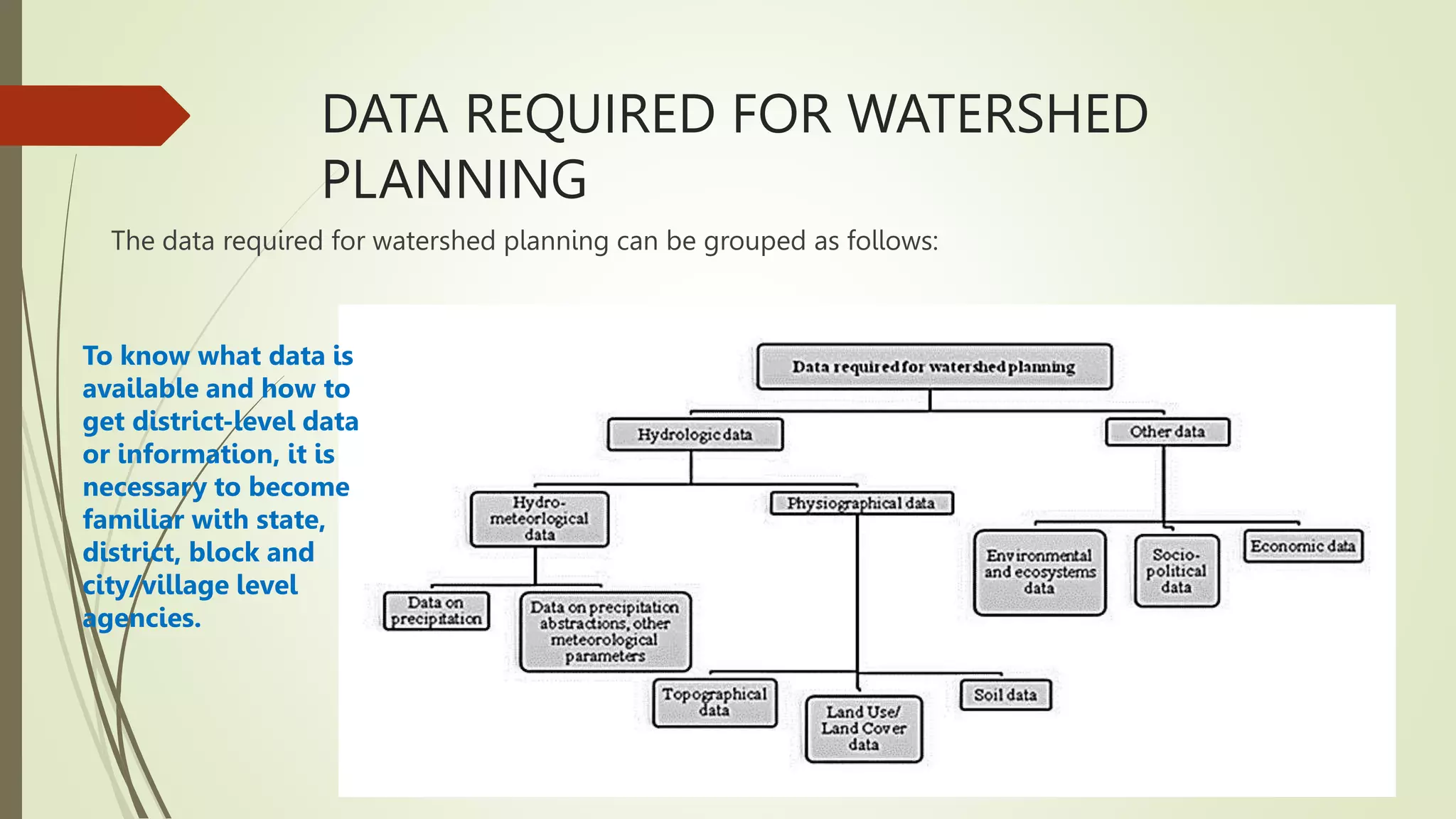
The data required for watershed planning can be grouped as follows:
To know what data is
available and how to
get district-level data
or information, it is
necessary to become
familiar with state,
district, block and
city/village level
agencies.
USE OF HYDRO-METEOROLOGICAL DATA
IN WATERSHED PLANNING
It includes data on
 precipitation,
 abstractions of precipitation and
 other meteorological parameters
which influence the watershed management.
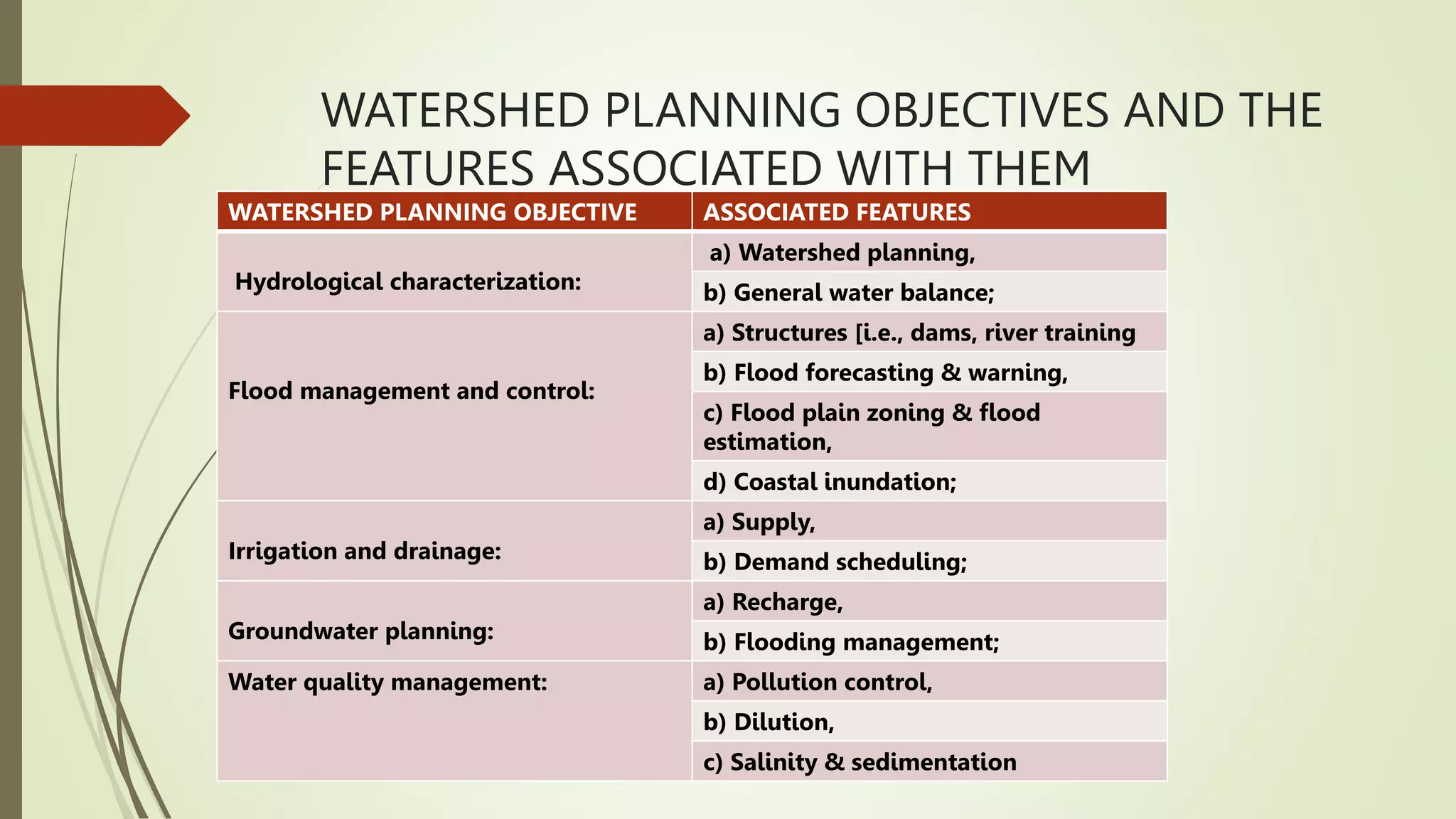
WATERSHED PLANNING OBJECTIVES AND THE
FEATURES ASSOCIATED WITH THEM
WATERSHED PLANNING OBJECTIVE ASSOCIATED FEATURES
Hydrological characterization:
a) Watershed planning,
b) General water balance;
Flood management and control:
a) Structures [i.e., dams, river training
b) Flood forecasting & warning,
c) Flood plain zoning & flood
estimation,
d) Coastal inundation;
Irrigation and drainage:
a) Supply,
b) Demand scheduling;
Groundwater planning:
a) Recharge,
b) Flooding management;
Water quality management: a) Pollution control,
b) Dilution,
c) Salinity & sedimentation
USE OF HYDRO-METEOROLOGICAL DATA IN
HYDROLOGICAL CHARACTERIZATION
The primary concern of a water management agency is with rainfall, river
flow and groundwater, and the focus of their activity will be the
measurement and analysis of these variables.
The climate data items used are: precipitation, temperature and evaporation,
either in conjunction with, or drivers for, hydrological and hydro-geological
variables.
A significant data item in water balance activities is the estimation of evapo-
transpiration (ET) as a major component of losses on a range of spatial and
temporal scales. All of these helps in the modeling of water balance.
The most basic level of providing data for catchment planning is through a
“catalogue” approach, where statistics related to locations and areas are
presented.
USE OF HYDRO-METEOROLOGICAL DATA IN
FLOOD MANAGEMENT AND CONTROL
Flood forecasting and warning may be the responsibility of water management or
meteorological agencies. The following data is also needed:
 Daily rainfall,
 Sub-daily rainfall, at least hourly,
 Wind velocity and direction.
For flood forecasting and warning, radar measurement of rainfall, weather
satellite information, numerical weather prediction and quantitative precipitation
forecasting are required.
In flood frequency estimation, maximum river levels and discharges are
required as part of the extrapolation of the more extreme events.
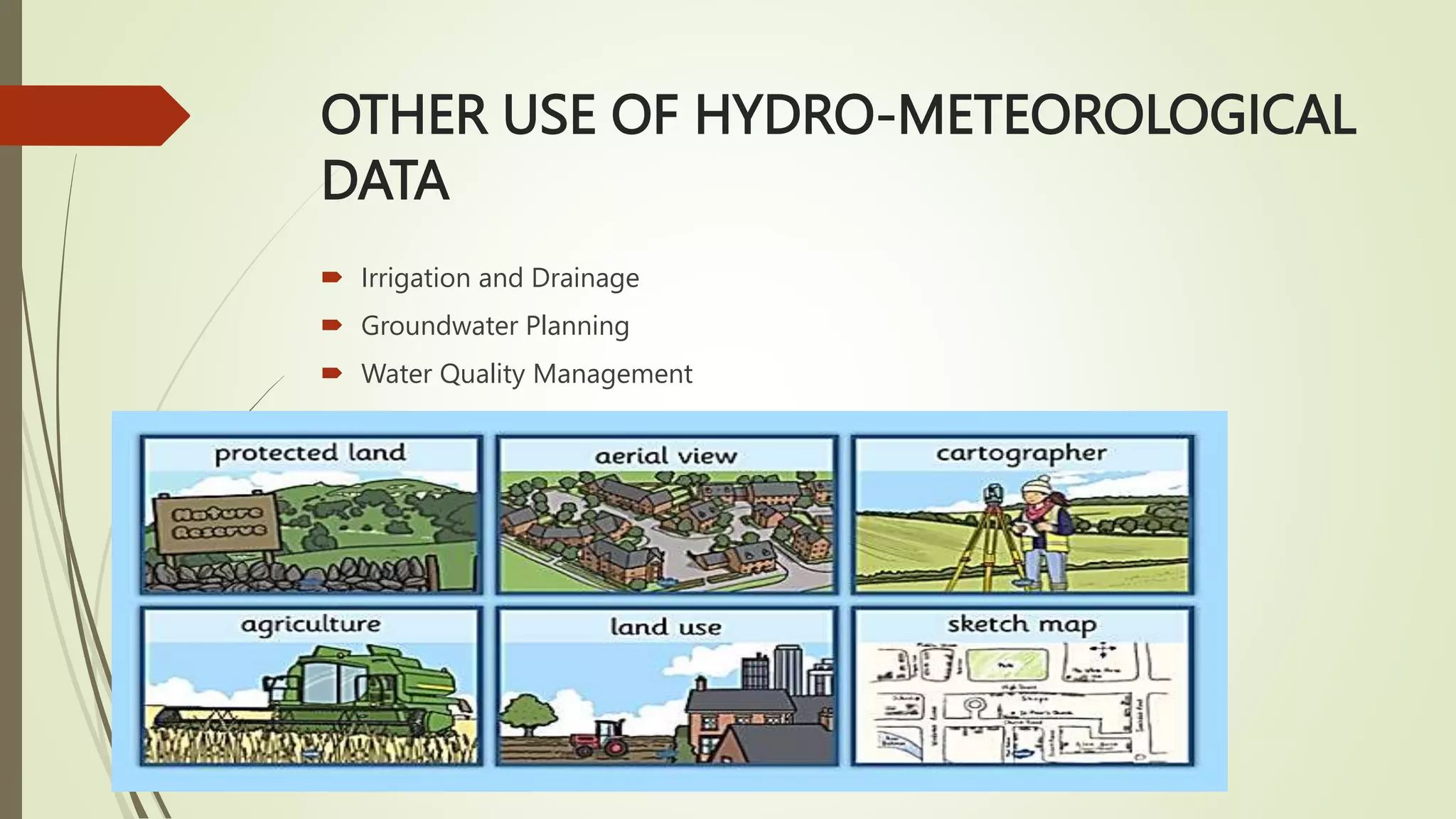
OTHER USE OF HYDRO-METEOROLOGICAL
DATA
 Irrigation and Drainage
 Groundwater Planning
 Water Quality Management
USE OF PHYSIOGRAPHICAL DATA IN
WATERSHED PLANNING
 Topographical Data in Watershed Planning
Topographical data involves data on physical/ natural features of the watershed, watershed
boundaries, floodplains in the watershed, wetlands and water bodies etc. Depending upon the
purpose and the features of watershed planning, the utility of the topographical data will vary.
For hydrological characterization, the data
• on slope,
• permeability of the ground surface,
• roughness of the ground surface,
• obstructions like buildings or other
manmade infrastructure or hills or
depressions
is required.
For flood management and control, the data on
• wetlands and water bodies,
• channel cross sections,
• other natural and artificial flood mitigation
structures
is required.
For irrigation and drainage, data on
• optimum water table depth,
• canal linings, canal flow capacity,
• crop type, crop area
are necessary.
For water quality management,
• the locations of point and non-point pollution
sources,
• total maximum daily loads (TMDLs),
• spatio-temporal variations in pH,
• turbidity,
• total suspended solids, total dissolved solids,
biochemical oxygen demand (BOD) etc.
Utility of Land Use/ Land Cover (LULC)
Data in Watershed Planning
LULC data consists of data on forests, grass/ range lands, cultivated lands,
orchards, wildlife reservations, recreation areas, urban/ rural areas, water
bodies, eroded areas etc.
LULC influences practically all the
processes of hydrologic cycle like
interception, infiltration, surface
runoff, surface storage,
groundwater runoff, groundwater
storage, evapo-transpiration (ET).
Utility of Soil Data in Watershed Planning
Soil data can be an important factor in determining the amount of
 erosion and
 storm water runoff
that occurs in the watershed of interest.
It can enable the estimation of water retained within the soil, analyze the slope stability or the flow of
groundwater through the soil pores. Data on the types of soils in the watershed and their characteristics
helps us to identify the areas that are prone to erosion or sedimentation as well as the areas which are more
likely to experience runoff.
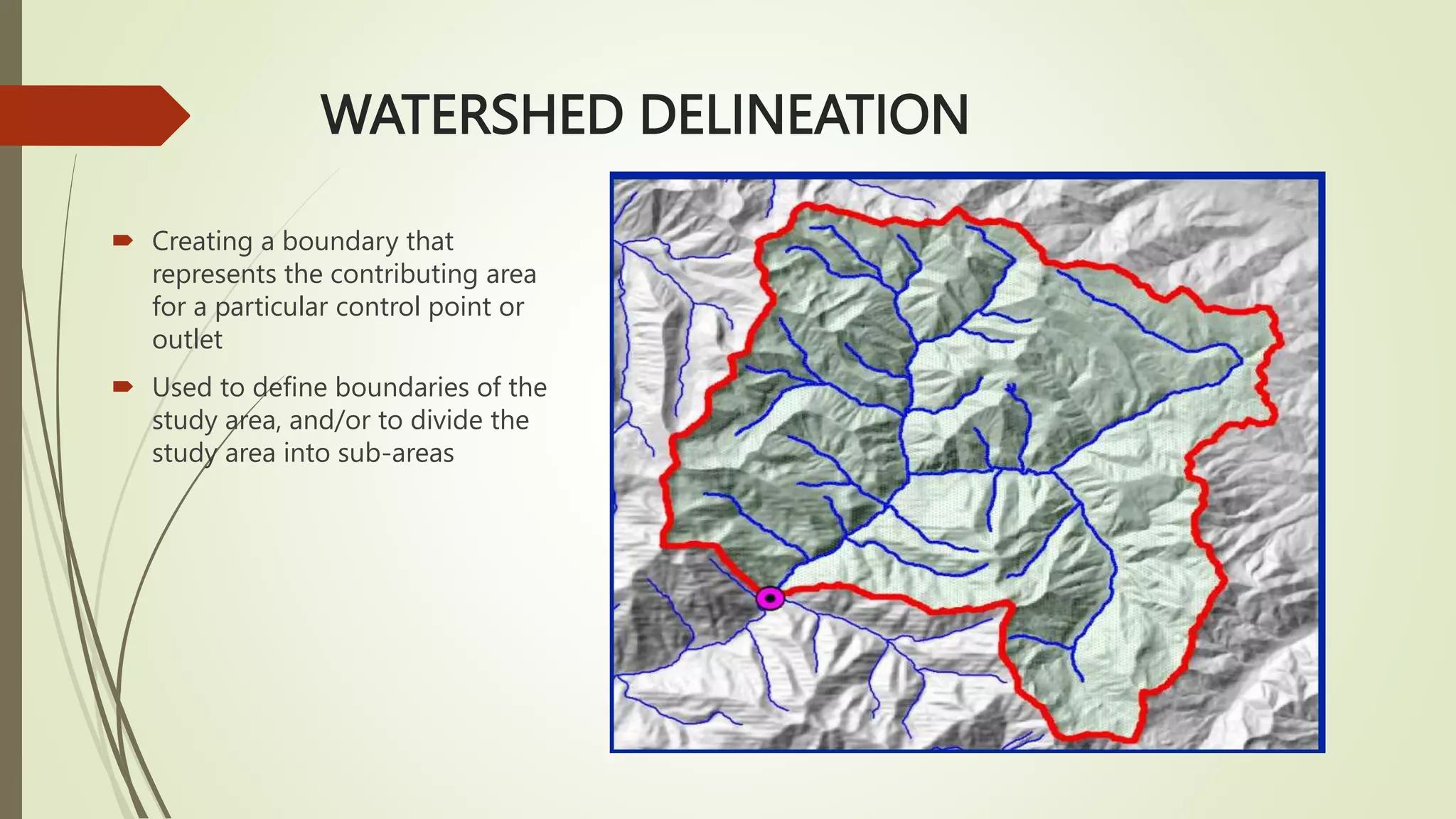
WATERSHED DELINEATION
 Creating a boundary that
represents the contributing area
for a particular control point or
outlet
 Used to define boundaries of the
study area, and/or to divide the
study area into sub-areas
WHY DELINEATE
WATERSHED DELINEATION
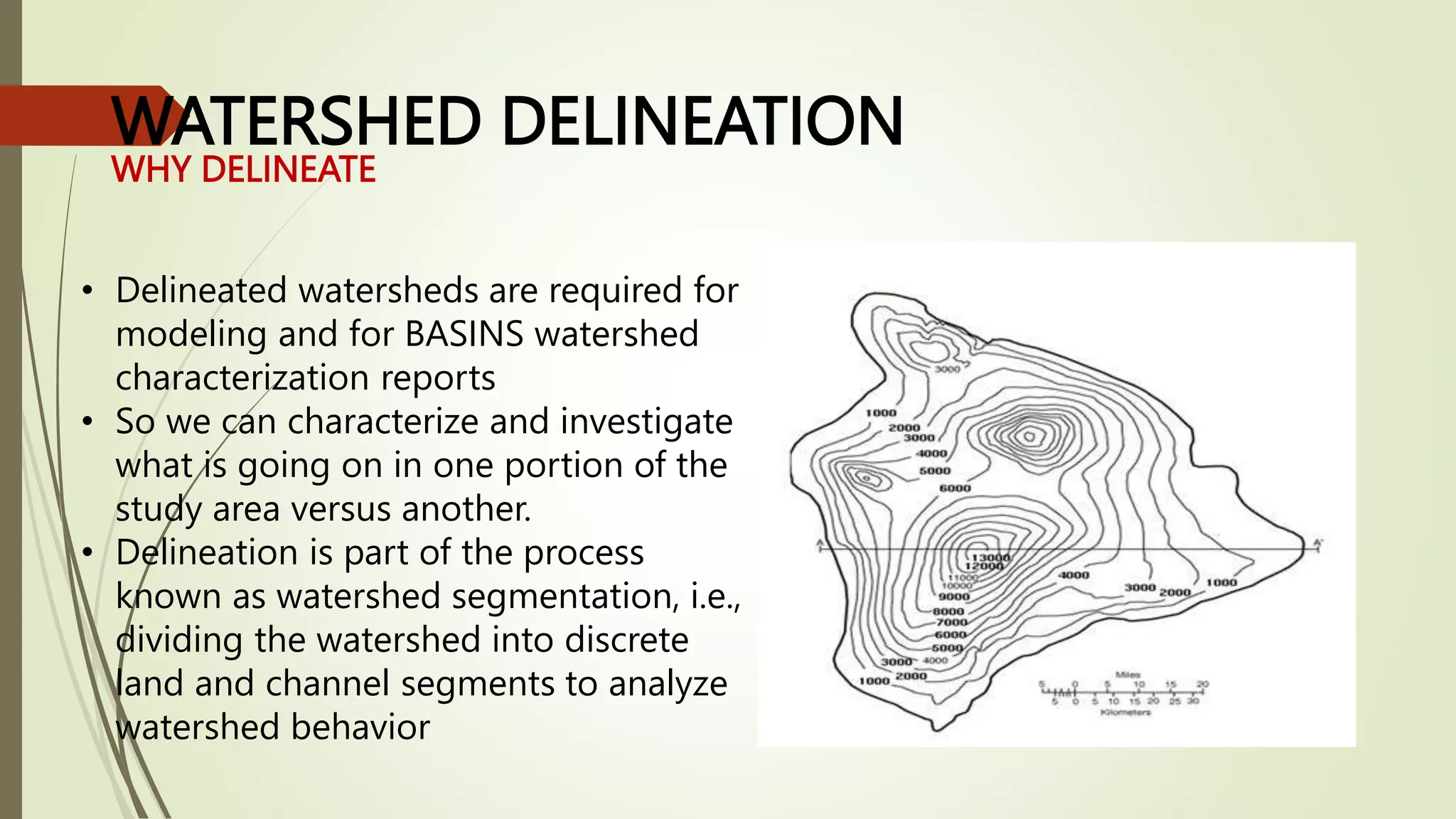
• Delineated watersheds are required for
modeling and for BASINS watershed
characterization reports
• So we can characterize and investigate
what is going on in one portion of the
study area versus another.
• Delineation is part of the process
known as watershed segmentation, i.e.,
dividing the watershed into discrete
land and channel segments to analyze
watershed behavior
DELINEATION METHODS
DEM(Digital Elevation Model) Based (Automatic Delineation)
– Water flows downhill
– Grid cell based approach
– Boundaries created automatically by computer
Manual Delineation
– Drawing watersheds by clicking on the
map
– Requires underlying data for accuracy
BASINS DELINEATION TOOLS
Automatic (DEM based)
delineation
- DEM and NED grids
• Manual delineation
- From existing watershed
boundaries and stream layers
CONCEPT OF TOPOGRAPHIC OR
CONTOUR MAP
A topographic map is a two-dimensional representation of a portion of the three-
dimensional surface of the earth. Topography is the shape of the land surface, and
topographic maps exist to represent the land surface.
Cartographers solve the problem
of representing the three-
dimensional land surface on a flat
piece of paper by using contour
lines, thus horizontal distances
and vertical elevations can both
be measured from a topographic
map
CONCEPT OF TOPOGRAPHIC OR
CONTOUR MAP
The terms used to indicate what information is contained on a topographic map are given below:
Map Scale: Maps come in a variety of scales, covering areas ranging from the
entire earth to a city block (or less).
Vertical Scale (Contour Interval): All maps have a horizontal scale. Topographic
maps also have a vertical scale to allow the determination of a point in three
dimensional spaces.
Contour Lines: Contour lines are used to determine elevations and are lines on a
map that are produced from connecting points of equal elevation (elevation
refers to height in feet, or meters above sea level). The following are general
characteristics of contour lines:
CHARACTERISTICS OF CONTOUR LINES
 Contour lines do not cross each other, divide or split.
 Closely spaced contour lines represent steep slopes, conversely, contour lines that
are spaced far apart represent gentle slopes.
 Contour lines trend up valleys and form a "V" or a "U" where they cross a stream.
 Contour lines can not merge or cross one another on the map, except in the case
of an overhanging cliff.
 Contour lines can not end anywhere, but close on themselves either within or
outside the limits of the map.

LECTURE 3-HYDROLOGICAL DATA FOR WATERSHED PLANNING.pptx

  • 1.
    HYDROLOGICAL DATA FOR WATERSHEDPLANNING Eng. CHU DICKSON
  • 2.
    IMPORTANCE OF WATERSHEDPLANNING Definition and Scope of Watershed Planning Planning is the process of formulation of a project consisting of practices/ strategies to achieve certain objective(s) by a definite time in future keeping the constraints in mind and considering all the available techniques. Watershed Planning pertains to the planning related to watershed(s), so as to achieve certain objective(s) related to watershed(s). Although planning is a continuous process, it is split into a time bound process to facilitate the evaluation of its impact over a time period. Like any planning, watershed planning also involves the integration of objectives, constraints, available techniques to improve the utility and effectiveness of the watershed(s) over a certain time period.
  • 3.
    IMPORTANCE OF WATERSHEDPLANNING An Overview of Watershed Planning Watershed planning involves the following three sets of factors: 1.Objectives must be established on the basis of a problem analysis; 2.Constraints to implementing a proposed management practice (i.e., project) need to be determined, including biophysical limitations, budget restrictions, and social/ cultural/ political conditions that are associated with the situation; and 3.There needs to be managerial techniques & capabilities available for implementing any proposed practice. Planning, therefore, involves the integration of objectives, constraints, and available techniques to improve the effectiveness and implementing watershed planning.
  • 4.
    STEPS IN THEWATERSHED PLANNING PROCESS 1. Monitor and evaluate past activities and identity problems and opportunities. 2. Identity the main characteristics of the problems confronted, opportunities to resolve these problems, and establish the objectives and constraints to accomplish these objectives. This eventually leads to the formulating strategies for action. 3. Identify alternative management practices (i.e., projects) to implement the formulated strategies within the limits of the constraints. 4. Appraise and evaluate the impacts of the alternative management practices (i.e., projects) including the environmental, social, and economic effects and assess the uncertainty associated with the impacts. 5. Rank or prioritize the alternative management practices and recommend the project to be implemented when a recommendation is requested
  • 5.
    DATA REQUIRED FORWATERSHED PLANNING The data required for watershed planning can be grouped as follows: To know what data is available and how to get district-level data or information, it is necessary to become familiar with state, district, block and city/village level agencies.
  • 6.
    USE OF HYDRO-METEOROLOGICALDATA IN WATERSHED PLANNING It includes data on  precipitation,  abstractions of precipitation and  other meteorological parameters which influence the watershed management.
  • 7.
    WATERSHED PLANNING OBJECTIVESAND THE FEATURES ASSOCIATED WITH THEM WATERSHED PLANNING OBJECTIVE ASSOCIATED FEATURES Hydrological characterization: a) Watershed planning, b) General water balance; Flood management and control: a) Structures [i.e., dams, river training b) Flood forecasting & warning, c) Flood plain zoning & flood estimation, d) Coastal inundation; Irrigation and drainage: a) Supply, b) Demand scheduling; Groundwater planning: a) Recharge, b) Flooding management; Water quality management: a) Pollution control, b) Dilution, c) Salinity & sedimentation
  • 8.
    USE OF HYDRO-METEOROLOGICALDATA IN HYDROLOGICAL CHARACTERIZATION The primary concern of a water management agency is with rainfall, river flow and groundwater, and the focus of their activity will be the measurement and analysis of these variables. The climate data items used are: precipitation, temperature and evaporation, either in conjunction with, or drivers for, hydrological and hydro-geological variables. A significant data item in water balance activities is the estimation of evapo- transpiration (ET) as a major component of losses on a range of spatial and temporal scales. All of these helps in the modeling of water balance. The most basic level of providing data for catchment planning is through a “catalogue” approach, where statistics related to locations and areas are presented.
  • 9.
    USE OF HYDRO-METEOROLOGICALDATA IN FLOOD MANAGEMENT AND CONTROL Flood forecasting and warning may be the responsibility of water management or meteorological agencies. The following data is also needed:  Daily rainfall,  Sub-daily rainfall, at least hourly,  Wind velocity and direction. For flood forecasting and warning, radar measurement of rainfall, weather satellite information, numerical weather prediction and quantitative precipitation forecasting are required. In flood frequency estimation, maximum river levels and discharges are required as part of the extrapolation of the more extreme events.
  • 10.
    OTHER USE OFHYDRO-METEOROLOGICAL DATA  Irrigation and Drainage  Groundwater Planning  Water Quality Management
  • 11.
    USE OF PHYSIOGRAPHICALDATA IN WATERSHED PLANNING  Topographical Data in Watershed Planning Topographical data involves data on physical/ natural features of the watershed, watershed boundaries, floodplains in the watershed, wetlands and water bodies etc. Depending upon the purpose and the features of watershed planning, the utility of the topographical data will vary. For hydrological characterization, the data • on slope, • permeability of the ground surface, • roughness of the ground surface, • obstructions like buildings or other manmade infrastructure or hills or depressions is required. For flood management and control, the data on • wetlands and water bodies, • channel cross sections, • other natural and artificial flood mitigation structures is required. For irrigation and drainage, data on • optimum water table depth, • canal linings, canal flow capacity, • crop type, crop area are necessary. For water quality management, • the locations of point and non-point pollution sources, • total maximum daily loads (TMDLs), • spatio-temporal variations in pH, • turbidity, • total suspended solids, total dissolved solids, biochemical oxygen demand (BOD) etc.
  • 12.
    Utility of LandUse/ Land Cover (LULC) Data in Watershed Planning LULC data consists of data on forests, grass/ range lands, cultivated lands, orchards, wildlife reservations, recreation areas, urban/ rural areas, water bodies, eroded areas etc. LULC influences practically all the processes of hydrologic cycle like interception, infiltration, surface runoff, surface storage, groundwater runoff, groundwater storage, evapo-transpiration (ET).
  • 13.
    Utility of SoilData in Watershed Planning Soil data can be an important factor in determining the amount of  erosion and  storm water runoff that occurs in the watershed of interest. It can enable the estimation of water retained within the soil, analyze the slope stability or the flow of groundwater through the soil pores. Data on the types of soils in the watershed and their characteristics helps us to identify the areas that are prone to erosion or sedimentation as well as the areas which are more likely to experience runoff.
  • 14.
    WATERSHED DELINEATION  Creatinga boundary that represents the contributing area for a particular control point or outlet  Used to define boundaries of the study area, and/or to divide the study area into sub-areas
  • 15.
    WHY DELINEATE WATERSHED DELINEATION •Delineated watersheds are required for modeling and for BASINS watershed characterization reports • So we can characterize and investigate what is going on in one portion of the study area versus another. • Delineation is part of the process known as watershed segmentation, i.e., dividing the watershed into discrete land and channel segments to analyze watershed behavior
  • 16.
    DELINEATION METHODS DEM(Digital ElevationModel) Based (Automatic Delineation) – Water flows downhill – Grid cell based approach – Boundaries created automatically by computer Manual Delineation – Drawing watersheds by clicking on the map – Requires underlying data for accuracy
  • 17.
    BASINS DELINEATION TOOLS Automatic(DEM based) delineation - DEM and NED grids • Manual delineation - From existing watershed boundaries and stream layers
  • 18.
    CONCEPT OF TOPOGRAPHICOR CONTOUR MAP A topographic map is a two-dimensional representation of a portion of the three- dimensional surface of the earth. Topography is the shape of the land surface, and topographic maps exist to represent the land surface. Cartographers solve the problem of representing the three- dimensional land surface on a flat piece of paper by using contour lines, thus horizontal distances and vertical elevations can both be measured from a topographic map
  • 19.
    CONCEPT OF TOPOGRAPHICOR CONTOUR MAP The terms used to indicate what information is contained on a topographic map are given below: Map Scale: Maps come in a variety of scales, covering areas ranging from the entire earth to a city block (or less). Vertical Scale (Contour Interval): All maps have a horizontal scale. Topographic maps also have a vertical scale to allow the determination of a point in three dimensional spaces. Contour Lines: Contour lines are used to determine elevations and are lines on a map that are produced from connecting points of equal elevation (elevation refers to height in feet, or meters above sea level). The following are general characteristics of contour lines:
  • 20.
    CHARACTERISTICS OF CONTOURLINES  Contour lines do not cross each other, divide or split.  Closely spaced contour lines represent steep slopes, conversely, contour lines that are spaced far apart represent gentle slopes.  Contour lines trend up valleys and form a "V" or a "U" where they cross a stream.  Contour lines can not merge or cross one another on the map, except in the case of an overhanging cliff.  Contour lines can not end anywhere, but close on themselves either within or outside the limits of the map.