DOUBLE RING
INFILTROMETER
PRESENTED BY
KISHAN KUMAR
M.SC. (AG.)
ROLL NO. 120116015
An
presentation
on
CONTENT
1. Infiltration & infiltration rate
2. Infiltration rates for various soil types
3. Double ring infiltrometer
4. Material required
5. Method
6. References
INFILTRATION & INFILTRATION RATE
INFILTRATION REFERS TO THE ENTRY AND
DOWNWARD MOVEMENT OF WATER IN TO THE SOIL
SURFACE.
The infiltration rate is the velocity or speed at which water
enters into the soil. It is usually measured by the depth (in mm)
of the water layer that can enter the soil in one hour.
INFILTRATION RATES FOR VARIOUS SOIL
TYPES
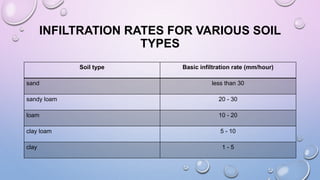
Soil type Basic infiltration rate (mm/hour)
sand less than 30
sandy loam 20 - 30
loam 10 - 20
clay loam 5 - 10
clay 1 - 5
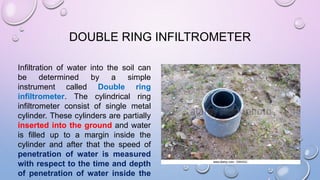
DOUBLE RING INFILTROMETER
Infiltration of water into the soil can
be determined by a simple
instrument called Double ring
infiltrometer. The cylindrical ring
infiltrometer consist of single metal
cylinder. These cylinders are partially
inserted into the ground and water
is filled up to a margin inside the
cylinder and after that the speed of
penetration of water is measured
with respect to the time and depth
of penetration of water inside the
MATERIALS REQUIRED
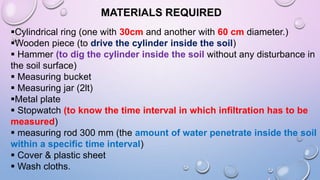
Cylindrical ring (one with 30cm and another with 60 cm diameter.)
Wooden piece (to drive the cylinder inside the soil)
 Hammer (to dig the cylinder inside the soil without any disturbance in
the soil surface)
 Measuring bucket
 Measuring jar (2lt)
Metal plate
 Stopwatch (to know the time interval in which infiltration has to be
measured)
 measuring rod 300 mm (the amount of water penetrate inside the soil
within a specific time interval)
 Cover & plastic sheet
 Wash cloths.
METHOD
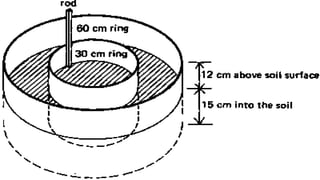
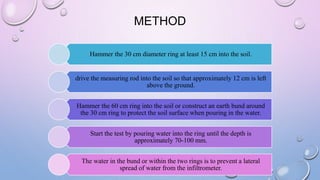
Hammer the 30 cm diameter ring at least 15 cm into the soil.
drive the measuring rod into the soil so that approximately 12 cm is left
above the ground.
Hammer the 60 cm ring into the soil or construct an earth bund around
the 30 cm ring to protect the soil surface when pouring in the water.
Start the test by pouring water into the ring until the depth is
approximately 70-100 mm.
The water in the bund or within the two rings is to prevent a lateral
spread of water from the infiltrometer.
Record the clock time when the test begins and note the water level on
the measuring rod.
After 1-2 minutes, record the drop in water level in the inner ring on
the measuring rod in inner cylinder
Record the water level. Maintain the water level outside the ring
similar to that inside.
Continue the test until the drop in water level is the same over the
same time interval.
Note that at least two infiltration tests should be carried out at a site to
make sure that the correct results are obtained.
REFERENCE
1. Champatira, A. Balmuri, V. , Patra ,K. C.,Sahoo , M.M. . Standard Test for Determination of
Infiltration Rate of Soil Using Double Ring Infiltrometer,
2. http://www.fao.org/docrep/s8684e/s8684e0a.htm date on 01/4/2017
double ring infiltrometer

double ring infiltrometer

  • 1.
    DOUBLE RING INFILTROMETER PRESENTED BY KISHANKUMAR M.SC. (AG.) ROLL NO. 120116015 An presentation on
  • 2.
    CONTENT 1. Infiltration &infiltration rate 2. Infiltration rates for various soil types 3. Double ring infiltrometer 4. Material required 5. Method 6. References
  • 3.
    INFILTRATION & INFILTRATIONRATE INFILTRATION REFERS TO THE ENTRY AND DOWNWARD MOVEMENT OF WATER IN TO THE SOIL SURFACE. The infiltration rate is the velocity or speed at which water enters into the soil. It is usually measured by the depth (in mm) of the water layer that can enter the soil in one hour.
  • 4.
    INFILTRATION RATES FORVARIOUS SOIL TYPES Soil type Basic infiltration rate (mm/hour) sand less than 30 sandy loam 20 - 30 loam 10 - 20 clay loam 5 - 10 clay 1 - 5
  • 5.
    DOUBLE RING INFILTROMETER Infiltrationof water into the soil can be determined by a simple instrument called Double ring infiltrometer. The cylindrical ring infiltrometer consist of single metal cylinder. These cylinders are partially inserted into the ground and water is filled up to a margin inside the cylinder and after that the speed of penetration of water is measured with respect to the time and depth of penetration of water inside the
  • 6.
    MATERIALS REQUIRED Cylindrical ring(one with 30cm and another with 60 cm diameter.) Wooden piece (to drive the cylinder inside the soil)  Hammer (to dig the cylinder inside the soil without any disturbance in the soil surface)  Measuring bucket  Measuring jar (2lt) Metal plate  Stopwatch (to know the time interval in which infiltration has to be measured)  measuring rod 300 mm (the amount of water penetrate inside the soil within a specific time interval)  Cover & plastic sheet  Wash cloths.
  • 9.
    METHOD Hammer the 30cm diameter ring at least 15 cm into the soil. drive the measuring rod into the soil so that approximately 12 cm is left above the ground. Hammer the 60 cm ring into the soil or construct an earth bund around the 30 cm ring to protect the soil surface when pouring in the water. Start the test by pouring water into the ring until the depth is approximately 70-100 mm. The water in the bund or within the two rings is to prevent a lateral spread of water from the infiltrometer.
  • 10.
    Record the clocktime when the test begins and note the water level on the measuring rod. After 1-2 minutes, record the drop in water level in the inner ring on the measuring rod in inner cylinder Record the water level. Maintain the water level outside the ring similar to that inside. Continue the test until the drop in water level is the same over the same time interval. Note that at least two infiltration tests should be carried out at a site to make sure that the correct results are obtained.
  • 11.
    REFERENCE 1. Champatira, A.Balmuri, V. , Patra ,K. C.,Sahoo , M.M. . Standard Test for Determination of Infiltration Rate of Soil Using Double Ring Infiltrometer, 2. http://www.fao.org/docrep/s8684e/s8684e0a.htm date on 01/4/2017