PRESENTED BY,
AKSHAY S. BHORKADE
MSc. 1st year
POST GRADUATE INSTITUTE, AKOLA
Dr. Panjabrao Deshmukh Krishi Vidyapeeth, Akola
Watershed : A topographic hydrological unit draining
runoff water at a common or a particular point by a
network of channels and streams.
 Watershed is a topographically
delineated area that is drained
by stream system, i.e. the total
land area that is drained to
some point on stream or river.
 Watershed catchment area or
drainage basin are used
synonymously.
 The watershed boundary is
called drainage divide.
 Technically, a watershed is the
divide separating one drainage
area from another.
 To control damaging runoff and degradation and
thereby conservation of soil and water.
 To manage and utilize the runoff for useful purpose.
 To check soil erosion and to reduce the effect of
sediment yield on the watershed.
 To moderate floods in the down stream areas.
 To enhance the ground water storage, wherever
applicable.
 Appropriate use of land resources in the watershed.
 To improve and increase production of timber, fodder
and wild life resource.
 To protect, conserve and improve the land of watershed
for more efficient and sustained production.
Objectives
 The soil and water conservation measures in the lower
catchment areas are prone to damage due to uncontrolled
runoff from the upper areas. It is therefore necessary to
protect the upper catchment areas through the watershed
approach.
 Small watershed are those where the overland flow is the
chief contributor to the peak flow are not affected by the
channel characteristics. On large watersheds, the channel
flows are highly pronounced and peak flows are influenced
by the channel characteristics.
 A typical small watershed project concentrates first on land
treatment. Development starts at the top of the drainage
basin and proceeds gradually down the slopes to low lands.
In humid areas, the highest elevations are usually forest,
and forest is often the resource most in need of repair.
Approach
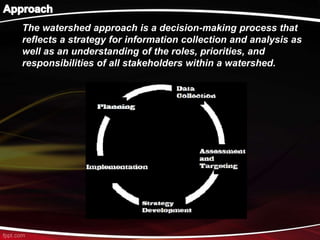
The watershed approach is a decision-making process that
reflects a strategy for information collection and analysis as
well as an understanding of the roles, priorities, and
responsibilities of all stakeholders within a watershed.
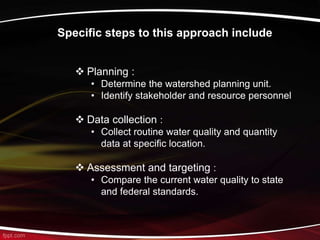
 Planning :
• Determine the watershed planning unit.
• Identify stakeholder and resource personnel
 Data collection :
• Collect routine water quality and quantity
data at specific location.
 Assessment and targeting :
• Compare the current water quality to state
and federal standards.
Specific steps to this approach include
 Strategy development :
• Develop goals and strategies to maintain or achieve
water quality standards and meet future demands.
 Implementation :
• Implement goals and strategies through permits, best
management practices and education.
• Measure progress
References :
 Principles and Practices of Water Management by S.C. Panda
 Fundamentals of Soil Science by ISSS
 Elements of soil conservation by H. H. Bennett
Watershed concept, objectives and approach

Watershed concept, objectives and approach

  • 1.
    PRESENTED BY, AKSHAY S.BHORKADE MSc. 1st year POST GRADUATE INSTITUTE, AKOLA Dr. Panjabrao Deshmukh Krishi Vidyapeeth, Akola
  • 2.
    Watershed : Atopographic hydrological unit draining runoff water at a common or a particular point by a network of channels and streams.  Watershed is a topographically delineated area that is drained by stream system, i.e. the total land area that is drained to some point on stream or river.  Watershed catchment area or drainage basin are used synonymously.  The watershed boundary is called drainage divide.  Technically, a watershed is the divide separating one drainage area from another.
  • 3.
     To controldamaging runoff and degradation and thereby conservation of soil and water.  To manage and utilize the runoff for useful purpose.  To check soil erosion and to reduce the effect of sediment yield on the watershed.  To moderate floods in the down stream areas.  To enhance the ground water storage, wherever applicable.  Appropriate use of land resources in the watershed.  To improve and increase production of timber, fodder and wild life resource.  To protect, conserve and improve the land of watershed for more efficient and sustained production. Objectives
  • 4.
     The soiland water conservation measures in the lower catchment areas are prone to damage due to uncontrolled runoff from the upper areas. It is therefore necessary to protect the upper catchment areas through the watershed approach.  Small watershed are those where the overland flow is the chief contributor to the peak flow are not affected by the channel characteristics. On large watersheds, the channel flows are highly pronounced and peak flows are influenced by the channel characteristics.  A typical small watershed project concentrates first on land treatment. Development starts at the top of the drainage basin and proceeds gradually down the slopes to low lands. In humid areas, the highest elevations are usually forest, and forest is often the resource most in need of repair. Approach
  • 5.
    The watershed approachis a decision-making process that reflects a strategy for information collection and analysis as well as an understanding of the roles, priorities, and responsibilities of all stakeholders within a watershed.
  • 6.
     Planning : •Determine the watershed planning unit. • Identify stakeholder and resource personnel  Data collection : • Collect routine water quality and quantity data at specific location.  Assessment and targeting : • Compare the current water quality to state and federal standards. Specific steps to this approach include
  • 7.
     Strategy development: • Develop goals and strategies to maintain or achieve water quality standards and meet future demands.  Implementation : • Implement goals and strategies through permits, best management practices and education. • Measure progress
  • 8.
    References :  Principlesand Practices of Water Management by S.C. Panda  Fundamentals of Soil Science by ISSS  Elements of soil conservation by H. H. Bennett