1
Different forms of
Water Erosion
Different Forms of Water Erosion
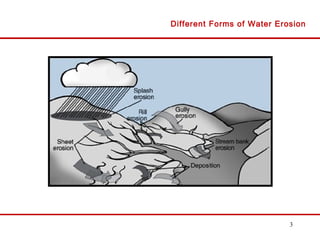
 Splash/ Raindrop Erosion
 Sheet Erosion
 Rill Erosion
 Gully Erosion
3
Different Forms of Water Erosion
4
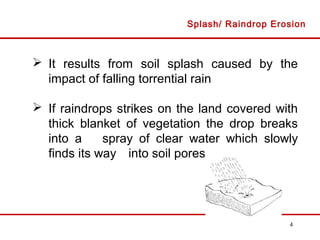
 It results from soil splash caused by the
impact of falling torrential rain
 If raindrops strikes on the land covered with
thick blanket of vegetation the drop breaks
into a spray of clear water which slowly
finds its way into soil pores
Splash/ Raindrop Erosion
5
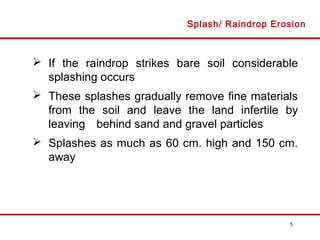
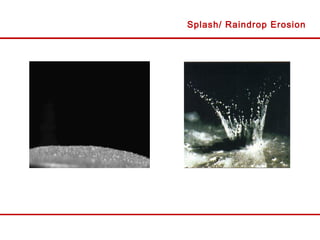
 If the raindrop strikes bare soil considerable
splashing occurs
 These splashes gradually remove fine materials
from the soil and leave the land infertile by
leaving behind sand and gravel particles
 Splashes as much as 60 cm. high and 150 cm.
away
Splash/ Raindrop Erosion
Sheet Erosion
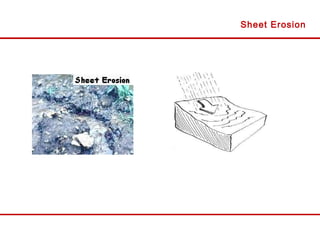
 It is the removal of fairly uniform layer of soil
from land surface by the action of rainfall and
runoff water
 Sloping land having a shallow loose topsoil
overlying a compact subsoil are the most
susceptible to sheet erosion
 detected by the muddy colour of the run-off
from the fields
Sheet Erosion
9
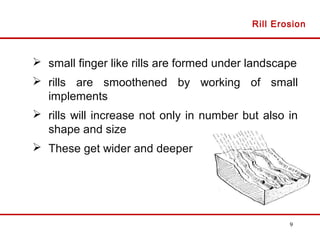
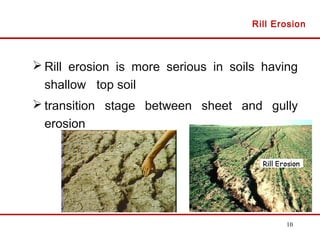
 small finger like rills are formed under landscape
 rills are smoothened by working of small
implements
 rills will increase not only in number but also in
shape and size
 These get wider and deeper
Rill Erosion
10
 Rill erosion is more serious in soils having
shallow top soil
 transition stage between sheet and gully
erosion
Rill Erosion
11
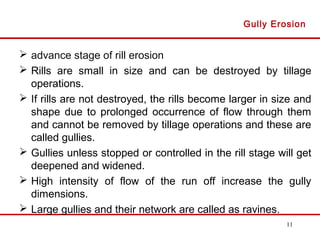
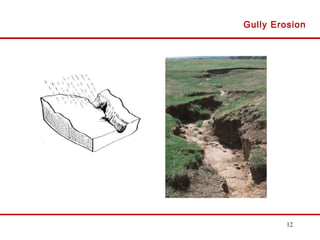
 advance stage of rill erosion
 Rills are small in size and can be destroyed by tillage
operations.
 If rills are not destroyed, the rills become larger in size and
shape due to prolonged occurrence of flow through them
and cannot be removed by tillage operations and these are
called gullies.
 Gullies unless stopped or controlled in the rill stage will get
deepened and widened.
 High intensity of flow of the run off increase the gully
dimensions.
 Large gullies and their network are called as ravines.
Gully Erosion
12
Gully Erosion
 The rate of gully erosion mainly depends on the runoff
characteristics of the watershed, namely watershed area,
soil characteristics
Gully Erosion
Stages of Gully
Development
Formation Stage
It is beginning of formation of rills (small channels)
and development by downward scouring of the
soils
Stages of Gully Development
Development Stage
It is a stage where the upstream movement in the
gully head and enlargement of gully in depth and
width takes place
Stages of Gully Development
Healing Stage
It is the stage where the vegetation begins to
grow in the gullies
Stages of Gully Development
Stabilization Stage
Here the gully bed, reaches a stable condition
The gully walls reach a stable slope and vegetative
cover spreads over the gully surface
• Based on shape (U shape, V shape)
• Based on nature of gully flow (Active,
Inactive)
• Based on size (depth, width and side
slopes)
Gully Classification
18
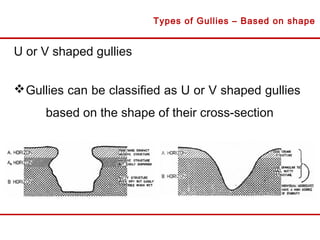
Types of Gullies – Based on shape
U or V shaped gullies
Gullies can be classified as U or V shaped gullies
based on the shape of their cross-section
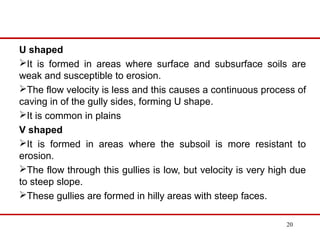
U shaped
It is formed in areas where surface and subsurface soils are
weak and susceptible to erosion.
The flow velocity is less and this causes a continuous process of
caving in of the gully sides, forming U shape.
It is common in plains
V shaped
It is formed in areas where the subsoil is more resistant to
erosion.
The flow through this gullies is low, but velocity is very high due
to steep slope.
These gullies are formed in hilly areas with steep faces.
20
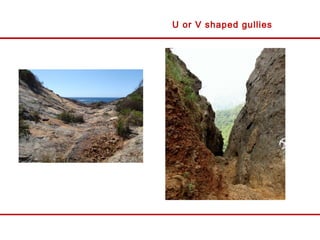
U or V shaped gullies
Active and inactive gullies
Active gullies are those which continued to enlarge
and they will be recognized by the presence of loose
soils
Inactive gullies are that which doesn’t enlarge
further and is covered with vegetation on the side
slopes
Types of gullies
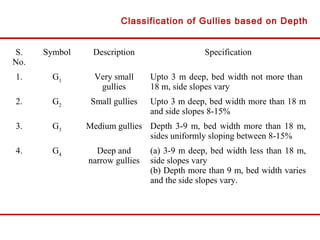
Classification of Gullies based on Depth
S.
No.
Symbol Description Specification
1. G1
Very small
gullies
Upto 3 m deep, bed width not more than
18 m, side slopes vary
2. G2
Small gullies Upto 3 m deep, bed width more than 18 m
and side slopes 8-15%
3. G3
Medium gullies Depth 3-9 m, bed width more than 18 m,
sides uniformly sloping between 8-15%
4. G4
Deep and
narrow gullies
(a) 3-9 m deep, bed width less than 18 m,
side slopes vary
(b) Depth more than 9 m, bed width varies
and the side slopes vary.
24
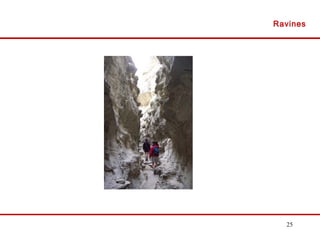
• A ravine is generally a slope landform (larger
than a gully) of relatively steep (cross-sectional)
sides, on the order of 20 – 70 % in gradient.
Ravines
25
Ravines
26
• Landslides are simply defined as the
mass movement of rock, debris or earth
down a slope
• They often take place in conjunction
with earthquakes, floods and volcanoes.
Landslides
27
• Landslides are caused when the
stability of a slope changes from a
stable to an unstable condition.
• A change in the stability of a slope can
be caused by a number of factors,
acting together or alone
Causes of Landslides
28
• Ground water pressure acting to destabilize the
slope
• Loss or absence of vertical vegetative structure,
soil nutrients, and soil structure.
• Erosion of the toe of a slope by rivers or ocean
waves
• Weakening of a slope through saturation by
snowmelt, glaciers melting, or heavy rains
• Earthquakes adding loads to barely-stable slopes
• Volcanic eruptions
Natural Causes of Landslides
29
• Vibrations from machinery or traffic.
• Earthwork which alters the shape of a slope,
or which imposes new loads on an existing
slope in shallow soils.
• Removal of deep-rooted vegetation that binds
colluvium to bedrock.
• Construction, agricultural, or forestry activities
which change the amount of water which
infiltrates into the soil.
Human Causes of Landslides
Specialized Forms of Water Erosion
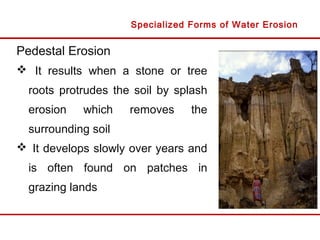
Pedestal Erosion
 It results when a stone or tree
roots protrudes the soil by splash
erosion which removes the
surrounding soil
 It develops slowly over years and
is often found on patches in
grazing lands
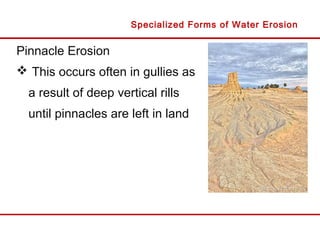
Pinnacle Erosion
 This occurs often in gullies as
a result of deep vertical rills
until pinnacles are left in land
Specialized Forms of Water Erosion
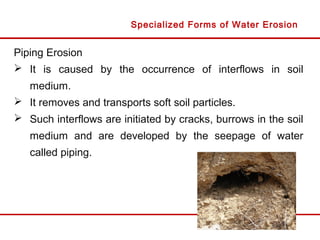
Piping Erosion
 It is caused by the occurrence of interflows in soil
medium.
 It removes and transports soft soil particles.
 Such interflows are initiated by cracks, burrows in the soil
medium and are developed by the seepage of water
called piping.
Specialized Forms of Water Erosion
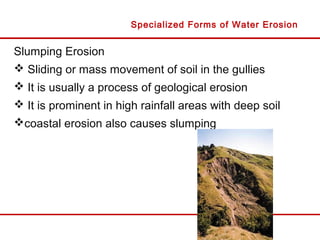
Slumping Erosion
 Sliding or mass movement of soil in the gullies
 It is usually a process of geological erosion
 It is prominent in high rainfall areas with deep soil
coastal erosion also causes slumping
Specialized Forms of Water Erosion
Fertility Erosion
It is the loss of plant nutrients by erosion
P is mainly lost along with the colloidal particles on the
surface is observed
N in the form of NO2 or NO3 is soluble and so can be
lost as solution with the runoff without any soil movement
occurring
Specialized Forms of Water Erosion

Water erosion

  • 1.
  • 2.
    Different Forms ofWater Erosion  Splash/ Raindrop Erosion  Sheet Erosion  Rill Erosion  Gully Erosion
  • 3.
    3 Different Forms ofWater Erosion
  • 4.
    4  It resultsfrom soil splash caused by the impact of falling torrential rain  If raindrops strikes on the land covered with thick blanket of vegetation the drop breaks into a spray of clear water which slowly finds its way into soil pores Splash/ Raindrop Erosion
  • 5.
    5  If theraindrop strikes bare soil considerable splashing occurs  These splashes gradually remove fine materials from the soil and leave the land infertile by leaving behind sand and gravel particles  Splashes as much as 60 cm. high and 150 cm. away Splash/ Raindrop Erosion
  • 6.
  • 7.
    Sheet Erosion  Itis the removal of fairly uniform layer of soil from land surface by the action of rainfall and runoff water  Sloping land having a shallow loose topsoil overlying a compact subsoil are the most susceptible to sheet erosion  detected by the muddy colour of the run-off from the fields
  • 8.
  • 9.
    9  small fingerlike rills are formed under landscape  rills are smoothened by working of small implements  rills will increase not only in number but also in shape and size  These get wider and deeper Rill Erosion
  • 10.
    10  Rill erosionis more serious in soils having shallow top soil  transition stage between sheet and gully erosion Rill Erosion
  • 11.
    11  advance stageof rill erosion  Rills are small in size and can be destroyed by tillage operations.  If rills are not destroyed, the rills become larger in size and shape due to prolonged occurrence of flow through them and cannot be removed by tillage operations and these are called gullies.  Gullies unless stopped or controlled in the rill stage will get deepened and widened.  High intensity of flow of the run off increase the gully dimensions.  Large gullies and their network are called as ravines. Gully Erosion
  • 12.
  • 13.
     The rateof gully erosion mainly depends on the runoff characteristics of the watershed, namely watershed area, soil characteristics Gully Erosion
  • 14.
    Stages of Gully Development FormationStage It is beginning of formation of rills (small channels) and development by downward scouring of the soils
  • 15.
    Stages of GullyDevelopment Development Stage It is a stage where the upstream movement in the gully head and enlargement of gully in depth and width takes place
  • 16.
    Stages of GullyDevelopment Healing Stage It is the stage where the vegetation begins to grow in the gullies
  • 17.
    Stages of GullyDevelopment Stabilization Stage Here the gully bed, reaches a stable condition The gully walls reach a stable slope and vegetative cover spreads over the gully surface
  • 18.
    • Based onshape (U shape, V shape) • Based on nature of gully flow (Active, Inactive) • Based on size (depth, width and side slopes) Gully Classification 18
  • 19.
    Types of Gullies– Based on shape U or V shaped gullies Gullies can be classified as U or V shaped gullies based on the shape of their cross-section
  • 20.
    U shaped It isformed in areas where surface and subsurface soils are weak and susceptible to erosion. The flow velocity is less and this causes a continuous process of caving in of the gully sides, forming U shape. It is common in plains V shaped It is formed in areas where the subsoil is more resistant to erosion. The flow through this gullies is low, but velocity is very high due to steep slope. These gullies are formed in hilly areas with steep faces. 20
  • 21.
    U or Vshaped gullies
  • 22.
    Active and inactivegullies Active gullies are those which continued to enlarge and they will be recognized by the presence of loose soils Inactive gullies are that which doesn’t enlarge further and is covered with vegetation on the side slopes Types of gullies
  • 23.
    Classification of Gulliesbased on Depth S. No. Symbol Description Specification 1. G1 Very small gullies Upto 3 m deep, bed width not more than 18 m, side slopes vary 2. G2 Small gullies Upto 3 m deep, bed width more than 18 m and side slopes 8-15% 3. G3 Medium gullies Depth 3-9 m, bed width more than 18 m, sides uniformly sloping between 8-15% 4. G4 Deep and narrow gullies (a) 3-9 m deep, bed width less than 18 m, side slopes vary (b) Depth more than 9 m, bed width varies and the side slopes vary.
  • 24.
    24 • A ravineis generally a slope landform (larger than a gully) of relatively steep (cross-sectional) sides, on the order of 20 – 70 % in gradient. Ravines
  • 25.
  • 26.
    26 • Landslides aresimply defined as the mass movement of rock, debris or earth down a slope • They often take place in conjunction with earthquakes, floods and volcanoes. Landslides
  • 27.
    27 • Landslides arecaused when the stability of a slope changes from a stable to an unstable condition. • A change in the stability of a slope can be caused by a number of factors, acting together or alone Causes of Landslides
  • 28.
    28 • Ground waterpressure acting to destabilize the slope • Loss or absence of vertical vegetative structure, soil nutrients, and soil structure. • Erosion of the toe of a slope by rivers or ocean waves • Weakening of a slope through saturation by snowmelt, glaciers melting, or heavy rains • Earthquakes adding loads to barely-stable slopes • Volcanic eruptions Natural Causes of Landslides
  • 29.
    29 • Vibrations frommachinery or traffic. • Earthwork which alters the shape of a slope, or which imposes new loads on an existing slope in shallow soils. • Removal of deep-rooted vegetation that binds colluvium to bedrock. • Construction, agricultural, or forestry activities which change the amount of water which infiltrates into the soil. Human Causes of Landslides
  • 30.
    Specialized Forms ofWater Erosion Pedestal Erosion  It results when a stone or tree roots protrudes the soil by splash erosion which removes the surrounding soil  It develops slowly over years and is often found on patches in grazing lands
  • 31.
    Pinnacle Erosion  Thisoccurs often in gullies as a result of deep vertical rills until pinnacles are left in land Specialized Forms of Water Erosion
  • 32.
    Piping Erosion  Itis caused by the occurrence of interflows in soil medium.  It removes and transports soft soil particles.  Such interflows are initiated by cracks, burrows in the soil medium and are developed by the seepage of water called piping. Specialized Forms of Water Erosion
  • 33.
    Slumping Erosion  Slidingor mass movement of soil in the gullies  It is usually a process of geological erosion  It is prominent in high rainfall areas with deep soil coastal erosion also causes slumping Specialized Forms of Water Erosion
  • 34.
    Fertility Erosion It isthe loss of plant nutrients by erosion P is mainly lost along with the colloidal particles on the surface is observed N in the form of NO2 or NO3 is soluble and so can be lost as solution with the runoff without any soil movement occurring Specialized Forms of Water Erosion