1 | P a g e Physical Hazards
Lecture Notes
on
Environmental Hazards and Disasters-II (Human-Induced)
Md. Abdullah-Al-Mahbub
Assistant Professor, Dept. of Disaster Management
Begum Rokeya University, Rangpur
Components of Disaster
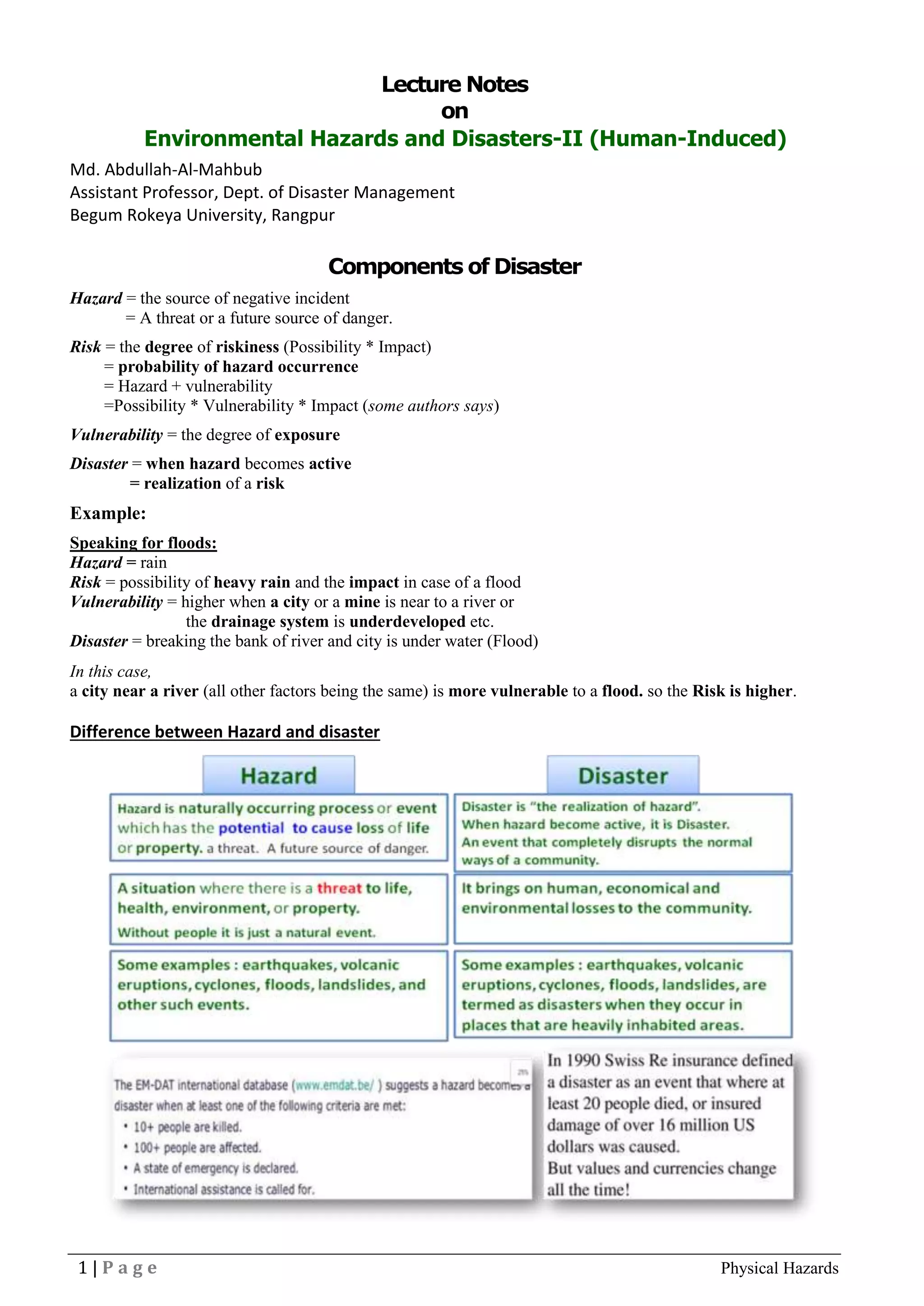
Hazard = the source of negative incident
= A threat or a future source of danger.
Risk = the degree of riskiness (Possibility * Impact)
= probability of hazard occurrence
= Hazard + vulnerability
=Possibility * Vulnerability * Impact (some authors says)
Vulnerability = the degree of exposure
Disaster = when hazard becomes active
= realization of a risk
Example:
Speaking for floods:
Hazard = rain
Risk = possibility of heavy rain and the impact in case of a flood
Vulnerability = higher when a city or a mine is near to a river or
the drainage system is underdeveloped etc.
Disaster = breaking the bank of river and city is under water (Flood)
In this case,
a city near a river (all other factors being the same) is more vulnerable to a flood. so the Risk is higher.
Difference between Hazard and disaster
2 | P a g e Physical Hazards
Impact of Disaster
Human Impact
ā–Ŗ Injury/death
ā–Ŗ Loss of homes/properties
Economic Impact
ā–Ŗ Loss of jobs/business
Infrastructural Impact
ā–Ŗ Damage/destroyed roads, bridges, power grid, communications
Anthropogenic/ManmadeHazard
Definitionandtypes
Try yourself
Physical Hazard
Try yourself
Soil Erosion and Land Degradation
1. Definition of Soil Erosion
Soil erosion is the washing or blowing away of the top layer of the soil by water or wind or glacier. It is a natural
process. It becomes a problem when human activity causes it to occur much faster than under natural conditions.
If the soil has eroded, the crops will not grow very well.
Soil erosion is the movement of soil from on place to another by wind, water, ice, gravity.
2. Types of Soil Erosion
There are two major types of erosion: geologic erosion, accelerated erosion and gravity erosion.
1. Geologic erosion: It is a natural process of weathering that generally occurs at low rates on the parent rocks
as the natural soil-forming processes. It occurs over long geologic time horizons and is not influenced by
human activity. Some idea of the ā€˜geologic time’ can be formed from the fact that a measurable depth of a
few centimeters of soil takes thousands year to form due to weathering of parent rocks.
It is caused by effect of rainfall, run-off, wind, topography & atmospheric temperature
2. Accelerated erosion: It occurs due to anthropogenic causes such as deforestation, slash-and-burn agriculture,
intensive plowing, intensive and uncontrolled grazing, and biomass burning. These activities intensify the
factors responsible for erosion and the erosion process is accelerated.
3. Gravity erosion: Mass movement of soil occurs on steep slopes under the influence of gravity is called
gravity erosion. The process involves the transfer of slope-forming materials from higher to lower grounds
due to self weight. Examples are- rock falls, landslide, mudslide, creep, slumping etc.
2.1. ErosionbyWater
2.1.1. Types/FormsofWaterErosion
a) Raindrop Erosion (Splash Erosion): Small soil particles are detached and sent airborne through the
impact of raindrops on soil.
3 | P a g e Physical Hazards
b) Sheet Erosion: Raindrops break apart the soil structure and it's moved downslope by water that flows
overland as a sheet rather than definitive channels. This occurs frequently during cloud bursts.
c) Rill Erosion: This process develops small, short-lived, concentrated flow paths. These paths creates a
sediment source and delivery system for hillslope erosion. Areas where precipitation rates exceed soil
infiltration rates are more prone to this type of erosion.
d) Gully Erosion: Water flows in narrow channels during or directly following heavy rains or melting
snow. The gullies can erode to considerable depths.
e) Valley or Stream Erosion: Continual water flow alongside land (along a linear feature) creates this type
of erosion. It extends downward, deepening a valley, and headward, extending the valley into the hillside.
This occurs most frequently in times of flooding.
f) Bank Erosion: Over time, banks of rivers and streams are naturally worn down.
g) Wave Erosion: Waves are the major cause of erosion along the coast.
2.1.2. CausesofSoilErosionbyWater
1. Rainfall intensity and runoff: The impact of raindrops will break up the soil and water build-up will create
runoff, taking sediment with it.
2. Soil erodability: Based on the characteristics of each unique soil, it is more or less susceptible to erosion.
Recurring erosion is more typical for soil in areas that have experienced erosion in the past.
3. Slope gradient and length: The steeper the slope, the greater amount of soil can be lost. As the soil erodes
downward, it increases the slope degree, which in turn, creates further erosion.
4. Vegetation: Vegetative cover of plants or crop residues protect the soil from raindrop impact and splash.
The less vegetation cover, the more erosion can occur.
2.1.3. EffectsofSoilErosionbyWater
The loss of natural nutrients and possible fertilizers directly affect crop emergence, growth, and yield. Seeds can
be disturbed or removed and pesticides can be carried off. The soil quality, structure, stability, and texture are also
affected, which in turn affect the holding capacity of the soil.
Eroded soil can reduce the growth of seeds, bury seedlings, contribute to road damage, and even contaminate
water sources and recreational areas.
2.1.4. WaterErosionControl
The greatest way to restore eroded land is very simple: Vegetation. Plants grow and colonize creating deep
root systems protecting the soil from water in its various forms. As simple as the solution is, a little help never
hurts. Coir is natural coconut fiber that will protect the soil while the plants grow. Woven geotextiles and non-
woven geotextiles separate soils, filter water, and reinforce the ground.
2.2. ErosionbyWind
2.2.1. FactorsofSoilErosionbyWind
1. Aridity of Climate: The less rainfall, the more opportunity for erosion caused by wind.
2. Wind Speed: Erosion increases with strong winds or gusts
3. Soil Texture: Loamy sand (particles 10-100 microns) is the most vulnerable soil. Soil containing clay is
stickier and is more resistant to wind.
4. Soil Structure: The absence of structure-improving matter (organic matter, iron, free aluminum, lime) the
soil contains on the surface, the more susceptible to erosion it is.
5. State of the Soil Surface: If the soil surface is stony, the risks of erosion are lower.
6. Vegetation: Stubble and crop residues in the soil cut wind-speed at ground level.
4 | P a g e Physical Hazards
7. Soil Moisture: Moisture makes the sand and loam more cohesive, temporarily preventing erosion.
2.2.2. CausesofSoilErosionbyWind
1. Erodability of soil: The finest particles are transported by the wind, while the heavier particles are blown
across the surface causing abrasion.
2. Soil surface roughness: Soil surfaces that are not rough offer little resistance to wind erosion. Excess
tillage can contribute to the breakdown of soil.
3. Climate: Soil moisture levels at the surface can become extremely low in times of drought, increasing
particles to be carried by the wind. Conversely, this effect can occur in freezing climates as well.
4. Un-Sheltered distance: The lack of windbreaks allows wind to transport particles a farther distance,
increasing abrasion and erosion.
5. Vegetative cover: Lack of permanent vegetation creates loose, dry, and barren soil that is perfect for wind
transport.
2.2.3. EffectsofSoilErosionbyWind
The smallest and finest particles are carried by the wind and collected in various areas, creating a build up of
loam. Sediment crust degrades and rocks are easily weathered. Sheets of sand traveling close to the ground
can degrade crops. It reduces the capacity of the soil to store nutrients. One of the most noticeable effects is
seen in sand dunes. The sand will move wherever the wind takes it--burying oases and ancient cities along the
way.
Crops can be completely ruined, resulting in delay and reseeding, which is costly. Plants could become
sandblasted resulting in a decreased yield. Soil drifting depletes fertility and continual drifting can change the
texture of soil.
2.2.4. WindErosionControl
Control erosion created by wind is no easy task. The wind, after all, is a seemingly unstoppable force. With that in mind, there are other
ways to control the erosion through controlling the soil. The two things that must be done are reduce the wind-speed at ground
level and increase soil cohesion. These two actions will improve the soil's resistance to wind.
There are numerous ways to increase soil cohesion from spraying it with binding solutions to simply irrigating the soil. The roughness of
the soil surface can be increased through specific cropping techniques to cut down wind-speed. Wind-speed can also be cut by increasing
plant density. On a larger scale, a wind-break can be created to cut wind-speed and reduce both evaporation and erosion. The best
arrangement is two rows of tall trees surrounded by two rows of large trees.
The use of coir, geotextiles, and non-woven geotextiles will greatly improve the growth of the these plants. These products will separate
sand from soil and allow the plants to colonize and establish a significant root system, which will ultimately cut down wind-speed, hence
decreasing possible erosion.
3. Effects of Soil Erosion
A. On-SiteEffects
1. Impaired soil productivity
2. Desertification
3. Land degradation
B. Off-SiteEffects
1. Water pollution and sedimentation
2. Flooding
3. Airborne dust pollution
4. Damage to infrastructure
5 | P a g e Physical Hazards
A. On-SiteEffects
1. Impaired soil productivity
The loss of topsoil is what decreases the productivity of soils and negatively affects our capability to grow crops on them.
Topsoil is crucial for plant growth because it contains the majority of organic matter and 50 percent of important nutrients such as
phosphorus and potassium. It is in the topsoil where large pores and soil aggregates form, allowing for proper water infiltration and
aeration.
When topsoil erodes away, nutrient and organic material is lost and only compacted clayish soils with poor structure remain behind. Due to
the unfavorable conditions, plants grown on these soils strive and often do not produce sufficient yields.
A very common practice in intensive agriculture to offset the declining yield from eroded soils is to add synthetic fertilizers which supply
some of the lost nutrients. However, this strategy is only a short-term fix to get the last bit of harvest from damaged soils.
2. Desertification
Overexploited lands in dry regions are extremely vulnerable to soil erosion. Soil erosion itself seriously impairs the quality of soil and its
natural recovery rate, but it is not the worst problem that can occur.
In many cases, erosion is the first step that starts the irreversible transformation of the landscape into the barren desert. Grain by grain,
sand and dirt is picked up by wind from mismanaged lands and pushed farther and farther into new territories, slowly swallowing
remaining vegetation and turning the area into the wasteland.
Once turn into desert, soils cannot support plant life anymore, which leads to crop failures, the disappearance of whole ecosystems and
biodiversity declines.
3. Land degradation
Erosion by wind or water is greatly responsible for nearly 85 percent of soil degradation throughout the world . A new study backed by the
United Nations estimates that one third of all the land is severely degraded worldwide.
Land degradation is defined as the long-term loss of soil productivity and ability to provide crucial ecosystem services for the proper health
and functioning of our planet. This includes services such as decomposition of organic matter and cycling of nutrients, formation of new
topsoil and groundwater replenishment.
A common problem of degraded lands is a sealing of the soil surface. This minimizes water infiltration and causes a myriad of changes to
local hydrology. Increased runoff, for example, leads to frequent flooding after rain, while soil overall becomes drier because it loses its
water holding capacity over the long term.
Degraded land cannot support these essential soil functions or growth of vegetation, and therefore, renders affected land unsuitable for
cultivation.
B. Off-SiteEffects
1. Water pollution and sedimentation
6 | P a g e Physical Hazards
The major off-site problem caused by erosion is the deposition of eroded soil, along with pollutants it picked up, into watercourses. This
causes two serious problems:
a. Water pollution by heavy metals, agricultural chemicals and other contaminants
b. Sedimentation in water bodies
Soil transported pollutants into water bodies disrupts aquatic ecosystems by changing chemical and physical properties of water.
Agricultural fertilizers can cause eutrophication and mass dying of aquatic life.
Additional problem is the pollution of drinking water supply, which requires extra investment into removing impurities and making water
suitable for drinking again.
Increasing sediment loads can block rivers and dams, eventually leading to mud floods and further damage to surrounding ecosystems and
built structures.
High sedimentation rates also damage hydro-electricity plants and decrease the lifetime of constructed water reservoirs.
Environmental Protection Agency (EPA) estimates that the yearly cost of fixing the damage caused by sedimentation rises as high as $US
16 billion in the United States. Sedimentation which is out of 70 percent brought about by human-induced erosion
2. Flooding
The deposition of silt in water courses often obstructs their natural path. This increases the risk of flooding and further enhances erosion
of water banks, since the water seeks the way to flow around a newly created obstruction.
3. Airborne dust pollution
Wind erosion has the power to cause widespread air pollution that can affect places hundreds or even thousands of miles away from the
original site of erosion.
Wind-blown dust particles do not harm only the health of people and animals, they also damage young plants and crops. Wind
often picks up fine particles of sand, silt and organic matter and buries or breaks seedlings, while exposing seeds or plant roots in other
places. This leaves behind weak and vulnerable crops that cannot provide sufficient yield.
There are numerous cases describing its suffocating effects.
In the spring of 2015, the Department for Environment, Food and Rural Affairs warned England’s citizens about ā€œblood rainā€- rain mixed
with red sand and light dirt particles carried by wind more than 2,000 miles from Sahara Desert to England. The polluted rain was
expected to contribute to poor outdoor air quality that might result in respiratory problems .
The same problem bothers citizens in China, North and South Korea, and Japan, as the dust blown from the Gobi Desert scourges their
territory every spring.
4. Damage to infrastructure
Whether it is a damage caused by flooded rivers, roads and rails torn apart by sliding land or dams cracking under the burden of
accumulating sediments, soil erosion can gradually and certainly somewhat sneakily destroy many built structures.
4. Ways to Prevent Soil Erosion
A. UsingBasicErosionPreventionTechniques
1. Planting grass and shrubs: Bare soil is easily swept away by wind and water, the two main causes of
erosion. Plant roots hold the soil together, while their leaves block rain and stop it breaking the soil
apart. Turf, ornamental grass, and low, spreading shrubs work best since they cover the soil completely.
• If you have any bare ground, try to establish plant cover as soon as possible to limit erosion.
• If the ground is mostly flat (slope of 3:1 or less), this might be enough to solve the problem. Steep slopes
erode faster, so they need more protection.
7 | P a g e Physical Hazards
2. Add mulch or rocks: This will weigh down the soil and protect the seeds and young plants underneath from
getting washed away. It also slows the absorption of water to reduce runoff. Grass clippings or bark chips
work especially well.
• If you don’t plant anything, keep the soil covered with mulch. You can also add mulch around plants to
add another layer of protection or to keep the soil warm.
3. Use mulch matting to hold vegetation on slopes: Simply lay the mat over your seeds or young plants. On
steep slopes, dig a small trench at the top of the hill first. Lay the top of the mat in the trench, fill it up with
soil, then fold the mat back over the top. This helps water run over the top of the mat, where the mat will slow
it down, instead of traveling underneath it.[4]
• Fiber mulch mats or erosion control mats are a layer of mulch held together in a fiber mesh. This structure
holds the mulch together in areas where normal mulch would be washed or blown away.
4. Put down fiber logs: Another option for erosion control on steep slopes is a series of rolled up logs or
"wattles" made from fibrous material (like straw). Water running down the slope will slow down when it hits
the logs, soaking into the soil instead of carrying mud downhill. Put the logs down across the slope, 10 to 25
feet (3–8m) apart. Hold them in place with wooden stakes or sturdy, living plants.[6]
• You can plant seeds directly in the logs to protect them while they grow.
• If you do plant seeds directly into the logs, you should still use stakes to hold the logs in place, at least
until the seeds develop sturdy roots that go into the soil.
5. Build retaining walls: Badly eroded slopes will continue to collapse downhill until they are stabilized. A
retaining wall at the base of the slope will block the soil and slow down the collapse. This gives grass or other
plants time to grow and help the soil hold together.
• Give the wall a 2% slope on the side (perpendicular to the incline) so that water flows off to the side
instead of pooling.
• You may build the wall from concrete blocks, rock, or wood. Only use wood treated with a preservative
to prevent rot.
• Use retaining walls around flowerbeds and other raised soil areas as well.
• You may need local government approval to build these structures.
8 | P a g e Physical Hazards
6. Improve drainage: All buildings should have gutters or pipes that can drain water effectively out of your
garden and into water collection systems. Without adequate drainage, heavy rain could wash away a whole
layer of topsoil.
• Areas with heavy water runoff may require installing an underground perforated drainage pipe.
7. Reduce watering if possible: Over-watering your garden can speed up erosion by washing away soil. Use
less water if you can, or install a drip irrigation system. Since a drip system only delivers small amounts of
water at a time, there is no water flooding across the surface to carry topsoil.
B. PreventingFarmlandErosion
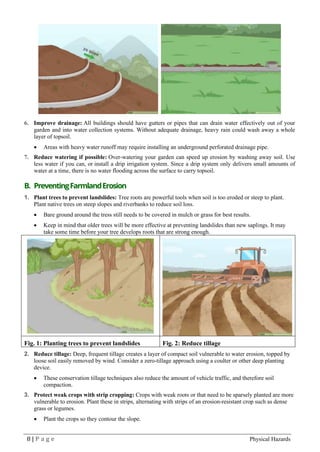
1. Plant trees to prevent landslides: Tree roots are powerful tools when soil is too eroded or steep to plant.
Plant native trees on steep slopes and riverbanks to reduce soil loss.
• Bare ground around the tress still needs to be covered in mulch or grass for best results.
• Keep in mind that older trees will be more effective at preventing landslides than new saplings. It may
take some time before your tree develops roots that are strong enough.
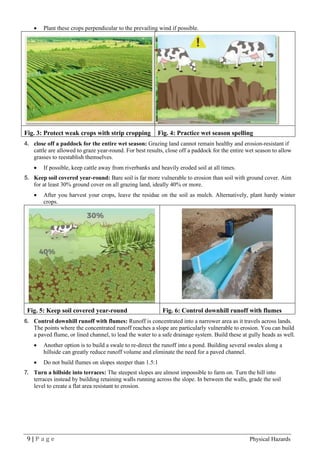
Fig. 1: Planting trees to prevent landslides Fig. 2: Reduce tillage
2. Reduce tillage: Deep, frequent tillage creates a layer of compact soil vulnerable to water erosion, topped by
loose soil easily removed by wind. Consider a zero-tillage approach using a coulter or other deep planting
device.
• These conservation tillage techniques also reduce the amount of vehicle traffic, and therefore soil
compaction.
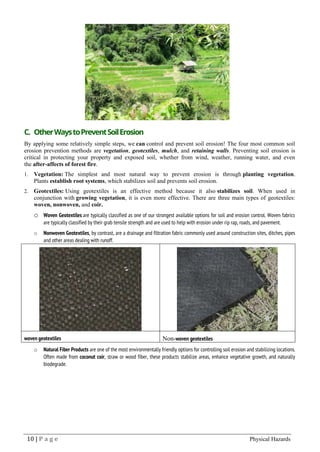
3. Protect weak crops with strip cropping: Crops with weak roots or that need to be sparsely planted are more
vulnerable to erosion. Plant these in strips, alternating with strips of an erosion-resistant crop such as dense
grass or legumes.
• Plant the crops so they contour the slope.
9 | P a g e Physical Hazards
• Plant these crops perpendicular to the prevailing wind if possible.
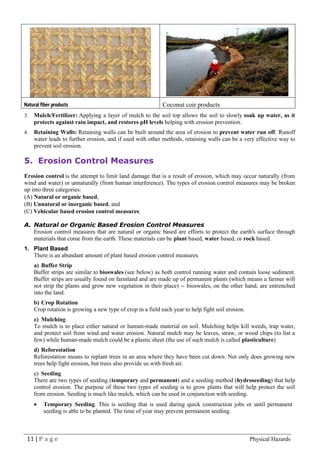
Fig. 3: Protect weak crops with strip cropping Fig. 4: Practice wet season spelling
4. close off a paddock for the entire wet season: Grazing land cannot remain healthy and erosion-resistant if
cattle are allowed to graze year-round. For best results, close off a paddock for the entire wet season to allow
grasses to reestablish themselves.
• If possible, keep cattle away from riverbanks and heavily eroded soil at all times.
5. Keep soil covered year-round: Bare soil is far more vulnerable to erosion than soil with ground cover. Aim
for at least 30% ground cover on all grazing land, ideally 40% or more.
• After you harvest your crops, leave the residue on the soil as mulch. Alternatively, plant hardy winter
crops.
Fig. 5: Keep soil covered year-round Fig. 6: Control downhill runoff with flumes
6. Control downhill runoff with flumes: Runoff is concentrated into a narrower area as it travels across lands.
The points where the concentrated runoff reaches a slope are particularly vulnerable to erosion. You can build
a paved flume, or lined channel, to lead the water to a safe drainage system. Build these at gully heads as well.
• Another option is to build a swale to re-direct the runoff into a pond. Building several swales along a
hillside can greatly reduce runoff volume and eliminate the need for a paved channel.
• Do not build flumes on slopes steeper than 1.5:1
7. Turn a hillside into terraces: The steepest slopes are almost impossible to farm on. Turn the hill into
terraces instead by building retaining walls running across the slope. In between the walls, grade the soil
level to create a flat area resistant to erosion.
10 | P a g e Physical Hazards
C. OtherWaystoPreventSoilErosion
By applying some relatively simple steps, we can control and prevent soil erosion! The four most common soil
erosion prevention methods are vegetation, geotextiles, mulch, and retaining walls. Preventing soil erosion is
critical in protecting your property and exposed soil, whether from wind, weather, running water, and even
the after-affects of forest fire.
1. Vegetation: The simplest and most natural way to prevent erosion is through planting vegetation.
Plants establish root systems, which stabilizes soil and prevents soil erosion.
2. Geotextiles: Using geotextiles is an effective method because it also stabilizes soil. When used in
conjunction with growing vegetation, it is even more effective. There are three main types of geotextiles:
woven, nonwoven, and coir.
o Woven Geotextiles are typically classified as one of our strongest available options for soil and erosion control. Woven fabrics
are typically classified by their grab tensile strength and are used to help with erosion under rip rap, roads, and pavement.
o Nonwoven Geotextiles, by contrast, are a drainage and filtration fabric commonly used around construction sites, ditches, pipes
and other areas dealing with runoff.
woven geotextiles Non-woven geotextiles
o Natural Fiber Products are one of the most environmentally friendly options for controlling soil erosion and stabilizing locations.
Often made from coconut coir, straw or wood fiber, these products stabilize areas, enhance vegetative growth, and naturally
biodegrade.
11 | P a g e Physical Hazards
Natural fiber products Coconut coir products
3. Mulch/Fertilizer: Applying a layer of mulch to the soil top allows the soil to slowly soak up water, as it
protects against rain impact, and restores pH levels helping with erosion prevention.
4. Retaining Walls: Retaining walls can be built around the area of erosion to prevent water run off. Runoff
water leads to further erosion, and if used with other methods, retaining walls can be a very effective way to
prevent soil erosion.
5. Erosion Control Measures
Erosion control is the attempt to limit land damage that is a result of erosion, which may occur naturally (from
wind and water) or unnaturally (from human interference). The types of erosion control measures may be broken
up into three categories:
(A) Natural or organic based,
(B) Unnatural or inorganic based, and
(C) Vehicular based erosion control measures.
A. Natural or Organic Based Erosion Control Measures
Erosion control measures that are natural or organic based are efforts to protect the earth's surface through
materials that come from the earth. These materials can be plant based, water based, or rock based.
1. Plant Based
There is an abundant amount of plant based erosion control measures.
a) Buffer Strip
Buffer strips are similar to bioswales (see below) as both control running water and contain loose sediment.
Buffer strips are usually found on farmland and are made up of permanent plants (which means a farmer will
not strip the plants and grow new vegetation in their place) -- bioswales, on the other hand, are entrenched
into the land.
b) Crop Rotation
Crop rotation is growing a new type of crop in a field each year to help fight soil erosion.
c) Mulching
To mulch is to place either natural or human-made material on soil. Mulching helps kill weeds, trap water,
and protect soil from wind and water erosion. Natural mulch may be leaves, straw, or wood chips (to list a
few) while human-made mulch could be a plastic sheet (the use of such mulch is called plasticulture)
d) Reforestation
Reforestation means to replant trees in an area where they have been cut down. Not only does growing new
trees help fight erosion, but trees also provide us with fresh air.
e) Seeding
There are two types of seeding (temporary and permanent) and a seeding method (hydroseeding) that help
control erosion. The purpose of these two types of seeding is to grow plants that will help protect the soil
from erosion. Seeding is much like mulch, which can be used in conjunction with seeding.
• Temporary Seeding. This is seeding that is used during quick construction jobs or until permanent
seeding is able to be planted. The time of year may prevent permanent seeding.
12 | P a g e Physical Hazards
• Permanent Seeding. This is seeding that occurs after construction and is done in order to provide the
land with lasting protection against erosion.
• Hydroseeding. Hydroseeding is a method of seeding and can be used for either temporary or permanent
seeding. It is employed when the land is difficult to access (a steep slope, for example). With
hydroseeding, seeds are sprayed onto the ground either through the use of a truck or helicopter.
A similar concept to seeding is cover crops which are crops made up of strong plants compacted together
to help prevent the soil from eroding.
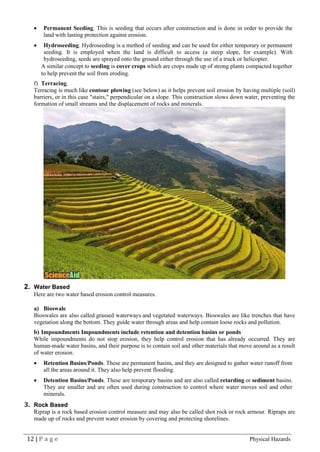
f) Terracing.
Terracing is much like contour plowing (see below) as it helps prevent soil erosion by having multiple (soil)
barriers, or in this case "stairs," perpendicular on a slope. This construction slows down water, preventing the
formation of small streams and the displacement of rocks and minerals.
2. Water Based
Here are two water based erosion control measures.
a) Bioswale
Bioswales are also called grassed waterways and vegetated waterways. Bioswales are like trenches that have
vegetation along the bottom. They guide water through areas and help contain loose rocks and pollution.
b) Impoundments Impoundments include retention and detention basins or ponds
While impoundments do not stop erosion, they help control erosion that has already occurred. They are
human-made water basins, and their purpose is to contain soil and other materials that move around as a result
of water erosion.
• Retention Basins/Ponds. These are permanent basins, and they are designed to gather water runoff from
all the areas around it. They also help prevent flooding.
• Detention Basins/Ponds. These are temporary basins and are also called retarding or sediment basins.
They are smaller and are often used during construction to control where water moves soil and other
minerals.
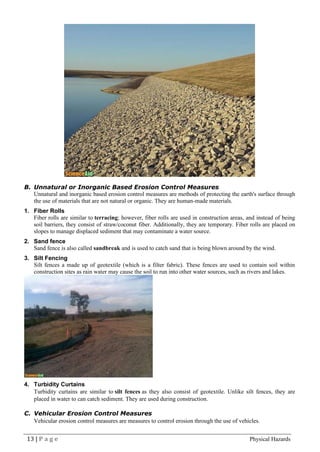
3. Rock Based
Riprap is a rock based erosion control measure and may also be called shot rock or rock armour. Ripraps are
made up of rocks and prevent water erosion by covering and protecting shorelines.
13 | P a g e Physical Hazards
B. Unnatural or Inorganic Based Erosion Control Measures
Unnatural and inorganic based erosion control measures are methods of protecting the earth's surface through
the use of materials that are not natural or organic. They are human-made materials.
1. Fiber Rolls
Fiber rolls are similar to terracing; however, fiber rolls are used in construction areas, and instead of being
soil barriers, they consist of straw/coconut fiber. Additionally, they are temporary. Fiber rolls are placed on
slopes to manage displaced sediment that may contaminate a water source.
2. Sand fence
Sand fence is also called sandbreak and is used to catch sand that is being blown around by the wind.
3. Silt Fencing
Silt fences a made up of geotextile (which is a filter fabric). These fences are used to contain soil within
construction sites as rain water may cause the soil to run into other water sources, such as rivers and lakes.
4. Turbidity Curtains
Turbidity curtains are similar to silt fences as they also consist of geotextile. Unlike silt fences, they are
placed in water to can catch sediment. They are used during construction.
C. Vehicular Erosion Control Measures
Vehicular erosion control measures are measures to control erosion through the use of vehicles.
14 | P a g e Physical Hazards
1. Conservative tillage
Conservative tillage is a soil cultivating method and an alternative to conventional tillage, which is more
harmful to the environment as it removes the soil's protective barrier of leaves and plants. Conservative
tillage, on the other hand, has a reduced amount of soil disruption as it preserves about 30% of the plant
barrier.
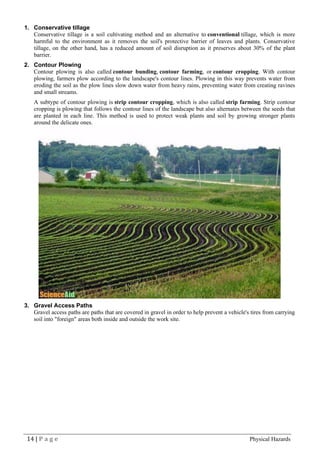
2. Contour Plowing
Contour plowing is also called contour bunding, contour farming, or contour cropping. With contour
plowing, farmers plow according to the landscape's contour lines. Plowing in this way prevents water from
eroding the soil as the plow lines slow down water from heavy rains, preventing water from creating ravines
and small streams.
A subtype of contour plowing is strip contour cropping, which is also called strip farming. Strip contour
cropping is plowing that follows the contour lines of the landscape but also alternates between the seeds that
are planted in each line. This method is used to protect weak plants and soil by growing stronger plants
around the delicate ones.
3. Gravel Access Paths
Gravel access paths are paths that are covered in gravel in order to help prevent a vehicle's tires from carrying
soil into "foreign" areas both inside and outside the work site.

(Soil erosion (dsm 2202) m. a. mahbub

  • 1.
    1 | Pa g e Physical Hazards Lecture Notes on Environmental Hazards and Disasters-II (Human-Induced) Md. Abdullah-Al-Mahbub Assistant Professor, Dept. of Disaster Management Begum Rokeya University, Rangpur Components of Disaster Hazard = the source of negative incident = A threat or a future source of danger. Risk = the degree of riskiness (Possibility * Impact) = probability of hazard occurrence = Hazard + vulnerability =Possibility * Vulnerability * Impact (some authors says) Vulnerability = the degree of exposure Disaster = when hazard becomes active = realization of a risk Example: Speaking for floods: Hazard = rain Risk = possibility of heavy rain and the impact in case of a flood Vulnerability = higher when a city or a mine is near to a river or the drainage system is underdeveloped etc. Disaster = breaking the bank of river and city is under water (Flood) In this case, a city near a river (all other factors being the same) is more vulnerable to a flood. so the Risk is higher. Difference between Hazard and disaster
  • 2.
    2 | Pa g e Physical Hazards Impact of Disaster Human Impact ā–Ŗ Injury/death ā–Ŗ Loss of homes/properties Economic Impact ā–Ŗ Loss of jobs/business Infrastructural Impact ā–Ŗ Damage/destroyed roads, bridges, power grid, communications Anthropogenic/ManmadeHazard Definitionandtypes Try yourself Physical Hazard Try yourself Soil Erosion and Land Degradation 1. Definition of Soil Erosion Soil erosion is the washing or blowing away of the top layer of the soil by water or wind or glacier. It is a natural process. It becomes a problem when human activity causes it to occur much faster than under natural conditions. If the soil has eroded, the crops will not grow very well. Soil erosion is the movement of soil from on place to another by wind, water, ice, gravity. 2. Types of Soil Erosion There are two major types of erosion: geologic erosion, accelerated erosion and gravity erosion. 1. Geologic erosion: It is a natural process of weathering that generally occurs at low rates on the parent rocks as the natural soil-forming processes. It occurs over long geologic time horizons and is not influenced by human activity. Some idea of the ā€˜geologic time’ can be formed from the fact that a measurable depth of a few centimeters of soil takes thousands year to form due to weathering of parent rocks. It is caused by effect of rainfall, run-off, wind, topography & atmospheric temperature 2. Accelerated erosion: It occurs due to anthropogenic causes such as deforestation, slash-and-burn agriculture, intensive plowing, intensive and uncontrolled grazing, and biomass burning. These activities intensify the factors responsible for erosion and the erosion process is accelerated. 3. Gravity erosion: Mass movement of soil occurs on steep slopes under the influence of gravity is called gravity erosion. The process involves the transfer of slope-forming materials from higher to lower grounds due to self weight. Examples are- rock falls, landslide, mudslide, creep, slumping etc. 2.1. ErosionbyWater 2.1.1. Types/FormsofWaterErosion a) Raindrop Erosion (Splash Erosion): Small soil particles are detached and sent airborne through the impact of raindrops on soil.
  • 3.
    3 | Pa g e Physical Hazards b) Sheet Erosion: Raindrops break apart the soil structure and it's moved downslope by water that flows overland as a sheet rather than definitive channels. This occurs frequently during cloud bursts. c) Rill Erosion: This process develops small, short-lived, concentrated flow paths. These paths creates a sediment source and delivery system for hillslope erosion. Areas where precipitation rates exceed soil infiltration rates are more prone to this type of erosion. d) Gully Erosion: Water flows in narrow channels during or directly following heavy rains or melting snow. The gullies can erode to considerable depths. e) Valley or Stream Erosion: Continual water flow alongside land (along a linear feature) creates this type of erosion. It extends downward, deepening a valley, and headward, extending the valley into the hillside. This occurs most frequently in times of flooding. f) Bank Erosion: Over time, banks of rivers and streams are naturally worn down. g) Wave Erosion: Waves are the major cause of erosion along the coast. 2.1.2. CausesofSoilErosionbyWater 1. Rainfall intensity and runoff: The impact of raindrops will break up the soil and water build-up will create runoff, taking sediment with it. 2. Soil erodability: Based on the characteristics of each unique soil, it is more or less susceptible to erosion. Recurring erosion is more typical for soil in areas that have experienced erosion in the past. 3. Slope gradient and length: The steeper the slope, the greater amount of soil can be lost. As the soil erodes downward, it increases the slope degree, which in turn, creates further erosion. 4. Vegetation: Vegetative cover of plants or crop residues protect the soil from raindrop impact and splash. The less vegetation cover, the more erosion can occur. 2.1.3. EffectsofSoilErosionbyWater The loss of natural nutrients and possible fertilizers directly affect crop emergence, growth, and yield. Seeds can be disturbed or removed and pesticides can be carried off. The soil quality, structure, stability, and texture are also affected, which in turn affect the holding capacity of the soil. Eroded soil can reduce the growth of seeds, bury seedlings, contribute to road damage, and even contaminate water sources and recreational areas. 2.1.4. WaterErosionControl The greatest way to restore eroded land is very simple: Vegetation. Plants grow and colonize creating deep root systems protecting the soil from water in its various forms. As simple as the solution is, a little help never hurts. Coir is natural coconut fiber that will protect the soil while the plants grow. Woven geotextiles and non- woven geotextiles separate soils, filter water, and reinforce the ground. 2.2. ErosionbyWind 2.2.1. FactorsofSoilErosionbyWind 1. Aridity of Climate: The less rainfall, the more opportunity for erosion caused by wind. 2. Wind Speed: Erosion increases with strong winds or gusts 3. Soil Texture: Loamy sand (particles 10-100 microns) is the most vulnerable soil. Soil containing clay is stickier and is more resistant to wind. 4. Soil Structure: The absence of structure-improving matter (organic matter, iron, free aluminum, lime) the soil contains on the surface, the more susceptible to erosion it is. 5. State of the Soil Surface: If the soil surface is stony, the risks of erosion are lower. 6. Vegetation: Stubble and crop residues in the soil cut wind-speed at ground level.
  • 4.
    4 | Pa g e Physical Hazards 7. Soil Moisture: Moisture makes the sand and loam more cohesive, temporarily preventing erosion. 2.2.2. CausesofSoilErosionbyWind 1. Erodability of soil: The finest particles are transported by the wind, while the heavier particles are blown across the surface causing abrasion. 2. Soil surface roughness: Soil surfaces that are not rough offer little resistance to wind erosion. Excess tillage can contribute to the breakdown of soil. 3. Climate: Soil moisture levels at the surface can become extremely low in times of drought, increasing particles to be carried by the wind. Conversely, this effect can occur in freezing climates as well. 4. Un-Sheltered distance: The lack of windbreaks allows wind to transport particles a farther distance, increasing abrasion and erosion. 5. Vegetative cover: Lack of permanent vegetation creates loose, dry, and barren soil that is perfect for wind transport. 2.2.3. EffectsofSoilErosionbyWind The smallest and finest particles are carried by the wind and collected in various areas, creating a build up of loam. Sediment crust degrades and rocks are easily weathered. Sheets of sand traveling close to the ground can degrade crops. It reduces the capacity of the soil to store nutrients. One of the most noticeable effects is seen in sand dunes. The sand will move wherever the wind takes it--burying oases and ancient cities along the way. Crops can be completely ruined, resulting in delay and reseeding, which is costly. Plants could become sandblasted resulting in a decreased yield. Soil drifting depletes fertility and continual drifting can change the texture of soil. 2.2.4. WindErosionControl Control erosion created by wind is no easy task. The wind, after all, is a seemingly unstoppable force. With that in mind, there are other ways to control the erosion through controlling the soil. The two things that must be done are reduce the wind-speed at ground level and increase soil cohesion. These two actions will improve the soil's resistance to wind. There are numerous ways to increase soil cohesion from spraying it with binding solutions to simply irrigating the soil. The roughness of the soil surface can be increased through specific cropping techniques to cut down wind-speed. Wind-speed can also be cut by increasing plant density. On a larger scale, a wind-break can be created to cut wind-speed and reduce both evaporation and erosion. The best arrangement is two rows of tall trees surrounded by two rows of large trees. The use of coir, geotextiles, and non-woven geotextiles will greatly improve the growth of the these plants. These products will separate sand from soil and allow the plants to colonize and establish a significant root system, which will ultimately cut down wind-speed, hence decreasing possible erosion. 3. Effects of Soil Erosion A. On-SiteEffects 1. Impaired soil productivity 2. Desertification 3. Land degradation B. Off-SiteEffects 1. Water pollution and sedimentation 2. Flooding 3. Airborne dust pollution 4. Damage to infrastructure
  • 5.
    5 | Pa g e Physical Hazards A. On-SiteEffects 1. Impaired soil productivity The loss of topsoil is what decreases the productivity of soils and negatively affects our capability to grow crops on them. Topsoil is crucial for plant growth because it contains the majority of organic matter and 50 percent of important nutrients such as phosphorus and potassium. It is in the topsoil where large pores and soil aggregates form, allowing for proper water infiltration and aeration. When topsoil erodes away, nutrient and organic material is lost and only compacted clayish soils with poor structure remain behind. Due to the unfavorable conditions, plants grown on these soils strive and often do not produce sufficient yields. A very common practice in intensive agriculture to offset the declining yield from eroded soils is to add synthetic fertilizers which supply some of the lost nutrients. However, this strategy is only a short-term fix to get the last bit of harvest from damaged soils. 2. Desertification Overexploited lands in dry regions are extremely vulnerable to soil erosion. Soil erosion itself seriously impairs the quality of soil and its natural recovery rate, but it is not the worst problem that can occur. In many cases, erosion is the first step that starts the irreversible transformation of the landscape into the barren desert. Grain by grain, sand and dirt is picked up by wind from mismanaged lands and pushed farther and farther into new territories, slowly swallowing remaining vegetation and turning the area into the wasteland. Once turn into desert, soils cannot support plant life anymore, which leads to crop failures, the disappearance of whole ecosystems and biodiversity declines. 3. Land degradation Erosion by wind or water is greatly responsible for nearly 85 percent of soil degradation throughout the world . A new study backed by the United Nations estimates that one third of all the land is severely degraded worldwide. Land degradation is defined as the long-term loss of soil productivity and ability to provide crucial ecosystem services for the proper health and functioning of our planet. This includes services such as decomposition of organic matter and cycling of nutrients, formation of new topsoil and groundwater replenishment. A common problem of degraded lands is a sealing of the soil surface. This minimizes water infiltration and causes a myriad of changes to local hydrology. Increased runoff, for example, leads to frequent flooding after rain, while soil overall becomes drier because it loses its water holding capacity over the long term. Degraded land cannot support these essential soil functions or growth of vegetation, and therefore, renders affected land unsuitable for cultivation. B. Off-SiteEffects 1. Water pollution and sedimentation
  • 6.
    6 | Pa g e Physical Hazards The major off-site problem caused by erosion is the deposition of eroded soil, along with pollutants it picked up, into watercourses. This causes two serious problems: a. Water pollution by heavy metals, agricultural chemicals and other contaminants b. Sedimentation in water bodies Soil transported pollutants into water bodies disrupts aquatic ecosystems by changing chemical and physical properties of water. Agricultural fertilizers can cause eutrophication and mass dying of aquatic life. Additional problem is the pollution of drinking water supply, which requires extra investment into removing impurities and making water suitable for drinking again. Increasing sediment loads can block rivers and dams, eventually leading to mud floods and further damage to surrounding ecosystems and built structures. High sedimentation rates also damage hydro-electricity plants and decrease the lifetime of constructed water reservoirs. Environmental Protection Agency (EPA) estimates that the yearly cost of fixing the damage caused by sedimentation rises as high as $US 16 billion in the United States. Sedimentation which is out of 70 percent brought about by human-induced erosion 2. Flooding The deposition of silt in water courses often obstructs their natural path. This increases the risk of flooding and further enhances erosion of water banks, since the water seeks the way to flow around a newly created obstruction. 3. Airborne dust pollution Wind erosion has the power to cause widespread air pollution that can affect places hundreds or even thousands of miles away from the original site of erosion. Wind-blown dust particles do not harm only the health of people and animals, they also damage young plants and crops. Wind often picks up fine particles of sand, silt and organic matter and buries or breaks seedlings, while exposing seeds or plant roots in other places. This leaves behind weak and vulnerable crops that cannot provide sufficient yield. There are numerous cases describing its suffocating effects. In the spring of 2015, the Department for Environment, Food and Rural Affairs warned England’s citizens about ā€œblood rainā€- rain mixed with red sand and light dirt particles carried by wind more than 2,000 miles from Sahara Desert to England. The polluted rain was expected to contribute to poor outdoor air quality that might result in respiratory problems . The same problem bothers citizens in China, North and South Korea, and Japan, as the dust blown from the Gobi Desert scourges their territory every spring. 4. Damage to infrastructure Whether it is a damage caused by flooded rivers, roads and rails torn apart by sliding land or dams cracking under the burden of accumulating sediments, soil erosion can gradually and certainly somewhat sneakily destroy many built structures. 4. Ways to Prevent Soil Erosion A. UsingBasicErosionPreventionTechniques 1. Planting grass and shrubs: Bare soil is easily swept away by wind and water, the two main causes of erosion. Plant roots hold the soil together, while their leaves block rain and stop it breaking the soil apart. Turf, ornamental grass, and low, spreading shrubs work best since they cover the soil completely. • If you have any bare ground, try to establish plant cover as soon as possible to limit erosion. • If the ground is mostly flat (slope of 3:1 or less), this might be enough to solve the problem. Steep slopes erode faster, so they need more protection.
  • 7.
    7 | Pa g e Physical Hazards 2. Add mulch or rocks: This will weigh down the soil and protect the seeds and young plants underneath from getting washed away. It also slows the absorption of water to reduce runoff. Grass clippings or bark chips work especially well. • If you don’t plant anything, keep the soil covered with mulch. You can also add mulch around plants to add another layer of protection or to keep the soil warm. 3. Use mulch matting to hold vegetation on slopes: Simply lay the mat over your seeds or young plants. On steep slopes, dig a small trench at the top of the hill first. Lay the top of the mat in the trench, fill it up with soil, then fold the mat back over the top. This helps water run over the top of the mat, where the mat will slow it down, instead of traveling underneath it.[4] • Fiber mulch mats or erosion control mats are a layer of mulch held together in a fiber mesh. This structure holds the mulch together in areas where normal mulch would be washed or blown away. 4. Put down fiber logs: Another option for erosion control on steep slopes is a series of rolled up logs or "wattles" made from fibrous material (like straw). Water running down the slope will slow down when it hits the logs, soaking into the soil instead of carrying mud downhill. Put the logs down across the slope, 10 to 25 feet (3–8m) apart. Hold them in place with wooden stakes or sturdy, living plants.[6] • You can plant seeds directly in the logs to protect them while they grow. • If you do plant seeds directly into the logs, you should still use stakes to hold the logs in place, at least until the seeds develop sturdy roots that go into the soil. 5. Build retaining walls: Badly eroded slopes will continue to collapse downhill until they are stabilized. A retaining wall at the base of the slope will block the soil and slow down the collapse. This gives grass or other plants time to grow and help the soil hold together. • Give the wall a 2% slope on the side (perpendicular to the incline) so that water flows off to the side instead of pooling. • You may build the wall from concrete blocks, rock, or wood. Only use wood treated with a preservative to prevent rot. • Use retaining walls around flowerbeds and other raised soil areas as well. • You may need local government approval to build these structures.
  • 8.
    8 | Pa g e Physical Hazards 6. Improve drainage: All buildings should have gutters or pipes that can drain water effectively out of your garden and into water collection systems. Without adequate drainage, heavy rain could wash away a whole layer of topsoil. • Areas with heavy water runoff may require installing an underground perforated drainage pipe. 7. Reduce watering if possible: Over-watering your garden can speed up erosion by washing away soil. Use less water if you can, or install a drip irrigation system. Since a drip system only delivers small amounts of water at a time, there is no water flooding across the surface to carry topsoil. B. PreventingFarmlandErosion 1. Plant trees to prevent landslides: Tree roots are powerful tools when soil is too eroded or steep to plant. Plant native trees on steep slopes and riverbanks to reduce soil loss. • Bare ground around the tress still needs to be covered in mulch or grass for best results. • Keep in mind that older trees will be more effective at preventing landslides than new saplings. It may take some time before your tree develops roots that are strong enough. Fig. 1: Planting trees to prevent landslides Fig. 2: Reduce tillage 2. Reduce tillage: Deep, frequent tillage creates a layer of compact soil vulnerable to water erosion, topped by loose soil easily removed by wind. Consider a zero-tillage approach using a coulter or other deep planting device. • These conservation tillage techniques also reduce the amount of vehicle traffic, and therefore soil compaction. 3. Protect weak crops with strip cropping: Crops with weak roots or that need to be sparsely planted are more vulnerable to erosion. Plant these in strips, alternating with strips of an erosion-resistant crop such as dense grass or legumes. • Plant the crops so they contour the slope.
  • 9.
    9 | Pa g e Physical Hazards • Plant these crops perpendicular to the prevailing wind if possible. Fig. 3: Protect weak crops with strip cropping Fig. 4: Practice wet season spelling 4. close off a paddock for the entire wet season: Grazing land cannot remain healthy and erosion-resistant if cattle are allowed to graze year-round. For best results, close off a paddock for the entire wet season to allow grasses to reestablish themselves. • If possible, keep cattle away from riverbanks and heavily eroded soil at all times. 5. Keep soil covered year-round: Bare soil is far more vulnerable to erosion than soil with ground cover. Aim for at least 30% ground cover on all grazing land, ideally 40% or more. • After you harvest your crops, leave the residue on the soil as mulch. Alternatively, plant hardy winter crops. Fig. 5: Keep soil covered year-round Fig. 6: Control downhill runoff with flumes 6. Control downhill runoff with flumes: Runoff is concentrated into a narrower area as it travels across lands. The points where the concentrated runoff reaches a slope are particularly vulnerable to erosion. You can build a paved flume, or lined channel, to lead the water to a safe drainage system. Build these at gully heads as well. • Another option is to build a swale to re-direct the runoff into a pond. Building several swales along a hillside can greatly reduce runoff volume and eliminate the need for a paved channel. • Do not build flumes on slopes steeper than 1.5:1 7. Turn a hillside into terraces: The steepest slopes are almost impossible to farm on. Turn the hill into terraces instead by building retaining walls running across the slope. In between the walls, grade the soil level to create a flat area resistant to erosion.
  • 10.
    10 | Pa g e Physical Hazards C. OtherWaystoPreventSoilErosion By applying some relatively simple steps, we can control and prevent soil erosion! The four most common soil erosion prevention methods are vegetation, geotextiles, mulch, and retaining walls. Preventing soil erosion is critical in protecting your property and exposed soil, whether from wind, weather, running water, and even the after-affects of forest fire. 1. Vegetation: The simplest and most natural way to prevent erosion is through planting vegetation. Plants establish root systems, which stabilizes soil and prevents soil erosion. 2. Geotextiles: Using geotextiles is an effective method because it also stabilizes soil. When used in conjunction with growing vegetation, it is even more effective. There are three main types of geotextiles: woven, nonwoven, and coir. o Woven Geotextiles are typically classified as one of our strongest available options for soil and erosion control. Woven fabrics are typically classified by their grab tensile strength and are used to help with erosion under rip rap, roads, and pavement. o Nonwoven Geotextiles, by contrast, are a drainage and filtration fabric commonly used around construction sites, ditches, pipes and other areas dealing with runoff. woven geotextiles Non-woven geotextiles o Natural Fiber Products are one of the most environmentally friendly options for controlling soil erosion and stabilizing locations. Often made from coconut coir, straw or wood fiber, these products stabilize areas, enhance vegetative growth, and naturally biodegrade.
  • 11.
    11 | Pa g e Physical Hazards Natural fiber products Coconut coir products 3. Mulch/Fertilizer: Applying a layer of mulch to the soil top allows the soil to slowly soak up water, as it protects against rain impact, and restores pH levels helping with erosion prevention. 4. Retaining Walls: Retaining walls can be built around the area of erosion to prevent water run off. Runoff water leads to further erosion, and if used with other methods, retaining walls can be a very effective way to prevent soil erosion. 5. Erosion Control Measures Erosion control is the attempt to limit land damage that is a result of erosion, which may occur naturally (from wind and water) or unnaturally (from human interference). The types of erosion control measures may be broken up into three categories: (A) Natural or organic based, (B) Unnatural or inorganic based, and (C) Vehicular based erosion control measures. A. Natural or Organic Based Erosion Control Measures Erosion control measures that are natural or organic based are efforts to protect the earth's surface through materials that come from the earth. These materials can be plant based, water based, or rock based. 1. Plant Based There is an abundant amount of plant based erosion control measures. a) Buffer Strip Buffer strips are similar to bioswales (see below) as both control running water and contain loose sediment. Buffer strips are usually found on farmland and are made up of permanent plants (which means a farmer will not strip the plants and grow new vegetation in their place) -- bioswales, on the other hand, are entrenched into the land. b) Crop Rotation Crop rotation is growing a new type of crop in a field each year to help fight soil erosion. c) Mulching To mulch is to place either natural or human-made material on soil. Mulching helps kill weeds, trap water, and protect soil from wind and water erosion. Natural mulch may be leaves, straw, or wood chips (to list a few) while human-made mulch could be a plastic sheet (the use of such mulch is called plasticulture) d) Reforestation Reforestation means to replant trees in an area where they have been cut down. Not only does growing new trees help fight erosion, but trees also provide us with fresh air. e) Seeding There are two types of seeding (temporary and permanent) and a seeding method (hydroseeding) that help control erosion. The purpose of these two types of seeding is to grow plants that will help protect the soil from erosion. Seeding is much like mulch, which can be used in conjunction with seeding. • Temporary Seeding. This is seeding that is used during quick construction jobs or until permanent seeding is able to be planted. The time of year may prevent permanent seeding.
  • 12.
    12 | Pa g e Physical Hazards • Permanent Seeding. This is seeding that occurs after construction and is done in order to provide the land with lasting protection against erosion. • Hydroseeding. Hydroseeding is a method of seeding and can be used for either temporary or permanent seeding. It is employed when the land is difficult to access (a steep slope, for example). With hydroseeding, seeds are sprayed onto the ground either through the use of a truck or helicopter. A similar concept to seeding is cover crops which are crops made up of strong plants compacted together to help prevent the soil from eroding. f) Terracing. Terracing is much like contour plowing (see below) as it helps prevent soil erosion by having multiple (soil) barriers, or in this case "stairs," perpendicular on a slope. This construction slows down water, preventing the formation of small streams and the displacement of rocks and minerals. 2. Water Based Here are two water based erosion control measures. a) Bioswale Bioswales are also called grassed waterways and vegetated waterways. Bioswales are like trenches that have vegetation along the bottom. They guide water through areas and help contain loose rocks and pollution. b) Impoundments Impoundments include retention and detention basins or ponds While impoundments do not stop erosion, they help control erosion that has already occurred. They are human-made water basins, and their purpose is to contain soil and other materials that move around as a result of water erosion. • Retention Basins/Ponds. These are permanent basins, and they are designed to gather water runoff from all the areas around it. They also help prevent flooding. • Detention Basins/Ponds. These are temporary basins and are also called retarding or sediment basins. They are smaller and are often used during construction to control where water moves soil and other minerals. 3. Rock Based Riprap is a rock based erosion control measure and may also be called shot rock or rock armour. Ripraps are made up of rocks and prevent water erosion by covering and protecting shorelines.
  • 13.
    13 | Pa g e Physical Hazards B. Unnatural or Inorganic Based Erosion Control Measures Unnatural and inorganic based erosion control measures are methods of protecting the earth's surface through the use of materials that are not natural or organic. They are human-made materials. 1. Fiber Rolls Fiber rolls are similar to terracing; however, fiber rolls are used in construction areas, and instead of being soil barriers, they consist of straw/coconut fiber. Additionally, they are temporary. Fiber rolls are placed on slopes to manage displaced sediment that may contaminate a water source. 2. Sand fence Sand fence is also called sandbreak and is used to catch sand that is being blown around by the wind. 3. Silt Fencing Silt fences a made up of geotextile (which is a filter fabric). These fences are used to contain soil within construction sites as rain water may cause the soil to run into other water sources, such as rivers and lakes. 4. Turbidity Curtains Turbidity curtains are similar to silt fences as they also consist of geotextile. Unlike silt fences, they are placed in water to can catch sediment. They are used during construction. C. Vehicular Erosion Control Measures Vehicular erosion control measures are measures to control erosion through the use of vehicles.
  • 14.
    14 | Pa g e Physical Hazards 1. Conservative tillage Conservative tillage is a soil cultivating method and an alternative to conventional tillage, which is more harmful to the environment as it removes the soil's protective barrier of leaves and plants. Conservative tillage, on the other hand, has a reduced amount of soil disruption as it preserves about 30% of the plant barrier. 2. Contour Plowing Contour plowing is also called contour bunding, contour farming, or contour cropping. With contour plowing, farmers plow according to the landscape's contour lines. Plowing in this way prevents water from eroding the soil as the plow lines slow down water from heavy rains, preventing water from creating ravines and small streams. A subtype of contour plowing is strip contour cropping, which is also called strip farming. Strip contour cropping is plowing that follows the contour lines of the landscape but also alternates between the seeds that are planted in each line. This method is used to protect weak plants and soil by growing stronger plants around the delicate ones. 3. Gravel Access Paths Gravel access paths are paths that are covered in gravel in order to help prevent a vehicle's tires from carrying soil into "foreign" areas both inside and outside the work site.