INFILTRATION
M.Zulfiqar Ali
2016-MSGS-8
MSc Geological Sciences
Department of Geological Engineering
University of Engineering and Technology Lahore
INFILTRATION
Definition
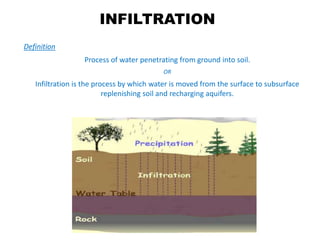
Process of water penetrating from ground into soil.
OR
Infiltration is the process by which water is moved from the surface to subsurface
replenishing soil and recharging aquifers.
Infiltration Capacity
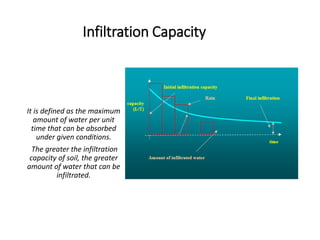
It is defined as the maximum
amount of water per unit
time that can be absorbed
under given conditions.
The greater the infiltration
capacity of soil, the greater
amount of water that can be
infiltrated.
Percolation
• Once water enters into the soil, the process of transmission of water
within the soil known as Percolation takes place.
INFILTRATION & PERCOLATION are directly interrelated.
When percolation stops infiltration also stops
Surface Entry
• If surface area is bare, this
retards infiltration.
• Area covered by bushy plants
or grass has better infiltration.
Bare land < Vegetated land
Factors Affecting Infiltration
1. Surface Entry
2. Percolation
3. Soil Moisture
4. Climate Condition
5. Degree of Saturation
6. Human Activities
7. Porosity
8. Vegetation
9. Grain size of soil particles
10. Permeability
Percolation
The infiltration rate is bounded by
the rate of Percolation.
Depend on the factor,
• Soil type
• Composition
• Permeability
• Porosity
• Stratification
• Presence of organic matter
• Presence of salt
Factors Affecting Infiltration
1. Surface Entry
2. Percolation
3. Soil Moisture
4. Climate Condition
5. Degree of Saturation
6. Human Activities
7. Porosity
8. Vegetation
9. Grain size of soil particles
10. Permeability
Soil Moisture
•Infiltration depends
on the presence of
moisture in soil .
• Second storm in succession the
soil will have lesser rate of
infiltration than the first storm
of the season
Factors Affecting Infiltration
1. Surface Entry
2. Percolation
3. Soil Moisture
4. Climate Condition
5. Degree of Saturation
6. Human Activities
7. Porosity
8. Vegetation
9. Grain size of soil particles
10. Permeability
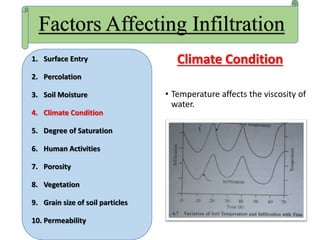
Climate Condition
• Temperature affects the viscosity of
water.
Factors Affecting Infiltration
1. Surface Entry
2. Percolation
3. Soil Moisture
4. Climate Condition
5. Degree of Saturation
6. Human Activities
7. Porosity
8. Vegetation
9. Grain size of soil particles
10. Permeability
Degree of Saturation
The more saturated the loose
Earth materials are, the less
the infiltration inverse or
indirect relationship
• The depth of the water
table below the surface
varies with the amount of
infiltration
Factors Affecting Infiltration
1. Surface Entry
2. Percolation
3. Soil Moisture
4. Climate Condition
5. Degree of Saturation
6. Human Activities
7. Porosity
8. Vegetation
9. Grain size of soil particles
10. Permeability
Human Activities
Roads, parking lots, and buildings
create surfaces that are not
longer permeable.
These impermeable surfaces often
channel runoff.
Farming, cutting down trees and
grazing animals will reduce
vegetation and therefore
decrease permeability.
Factors Affecting Infiltration
1. Surface Entry
2. Percolation
3. Soil Moisture
4. Climate Condition
5. Degree of Saturation
6. Human Activities
7. Porosity
8. Vegetation
9. Grain size of soil particles
10. Permeability
Porosity
• Porosity is the percentage of
open space (pores and
cracks) in a material
compared to its total
volume
• Generally: the greater the
porosity, the greater the
amount of infiltration.
Factors Affecting Infiltration
1. Surface Entry
2. Percolation
3. Soil Moisture
4. Climate Condition
5. Degree of Saturation
6. Human Activities
7. Porosity
8. Vegetation
9. Grain size of soil particles
10. Permeability
Vegetation
• Grasses, trees and other plant
types capture falling precipitation
on leaves and branches, keeping
that water from being absorbed
into the Earth
• If any water gets through the
vegetation, the velocity of the
water will be reduced and this will
give the ground more time to
absorb the water
• Ground without vegetation
usually has high runoff and low
infiltration rates
Factors Affecting Infiltration
1. Surface Entry
2. Percolation
3. Soil Moisture
4. Climate Condition
5. Degree of Saturation
6. Human Activities
7. Porosity
8. Vegetation
9. Grain size of soil particles
10. Permeability
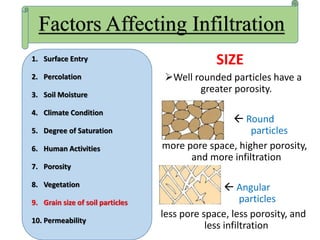
SIZE
Well rounded particles have a
greater porosity.
 Round
particles
more pore space, higher porosity,
and more infiltration
 Angular
particles
less pore space, less porosity, and
less infiltration
Factors Affecting Infiltration
1. Surface Entry
2. Percolation
3. Soil Moisture
4. Climate Condition
5. Degree of Saturation
6. Human Activities
7. Porosity
8. Vegetation
9. Grain size of soil particles
10. Permeability
Permeability
The ability of a material to allow
fluids such as water to pass
through it. Larger particles will
increase permeability, because
pore space is larger.
Impermeability may be due to
tight packing or cementing of
particles, which seals off the
pores from one another.
Factors Affecting Infiltration
1. Surface Entry
2. Percolation
3. Soil Moisture
4. Climate Condition
5. Degree of Saturation
6. Human Activities
7. Porosity
8. Vegetation
9. Grain size of soil particles
10. Permeability
1. FIELD MEASUREMENT METHOD
a. Single Tube Infiltrometer
b. Double Tube Infiltrometer
2. RAINFALL SIMULATOR
3. RAINFALL RUNOFF ANALYSIS
Measurements of infiltration
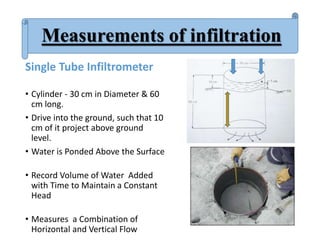
Single Tube Infiltrometer
• Cylinder - 30 cm in Diameter & 60
cm long.
• Drive into the ground, such that 10
cm of it project above ground
level.
• Water is Ponded Above the Surface
• Record Volume of Water Added
with Time to Maintain a Constant
Head
• Measures a Combination of
Horizontal and Vertical Flow
Measurements of infiltration
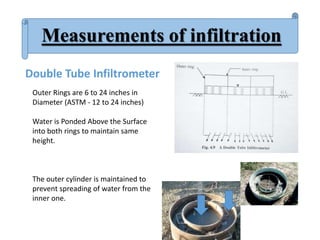
Double Tube Infiltrometer
Measurements of infiltration
Outer Rings are 6 to 24 inches in
Diameter (ASTM - 12 to 24 inches)
Water is Ponded Above the Surface
into both rings to maintain same
height.
The outer cylinder is maintained to
prevent spreading of water from the
inner one.
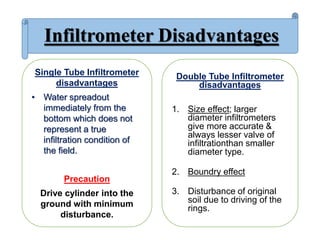
Infiltrometer Disadvantages
Single Tube Infiltrometer
disadvantages
• Water spreadout
immediately from the
bottom which does not
represent a true
infiltration condition of
the field.
Precaution
Drive cylinder into the
ground with minimum
disturbance.
Double Tube Infiltrometer
disadvantages
1. Size effect; larger
diameter infiltrometers
give more accurate &
always lesser valve of
infiltrationthan smaller
diameter type.
2. Boundry effect
3. Disturbance of original
soil due to driving of the
rings.
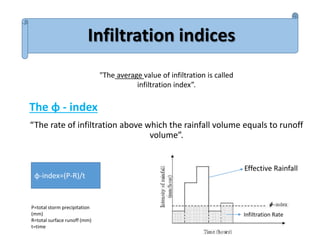
The φ - index
“The rate of infiltration above which the rainfall volume equals to runoff
volume”.
Infiltration indices
Effective Rainfall
Infiltration Rate
"The average value of infiltration is called
infiltration index”.
P=total storm precipitation
(mm)
R=total surface runoff (mm)
t=time
φ-index=(P-R)/t
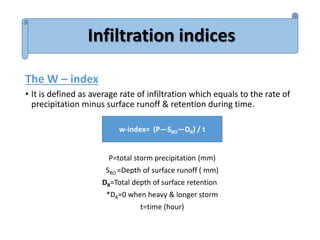
The W – index
• It is defined as average rate of infiltration which equals to the rate of
precipitation minus surface runoff & retention during time.
P=total storm precipitation (mm)
SRO =Depth of surface runoff ( mm)
DR=Total depth of surface retention
*DR=0 when heavy & longer storm
t=time (hour)
w-index= (P—SRO—DR) / t
Infiltration indices

Infiltration presentation by zulfiqar UET Lhr

  • 1.
    INFILTRATION M.Zulfiqar Ali 2016-MSGS-8 MSc GeologicalSciences Department of Geological Engineering University of Engineering and Technology Lahore
  • 2.
    INFILTRATION Definition Process of waterpenetrating from ground into soil. OR Infiltration is the process by which water is moved from the surface to subsurface replenishing soil and recharging aquifers.
  • 3.
    Infiltration Capacity It isdefined as the maximum amount of water per unit time that can be absorbed under given conditions. The greater the infiltration capacity of soil, the greater amount of water that can be infiltrated.
  • 4.
    Percolation • Once waterenters into the soil, the process of transmission of water within the soil known as Percolation takes place. INFILTRATION & PERCOLATION are directly interrelated. When percolation stops infiltration also stops
  • 5.
    Surface Entry • Ifsurface area is bare, this retards infiltration. • Area covered by bushy plants or grass has better infiltration. Bare land < Vegetated land Factors Affecting Infiltration 1. Surface Entry 2. Percolation 3. Soil Moisture 4. Climate Condition 5. Degree of Saturation 6. Human Activities 7. Porosity 8. Vegetation 9. Grain size of soil particles 10. Permeability
  • 6.
    Percolation The infiltration rateis bounded by the rate of Percolation. Depend on the factor, • Soil type • Composition • Permeability • Porosity • Stratification • Presence of organic matter • Presence of salt Factors Affecting Infiltration 1. Surface Entry 2. Percolation 3. Soil Moisture 4. Climate Condition 5. Degree of Saturation 6. Human Activities 7. Porosity 8. Vegetation 9. Grain size of soil particles 10. Permeability
  • 7.
    Soil Moisture •Infiltration depends onthe presence of moisture in soil . • Second storm in succession the soil will have lesser rate of infiltration than the first storm of the season Factors Affecting Infiltration 1. Surface Entry 2. Percolation 3. Soil Moisture 4. Climate Condition 5. Degree of Saturation 6. Human Activities 7. Porosity 8. Vegetation 9. Grain size of soil particles 10. Permeability
  • 8.
    Climate Condition • Temperatureaffects the viscosity of water. Factors Affecting Infiltration 1. Surface Entry 2. Percolation 3. Soil Moisture 4. Climate Condition 5. Degree of Saturation 6. Human Activities 7. Porosity 8. Vegetation 9. Grain size of soil particles 10. Permeability
  • 9.
    Degree of Saturation Themore saturated the loose Earth materials are, the less the infiltration inverse or indirect relationship • The depth of the water table below the surface varies with the amount of infiltration Factors Affecting Infiltration 1. Surface Entry 2. Percolation 3. Soil Moisture 4. Climate Condition 5. Degree of Saturation 6. Human Activities 7. Porosity 8. Vegetation 9. Grain size of soil particles 10. Permeability
  • 10.
    Human Activities Roads, parkinglots, and buildings create surfaces that are not longer permeable. These impermeable surfaces often channel runoff. Farming, cutting down trees and grazing animals will reduce vegetation and therefore decrease permeability. Factors Affecting Infiltration 1. Surface Entry 2. Percolation 3. Soil Moisture 4. Climate Condition 5. Degree of Saturation 6. Human Activities 7. Porosity 8. Vegetation 9. Grain size of soil particles 10. Permeability
  • 11.
    Porosity • Porosity isthe percentage of open space (pores and cracks) in a material compared to its total volume • Generally: the greater the porosity, the greater the amount of infiltration. Factors Affecting Infiltration 1. Surface Entry 2. Percolation 3. Soil Moisture 4. Climate Condition 5. Degree of Saturation 6. Human Activities 7. Porosity 8. Vegetation 9. Grain size of soil particles 10. Permeability
  • 12.
    Vegetation • Grasses, treesand other plant types capture falling precipitation on leaves and branches, keeping that water from being absorbed into the Earth • If any water gets through the vegetation, the velocity of the water will be reduced and this will give the ground more time to absorb the water • Ground without vegetation usually has high runoff and low infiltration rates Factors Affecting Infiltration 1. Surface Entry 2. Percolation 3. Soil Moisture 4. Climate Condition 5. Degree of Saturation 6. Human Activities 7. Porosity 8. Vegetation 9. Grain size of soil particles 10. Permeability
  • 13.
    SIZE Well rounded particleshave a greater porosity.  Round particles more pore space, higher porosity, and more infiltration  Angular particles less pore space, less porosity, and less infiltration Factors Affecting Infiltration 1. Surface Entry 2. Percolation 3. Soil Moisture 4. Climate Condition 5. Degree of Saturation 6. Human Activities 7. Porosity 8. Vegetation 9. Grain size of soil particles 10. Permeability
  • 14.
    Permeability The ability ofa material to allow fluids such as water to pass through it. Larger particles will increase permeability, because pore space is larger. Impermeability may be due to tight packing or cementing of particles, which seals off the pores from one another. Factors Affecting Infiltration 1. Surface Entry 2. Percolation 3. Soil Moisture 4. Climate Condition 5. Degree of Saturation 6. Human Activities 7. Porosity 8. Vegetation 9. Grain size of soil particles 10. Permeability
  • 15.
    1. FIELD MEASUREMENTMETHOD a. Single Tube Infiltrometer b. Double Tube Infiltrometer 2. RAINFALL SIMULATOR 3. RAINFALL RUNOFF ANALYSIS Measurements of infiltration
  • 16.
    Single Tube Infiltrometer •Cylinder - 30 cm in Diameter & 60 cm long. • Drive into the ground, such that 10 cm of it project above ground level. • Water is Ponded Above the Surface • Record Volume of Water Added with Time to Maintain a Constant Head • Measures a Combination of Horizontal and Vertical Flow Measurements of infiltration
  • 17.
    Double Tube Infiltrometer Measurementsof infiltration Outer Rings are 6 to 24 inches in Diameter (ASTM - 12 to 24 inches) Water is Ponded Above the Surface into both rings to maintain same height. The outer cylinder is maintained to prevent spreading of water from the inner one.
  • 18.
    Infiltrometer Disadvantages Single TubeInfiltrometer disadvantages • Water spreadout immediately from the bottom which does not represent a true infiltration condition of the field. Precaution Drive cylinder into the ground with minimum disturbance. Double Tube Infiltrometer disadvantages 1. Size effect; larger diameter infiltrometers give more accurate & always lesser valve of infiltrationthan smaller diameter type. 2. Boundry effect 3. Disturbance of original soil due to driving of the rings.
  • 19.
    The φ -index “The rate of infiltration above which the rainfall volume equals to runoff volume”. Infiltration indices Effective Rainfall Infiltration Rate "The average value of infiltration is called infiltration index”. P=total storm precipitation (mm) R=total surface runoff (mm) t=time φ-index=(P-R)/t
  • 20.
    The W –index • It is defined as average rate of infiltration which equals to the rate of precipitation minus surface runoff & retention during time. P=total storm precipitation (mm) SRO =Depth of surface runoff ( mm) DR=Total depth of surface retention *DR=0 when heavy & longer storm t=time (hour) w-index= (P—SRO—DR) / t Infiltration indices