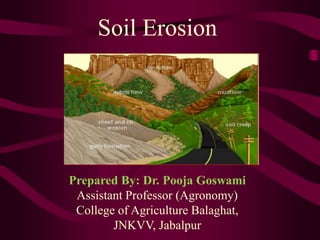
Soil Erosion
Prepared By: Dr. Pooja Goswami
Assistant Professor (Agronomy)
College of Agriculture Balaghat,
JNKVV, Jabalpur
Soil Erosion
Soil erosion: Soil erosion is the detachment, transport
and deposition of soil particles on land surface.
Measured as Mass/unit area.
In general, soil erosion implies the physical
removal of topsoil by various agents, including rain,
water flowing over and through the soil profile, wind,
glaciers or gravitational pull.
Land and water are the most precious natural
resources that support and sustain the anthropogenic
activities.
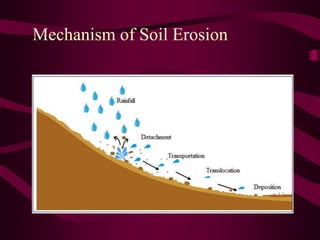
Mechanism of Soil Erosion
Harmful effects of Soil Erosion
Top layer of soil contains most of the organic matter and
nutrients, loss of this soil reducing soil fertility and affecting
its structure badly.
Soil erosion decreases the moisture supply by soil to the
plants for their growth. It also affects the activity of soil
micro-organisms thus deteriorating the crop yield.
Wind erosion is very selective, carrying the finest particles
- particularly organic matter, clay and loam for many
kilometres. There the wind erosion causes losses of fertile
soils from highly productive farming areas.
The most spectacular forms are dunes - mounds of more or
less sterile sand - which move as the wind takes them, even
burying oases and ancient cities.
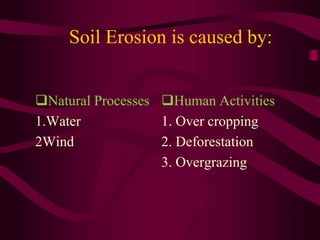
Soil Erosion is caused by:
Natural Processes
1.Water
2Wind
Human Activities
1. Over cropping
2. Deforestation
3. Overgrazing
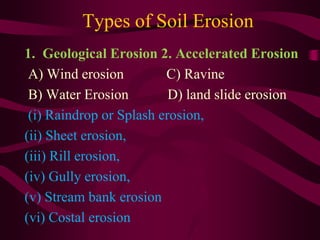
Types of Soil Erosion
1. Geological Erosion 2. Accelerated Erosion
A) Wind erosion C) Ravine
B) Water Erosion D) land slide erosion
(i) Raindrop or Splash erosion,
(ii) Sheet erosion,
(iii) Rill erosion,
(iv) Gully erosion,
(v) Stream bank erosion
(vi) Costal erosion
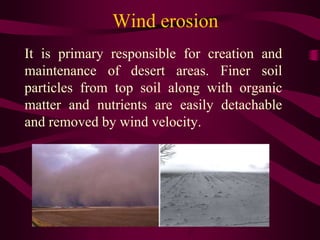
Wind erosion
It is primary responsible for creation and
maintenance of desert areas. Finer soil
particles from top soil along with organic
matter and nutrients are easily detachable
and removed by wind velocity.
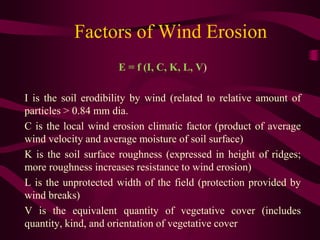
Factors of Wind Erosion
E = f (I, C, K, L, V)
I is the soil erodibility by wind (related to relative amount of
particles > 0.84 mm dia.
C is the local wind erosion climatic factor (product of average
wind velocity and average moisture of soil surface)
K is the soil surface roughness (expressed in height of ridges;
more roughness increases resistance to wind erosion)
L is the unprotected width of the field (protection provided by
wind breaks)
V is the equivalent quantity of vegetative cover (includes
quantity, kind, and orientation of vegetative cover
Factors Affecting Wind Erosion
Several factors relating to soil, landscape and
climate that affects wind erosion are
soil texture: Erosion works on loosely held
soil particles at the soil surface.
 soil structure Silty and very fine sandy soils
are particularly vulnerable to erosion. Poorly
structured soils whose aggregates (clumps)
have been broken down into fine particles by
tillage and other forces are also easily eroded
Continued…
surface relief Surface relief (shape and slope) affects the direction
and rate of erosion. It also affects the location of soil deposition,
because eroded soil tends to accumulate at the base of slopes and in
depressions.
 soil protection by plants or plant residues Exposed soils suffer
greater erosion than soils well protected by standing plants or plant
residues•). Soils are most vulnerable to wind erosion when the soil
surface dries out rapidly during periods of low or no rainfall, such
as the drought during the "dirty thirties" in the prairiesor in early
spring when the soil is not protected by vegetation.
 rainfall Climate affects erosion mainly through the moisture
conditions of the soil and specific climatic events (wind and
rainstorms
 wind force. Wind speed and the length of time the wind blows
are major factors in wind erosion.
Causes of Wind Erosion
Bare, unprotected soil is extremely vulnerable
to wind erosion
Erosion occurs with strong, turbulent winds
blowing across a soil surface that is smooth,
loose, dry and finely granulated.
 Slightly larger soil particles bounce or roll
along the soil surface.
Loose particles drift along, bombarding and
dislodging still more particles with the same
effect on clods or growing plants as
Forms of Wind Erosion
Saltation : lifting and bouncing of a particle,
most important for particles 0.1 - 0.5 mm dia.
Creep: coarse and very coarse sand grains
rolled on ground surface.
Suspension: Lifting of silt- and clay-sized
particles(<0.1 mm) high into the air and can
thus be carried long distances
Damages of Wind Erosion
Losing topsoil has a direct effect on the
productivity of the land. A loss of 2.5 cm of soil can
reduce wheat yields by 5-10% while a loss of 20 cm
can reduce yields to 1/3 of their previous levels.
Estimated soil loss by wind erosion on the is 160
million tones per year.•
As soil productivity decreases due to a decrease in
topsoil, soil fertility becomes less.•
Organic material is reduced and hence, less plant
growth occurs.
How to control wind erosion?
Planting shelterbelts (trees may be obtained
from the Tree Nursery) to help reduce the
velocity of the wind
Increasing the organic content of the soil
 Using fertilizers to increase soil
productivity.
Alternating narrow strips of summer fallow
and crop perpendicular to the prevailing
winds (strip cropping)
Leaving stubble barriers
Using trash cover and green manure.
Reducing tillage.
Using marginal land for livestock rather than crop
production.
Reducing the speed of tillage• Planting of fall cover
crops (winter wheat or rye) in areas of light, sandy soil
which are particularly prone to wind erosion
Using marginal land for livestock rather than crop
production
Reducing the speed of tillage• Planting perennial
grass or legumes on grazing lands.
Zero tillage - planting crops in to last years stubble
Continued….
The more organic material present in the soil,
the greater the resistance of the soil to be broken
into particles small enough to be carried away
by wind or water, and the more moisture the soil
will hold.
Adding fertilizers to the soil aids in making
the soil more productive, which protects it
against the effects of erosion.
Mulching
 Strip Cropping
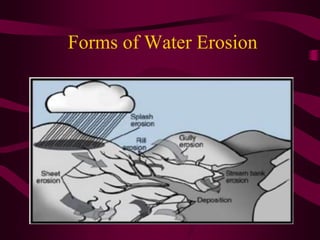
Forms of Water Erosion
Different Forms of Water
Erosion
(i) Raindrop or Splash erosion,
(ii) Sheet erosion,
(iii) Rill erosion,
(iv) Gully erosion,
(v) Stream bank erosion
(vi) Costal erosion
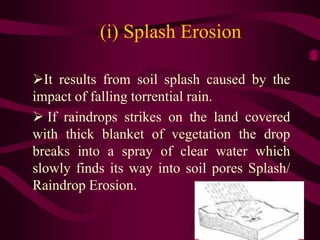
(i) Splash Erosion
It results from soil splash caused by the
impact of falling torrential rain.
 If raindrops strikes on the land covered
with thick blanket of vegetation the drop
breaks into a spray of clear water which
slowly finds its way into soil pores Splash/
Raindrop Erosion.
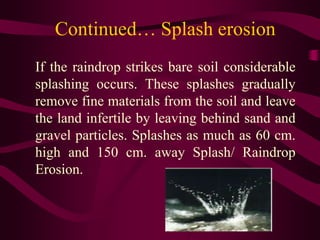
Continued… Splash erosion
If the raindrop strikes bare soil considerable
splashing occurs. These splashes gradually
remove fine materials from the soil and leave
the land infertile by leaving behind sand and
gravel particles. Splashes as much as 60 cm.
high and 150 cm. away Splash/ Raindrop
Erosion.
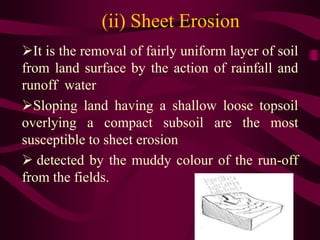
(ii) Sheet Erosion
It is the removal of fairly uniform layer of soil
from land surface by the action of rainfall and
runoff water
Sloping land having a shallow loose topsoil
overlying a compact subsoil are the most
susceptible to sheet erosion
 detected by the muddy colour of the run-off
from the fields.
(iii) Rill Erosion
These The advance form of the rill is initial stage of gully
formation.
The rills are shallow drainage lines less than 30cm deep and 50
cm wide.
They develop when surface water concentrates in depressions or
low points through paddocks and erodes the soil.
Rill erosion is common in bare agricultural land, particularly
overgrazed land, and in freshly tilled soil where the soil structure
has been loosened.
 Rills will increase not only in
number but also in shape and
size.
Rill erosion is more serious
in soils having shallow top soil.
 transition stage between
sheet and gully erosion Rill
Erosion.
Rill erosion is mostly occurs
in alluvial soil and is quite
frequent in Chambal river
valley in India.
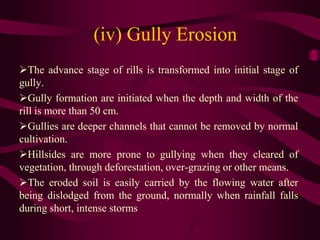
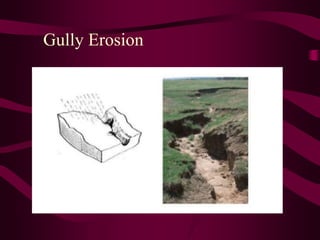
(iv) Gully Erosion
The advance stage of rills is transformed into initial stage of
gully.
Gully formation are initiated when the depth and width of the
rill is more than 50 cm.
Gullies are deeper channels that cannot be removed by normal
cultivation.
Hillsides are more prone to gullying when they cleared of
vegetation, through deforestation, over-grazing or other means.
The eroded soil is easily carried by the flowing water after
being dislodged from the ground, normally when rainfall falls
during short, intense storms
Gully Erosion
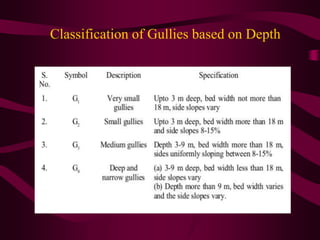
Classification of Gullies
Based on shape
(U shape, V shape)
Based on nature of gully flow (Active,
Inactive)
Based on size (depth, width and side
slopes)
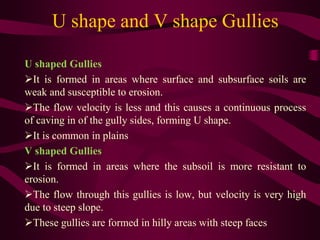
U shape and V shape Gullies
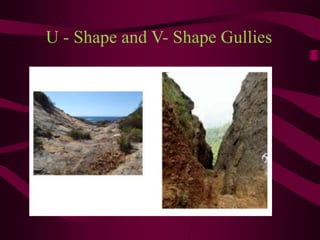
U shaped Gullies
It is formed in areas where surface and subsurface soils are
weak and susceptible to erosion.
The flow velocity is less and this causes a continuous process
of caving in of the gully sides, forming U shape.
It is common in plains
V shaped Gullies
It is formed in areas where the subsoil is more resistant to
erosion.
The flow through this gullies is low, but velocity is very high
due to steep slope.
These gullies are formed in hilly areas with steep faces
U - Shape and V- Shape Gullies
Classification of Gullies based on Depth
(v) Stream bank erosion
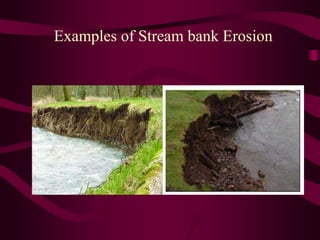
Stream bank erosion occurs where streams begin cutting deeper
and wider channels as a consequence of increased peak flows or the
removal of local protective vegetation.
Stream bank erosion is common along rivers, streams and drains
where banks have been eroded, sloughed or undercut.
Generally, stream bank erosion becomes a problem where
development has limited the meandering nature of streams, where
streams have been channelized, or where stream bank structures (like
bridges, culverts, etc.) are located in places where they can actually
cause damage to downstream areas.
Stabilizing these areas can help protect watercourses from
continued sedimentation, damage to adjacent land uses, control
unwanted meander, and improvement of habitat for fish and wildlife.
Examples of Stream bank Erosion
(vi) Coastal erosion
The waves, geology and geomorphology are
the three major factors that affect the coastal
erosion.
Waves are the cause of coastal erosion.
Wave energy is the result the speed of the
wind blowing over the surface of the sea, the
length of fetch and the wind blowing time.
The geology of the coastline also affects the
rate of erosion
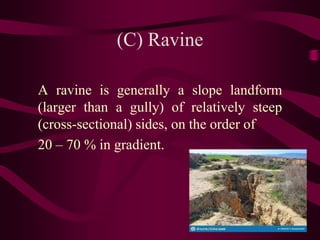
(C) Ravine
A ravine is generally a slope landform
(larger than a gully) of relatively steep
(cross-sectional) sides, on the order of
20 – 70 % in gradient.
(D) Landslides
Landslides are simply defined as the mass
movement of rock, debris or earth down a
slope.
They often take place in conjunction with
earthquakes, floods and volcanoes. Landslides
are caused when the stability of a slope
changes from a stable to an unstable condition.
A change in the stability of a slope can be
caused by a number of factors, acting together
or alone.

Soil erosion: Wind And Water

  • 1.
    Soil Erosion Prepared By:Dr. Pooja Goswami Assistant Professor (Agronomy) College of Agriculture Balaghat, JNKVV, Jabalpur
  • 2.
    Soil Erosion Soil erosion:Soil erosion is the detachment, transport and deposition of soil particles on land surface. Measured as Mass/unit area. In general, soil erosion implies the physical removal of topsoil by various agents, including rain, water flowing over and through the soil profile, wind, glaciers or gravitational pull. Land and water are the most precious natural resources that support and sustain the anthropogenic activities.
  • 3.
  • 4.
    Harmful effects ofSoil Erosion Top layer of soil contains most of the organic matter and nutrients, loss of this soil reducing soil fertility and affecting its structure badly. Soil erosion decreases the moisture supply by soil to the plants for their growth. It also affects the activity of soil micro-organisms thus deteriorating the crop yield. Wind erosion is very selective, carrying the finest particles - particularly organic matter, clay and loam for many kilometres. There the wind erosion causes losses of fertile soils from highly productive farming areas. The most spectacular forms are dunes - mounds of more or less sterile sand - which move as the wind takes them, even burying oases and ancient cities.
  • 5.
    Soil Erosion iscaused by: Natural Processes 1.Water 2Wind Human Activities 1. Over cropping 2. Deforestation 3. Overgrazing
  • 6.
    Types of SoilErosion 1. Geological Erosion 2. Accelerated Erosion A) Wind erosion C) Ravine B) Water Erosion D) land slide erosion (i) Raindrop or Splash erosion, (ii) Sheet erosion, (iii) Rill erosion, (iv) Gully erosion, (v) Stream bank erosion (vi) Costal erosion
  • 7.
    Wind erosion It isprimary responsible for creation and maintenance of desert areas. Finer soil particles from top soil along with organic matter and nutrients are easily detachable and removed by wind velocity.
  • 8.
    Factors of WindErosion E = f (I, C, K, L, V) I is the soil erodibility by wind (related to relative amount of particles > 0.84 mm dia. C is the local wind erosion climatic factor (product of average wind velocity and average moisture of soil surface) K is the soil surface roughness (expressed in height of ridges; more roughness increases resistance to wind erosion) L is the unprotected width of the field (protection provided by wind breaks) V is the equivalent quantity of vegetative cover (includes quantity, kind, and orientation of vegetative cover
  • 9.
    Factors Affecting WindErosion Several factors relating to soil, landscape and climate that affects wind erosion are soil texture: Erosion works on loosely held soil particles at the soil surface.  soil structure Silty and very fine sandy soils are particularly vulnerable to erosion. Poorly structured soils whose aggregates (clumps) have been broken down into fine particles by tillage and other forces are also easily eroded
  • 10.
    Continued… surface relief Surfacerelief (shape and slope) affects the direction and rate of erosion. It also affects the location of soil deposition, because eroded soil tends to accumulate at the base of slopes and in depressions.  soil protection by plants or plant residues Exposed soils suffer greater erosion than soils well protected by standing plants or plant residues•). Soils are most vulnerable to wind erosion when the soil surface dries out rapidly during periods of low or no rainfall, such as the drought during the "dirty thirties" in the prairiesor in early spring when the soil is not protected by vegetation.  rainfall Climate affects erosion mainly through the moisture conditions of the soil and specific climatic events (wind and rainstorms  wind force. Wind speed and the length of time the wind blows are major factors in wind erosion.
  • 11.
    Causes of WindErosion Bare, unprotected soil is extremely vulnerable to wind erosion Erosion occurs with strong, turbulent winds blowing across a soil surface that is smooth, loose, dry and finely granulated.  Slightly larger soil particles bounce or roll along the soil surface. Loose particles drift along, bombarding and dislodging still more particles with the same effect on clods or growing plants as
  • 12.
    Forms of WindErosion Saltation : lifting and bouncing of a particle, most important for particles 0.1 - 0.5 mm dia. Creep: coarse and very coarse sand grains rolled on ground surface. Suspension: Lifting of silt- and clay-sized particles(<0.1 mm) high into the air and can thus be carried long distances
  • 13.
    Damages of WindErosion Losing topsoil has a direct effect on the productivity of the land. A loss of 2.5 cm of soil can reduce wheat yields by 5-10% while a loss of 20 cm can reduce yields to 1/3 of their previous levels. Estimated soil loss by wind erosion on the is 160 million tones per year.• As soil productivity decreases due to a decrease in topsoil, soil fertility becomes less.• Organic material is reduced and hence, less plant growth occurs.
  • 14.
    How to controlwind erosion? Planting shelterbelts (trees may be obtained from the Tree Nursery) to help reduce the velocity of the wind Increasing the organic content of the soil  Using fertilizers to increase soil productivity. Alternating narrow strips of summer fallow and crop perpendicular to the prevailing winds (strip cropping) Leaving stubble barriers
  • 15.
    Using trash coverand green manure. Reducing tillage. Using marginal land for livestock rather than crop production. Reducing the speed of tillage• Planting of fall cover crops (winter wheat or rye) in areas of light, sandy soil which are particularly prone to wind erosion Using marginal land for livestock rather than crop production Reducing the speed of tillage• Planting perennial grass or legumes on grazing lands. Zero tillage - planting crops in to last years stubble
  • 16.
    Continued…. The more organicmaterial present in the soil, the greater the resistance of the soil to be broken into particles small enough to be carried away by wind or water, and the more moisture the soil will hold. Adding fertilizers to the soil aids in making the soil more productive, which protects it against the effects of erosion. Mulching  Strip Cropping
  • 17.
  • 18.
    Different Forms ofWater Erosion (i) Raindrop or Splash erosion, (ii) Sheet erosion, (iii) Rill erosion, (iv) Gully erosion, (v) Stream bank erosion (vi) Costal erosion
  • 19.
    (i) Splash Erosion Itresults from soil splash caused by the impact of falling torrential rain.  If raindrops strikes on the land covered with thick blanket of vegetation the drop breaks into a spray of clear water which slowly finds its way into soil pores Splash/ Raindrop Erosion.
  • 20.
    Continued… Splash erosion Ifthe raindrop strikes bare soil considerable splashing occurs. These splashes gradually remove fine materials from the soil and leave the land infertile by leaving behind sand and gravel particles. Splashes as much as 60 cm. high and 150 cm. away Splash/ Raindrop Erosion.
  • 21.
    (ii) Sheet Erosion Itis the removal of fairly uniform layer of soil from land surface by the action of rainfall and runoff water Sloping land having a shallow loose topsoil overlying a compact subsoil are the most susceptible to sheet erosion  detected by the muddy colour of the run-off from the fields.
  • 22.
    (iii) Rill Erosion TheseThe advance form of the rill is initial stage of gully formation. The rills are shallow drainage lines less than 30cm deep and 50 cm wide. They develop when surface water concentrates in depressions or low points through paddocks and erodes the soil. Rill erosion is common in bare agricultural land, particularly overgrazed land, and in freshly tilled soil where the soil structure has been loosened.
  • 23.
     Rills willincrease not only in number but also in shape and size. Rill erosion is more serious in soils having shallow top soil.  transition stage between sheet and gully erosion Rill Erosion. Rill erosion is mostly occurs in alluvial soil and is quite frequent in Chambal river valley in India.
  • 24.
    (iv) Gully Erosion Theadvance stage of rills is transformed into initial stage of gully. Gully formation are initiated when the depth and width of the rill is more than 50 cm. Gullies are deeper channels that cannot be removed by normal cultivation. Hillsides are more prone to gullying when they cleared of vegetation, through deforestation, over-grazing or other means. The eroded soil is easily carried by the flowing water after being dislodged from the ground, normally when rainfall falls during short, intense storms
  • 25.
  • 26.
    Classification of Gullies Basedon shape (U shape, V shape) Based on nature of gully flow (Active, Inactive) Based on size (depth, width and side slopes)
  • 27.
    U shape andV shape Gullies U shaped Gullies It is formed in areas where surface and subsurface soils are weak and susceptible to erosion. The flow velocity is less and this causes a continuous process of caving in of the gully sides, forming U shape. It is common in plains V shaped Gullies It is formed in areas where the subsoil is more resistant to erosion. The flow through this gullies is low, but velocity is very high due to steep slope. These gullies are formed in hilly areas with steep faces
  • 28.
    U - Shapeand V- Shape Gullies
  • 29.
  • 30.
    (v) Stream bankerosion Stream bank erosion occurs where streams begin cutting deeper and wider channels as a consequence of increased peak flows or the removal of local protective vegetation. Stream bank erosion is common along rivers, streams and drains where banks have been eroded, sloughed or undercut. Generally, stream bank erosion becomes a problem where development has limited the meandering nature of streams, where streams have been channelized, or where stream bank structures (like bridges, culverts, etc.) are located in places where they can actually cause damage to downstream areas. Stabilizing these areas can help protect watercourses from continued sedimentation, damage to adjacent land uses, control unwanted meander, and improvement of habitat for fish and wildlife.
  • 31.
    Examples of Streambank Erosion
  • 32.
    (vi) Coastal erosion Thewaves, geology and geomorphology are the three major factors that affect the coastal erosion. Waves are the cause of coastal erosion. Wave energy is the result the speed of the wind blowing over the surface of the sea, the length of fetch and the wind blowing time. The geology of the coastline also affects the rate of erosion
  • 33.
    (C) Ravine A ravineis generally a slope landform (larger than a gully) of relatively steep (cross-sectional) sides, on the order of 20 – 70 % in gradient.
  • 34.
    (D) Landslides Landslides aresimply defined as the mass movement of rock, debris or earth down a slope. They often take place in conjunction with earthquakes, floods and volcanoes. Landslides are caused when the stability of a slope changes from a stable to an unstable condition. A change in the stability of a slope can be caused by a number of factors, acting together or alone.