1
RUNOFF
by
Prof.A. Balasubramanian
Centre for Advanced Studies in Earth
Science
University of Mysore, India
2
Introduction:
Stream flow representing the runoff phase of the
hydrologic cycle is the most important basic data
for hydrologic studies.
A stream can be defined as a flow channel into
which the surface runoff from a specified basin
drains.
Runoff is generated by rainstorms.
Its occurrence and quantity are dependent on the
characteristics of the rainfall event, i.e. intensity,
duration and distribution.
3
Runoff can be defined as the portion of the
precipitation that makes it’s way towards rivers or
oceans etc, as surface or subsurface flow.
Surface runoff can be generated either by rainfall,
snowfall or by the melting of snow, or glaciers.
Runoff is that portion of the rainfall or irrigation
water which leaves a field either as surface or as
subsurface flow.
When rainfall intensity reaching the soil surface is
less than the infiltration capacity, all the water is
absorbed in to the soil.
4
As rain continues, soil becomes saturated and
infiltration capacity is reduced, shallow depression
begins to fill with water, then the overland flow
starts as runoff.
Surface detention/ Detention storage:
The amount of water on the land surface in transit
towards stream channels is called detention
storage/surface detention.
Types of Runoff:
Surface runoff/ Sub-surface runoff or Base flow.
5
a. Surface Runoff:
That portion of rainfall which enters the stream
immediately after the rainfall.
It occurs when all loses is satisfied and rainfall is
still continued and rate of rainfall [intensity] in
greater than infiltration rate.
b. Sub-Surface Runoff:
That part of rainfall which first leaches into the
soil and moves laterally without joining the water
table, to the stream, rivers or ocean is known as
sub-surface runoff.
6
It is usually referred is inter-flow.
c. Base flow: It is delayed flow defined as that part
of rainfall, which after falling on the ground the
surface, infiltrated into the soil and meets to the
water table and flow the streams, ocean etc.
The movement of water in this is very slow.
Therefore it is also referred a delayed runoff.
Total runoff = Surface runoff + GW Base flow.
7
The surface runoff process:
As the rain continues, water reaching the ground
surface infiltrates into the soil until it reaches a
stage where the rate of rainfall (intensity) exceeds
the infiltration capacity of the soil.
Thereafter, surface puddles, ditches, and other
depressions are filled with water (depression
storage), and after that overland flow as runoff is
generated.
8
The process of runoff generation continues as long
as the rainfall intensity exceeds the actual
infiltration capacity of the soil but it stops as soon
as the rate of rainfall drops below the actual rate of
infiltration.
Factors Affecting runoff:
Runoff rate and volume from an area are mainly
influenced by following two factors:
A. Climatic factors.
B. Physiographical Factors.
9
A. Climate factors:
Rainfall characteristics:
1.Types of Precipitation:
It has great effect on the runoff. E.g. A
precipitation which occurs in the form of rainfall
starts immediately as surface runoff depending
upon rainfall intensity while precipitation in the
form of snow does not result in surface runoff.
10
2. Rainfall Intensity:
If the rainfall intensity is greater than infiltration
rate of soil then runoff starts immediately after
rainfall.
While in case of low rainfall intensity runoff starts
later.
Thus high intensities of rainfall yield higher
runoff.
11
3. Duration of Rainfall:
It is directly related to the volume of runoff
because infiltration rate of soil decreases with
duration of rainfall.
Therefore medium intensity rainfall even results in
considerable amount of runoff if duration is
longer.
4. Rainfall Distribution:
Runoff from a watershed depends very much on
the distribution of rainfall.
12
It is also expressed as “distribution coefficient”.
Near the outlet of watershed, runoff will be more.
5. Direction of Prevailing Wind:
If the direction of prevailing wind is same as
drainage system, it results in peak low.
A storm moving in the direction of stream slope
produce a higher peak in shorter period of time
than a storm moving in opposite direction
13
6. Other Climate Factors:
Other factors such as temperature wind velocity,
relative humidity, annual rainfall etc. affect the
water losses from watershed area.
B Physiographic Factors:
1. Size of Watershed:
A large watershed takes longer time for draining
the runoff to outlet than smaller watershed and
vice-versa.
14
2. Shape of Watershed:
Runoff is greatly affected by shape of watershed.
Shape of watershed is generally expressed by the
term “form factor” and “compactness coefficient”.
Form Factor = Ratio of average width to axial
length of watershed.
Compactness Coefficient: Ratio off perimeter of
watershed to circumference of circle whose area is
equal to area of watershed.
Two types of shape: Fan shape [tends to produce
higher runoff very early].
15
Fern shape [tend to produced less runoff].
3. Slope of Watershed: It has complex effect. It
controls the time of overland flow and time of
concentration of rainfall. E.g. sloppy watershed
results in greater runoff due to greater runoff
velocity and vice-versa.
4. Orientation of Watershed: This affects the
evaporation and transpiration losses from the area.
The north or south orientation, affects the time of
melting of collected snow.
16
5. Land Use:
Land use and land management practices have
great effect on the runoff yield. E.g. an area with
forest cover or thick layer of mulch of leaves and
grasses contribute less runoff because water is
absorbed more into soil.
6. Soil moisture:
Magnitude of runoff yield depends upon the initial
moisture present in soil at the time of rainfall.
17
If the rain occurs after along dry spell then
infiltration rate is more, hence it contributes less
runoff.
7. Soil type:
In filtration rate vary with type of soil. So runoff is
great affected by soil type.
8. Topographic characteristics:
It includes those topographic features which
affects the runoff.
Undulating land has greater runoff than flat land.
18
9. Drainage Density:
It is defined as the ratio of the total channel length
[L] in the watershed to total watershed area [A].
Greater drainage density gives more runoff
Drainage density = L/A.
10. Storage Characteristics:
a. Depressions
b. Ponds, lakes and pools
c. Stream
d. Channels.
e. Check dams in gullies
19
f. Upstream reservoirs or tanks.
g. Ground water storage in deposits/aquifers.
Measurement:
River discharge, the volume flow rate through a
river cross section, is perhaps the most important
single hydrologic quantity.
Measurements of river discharge are required for
flood hazard management, water resource
planning, climate and ecology studies, and
compliance with transboundary water agreements.
20
The discharge (or streamflow) of a river relates to
the volume of water flowing through a single
point within a channel at a given time.
Understanding this information is essential for
many important uses across a broad range of
scales, including global water balances,
engineering design, flood forecasting, reservoir
operations, navigation, water supply, recreation,
and environmental management.
21
Stream flow measurement techniques can be
broadly classified into two categories as
(i) direct determination and
(ii) indirect determination.
1. Direct determination of stream discharge:
(a) Area-velocity methods,
(b) Dilution techniques,
(c) Electromagnetic method, and
(d) Ultrasonic method.
22
2. Indirect determination of stream flow:
(a) Hydraulic structures, such as weirs,
flumes and gated structures.
(b) Slope-area method.
Barring a few exceptional cases, continuous
measurement of stream discharge is very difficult
to obtain.
As a rule, direct measurement of discharge is a
very time-consuming and costly procedure. Hence,
a two step procedure is followed.
23
First, the discharge in a given stream is related to
the elevation of the water surface (stage) through a
series of careful measurements.
In the next step the stage of the steam is observed
routinely in a relatively inexpensive manner and
the discharge is estimated by using the previously
determined stage-discharge relationship.
The observation of the stage is easy, inexpensive,
and if desired, continuous readings can also be
obtained.
24
This method of discharge determination of streams
is adopted universally.
Stream Gauging:
Stream gauging is the technique used to measure
the volume of water flowing through a channel per
unit time, generally referred to as discharge.
Stream discharge is determined by the
relationship between stream velocity and channel
area.
25
Quantifying the relationship between these
variables allows continuous records of discharge to
be estimated.
The first step towards this is the measurement of
stage.
Stage measurement and rating curves:
Stage describes the depth of water within a
channel and is quantified by the height of water at
a gauging site above an arbitrary datum.
26
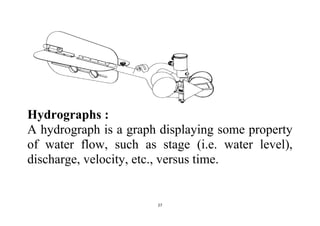
The velocity-area method:
The most common and direct method of
estimating discharge is the velocity-area method.
This technique requires measurement of stream
velocity, channel width and the depth of water
flow at cross stream vertical sections.
The measurement of velocity in rivers is achieved
using instruments such as current meters.
27
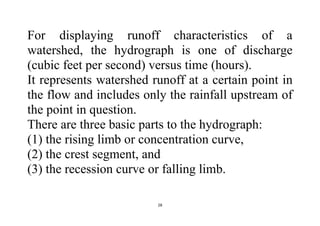
Hydrographs :
A hydrograph is a graph displaying some property
of water flow, such as stage (i.e. water level),
discharge, velocity, etc., versus time.
28
For displaying runoff characteristics of a
watershed, the hydrograph is one of discharge
(cubic feet per second) versus time (hours).
It represents watershed runoff at a certain point in
the flow and includes only the rainfall upstream of
the point in question.
There are three basic parts to the hydrograph:
(1) the rising limb or concentration curve,
(2) the crest segment, and
(3) the recession curve or falling limb.
29
Methods available for measuring site discharge:
Float Method:
This method requires the measurement and
calculation of the cross-sectional area of the
channel as well as the time it takes an object to “fl
oat” a designated distance.
Estimate the cross-sectional area of the channel.
To determine the velocity of the discharge, mark
off a 25 to 100 foot long section of the channel
that includes the part where you measured the
cross-section.
30
Gently release the fl oat into the channel slightly
upstream from the beginning of the section.
Measure the amount of time it takes the “fl oat” to
travel the marked section.
Repeat this process at least three times and
calculate the average time.
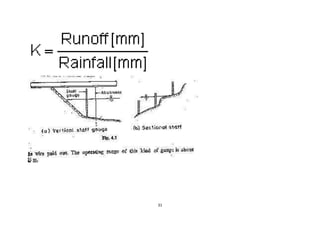
Determination of runoff coefficients:
The runoff coefficient from an individual
rainstorm is defined as runoff divided by the
corresponding rainfall both expressed as depth
over catchment area (mm):
31
32
33
Run-off coefficients:
The percentage of rainfall that appears as storm
water run-off from a surface is called the run-off
coefficient.
The run-off coefficient of roofed areas (Cr) is 1.0.
The run-off coefficient of paved areas (Ci) is 0.9.
Depending on the soil type and rainfall intensity
the run-off coefficient from pervious areas (Cp)
could be as low as no run-off at all (low rainfall
intensity, sandy soil) or up to 80% (high rainfall,
heavy clay soil).
34
You need to know the run-off coefficient to size
the storm water drainage system on the site.
Effects of surface runoff:
Erosion and deposition: Surface runoff can cause
erosion of the Earth's surface; eroded material may
be deposited a considerable distance away.
Environmental effects :
The principal environmental issues associated with
runoff are the impacts to surface water,
groundwater and soil through transport of water
pollutants to these systems.
35
Agricultural issues:
The transport of agricultural chemicals (nitrates,
phosphates, pesticides, herbicides etc.) via surface
runoff.
The resulting contaminated runoff represents not
only a waste of agricultural chemicals, but also an
environmental threat to downstream ecosystems.
Flooding :
Flooding occurs when a watercourse is unable to
convey the quantity of runoff flowing downstream.
36
Floods can be both beneficial to societies or cause
damage.
Importance of Runoff:
* water balance calculation
*Irrigation scheduling:
The magnitude of flood flows to enable safe
disposal of the excess flow.
The minimum flow and quantity of flow available
at various seasons.
37
The interaction of the flood wave and hydraulic
structures, such as levees, reservoirs, barrages and
bridges.
*river engineering.
*highway engineering
*flood control
*inland waterways.
The capacity of storage structure such as reservoir.

Runoff

  • 1.
    1 RUNOFF by Prof.A. Balasubramanian Centre forAdvanced Studies in Earth Science University of Mysore, India
  • 2.
    2 Introduction: Stream flow representingthe runoff phase of the hydrologic cycle is the most important basic data for hydrologic studies. A stream can be defined as a flow channel into which the surface runoff from a specified basin drains. Runoff is generated by rainstorms. Its occurrence and quantity are dependent on the characteristics of the rainfall event, i.e. intensity, duration and distribution.
  • 3.
    3 Runoff can bedefined as the portion of the precipitation that makes it’s way towards rivers or oceans etc, as surface or subsurface flow. Surface runoff can be generated either by rainfall, snowfall or by the melting of snow, or glaciers. Runoff is that portion of the rainfall or irrigation water which leaves a field either as surface or as subsurface flow. When rainfall intensity reaching the soil surface is less than the infiltration capacity, all the water is absorbed in to the soil.
  • 4.
    4 As rain continues,soil becomes saturated and infiltration capacity is reduced, shallow depression begins to fill with water, then the overland flow starts as runoff. Surface detention/ Detention storage: The amount of water on the land surface in transit towards stream channels is called detention storage/surface detention. Types of Runoff: Surface runoff/ Sub-surface runoff or Base flow.
  • 5.
    5 a. Surface Runoff: Thatportion of rainfall which enters the stream immediately after the rainfall. It occurs when all loses is satisfied and rainfall is still continued and rate of rainfall [intensity] in greater than infiltration rate. b. Sub-Surface Runoff: That part of rainfall which first leaches into the soil and moves laterally without joining the water table, to the stream, rivers or ocean is known as sub-surface runoff.
  • 6.
    6 It is usuallyreferred is inter-flow. c. Base flow: It is delayed flow defined as that part of rainfall, which after falling on the ground the surface, infiltrated into the soil and meets to the water table and flow the streams, ocean etc. The movement of water in this is very slow. Therefore it is also referred a delayed runoff. Total runoff = Surface runoff + GW Base flow.
  • 7.
    7 The surface runoffprocess: As the rain continues, water reaching the ground surface infiltrates into the soil until it reaches a stage where the rate of rainfall (intensity) exceeds the infiltration capacity of the soil. Thereafter, surface puddles, ditches, and other depressions are filled with water (depression storage), and after that overland flow as runoff is generated.
  • 8.
    8 The process ofrunoff generation continues as long as the rainfall intensity exceeds the actual infiltration capacity of the soil but it stops as soon as the rate of rainfall drops below the actual rate of infiltration. Factors Affecting runoff: Runoff rate and volume from an area are mainly influenced by following two factors: A. Climatic factors. B. Physiographical Factors.
  • 9.
    9 A. Climate factors: Rainfallcharacteristics: 1.Types of Precipitation: It has great effect on the runoff. E.g. A precipitation which occurs in the form of rainfall starts immediately as surface runoff depending upon rainfall intensity while precipitation in the form of snow does not result in surface runoff.
  • 10.
    10 2. Rainfall Intensity: Ifthe rainfall intensity is greater than infiltration rate of soil then runoff starts immediately after rainfall. While in case of low rainfall intensity runoff starts later. Thus high intensities of rainfall yield higher runoff.
  • 11.
    11 3. Duration ofRainfall: It is directly related to the volume of runoff because infiltration rate of soil decreases with duration of rainfall. Therefore medium intensity rainfall even results in considerable amount of runoff if duration is longer. 4. Rainfall Distribution: Runoff from a watershed depends very much on the distribution of rainfall.
  • 12.
    12 It is alsoexpressed as “distribution coefficient”. Near the outlet of watershed, runoff will be more. 5. Direction of Prevailing Wind: If the direction of prevailing wind is same as drainage system, it results in peak low. A storm moving in the direction of stream slope produce a higher peak in shorter period of time than a storm moving in opposite direction
  • 13.
    13 6. Other ClimateFactors: Other factors such as temperature wind velocity, relative humidity, annual rainfall etc. affect the water losses from watershed area. B Physiographic Factors: 1. Size of Watershed: A large watershed takes longer time for draining the runoff to outlet than smaller watershed and vice-versa.
  • 14.
    14 2. Shape ofWatershed: Runoff is greatly affected by shape of watershed. Shape of watershed is generally expressed by the term “form factor” and “compactness coefficient”. Form Factor = Ratio of average width to axial length of watershed. Compactness Coefficient: Ratio off perimeter of watershed to circumference of circle whose area is equal to area of watershed. Two types of shape: Fan shape [tends to produce higher runoff very early].
  • 15.
    15 Fern shape [tendto produced less runoff]. 3. Slope of Watershed: It has complex effect. It controls the time of overland flow and time of concentration of rainfall. E.g. sloppy watershed results in greater runoff due to greater runoff velocity and vice-versa. 4. Orientation of Watershed: This affects the evaporation and transpiration losses from the area. The north or south orientation, affects the time of melting of collected snow.
  • 16.
    16 5. Land Use: Landuse and land management practices have great effect on the runoff yield. E.g. an area with forest cover or thick layer of mulch of leaves and grasses contribute less runoff because water is absorbed more into soil. 6. Soil moisture: Magnitude of runoff yield depends upon the initial moisture present in soil at the time of rainfall.
  • 17.
    17 If the rainoccurs after along dry spell then infiltration rate is more, hence it contributes less runoff. 7. Soil type: In filtration rate vary with type of soil. So runoff is great affected by soil type. 8. Topographic characteristics: It includes those topographic features which affects the runoff. Undulating land has greater runoff than flat land.
  • 18.
    18 9. Drainage Density: Itis defined as the ratio of the total channel length [L] in the watershed to total watershed area [A]. Greater drainage density gives more runoff Drainage density = L/A. 10. Storage Characteristics: a. Depressions b. Ponds, lakes and pools c. Stream d. Channels. e. Check dams in gullies
  • 19.
    19 f. Upstream reservoirsor tanks. g. Ground water storage in deposits/aquifers. Measurement: River discharge, the volume flow rate through a river cross section, is perhaps the most important single hydrologic quantity. Measurements of river discharge are required for flood hazard management, water resource planning, climate and ecology studies, and compliance with transboundary water agreements.
  • 20.
    20 The discharge (orstreamflow) of a river relates to the volume of water flowing through a single point within a channel at a given time. Understanding this information is essential for many important uses across a broad range of scales, including global water balances, engineering design, flood forecasting, reservoir operations, navigation, water supply, recreation, and environmental management.
  • 21.
    21 Stream flow measurementtechniques can be broadly classified into two categories as (i) direct determination and (ii) indirect determination. 1. Direct determination of stream discharge: (a) Area-velocity methods, (b) Dilution techniques, (c) Electromagnetic method, and (d) Ultrasonic method.
  • 22.
    22 2. Indirect determinationof stream flow: (a) Hydraulic structures, such as weirs, flumes and gated structures. (b) Slope-area method. Barring a few exceptional cases, continuous measurement of stream discharge is very difficult to obtain. As a rule, direct measurement of discharge is a very time-consuming and costly procedure. Hence, a two step procedure is followed.
  • 23.
    23 First, the dischargein a given stream is related to the elevation of the water surface (stage) through a series of careful measurements. In the next step the stage of the steam is observed routinely in a relatively inexpensive manner and the discharge is estimated by using the previously determined stage-discharge relationship. The observation of the stage is easy, inexpensive, and if desired, continuous readings can also be obtained.
  • 24.
    24 This method ofdischarge determination of streams is adopted universally. Stream Gauging: Stream gauging is the technique used to measure the volume of water flowing through a channel per unit time, generally referred to as discharge. Stream discharge is determined by the relationship between stream velocity and channel area.
  • 25.
    25 Quantifying the relationshipbetween these variables allows continuous records of discharge to be estimated. The first step towards this is the measurement of stage. Stage measurement and rating curves: Stage describes the depth of water within a channel and is quantified by the height of water at a gauging site above an arbitrary datum.
  • 26.
    26 The velocity-area method: Themost common and direct method of estimating discharge is the velocity-area method. This technique requires measurement of stream velocity, channel width and the depth of water flow at cross stream vertical sections. The measurement of velocity in rivers is achieved using instruments such as current meters.
  • 27.
    27 Hydrographs : A hydrographis a graph displaying some property of water flow, such as stage (i.e. water level), discharge, velocity, etc., versus time.
  • 28.
    28 For displaying runoffcharacteristics of a watershed, the hydrograph is one of discharge (cubic feet per second) versus time (hours). It represents watershed runoff at a certain point in the flow and includes only the rainfall upstream of the point in question. There are three basic parts to the hydrograph: (1) the rising limb or concentration curve, (2) the crest segment, and (3) the recession curve or falling limb.
  • 29.
    29 Methods available formeasuring site discharge: Float Method: This method requires the measurement and calculation of the cross-sectional area of the channel as well as the time it takes an object to “fl oat” a designated distance. Estimate the cross-sectional area of the channel. To determine the velocity of the discharge, mark off a 25 to 100 foot long section of the channel that includes the part where you measured the cross-section.
  • 30.
    30 Gently release thefl oat into the channel slightly upstream from the beginning of the section. Measure the amount of time it takes the “fl oat” to travel the marked section. Repeat this process at least three times and calculate the average time. Determination of runoff coefficients: The runoff coefficient from an individual rainstorm is defined as runoff divided by the corresponding rainfall both expressed as depth over catchment area (mm):
  • 31.
  • 32.
  • 33.
    33 Run-off coefficients: The percentageof rainfall that appears as storm water run-off from a surface is called the run-off coefficient. The run-off coefficient of roofed areas (Cr) is 1.0. The run-off coefficient of paved areas (Ci) is 0.9. Depending on the soil type and rainfall intensity the run-off coefficient from pervious areas (Cp) could be as low as no run-off at all (low rainfall intensity, sandy soil) or up to 80% (high rainfall, heavy clay soil).
  • 34.
    34 You need toknow the run-off coefficient to size the storm water drainage system on the site. Effects of surface runoff: Erosion and deposition: Surface runoff can cause erosion of the Earth's surface; eroded material may be deposited a considerable distance away. Environmental effects : The principal environmental issues associated with runoff are the impacts to surface water, groundwater and soil through transport of water pollutants to these systems.
  • 35.
    35 Agricultural issues: The transportof agricultural chemicals (nitrates, phosphates, pesticides, herbicides etc.) via surface runoff. The resulting contaminated runoff represents not only a waste of agricultural chemicals, but also an environmental threat to downstream ecosystems. Flooding : Flooding occurs when a watercourse is unable to convey the quantity of runoff flowing downstream.
  • 36.
    36 Floods can beboth beneficial to societies or cause damage. Importance of Runoff: * water balance calculation *Irrigation scheduling: The magnitude of flood flows to enable safe disposal of the excess flow. The minimum flow and quantity of flow available at various seasons.
  • 37.
    37 The interaction ofthe flood wave and hydraulic structures, such as levees, reservoirs, barrages and bridges. *river engineering. *highway engineering *flood control *inland waterways. The capacity of storage structure such as reservoir.