Training On soil fertility and its management
Presented By
Sanskriti Kumari
B.sc Ag 4th year
Institute of Agriculture
Sciences
Rajeev Gandhi South
Presented At
Krishi Vigyan Kendra
Institute of Agriculture
Sciences
Rajeev Gandhi South
Topic: Soil erosion and its Causes
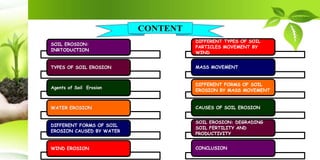
SOIL EROSION:
INRTODUCTION
TYPES OF SOIL EROSION
Agents of Soil Erosion
WATER EROSION
DIFFERENT FORMS OF SOIL
EROSION CAUSED BY WATER
WIND EROSION
DIFFERENT TYPES OF SOIL
PARTICLES MOVEMENT BY
WIND
MASS MOVEMENT
DIFFERENT FORMS OF SOIL
EROSION BY MASS MOVEMENT
CAUSES OF SOIL EROSION
SOIL EROSION: DEGRADING
SOIL FERTILITY AND
PRODUCTIVITY
CONCLUSION
INTRODUCTION
 Soil erosion is the detachment and movement of soil material.
 It is the steady, degenerative process of the loss of topsoil.
 It is a natural process which has increasingly been exacerbated by human activities such as
agriculture and deforestation.
 Soil erosion is an important social and economic problem and an essential factor in assessing
ecosystem health and function.
 The National Bureau of Soil Survey & Land Use Planning (NBSS & LUP) estimates that soil
erosion extends to about about 119.2 Mh area in India. The average annual rate of soil erosion in
the country is 16.35 t/h i.e. 5334 MT/year. (Source: https://www.indiawaterportal.org/faqs/soil-
erosion-threatens-agriculture-india)
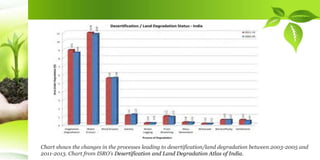
Chart shows the changes in the processes leading to desertification/land degradation between 2003-2005 and
2011-2013. Chart from ISRO’s Desertification and Land Degradation Atlas of India.
TYPES OF SOIL EROSION
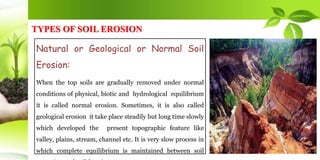
Natural or Geological or Normal Soil
Erosion:
When the top soils are gradually removed under normal
conditions of physical, biotic and hydrological equilibrium
it is called normal erosion. Sometimes, it is also called
geological erosion it take place steadily but long time slowly
which developed the present topographic feature like
valley, plains, stream, channel etc. It is very slow process in
which complete equilibrium is maintained between soil
TYPES OF SOIL EROSION
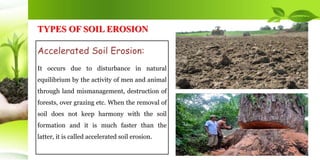
Accelerated Soil Erosion:
It occurs due to disturbance in natural
equilibrium by the activity of men and animal
through land mismanagement, destruction of
forests, over grazing etc. When the removal of
soil does not keep harmony with the soil
formation and it is much faster than the
latter, it is called accelerated soil erosion.
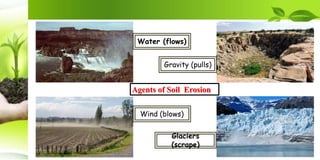
Agents of Soil Erosion
Water (flows)
Wind (blows)
Gravity (pulls)
Glaciers
(scrape)
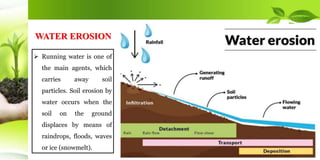
 Running water is one of
the main agents, which
carries away soil
particles. Soil erosion by
water occurs when the
soil on the ground
displaces by means of
raindrops, floods, waves
or ice (snowmelt).
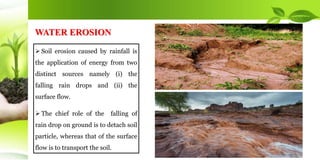
WATER EROSION
 Soil erosion caused by rainfall is
the application of energy from two
distinct sources namely (i) the
falling rain drops and (ii) the
surface flow.
 The chief role of the falling of
rain drop on ground is to detach soil
particle, whereas that of the surface
flow is to transport the soil.
WATER EROSION
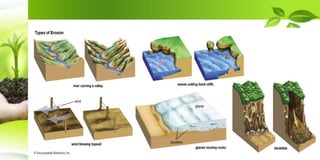
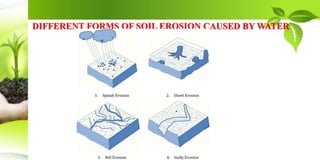
DIFFERENT FORMS OF SOIL EROSION CAUSED BY WATER
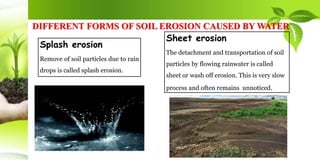
Splash erosion
Remove of soil particles due to rain
drops is called splash erosion.
Sheet erosion
The detachment and transportation of soil
particles by flowing rainwater is called
sheet or wash off erosion. This is very slow
process and often remains unnoticed.
DIFFERENT FORMS OF SOIL EROSION CAUSED BY WATER
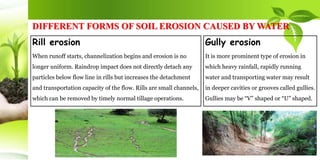
Rill erosion
When runoff starts, channelization begins and erosion is no
longer uniform. Raindrop impact does not directly detach any
particles below flow line in rills but increases the detachment
and transportation capacity of the flow. Rills are small channels,
which can be removed by timely normal tillage operations.
Gully erosion
It is more prominent type of erosion in
which heavy rainfall, rapidly running
water and transporting water may result
in deeper cavities or grooves called gullies.
Gullies may be “V” shaped or “U” shaped.
DIFFERENT FORMS OF SOIL EROSION CAUSED BY WATER
Ravine erosion
It is prolonged and advance stage
of gully erosion leads to ravines
found in deep alluvial soils. It is
nothing but deep and wide gullies.
Piping and sapping
erosion
Erosion of streambanks and
shorelines by exfiltrating seepage
DIFFERENT FORMS OF SOIL EROSION CAUSED BY WATER
Bank erosion
Stream or river banks are eroded by
water either flowing over the sides of
a stream or scouring at the base.
Coastal erosion
Coastal erosion of soil occurs along sea shores.
It is caused by the wave action of the sea and
the inward movement of the sea into the land.
DIFFERENT FORMS OF SOIL EROSION CAUSED BY WATER
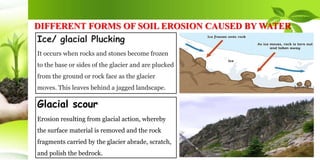
Glacial scour
Erosion resulting from glacial action, whereby
the surface material is removed and the rock
fragments carried by the glacier abrade, scratch,
and polish the bedrock.
Ice/ glacial Plucking
It occurs when rocks and stones become frozen
to the base or sides of the glacier and are plucked
from the ground or rock face as the glacier
moves. This leaves behind a jagged landscape.
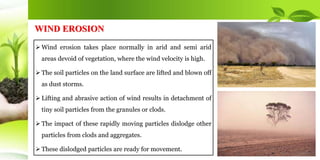
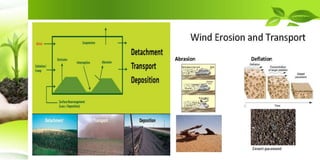
 Wind erosion takes place normally in arid and semi arid
areas devoid of vegetation, where the wind velocity is high.
 The soil particles on the land surface are lifted and blown off
as dust storms.
 Lifting and abrasive action of wind results in detachment of
tiny soil particles from the granules or clods.
 The impact of these rapidly moving particles dislodge other
particles from clods and aggregates.
 These dislodged particles are ready for movement.
WIND EROSION
WIND EROSION
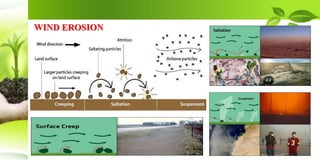
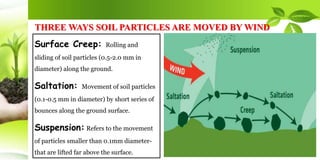
Surface Creep: Rolling and
sliding of soil particles (0.5-2.0 mm in
diameter) along the ground.
Saltation: Movement of soil particles
(0.1-0.5 mm in diameter) by short series of
bounces along the ground surface.
Suspension: Refers to the movement
of particles smaller than 0.1mm diameter-
that are lifted far above the surface.
THREE WAYS SOIL PARTICLES ARE MOVED BY WIND
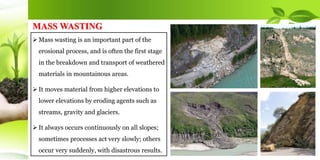
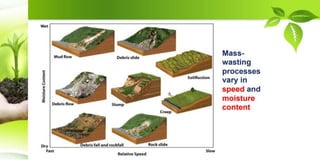
 Mass wasting is an important part of the
erosional process, and is often the first stage
in the breakdown and transport of weathered
materials in mountainous areas.
 It moves material from higher elevations to
lower elevations by eroding agents such as
streams, gravity and glaciers.
 It always occurs continuously on all slopes;
sometimes processes act very slowly; others
occur very suddenly, with disastrous results.
MASS WASTING
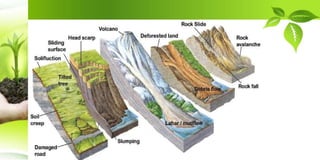
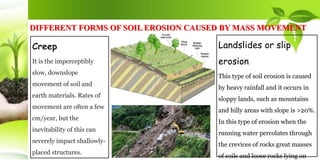
Creep
It is the imperceptibly
slow, downslope
movement of soil and
earth materials. Rates of
movement are often a few
cm/year, but the
inevitability of this can
severely impact shallowly-
placed structures.
DIFFERENT FORMS OF SOIL EROSION CAUSED BY MASS MOVEMENT
Landslides or slip
erosion
This type of soil erosion is caused
by heavy rainfall and it occurs in
sloppy lands, such as mountains
and hilly areas with slope is >20%.
In this type of erosion when the
running water percolates through
the crevices of rocks great masses
of soils and loose rocks lying on
DIFFERENT FORMS OF SOIL EROSION CAUSED BY MASS MOVEMENT
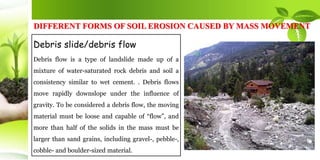
Debris slide/debris flow
Debris flow is a type of landslide made up of a
mixture of water-saturated rock debris and soil a
consistency similar to wet cement. . Debris flows
move rapidly downslope under the influence of
gravity. To be considered a debris flow, the moving
material must be loose and capable of “flow”, and
more than half of the solids in the mass must be
larger than sand grains, including gravel-, pebble-,
cobble- and boulder-sized material.
DIFFERENT FORMS OF SOIL EROSION CAUSED BY MASS MOVEMENT
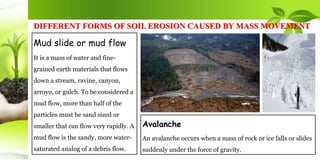
Mud slide or mud flow
It is a mass of water and fine-
grained earth materials that flows
down a stream, ravine, canyon,
arroyo, or gulch. To be considered a
mud flow, more than half of the
particles must be sand sized or
smaller that can flow very rapidly. A
mud flow is the sandy, more water-
saturated analog of a debris flow.
Avalanche
An avalanche occurs when a mass of rock or ice falls or slides
suddenly under the force of gravity.
DIFFERENT FORMS OF SOIL EROSION CAUSED BY MASS MOVEMENT
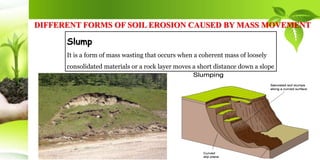
Slump
It is a form of mass wasting that occurs when a coherent mass of loosely
consolidated materials or a rock layer moves a short distance down a slope
DIFFERENT FORMS OF SOIL EROSION CAUSED BY MASS MOVEMENT
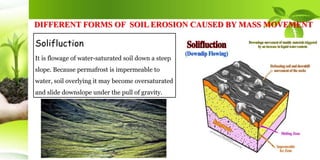
Solifluction
It is flowage of water-saturated soil down a steep
slope. Because permafrost is impermeable to
water, soil overlying it may become oversaturated
and slide downslope under the pull of gravity.
CAUSES OF SOIL EROSION
 Soil erodibility
 Undulating topography
 The slope of the Land
 Arid and semi arid climate
 Rain and Rainwater Runoff
 Overgrazing rangelands
 Over-harvesting vegetation
 Deforestation and urbanization
 Economic and developmental activities
 Unsheltered Distance and Lack of Vegetation
 Farming practices
 Continuous cropping
 Monoculture systems
 Shifting cultivations.
 Abandoning farmland
 Off-highway vehicle use
 Energy exploration
 Floods
 Drought
 Wildland fire
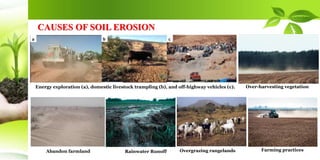
Abandon farmland
Energy exploration (a), domestic livestock trampling (b), and off-highway vehicles (c). Over-harvesting vegetation
CAUSES OF SOIL EROSION
Rainwater Runoff Overgrazing rangelands Farming practices
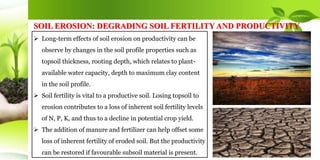
 Long-term effects of soil erosion on productivity can be
observe by changes in the soil profile properties such as
topsoil thickness, rooting depth, which relates to plant-
available water capacity, depth to maximum clay content
in the soil profile.
 Soil fertility is vital to a productive soil. Losing topsoil to
erosion contributes to a loss of inherent soil fertility levels
of N, P, K, and thus to a decline in potential crop yield.
 The addition of manure and fertilizer can help offset some
loss of inherent fertility of eroded soil. But the productivity
can be restored if favourable subsoil material is present.
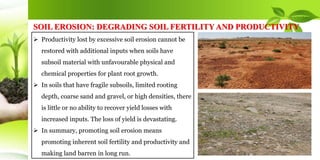
SOIL EROSION: DEGRADING SOIL FERTILITY AND PRODUCTIVITY
 Productivity lost by excessive soil erosion cannot be
restored with additional inputs when soils have
subsoil material with unfavourable physical and
chemical properties for plant root growth.
 In soils that have fragile subsoils, limited rooting
depth, coarse sand and gravel, or high densities, there
is little or no ability to recover yield losses with
increased inputs. The loss of yield is devastating.
 In summary, promoting soil erosion means
promoting inherent soil fertility and productivity and
making land barren in long run.
SOIL EROSION: DEGRADING SOIL FERTILITY AND PRODUCTIVITY
CONCLUSION
 Today soil erosion is considered as one of the most serious natural resource depletions in the
world. Soil erosion, or the gradual reduction of topsoil in a geographic area, can have great effects
on inhabitants of an affected area.
 It can permanently affect the land, which can be devastating for farmers. Habitable lands and
arable lands slowly, over time, become transformed into barren, dry and cracked beds incapable
of sustaining water or wildlife.
 And a loss of biodiversity, the disturbance of ecosystem processes and degradation are not just a
natural loss —these translate into very real economic losses.
“Essentially, all life depends upon the
soil … There can be no life without soil
and no soil without life; they have
evolved together.”
~ Charles Kellogg
Thank
You

soil erosion and its causes .pptx

  • 1.
    Training On soilfertility and its management Presented By Sanskriti Kumari B.sc Ag 4th year Institute of Agriculture Sciences Rajeev Gandhi South Presented At Krishi Vigyan Kendra Institute of Agriculture Sciences Rajeev Gandhi South Topic: Soil erosion and its Causes
  • 2.
    SOIL EROSION: INRTODUCTION TYPES OFSOIL EROSION Agents of Soil Erosion WATER EROSION DIFFERENT FORMS OF SOIL EROSION CAUSED BY WATER WIND EROSION DIFFERENT TYPES OF SOIL PARTICLES MOVEMENT BY WIND MASS MOVEMENT DIFFERENT FORMS OF SOIL EROSION BY MASS MOVEMENT CAUSES OF SOIL EROSION SOIL EROSION: DEGRADING SOIL FERTILITY AND PRODUCTIVITY CONCLUSION
  • 3.
    INTRODUCTION  Soil erosionis the detachment and movement of soil material.  It is the steady, degenerative process of the loss of topsoil.  It is a natural process which has increasingly been exacerbated by human activities such as agriculture and deforestation.  Soil erosion is an important social and economic problem and an essential factor in assessing ecosystem health and function.  The National Bureau of Soil Survey & Land Use Planning (NBSS & LUP) estimates that soil erosion extends to about about 119.2 Mh area in India. The average annual rate of soil erosion in the country is 16.35 t/h i.e. 5334 MT/year. (Source: https://www.indiawaterportal.org/faqs/soil- erosion-threatens-agriculture-india)
  • 4.
    Chart shows thechanges in the processes leading to desertification/land degradation between 2003-2005 and 2011-2013. Chart from ISRO’s Desertification and Land Degradation Atlas of India.
  • 5.
    TYPES OF SOILEROSION Natural or Geological or Normal Soil Erosion: When the top soils are gradually removed under normal conditions of physical, biotic and hydrological equilibrium it is called normal erosion. Sometimes, it is also called geological erosion it take place steadily but long time slowly which developed the present topographic feature like valley, plains, stream, channel etc. It is very slow process in which complete equilibrium is maintained between soil
  • 6.
    TYPES OF SOILEROSION Accelerated Soil Erosion: It occurs due to disturbance in natural equilibrium by the activity of men and animal through land mismanagement, destruction of forests, over grazing etc. When the removal of soil does not keep harmony with the soil formation and it is much faster than the latter, it is called accelerated soil erosion.
  • 7.
    Agents of SoilErosion Water (flows) Wind (blows) Gravity (pulls) Glaciers (scrape)
  • 9.
     Running wateris one of the main agents, which carries away soil particles. Soil erosion by water occurs when the soil on the ground displaces by means of raindrops, floods, waves or ice (snowmelt). WATER EROSION
  • 10.
     Soil erosioncaused by rainfall is the application of energy from two distinct sources namely (i) the falling rain drops and (ii) the surface flow.  The chief role of the falling of rain drop on ground is to detach soil particle, whereas that of the surface flow is to transport the soil. WATER EROSION
  • 11.
    DIFFERENT FORMS OFSOIL EROSION CAUSED BY WATER
  • 12.
    DIFFERENT FORMS OFSOIL EROSION CAUSED BY WATER Splash erosion Remove of soil particles due to rain drops is called splash erosion. Sheet erosion The detachment and transportation of soil particles by flowing rainwater is called sheet or wash off erosion. This is very slow process and often remains unnoticed.
  • 13.
    DIFFERENT FORMS OFSOIL EROSION CAUSED BY WATER Rill erosion When runoff starts, channelization begins and erosion is no longer uniform. Raindrop impact does not directly detach any particles below flow line in rills but increases the detachment and transportation capacity of the flow. Rills are small channels, which can be removed by timely normal tillage operations. Gully erosion It is more prominent type of erosion in which heavy rainfall, rapidly running water and transporting water may result in deeper cavities or grooves called gullies. Gullies may be “V” shaped or “U” shaped.
  • 14.
    DIFFERENT FORMS OFSOIL EROSION CAUSED BY WATER Ravine erosion It is prolonged and advance stage of gully erosion leads to ravines found in deep alluvial soils. It is nothing but deep and wide gullies. Piping and sapping erosion Erosion of streambanks and shorelines by exfiltrating seepage
  • 15.
    DIFFERENT FORMS OFSOIL EROSION CAUSED BY WATER Bank erosion Stream or river banks are eroded by water either flowing over the sides of a stream or scouring at the base. Coastal erosion Coastal erosion of soil occurs along sea shores. It is caused by the wave action of the sea and the inward movement of the sea into the land.
  • 16.
    DIFFERENT FORMS OFSOIL EROSION CAUSED BY WATER Glacial scour Erosion resulting from glacial action, whereby the surface material is removed and the rock fragments carried by the glacier abrade, scratch, and polish the bedrock. Ice/ glacial Plucking It occurs when rocks and stones become frozen to the base or sides of the glacier and are plucked from the ground or rock face as the glacier moves. This leaves behind a jagged landscape.
  • 17.
     Wind erosiontakes place normally in arid and semi arid areas devoid of vegetation, where the wind velocity is high.  The soil particles on the land surface are lifted and blown off as dust storms.  Lifting and abrasive action of wind results in detachment of tiny soil particles from the granules or clods.  The impact of these rapidly moving particles dislodge other particles from clods and aggregates.  These dislodged particles are ready for movement. WIND EROSION
  • 18.
  • 20.
    Surface Creep: Rollingand sliding of soil particles (0.5-2.0 mm in diameter) along the ground. Saltation: Movement of soil particles (0.1-0.5 mm in diameter) by short series of bounces along the ground surface. Suspension: Refers to the movement of particles smaller than 0.1mm diameter- that are lifted far above the surface. THREE WAYS SOIL PARTICLES ARE MOVED BY WIND
  • 21.
     Mass wastingis an important part of the erosional process, and is often the first stage in the breakdown and transport of weathered materials in mountainous areas.  It moves material from higher elevations to lower elevations by eroding agents such as streams, gravity and glaciers.  It always occurs continuously on all slopes; sometimes processes act very slowly; others occur very suddenly, with disastrous results. MASS WASTING
  • 24.
    Creep It is theimperceptibly slow, downslope movement of soil and earth materials. Rates of movement are often a few cm/year, but the inevitability of this can severely impact shallowly- placed structures. DIFFERENT FORMS OF SOIL EROSION CAUSED BY MASS MOVEMENT Landslides or slip erosion This type of soil erosion is caused by heavy rainfall and it occurs in sloppy lands, such as mountains and hilly areas with slope is >20%. In this type of erosion when the running water percolates through the crevices of rocks great masses of soils and loose rocks lying on
  • 25.
    DIFFERENT FORMS OFSOIL EROSION CAUSED BY MASS MOVEMENT Debris slide/debris flow Debris flow is a type of landslide made up of a mixture of water-saturated rock debris and soil a consistency similar to wet cement. . Debris flows move rapidly downslope under the influence of gravity. To be considered a debris flow, the moving material must be loose and capable of “flow”, and more than half of the solids in the mass must be larger than sand grains, including gravel-, pebble-, cobble- and boulder-sized material.
  • 26.
    DIFFERENT FORMS OFSOIL EROSION CAUSED BY MASS MOVEMENT Mud slide or mud flow It is a mass of water and fine- grained earth materials that flows down a stream, ravine, canyon, arroyo, or gulch. To be considered a mud flow, more than half of the particles must be sand sized or smaller that can flow very rapidly. A mud flow is the sandy, more water- saturated analog of a debris flow. Avalanche An avalanche occurs when a mass of rock or ice falls or slides suddenly under the force of gravity.
  • 27.
    DIFFERENT FORMS OFSOIL EROSION CAUSED BY MASS MOVEMENT Slump It is a form of mass wasting that occurs when a coherent mass of loosely consolidated materials or a rock layer moves a short distance down a slope
  • 28.
    DIFFERENT FORMS OFSOIL EROSION CAUSED BY MASS MOVEMENT Solifluction It is flowage of water-saturated soil down a steep slope. Because permafrost is impermeable to water, soil overlying it may become oversaturated and slide downslope under the pull of gravity.
  • 29.
    CAUSES OF SOILEROSION  Soil erodibility  Undulating topography  The slope of the Land  Arid and semi arid climate  Rain and Rainwater Runoff  Overgrazing rangelands  Over-harvesting vegetation  Deforestation and urbanization  Economic and developmental activities  Unsheltered Distance and Lack of Vegetation  Farming practices  Continuous cropping  Monoculture systems  Shifting cultivations.  Abandoning farmland  Off-highway vehicle use  Energy exploration  Floods  Drought  Wildland fire
  • 30.
    Abandon farmland Energy exploration(a), domestic livestock trampling (b), and off-highway vehicles (c). Over-harvesting vegetation CAUSES OF SOIL EROSION Rainwater Runoff Overgrazing rangelands Farming practices
  • 31.
     Long-term effectsof soil erosion on productivity can be observe by changes in the soil profile properties such as topsoil thickness, rooting depth, which relates to plant- available water capacity, depth to maximum clay content in the soil profile.  Soil fertility is vital to a productive soil. Losing topsoil to erosion contributes to a loss of inherent soil fertility levels of N, P, K, and thus to a decline in potential crop yield.  The addition of manure and fertilizer can help offset some loss of inherent fertility of eroded soil. But the productivity can be restored if favourable subsoil material is present. SOIL EROSION: DEGRADING SOIL FERTILITY AND PRODUCTIVITY
  • 32.
     Productivity lostby excessive soil erosion cannot be restored with additional inputs when soils have subsoil material with unfavourable physical and chemical properties for plant root growth.  In soils that have fragile subsoils, limited rooting depth, coarse sand and gravel, or high densities, there is little or no ability to recover yield losses with increased inputs. The loss of yield is devastating.  In summary, promoting soil erosion means promoting inherent soil fertility and productivity and making land barren in long run. SOIL EROSION: DEGRADING SOIL FERTILITY AND PRODUCTIVITY
  • 33.
    CONCLUSION  Today soilerosion is considered as one of the most serious natural resource depletions in the world. Soil erosion, or the gradual reduction of topsoil in a geographic area, can have great effects on inhabitants of an affected area.  It can permanently affect the land, which can be devastating for farmers. Habitable lands and arable lands slowly, over time, become transformed into barren, dry and cracked beds incapable of sustaining water or wildlife.  And a loss of biodiversity, the disturbance of ecosystem processes and degradation are not just a natural loss —these translate into very real economic losses.
  • 34.
    “Essentially, all lifedepends upon the soil … There can be no life without soil and no soil without life; they have evolved together.” ~ Charles Kellogg
  • 35.