WATER SHED MANAGEMENT
 ( p
 (Special emphasis on soil
            p
 and water conservation)
  WRE-I
  UNIT- VIII

Prof S S JAHAGIRDAR
BE (CIVIL) ME(ENV ) PhD(persuing)
   (CIVIL), ME(ENV.),PhD(persuing)
NK Orchid college of Engg. and Tech. , Solapur
Watershed:
• Definition:
“Watershed can be defined as a unit
“          h d       b d fi d           i
  of area covers all the land which
  contributes runoff to a common
  point or outlet and surrounded by a
  ridge line”.
Deterioration of watershed takes place due
  to faulty and bad management through
  the activity of man and hi animals.
   h     i i    f       d his i l
Causes of watershed Deterioration:
These activities are:
• Faulty agriculture, f
     l      i l       forestry and pasture
                                 d
  (Grass land) management leading to
                      g             g
  degradation of land.
• Unscientific mining and quarrying
                            quarrying.
• Faulty road alignment and construction.
• I d t i li ti
  Industrialization
• Forest Fires
• Apathy (less interest) of the people.
Results of watershed
           Deterioration
           D t i ti :
• Less production from agriculture, forests,
  grass lands etc.
• Erosion increases and decreases biomass
  production
• Rapid siltation of reservoirs, lakes
                        reservoirs
  and river beds.
•LLess storage of water and l
                 f          d lowering of
                                    i   f
  water table.
• Poverty as a result of less food production.
WATERSHED DEVELOPMENT
Possible range of treatment
 measures
• Contour bunding
• Contour trenching
• Contour stone walls
• Bench terraces
• Land levelling
• Summer ploughing
• Agro forestry with suitable species
• Vegetative barriers
• Ch k dams (Temporary and
  Check d     (T              d
  Permanent)
• Retaining walls
• Farm ponds and Percolation
  ponds
• Renovation of existing water
  bodies and inlet channels
COMPONENTS OF WATERSHED
  DEVELOPMENT:
• • Human Resource Development (
                         p     (Community
                                        y
  Development)
  • Soil and Land Management
 • Water M
   W     Management
  • Crop Management
  • Afforestation
  • Pasture/Fodder Development
  • Livestock Management
  •R lE
    Rural Energy MManagement
  • Farm and non-farm value addition activities
• All these components are interdependent and
  interactive.
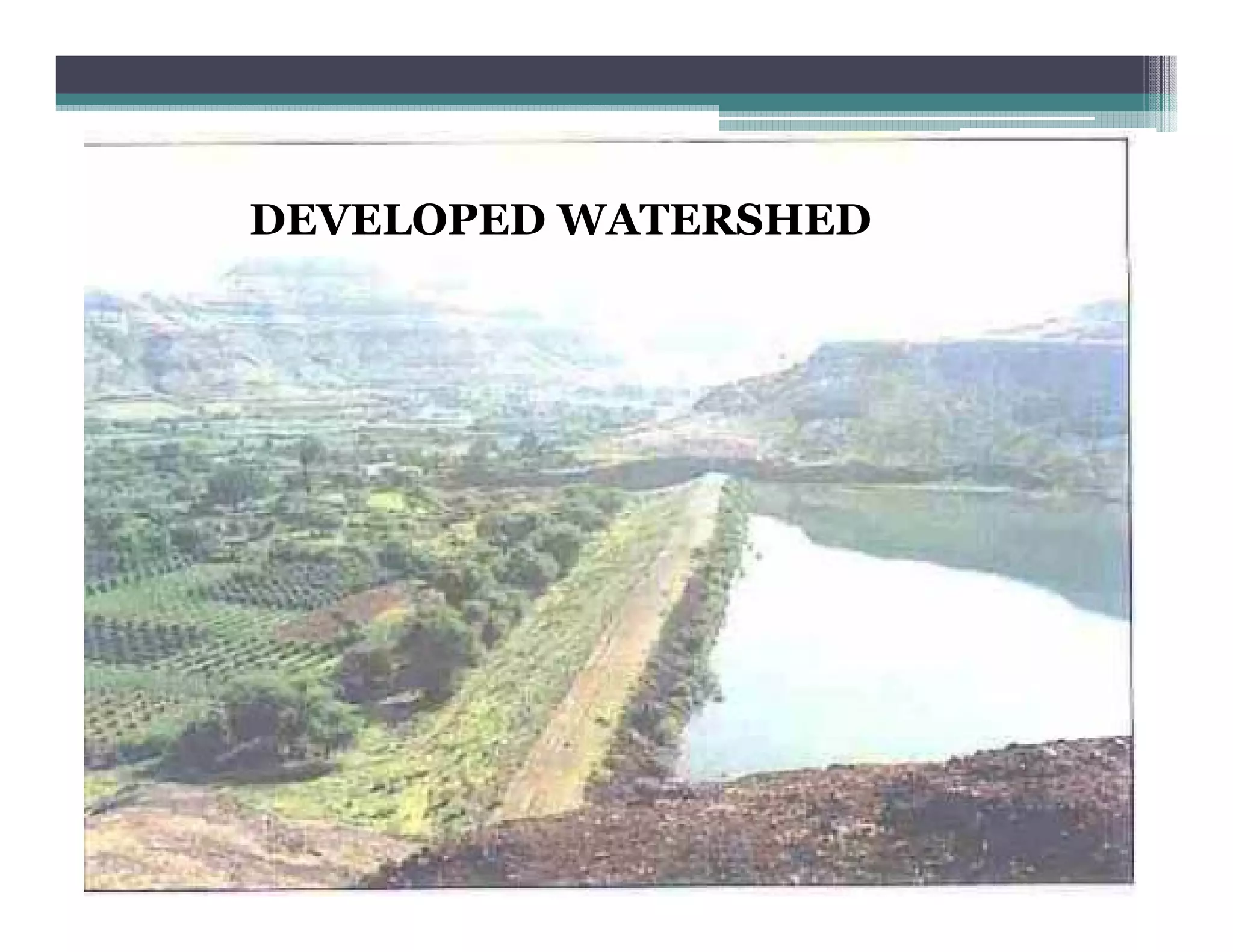
DEVELOPED WATERSHED
Methods for hill slopes
                    p
• CONTOUR TRENCHES AND
  STONE WALLS
• BENCH TERRACING
CONTOUR TRENCHES AND STONE
WALLS
•Suitable erosion control in
 S it bl      i       t li
 hills
•Adopted for hill slopes
 >20% %
•Continuous or interrupted
BENCH TERRACING
• It helps to bring sloping land into
  different level strips to enable
  cultivation.
     lti ti
• It consists of construction of step
  like fields along contours by half
  cutting and half filling.
         g               g
• Original slope is converted into
  level fields The vertical and
          fields.
  horizontal intervals are decided
  based l d slope.
  b     d land l
Methods for agric lt ral land
            agricultural
•   Check dam
•   Percolation pond
•   Micro catchments
•   Contour bund
•   Broad beds and furrows
•   Gully l
    G ll plugs
•   Tree plantation
•   Summer ploughing
    S         l   hi
•   Agro forestry
•   Vegetative barriers
•   Farm ponds
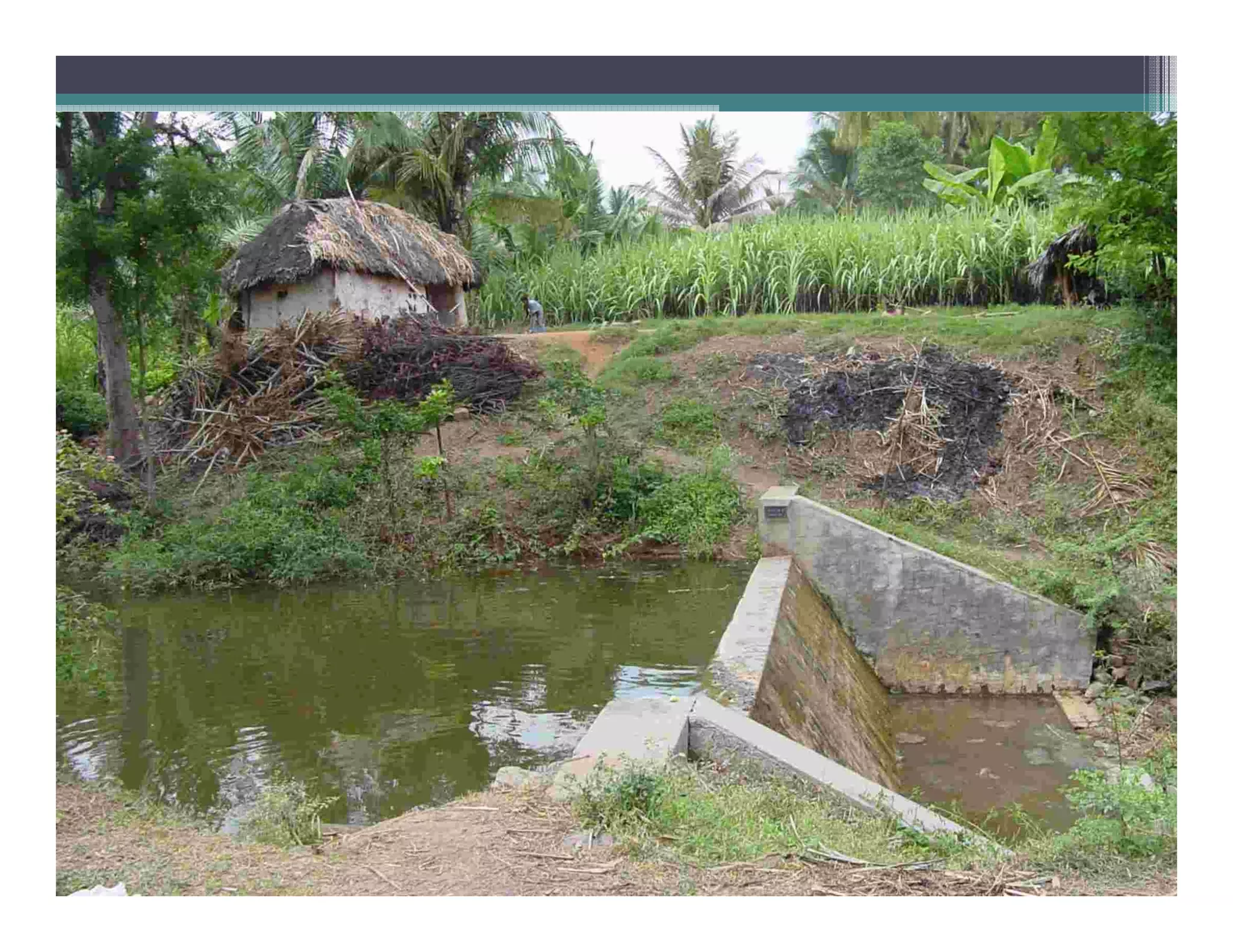
Check dam
• A low weir normally constructed across the
                       y
  gullies
• Constructed on small streams and long
  gullies formed by erosive activity of flood
  water
• It cuts the velocity and reduces erosive
  activity
• The stored water improves soil moisture of
  the adjoining area and allows percolation
  to recharge the aquifers
        h        h      if
• Height depends on the bank height, varies
  from a 1 m t 3 m and l
  f            to        d length varies from
                               th    i f
  less than 3m to 10m
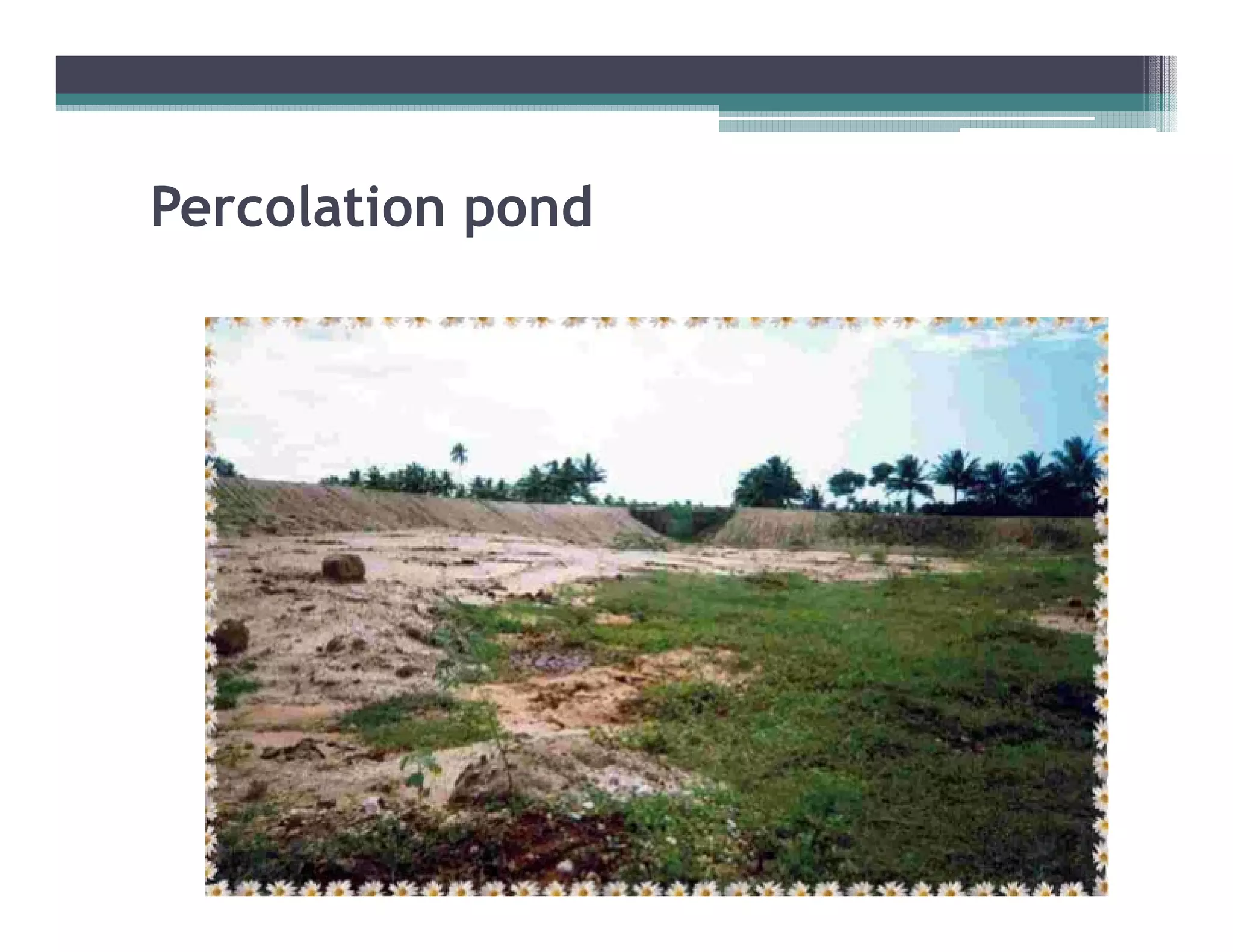
Percolation pond
• To improve the ground water
  recharge.
• Shallow depression created at lower
  portions in a natural or diverted
  stream course
• Located in soils of permeable nature
                      p
• Adaptable where 20-30 ground
  water wells for irrigation exist with
  in the zone of influence about 800 X
  900 m
Micro catchments
• To conserve insitu moisture and
  reduce soil loss
• Circular basin of one meter dia
  for level lands depending upon
  infiltration and rainfall
• Ditches of size 5m x 5m with
  trees planted centre
• Saucer basins / semi circular
  bunds with 2m diameter to a
  height of 15-20cm across the
  slope
Broad b d and furrows
B   d beds d f
• To control erosion and to
  conserve soil moisture in the
  soil during rainy days
• The broad bed and furrow
  system is laid within the field
  boundaries.
• Conserves soil moisture in dry
  land.
• Controls soil erosion
                erosion.
• Acts as a drainage channel
  during heavy rainy days.
  d i     h       i   d
Contour bund
• To intercept the runoff flowing
             p                    g
  down the slope by an
  embankment.
  embankment
• It helps to control runoff
  velocity.
• It can be adopted in light and
  medium textured soils.
• It can be laid up to 6% slopes.
• It helps to retain moisture in the
  field.
Gully plugs
    yp g
• Gully plug is one of the simple method of
  soil and water conservation. It plays an
  important role in soil and water
  conservation.
• G lli are f
  Gullies      formed d to erosion of top
                     d due         i   f
  soil by the flow of rain water. In course of
  time, a gully assumes a big shape and
  erosion goes on increasing. To prevent
  erosion, barriers or plugs of different
  types of material are put across the gully
                                        gully,
  at certain intervals.
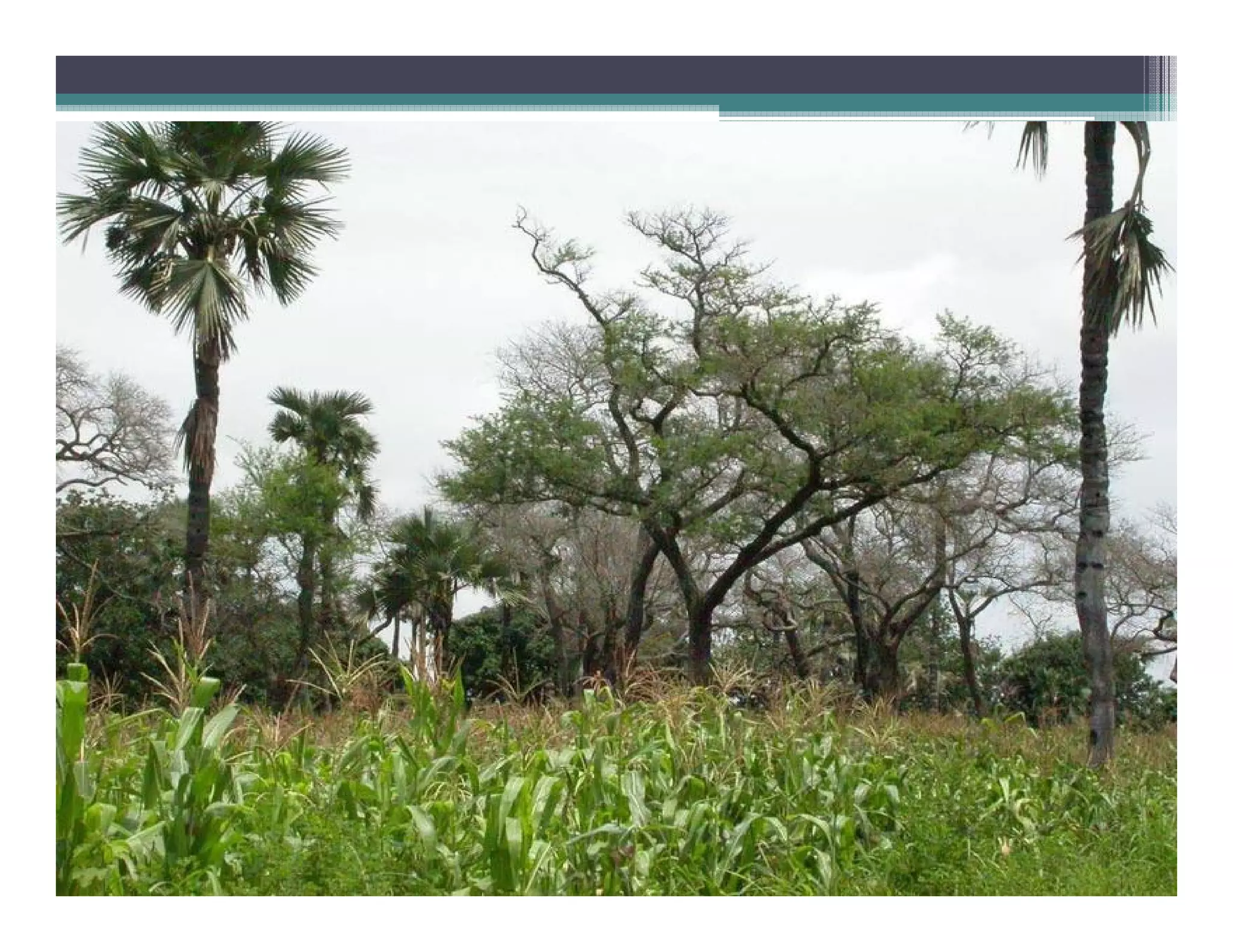
Tree plantation
• Instead of uneconomical agriculture,
                             g          ,
  farmers can grow grass in this hilly
  area and can use that as a fodder for
  cattle.
• Farmers can go for dairy development
  if good quantity and quality of grass is
  available.
•For soil and water conservation
 this activity will help. Plantation
 on common l d will satisfy b i
               land ill ti f basic
 need of fuel wood.
•Cheapest method for soil and
 water conservation
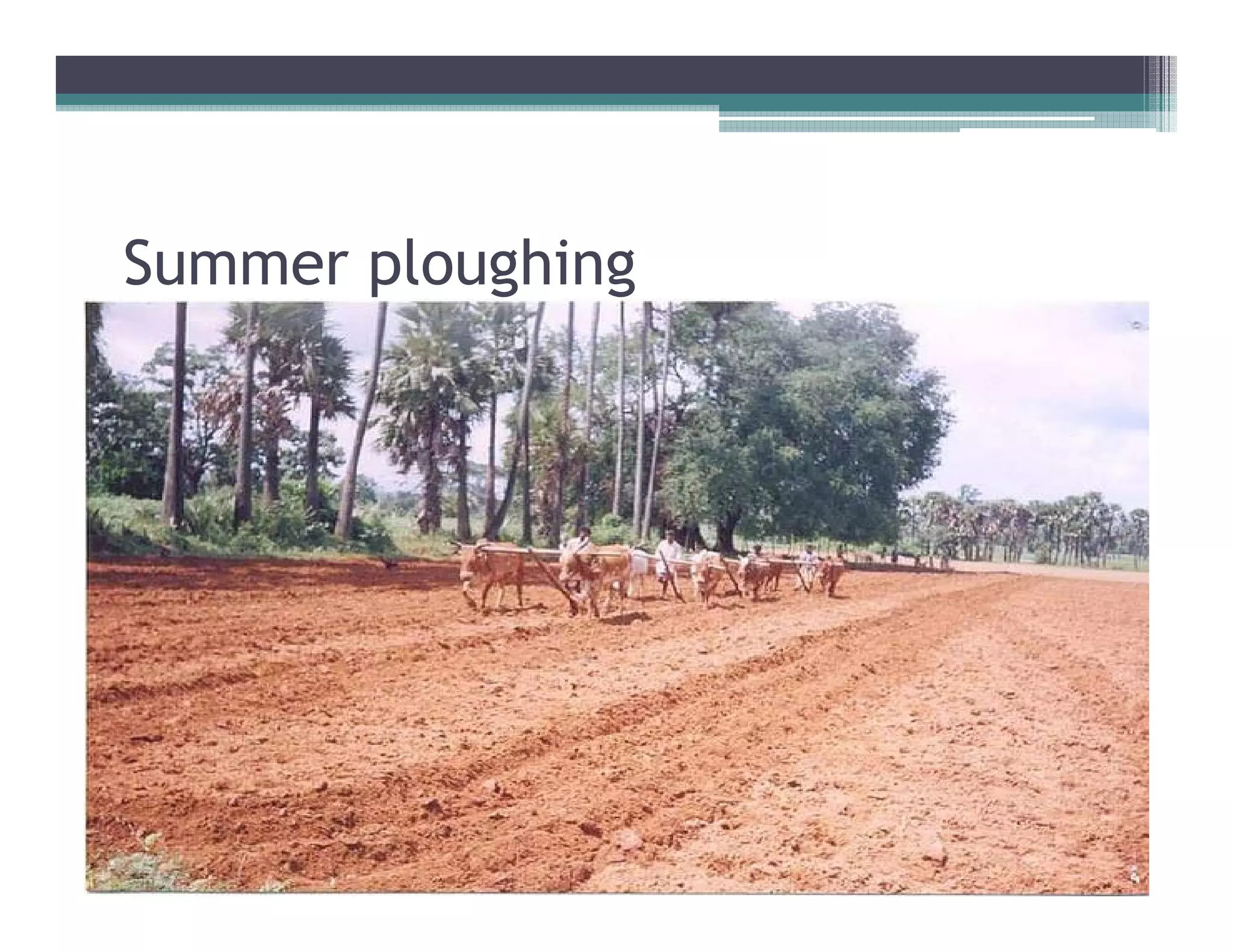
Summer ploughing
       p g g
•Main objective of field
 preparation is to control weeds
•Facilitate easy sowing and to
 establish good seed soil contact
•For easy absorption of moisture
         y       p
•To provide sufficient aeration
•To i
    improve water holding
                    h ldi
 capacity
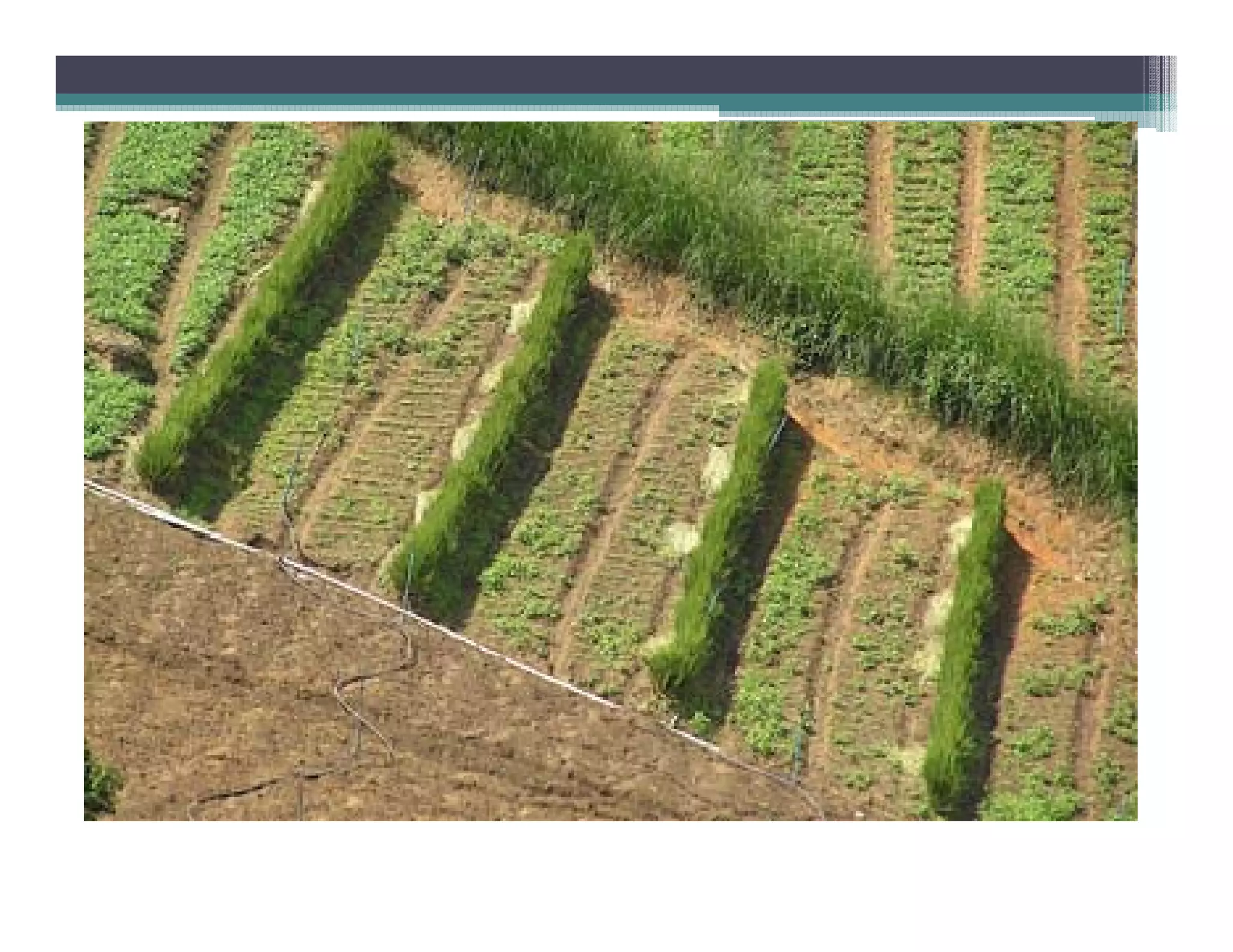
Agro forestry
 g          y
• Agroforestry is an integrated
  approach of using th i t
          h f i the interactive ti
  benefits from combining trees and
  shrubs with crops and/or li t k
   h b ith             d/ livestock.
• It combines agricultural and forestry
  technologies to create more di
      h l i                    diverse,
  productive, profitable, healthy and
  sustainable l d
       i bl land-use systems.
Vegetative barriers
  g
•Vegetative barriers are also an
    g
 effective inter-terrace land
 treatment in place of earthen
 barriers.
Farm ponds
     p
• Rain water is harvested and stored
• Used for storing water for longer duration
                                    duration.
• Covered with polythene sheet to prevent
  evaporation.
  evaporation
Roof top rainwater harvesting
       p                    g
• To recharge the wells (open and
  tube wells) particularly
  abandoned wells by a runoff
                        y
  collection system.
• Direct on-use of collected water
          on use
  if storage facility is available.
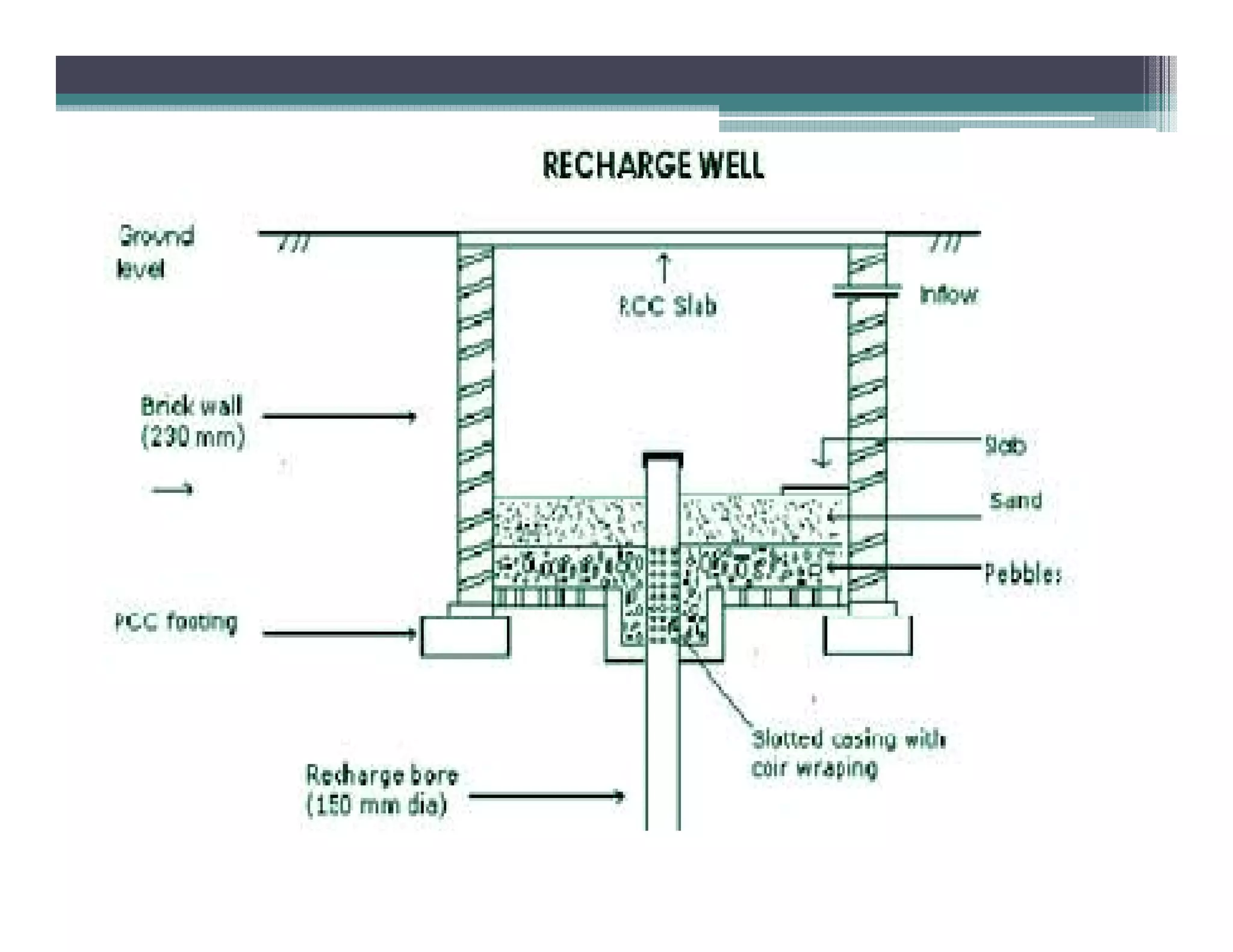
RECHARGE TUBE WELL
  • To   directly    feed  depleted
    aquifers to fresh water from
    g
    ground surface so that the
    recharge is fast without any
    evaporation loss
  • Depth of recharge tube well
    depends on the present depth of
    bore wells in the area
Watershed management

Watershed management

  • 1.
    WATER SHED MANAGEMENT ( p (Special emphasis on soil p and water conservation) WRE-I UNIT- VIII Prof S S JAHAGIRDAR BE (CIVIL) ME(ENV ) PhD(persuing) (CIVIL), ME(ENV.),PhD(persuing) NK Orchid college of Engg. and Tech. , Solapur
  • 2.
    Watershed: • Definition: “Watershed canbe defined as a unit “ h d b d fi d i of area covers all the land which contributes runoff to a common point or outlet and surrounded by a ridge line”. Deterioration of watershed takes place due to faulty and bad management through the activity of man and hi animals. h i i f d his i l
  • 3.
    Causes of watershedDeterioration: These activities are: • Faulty agriculture, f l i l forestry and pasture d (Grass land) management leading to g g degradation of land. • Unscientific mining and quarrying quarrying. • Faulty road alignment and construction. • I d t i li ti Industrialization • Forest Fires • Apathy (less interest) of the people.
  • 4.
    Results of watershed Deterioration D t i ti : • Less production from agriculture, forests, grass lands etc. • Erosion increases and decreases biomass production • Rapid siltation of reservoirs, lakes reservoirs and river beds. •LLess storage of water and l f d lowering of i f water table. • Poverty as a result of less food production.
  • 5.
    WATERSHED DEVELOPMENT Possible rangeof treatment measures • Contour bunding • Contour trenching • Contour stone walls • Bench terraces • Land levelling • Summer ploughing
  • 6.
    • Agro forestrywith suitable species • Vegetative barriers • Ch k dams (Temporary and Check d (T d Permanent) • Retaining walls • Farm ponds and Percolation ponds • Renovation of existing water bodies and inlet channels
  • 7.
    COMPONENTS OF WATERSHED DEVELOPMENT: • • Human Resource Development ( p (Community y Development) • Soil and Land Management • Water M W Management • Crop Management • Afforestation • Pasture/Fodder Development • Livestock Management •R lE Rural Energy MManagement • Farm and non-farm value addition activities • All these components are interdependent and interactive.
  • 8.
  • 9.
    Methods for hillslopes p • CONTOUR TRENCHES AND STONE WALLS • BENCH TERRACING
  • 10.
  • 13.
    •Suitable erosion controlin S it bl i t li hills •Adopted for hill slopes >20% % •Continuous or interrupted
  • 15.
  • 17.
    • It helpsto bring sloping land into different level strips to enable cultivation. lti ti • It consists of construction of step like fields along contours by half cutting and half filling. g g • Original slope is converted into level fields The vertical and fields. horizontal intervals are decided based l d slope. b d land l
  • 18.
    Methods for agriclt ral land agricultural • Check dam • Percolation pond • Micro catchments • Contour bund • Broad beds and furrows • Gully l G ll plugs • Tree plantation • Summer ploughing S l hi • Agro forestry • Vegetative barriers • Farm ponds
  • 19.
  • 21.
    • A lowweir normally constructed across the y gullies • Constructed on small streams and long gullies formed by erosive activity of flood water • It cuts the velocity and reduces erosive activity • The stored water improves soil moisture of the adjoining area and allows percolation to recharge the aquifers h h if • Height depends on the bank height, varies from a 1 m t 3 m and l f to d length varies from th i f less than 3m to 10m
  • 22.
  • 23.
    • To improvethe ground water recharge. • Shallow depression created at lower portions in a natural or diverted stream course • Located in soils of permeable nature p • Adaptable where 20-30 ground water wells for irrigation exist with in the zone of influence about 800 X 900 m
  • 24.
  • 26.
    • To conserveinsitu moisture and reduce soil loss • Circular basin of one meter dia for level lands depending upon infiltration and rainfall • Ditches of size 5m x 5m with trees planted centre • Saucer basins / semi circular bunds with 2m diameter to a height of 15-20cm across the slope
  • 27.
    Broad b dand furrows B d beds d f
  • 28.
    • To controlerosion and to conserve soil moisture in the soil during rainy days • The broad bed and furrow system is laid within the field boundaries. • Conserves soil moisture in dry land. • Controls soil erosion erosion. • Acts as a drainage channel during heavy rainy days. d i h i d
  • 29.
  • 32.
    • To interceptthe runoff flowing p g down the slope by an embankment. embankment • It helps to control runoff velocity. • It can be adopted in light and medium textured soils. • It can be laid up to 6% slopes. • It helps to retain moisture in the field.
  • 33.
  • 34.
    • Gully plugis one of the simple method of soil and water conservation. It plays an important role in soil and water conservation. • G lli are f Gullies formed d to erosion of top d due i f soil by the flow of rain water. In course of time, a gully assumes a big shape and erosion goes on increasing. To prevent erosion, barriers or plugs of different types of material are put across the gully gully, at certain intervals.
  • 35.
    Tree plantation • Insteadof uneconomical agriculture, g , farmers can grow grass in this hilly area and can use that as a fodder for cattle. • Farmers can go for dairy development if good quantity and quality of grass is available.
  • 36.
    •For soil andwater conservation this activity will help. Plantation on common l d will satisfy b i land ill ti f basic need of fuel wood. •Cheapest method for soil and water conservation
  • 37.
  • 38.
    •Main objective offield preparation is to control weeds •Facilitate easy sowing and to establish good seed soil contact •For easy absorption of moisture y p •To provide sufficient aeration •To i improve water holding h ldi capacity
  • 39.
    Agro forestry g y • Agroforestry is an integrated approach of using th i t h f i the interactive ti benefits from combining trees and shrubs with crops and/or li t k h b ith d/ livestock. • It combines agricultural and forestry technologies to create more di h l i diverse, productive, profitable, healthy and sustainable l d i bl land-use systems.
  • 41.
  • 43.
    •Vegetative barriers arealso an g effective inter-terrace land treatment in place of earthen barriers.
  • 44.
  • 45.
    • Rain wateris harvested and stored • Used for storing water for longer duration duration. • Covered with polythene sheet to prevent evaporation. evaporation
  • 46.
    Roof top rainwaterharvesting p g • To recharge the wells (open and tube wells) particularly abandoned wells by a runoff y collection system. • Direct on-use of collected water on use if storage facility is available.
  • 47.
    RECHARGE TUBE WELL • To directly feed depleted aquifers to fresh water from g ground surface so that the recharge is fast without any evaporation loss • Depth of recharge tube well depends on the present depth of bore wells in the area