FLUID KINEMATICS
(FLUID MECHANICS)
UNIT – 2
Dr. Rambabu Palaka, ProfessorAug-2020
Syllabus
Unit 1: Fluid Statics
CO1: Calculate Pressure and Hydrostatic forces on different plane surfaces
Unit 2: Fluid Kinematics
CO2: Solve the fluid flow problems using Continuity equation.
Unit 3: Fluid Dynamics
CO3: Calculate the discharges through the Venturi meter, Orifice meter and Pitot tube using Bernoulli’s
equation
Unit 4: Flow through Pipes
CO4: Calculate major and minor losses in closed conduits for different connection pattens.
Unit 5: Dimensional Analysis and Hydraulic Similitude
CO5: Apply the concept of Dimensional Analysis for solving the fluid flow problems and Model Analysis.
Unit 6: Boundary Layer Theory
Unit 2: Fluid Kinematics
1. Introduction to Kinematics (1 Period)
2. Methods of Describing Fluid Motion
a) Lagrangian Method
b) Eulerian Method
3. Flow Patterns (1 Period)
a) Stream Line
b) Path Line
c) Streak Line
d) Streak Tube
Learning Objectives
4. Classification of Fluid Flow (2 Periods)
a) Steady and Unsteady Flow
b) Uniform and Non-Uniform Flow
c) Laminar and Turbulent Flow
d) Rotational and Irrotational Flow
e) Compressible and Incompressible Flow
f) Ideal and Real Flow
g) One, Two and Three Dimensional Flow
5. Rate of Flow (Discharge) and Continuity Equation (2 Periods)
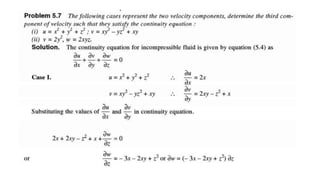
6. Continuity Equation in Three Dimensions (2 Periods)
7. Velocity and Acceleration (1 Period)
8. Stream and Velocity Potential Functions (2 Periods)
Fluid Kinematics
Definition:
It is a branch of science that deals with the motion of fluid without considering forces
causing the motion.
The study of Kinematics is often referred to as the geometry of motion.
It is generally a continuous function in space time.
Motion Characteristics:
• Velocity
• Acceleration
• Pressure
• Density
Methods of Describing Fluid Motion
Fluid motion is described by two methods.
Methods:
• Lagrangian Method – Describes a defined mass (position,
velocity, acceleration, pressure, temperature etc.,) as functions
of time.
Example:
Track the location of a migrating bird
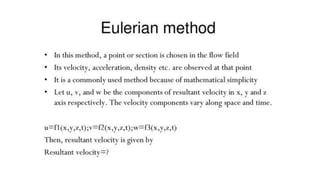
• Eulerian Method - Describes a flow field (velocity, acceleration,
pressure, temperature etc.,) as functions of position and time.
Example:
Count the birds passing through a particular location
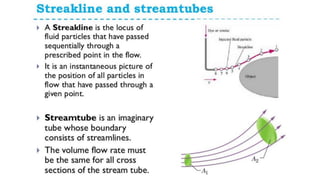
Flow Visualization
Flow Visualization is the Visual Examination of Flow-Field Features.
It is important for both physical experiments and numerical solutions.
Description of Flow Patterns:
1. Stream Lines
2. Path Lines
3. Streak Lines
4. Stream Tube
Types of Fluid Flow
Types of Fluid Flow:
1. Steady and Unsteady Flow
2. Uniform and Non-Uniform Flow
3. Laminar and Turbulent Flow
4. Rotational and Irrotational Flow
5. Compressible and Incompressible Flow
6. Ideal and Real Flow
7. One, Two and Three Dimensional Flow
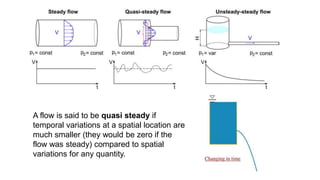
Steady and Unsteady Flow
Steady flow is that type of flow in which fluid parameters (velocity, pressure, density etc.) at any point in
the flow field do not change with time.
This means that the fluid particles passing through a fixed point have the same flow parameters like
velocity, pressure, surface tension etc. The parameters may be different at the different cross-section of
the flow passage.
Unsteady flow is that type of flow in which fluid parameters (velocity, pressure, density etc.) at a point
changes with time.
A flow is said to be quasi steady if
temporal variations at a spatial location are
much smaller (they would be zero if the
flow was steady) compared to spatial
variations for any quantity.
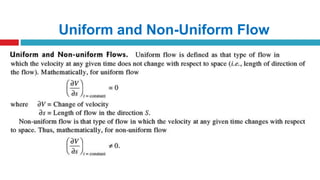
Uniform and Non-Uniform Flow
Laminar and Turbulent Flow
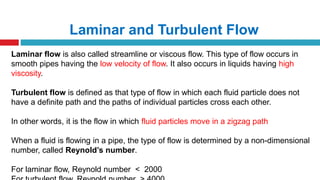
Laminar flow is also called streamline or viscous flow. This type of flow occurs in
smooth pipes having the low velocity of flow. It also occurs in liquids having high
viscosity.
Turbulent flow is defined as that type of flow in which each fluid particle does not
have a definite path and the paths of individual particles cross each other.
In other words, it is the flow in which fluid particles move in a zigzag path
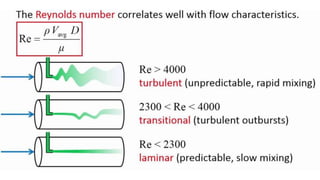
When a fluid is flowing in a pipe, the type of flow is determined by a non-dimensional
number, called Reynold’s number.
For laminar flow, Reynold number ˂ 2000
Compressible and Incompressible Flow
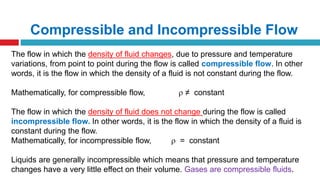
The flow in which the density of fluid changes, due to pressure and temperature
variations, from point to point during the flow is called compressible flow. In other
words, it is the flow in which the density of a fluid is not constant during the flow.
Mathematically, for compressible flow,  ≠ constant
The flow in which the density of fluid does not change during the flow is called
incompressible flow. In other words, it is the flow in which the density of a fluid is
constant during the flow.
Mathematically, for incompressible flow,  = constant
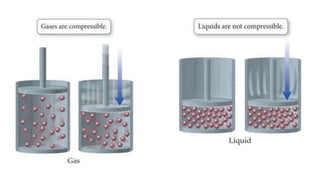
Liquids are generally incompressible which means that pressure and temperature
changes have a very little effect on their volume. Gases are compressible fluids.
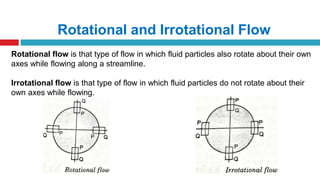
Rotational and Irrotational Flow
Rotational flow is that type of flow in which fluid particles also rotate about their own
axes while flowing along a streamline.
Irrotational flow is that type of flow in which fluid particles do not rotate about their
own axes while flowing.
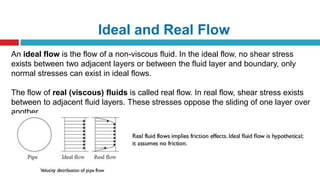
Ideal and Real Flow
An ideal flow is the flow of a non-viscous fluid. In the ideal flow, no shear stress
exists between two adjacent layers or between the fluid layer and boundary, only
normal stresses can exist in ideal flows.
The flow of real (viscous) fluids is called real flow. In real flow, shear stress exists
between to adjacent fluid layers. These stresses oppose the sliding of one layer over
another.
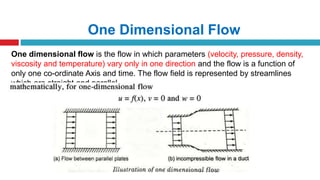
One Dimensional Flow
One dimensional flow is the flow in which parameters (velocity, pressure, density,
viscosity and temperature) vary only in one direction and the flow is a function of
only one co-ordinate Axis and time. The flow field is represented by streamlines
which are straight and parallel.
Two Dimensional Flow
Two-dimensional flow is the flow in which fluid parameters vary along two
directions and the flow is the function of two rectangular space coordinates (x and y-
axis) and time. The flow field is represented by streamlines which are curves.
Three Dimensional Flow
Three-dimensional flow is the flow in which flow parameters change in all the three
directions and the flow is the functions of three mutually perpendicular co-ordinate
Axis (x, y, z-axis) and time. The streamlines are space curves
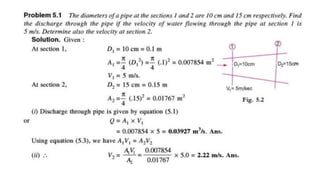
Rate of Flow or Discharge
Rate of Flow or Flow Rate or Discharge:
Quantity of fluid passing through any section in a unit time.
Unit: m3/sec
Types:
1. Volume Flow Rate = Volume of fluid / Time = Q or AV
2. Mass Flow Rate = Mass of fluid / Time =  x Volume / Time = Q or AV
3. Weigh Flow Rate = Weight of fluid / Time = (g x Volume) / Time = gQ or gAV
Where,
Q = Area x Velocity
Continuity
Equation
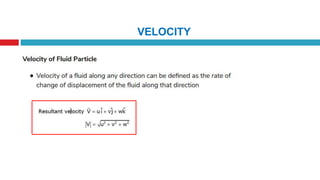
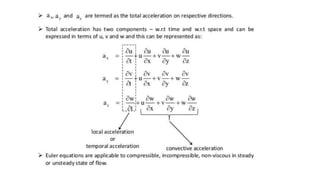
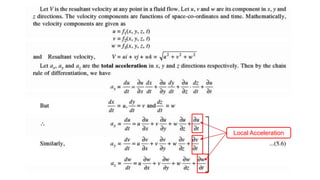
VELOCITY
ACCELERATION
Local Acceleration
CONTINUITY EQUATION IN THREE-DIMENSIONS
When fluid flow through a full pipe, the volume of fluid entering in to the pipe must be
equal to the volume of the fluid leaving the pipe, even if the diameter of the pipe
vary.
Therefore we can define the continuity equation as the equation based on the
principle of conservation of mass.
Therefore, for a flowing fluid through the pipe at every cross-section, the quantity of
fluid per second will be constant.
Stream Function and
Velocity Potential Function
Reference
Chapter 5
(Page 163- 191)
A Textbook of
Fluid Mechanics and Hydraulic Machines
Dr. R. K. Bansal
Laxmi Publications

Fluid Kinematics

  • 1.
    FLUID KINEMATICS (FLUID MECHANICS) UNIT– 2 Dr. Rambabu Palaka, ProfessorAug-2020
  • 2.
    Syllabus Unit 1: FluidStatics CO1: Calculate Pressure and Hydrostatic forces on different plane surfaces Unit 2: Fluid Kinematics CO2: Solve the fluid flow problems using Continuity equation. Unit 3: Fluid Dynamics CO3: Calculate the discharges through the Venturi meter, Orifice meter and Pitot tube using Bernoulli’s equation Unit 4: Flow through Pipes CO4: Calculate major and minor losses in closed conduits for different connection pattens. Unit 5: Dimensional Analysis and Hydraulic Similitude CO5: Apply the concept of Dimensional Analysis for solving the fluid flow problems and Model Analysis. Unit 6: Boundary Layer Theory
  • 3.
    Unit 2: FluidKinematics 1. Introduction to Kinematics (1 Period) 2. Methods of Describing Fluid Motion a) Lagrangian Method b) Eulerian Method 3. Flow Patterns (1 Period) a) Stream Line b) Path Line c) Streak Line d) Streak Tube
  • 4.
    Learning Objectives 4. Classificationof Fluid Flow (2 Periods) a) Steady and Unsteady Flow b) Uniform and Non-Uniform Flow c) Laminar and Turbulent Flow d) Rotational and Irrotational Flow e) Compressible and Incompressible Flow f) Ideal and Real Flow g) One, Two and Three Dimensional Flow 5. Rate of Flow (Discharge) and Continuity Equation (2 Periods) 6. Continuity Equation in Three Dimensions (2 Periods) 7. Velocity and Acceleration (1 Period) 8. Stream and Velocity Potential Functions (2 Periods)
  • 5.
    Fluid Kinematics Definition: It isa branch of science that deals with the motion of fluid without considering forces causing the motion. The study of Kinematics is often referred to as the geometry of motion. It is generally a continuous function in space time. Motion Characteristics: • Velocity • Acceleration • Pressure • Density
  • 6.
    Methods of DescribingFluid Motion Fluid motion is described by two methods. Methods: • Lagrangian Method – Describes a defined mass (position, velocity, acceleration, pressure, temperature etc.,) as functions of time. Example: Track the location of a migrating bird • Eulerian Method - Describes a flow field (velocity, acceleration, pressure, temperature etc.,) as functions of position and time. Example: Count the birds passing through a particular location
  • 14.
    Flow Visualization Flow Visualizationis the Visual Examination of Flow-Field Features. It is important for both physical experiments and numerical solutions. Description of Flow Patterns: 1. Stream Lines 2. Path Lines 3. Streak Lines 4. Stream Tube
  • 19.
    Types of FluidFlow Types of Fluid Flow: 1. Steady and Unsteady Flow 2. Uniform and Non-Uniform Flow 3. Laminar and Turbulent Flow 4. Rotational and Irrotational Flow 5. Compressible and Incompressible Flow 6. Ideal and Real Flow 7. One, Two and Three Dimensional Flow
  • 20.
    Steady and UnsteadyFlow Steady flow is that type of flow in which fluid parameters (velocity, pressure, density etc.) at any point in the flow field do not change with time. This means that the fluid particles passing through a fixed point have the same flow parameters like velocity, pressure, surface tension etc. The parameters may be different at the different cross-section of the flow passage. Unsteady flow is that type of flow in which fluid parameters (velocity, pressure, density etc.) at a point changes with time.
  • 21.
    A flow issaid to be quasi steady if temporal variations at a spatial location are much smaller (they would be zero if the flow was steady) compared to spatial variations for any quantity.
  • 24.
  • 27.
    Laminar and TurbulentFlow Laminar flow is also called streamline or viscous flow. This type of flow occurs in smooth pipes having the low velocity of flow. It also occurs in liquids having high viscosity. Turbulent flow is defined as that type of flow in which each fluid particle does not have a definite path and the paths of individual particles cross each other. In other words, it is the flow in which fluid particles move in a zigzag path When a fluid is flowing in a pipe, the type of flow is determined by a non-dimensional number, called Reynold’s number. For laminar flow, Reynold number ˂ 2000
  • 35.
    Compressible and IncompressibleFlow The flow in which the density of fluid changes, due to pressure and temperature variations, from point to point during the flow is called compressible flow. In other words, it is the flow in which the density of a fluid is not constant during the flow. Mathematically, for compressible flow,  ≠ constant The flow in which the density of fluid does not change during the flow is called incompressible flow. In other words, it is the flow in which the density of a fluid is constant during the flow. Mathematically, for incompressible flow,  = constant Liquids are generally incompressible which means that pressure and temperature changes have a very little effect on their volume. Gases are compressible fluids.
  • 39.
    Rotational and IrrotationalFlow Rotational flow is that type of flow in which fluid particles also rotate about their own axes while flowing along a streamline. Irrotational flow is that type of flow in which fluid particles do not rotate about their own axes while flowing.
  • 42.
    Ideal and RealFlow An ideal flow is the flow of a non-viscous fluid. In the ideal flow, no shear stress exists between two adjacent layers or between the fluid layer and boundary, only normal stresses can exist in ideal flows. The flow of real (viscous) fluids is called real flow. In real flow, shear stress exists between to adjacent fluid layers. These stresses oppose the sliding of one layer over another.
  • 44.
    One Dimensional Flow Onedimensional flow is the flow in which parameters (velocity, pressure, density, viscosity and temperature) vary only in one direction and the flow is a function of only one co-ordinate Axis and time. The flow field is represented by streamlines which are straight and parallel.
  • 46.
    Two Dimensional Flow Two-dimensionalflow is the flow in which fluid parameters vary along two directions and the flow is the function of two rectangular space coordinates (x and y- axis) and time. The flow field is represented by streamlines which are curves.
  • 47.
    Three Dimensional Flow Three-dimensionalflow is the flow in which flow parameters change in all the three directions and the flow is the functions of three mutually perpendicular co-ordinate Axis (x, y, z-axis) and time. The streamlines are space curves
  • 49.
    Rate of Flowor Discharge Rate of Flow or Flow Rate or Discharge: Quantity of fluid passing through any section in a unit time. Unit: m3/sec Types: 1. Volume Flow Rate = Volume of fluid / Time = Q or AV 2. Mass Flow Rate = Mass of fluid / Time =  x Volume / Time = Q or AV 3. Weigh Flow Rate = Weight of fluid / Time = (g x Volume) / Time = gQ or gAV Where, Q = Area x Velocity
  • 52.
  • 56.
  • 57.
  • 59.
  • 64.
    CONTINUITY EQUATION INTHREE-DIMENSIONS When fluid flow through a full pipe, the volume of fluid entering in to the pipe must be equal to the volume of the fluid leaving the pipe, even if the diameter of the pipe vary. Therefore we can define the continuity equation as the equation based on the principle of conservation of mass. Therefore, for a flowing fluid through the pipe at every cross-section, the quantity of fluid per second will be constant.
  • 71.
    Stream Function and VelocityPotential Function
  • 80.
    Reference Chapter 5 (Page 163-191) A Textbook of Fluid Mechanics and Hydraulic Machines Dr. R. K. Bansal Laxmi Publications