Waterproof
Breathable Fabrics:
Technologies and
Practices
ByVignesh Dhanabalan
12M.Tech13
I
N
T
R
O
D
U
C
T
I
O
N
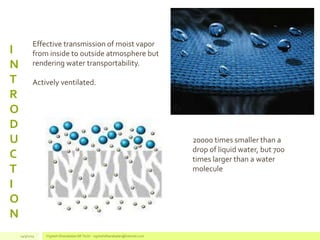
20000 times smaller than a
drop of liquid water, but 700
times larger than a water
molecule
Effective transmission of moist vapor
from inside to outside atmosphere but
rendering water transportability.
Actively ventilated.
14/3/2014 Vignesh Dhanabalan (M.Tech) - vigneshdhanabalan@hotmail.com
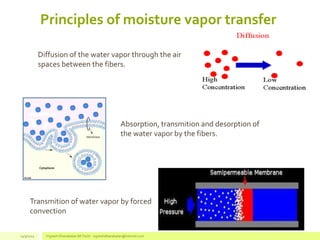
Principles of moisture vapor transfer
Absorption, transmition and desorption of
the water vapor by the fibers.
Diffusion of the water vapor through the air
spaces between the fibers.
Transmition of water vapor by forced
convection
14/3/2014 Vignesh Dhanabalan (M.Tech) - vigneshdhanabalan@hotmail.com
T
R
A
N
S
P
O
R
T
M
E
C
H
A
N
IS
M
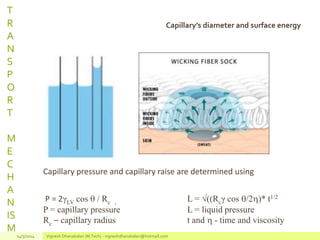
Capillary’s diameter and surface energy
Capillary pressure and capillary raise are determined using
P = 2γLV cos  / Rc , L = ((Rcγ cos /2)* t1/2
P = capillary pressure L = liquid pressure
Rc – capillary radius t and  - time and viscosity
14/3/2014 Vignesh Dhanabalan (M.Tech) - vigneshdhanabalan@hotmail.com
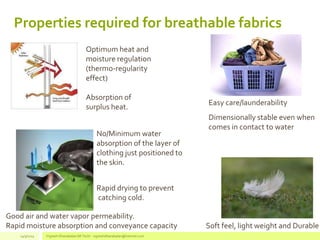
Properties required for breathable fabrics
Soft feel, light weight and Durable
Easy care/launderability
Rapid drying to prevent
catching cold.
Good air and water vapor permeability.
Rapid moisture absorption and conveyance capacity
Optimum heat and
moisture regulation
(thermo-regularity
effect)
Absorption of
surplus heat.
Dimensionally stable even when
comes in contact to water
No/Minimum water
absorption of the layer of
clothing just positioned to
the skin.
14/3/2014 Vignesh Dhanabalan (M.Tech) - vigneshdhanabalan@hotmail.com
Producing breathable fabrics
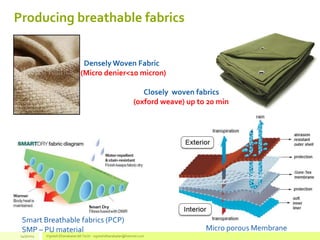
Smart Breathable fabrics (PCP)
SMP – PU material Micro porous Membrane
Densely Woven Fabric
(Micro denier<10 micron)
Closely woven fabrics
(oxford weave) up to 20 min
14/3/2014 Vignesh Dhanabalan (M.Tech) - vigneshdhanabalan@hotmail.com
Cont……
Various methods for
generating microspores
membrane and coating
•Mechanical fibrillation (Film) - PTFE films – biaxial stretched- negative poissons
ratio - 50– 400 µm – crystallinity of polymer >98% - 9 billion pores /inch2 -
•Wet coagulation - ultrafine pores < 1µm – salt leaching - Requires Precise
control below 3 µm.
•Thermo coagulation - volatile solvent - PU dissolved in methyl ethyl ketone,
toluene, and water, having 15–20% solid
•Foam coating - fluorocarbon (FC) polymer, PU coating – soft n flexible - abrasion
•Radio frequency (RF)/ion/UV or E beaming - Sputtering ofTeflon by Ar gas
14/3/2014 Vignesh Dhanabalan (M.Tech) - vigneshdhanabalan@hotmail.com
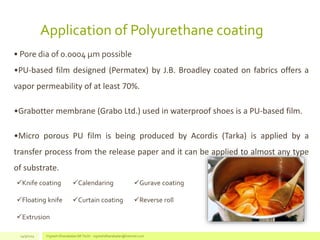
Application of Polyurethane coating
• Pore dia of 0.0004 µm possible
•PU-based film designed (Permatex) by J.B. Broadley coated on fabrics offers a
vapor permeability of at least 70%.
•Grabotter membrane (Grabo Ltd.) used in waterproof shoes is a PU-based film.
•Micro porous PU film is being produced by Acordis (Tarka) is applied by a
transfer process from the release paper and it can be applied to almost any type
of substrate.
Knife coating
Floating knife
Extrusion
Calendaring
Curtain coating
Gurave coating
Reverse roll
14/3/2014 Vignesh Dhanabalan (M.Tech) - vigneshdhanabalan@hotmail.com
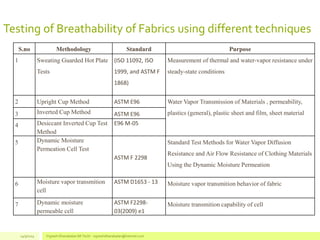
Testing of Breathability of Fabrics using different techniques
S.no Methodology Standard Purpose
1 Sweating Guarded Hot Plate
Tests
(ISO 11092, ISO
1999, and ASTM F
1868)
Measurement of thermal and water-vapor resistance under
steady-state conditions
2 Upright Cup Method ASTM E96 Water Vapor Transmission of Materials , permeability,
plastics (general), plastic sheet and film, sheet material3 Inverted Cup Method ASTM E96
4 Desiccant Inverted Cup Test
Method
E96 M-05
5 Dynamic Moisture
Permeation Cell Test
ASTM F 2298
Standard Test Methods for Water Vapor Diffusion
Resistance and Air Flow Resistance of Clothing Materials
Using the Dynamic Moisture Permeation
6 Moisture vapor transmition
cell
ASTM D1653 - 13 Moisture vapor transmition behavior of fabric
7 Dynamic moisture
permeable cell
ASTM F2298-
03(2009) e1
Moisture transmition capability of cell
14/3/2014 Vignesh Dhanabalan (M.Tech) - vigneshdhanabalan@hotmail.com
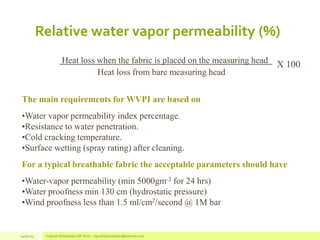
Relative water vapor permeability (%)
Heat loss when the fabric is placed on the measuring head X 100
Heat loss from bare measuring head
The main requirements for WVPI are based on
•Water vapor permeability index percentage.
•Resistance to water penetration.
•Cold cracking temperature.
•Surface wetting (spray rating) after cleaning.
For a typical breathable fabric the acceptable parameters should have
•Water-vapor permeability (min 5000gm-2 for 24 hrs)
•Water proofness min 130 cm (hydrostatic pressure)
•Wind proofness less than 1.5 ml/cm2/second @ 1M bar
14/3/2014 Vignesh Dhanabalan (M.Tech) - vigneshdhanabalan@hotmail.com
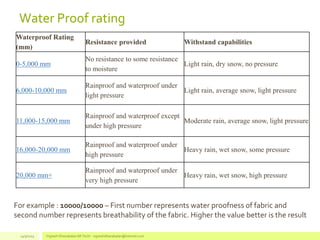
Water Proof rating
Waterproof Rating
(mm)
Resistance provided Withstand capabilities
0-5,000 mm
No resistance to some resistance
to moisture
Light rain, dry snow, no pressure
6,000-10,000 mm
Rainproof and waterproof under
light pressure
Light rain, average snow, light pressure
11,000-15,000 mm
Rainproof and waterproof except
under high pressure
Moderate rain, average snow, light pressure
16,000-20,000 mm
Rainproof and waterproof under
high pressure
Heavy rain, wet snow, some pressure
20,000 mm+
Rainproof and waterproof under
very high pressure
Heavy rain, wet snow, high pressure
For example : 10000/10000 – First number represents water proofness of fabric and
second number represents breathability of the fabric. Higher the value better is the result
14/3/2014 Vignesh Dhanabalan (M.Tech) - vigneshdhanabalan@hotmail.com
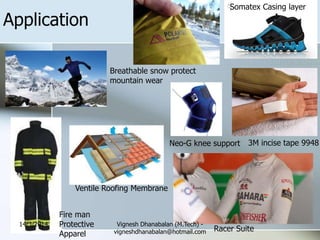
Application
3M incise tape 9948Neo-G knee support
Breathable snow protect
mountain wear
Fire man
Protective
Apparel
Racer Suite
Ventile Roofing Membrane
Somatex Casing layer
14/3/2014 Vignesh Dhanabalan (M.Tech) -
vigneshdhanabalan@hotmail.com
Conclusion
• Comfort property has become the most prime objective of the
buyer/consumer where breathability of the fabric with water
proofness has been the primary importance in areas that do not
enjoy the evergreen nature.
• Extensive research is required to understand the relationship
between segmental ventilation and local comfort of the fabric
subjected to active usage of the person.
14/3/2014 Vignesh Dhanabalan (M.Tech) - vigneshdhanabalan@hotmail.com
Thank you
Vignesh Dhanabalan
12M.Tech13
14/3/2014 Vignesh Dhanabalan (M.Tech) - vigneshdhanabalan@hotmail.com
Bibliography
• Arunangshu Mukhopadhyay and Vinay Kumar Midha, “A Review on Designing the Waterproof
Breathable Fabrics Part I, Fundamental Principles and Designing Aspects of Breathable Fabrics” ,
Journal of IndustrialTextiles 37: 225, (2008).
• Apurba das and R.Alagiruswamy, “Science in clothing comfort”, Woodhead publications, ISBN
13:978-81-908001-5-0, (2010).
• Shishoo.R, “Textiles for Sport”, Woodhead publications, ISBN 978-1-85573-922-2, 2005.
• Williams.J.T, “Textiles for cold weather apparel”, Woodhead publications, ISBN 978-1-84569-411-1,
(2009).
• Horrocks.A.R, Anandh.S.C, “Handbook of technical textiles”, Woodhead Publishing Limited, ISBN
1 85573 385 4, (2000).
• Shirley Institute,Toray Industries Inc., Naka,Y. and Kawakami, K. (1985).Moisture-Permeable
Waterproof Coated Fabric, USP 4560611, December: 8602376
• Manjeet Jassal, Amit Khungar, Pushpa Bajaj and T. J. M. Sinha, “Waterproof Breathable Polymeric
Coatings Based on Polyurethanes”, Journal of IndustrialTextiles 33: 269, (2004).
• Rudolph D. Deanin AND Dhirajlal C. Patel, Breathable, Permanent Water-Repellent Treatment of
C1ot,Textile Research Journal; 40; 970, (1970).
• VolkmarT. Bartels and Karl Heinz Umbach, “WaterVaporTransport through ProtectiveTextiles at
LowTemperatures”, Textile Research Journal 72: 899, (2002)
14/3/2014 Vignesh Dhanabalan (M.Tech) - vigneshdhanabalan@hotmail.com

Water proof breathable fabrics by Vignesh Dhanabalan

  • 1.
  • 2.
    I N T R O D U C T I O N 20000 times smallerthan a drop of liquid water, but 700 times larger than a water molecule Effective transmission of moist vapor from inside to outside atmosphere but rendering water transportability. Actively ventilated. 14/3/2014 Vignesh Dhanabalan (M.Tech) - vigneshdhanabalan@hotmail.com
  • 3.
    Principles of moisturevapor transfer Absorption, transmition and desorption of the water vapor by the fibers. Diffusion of the water vapor through the air spaces between the fibers. Transmition of water vapor by forced convection 14/3/2014 Vignesh Dhanabalan (M.Tech) - vigneshdhanabalan@hotmail.com
  • 4.
    T R A N S P O R T M E C H A N IS M Capillary’s diameter andsurface energy Capillary pressure and capillary raise are determined using P = 2γLV cos  / Rc , L = ((Rcγ cos /2)* t1/2 P = capillary pressure L = liquid pressure Rc – capillary radius t and  - time and viscosity 14/3/2014 Vignesh Dhanabalan (M.Tech) - vigneshdhanabalan@hotmail.com
  • 5.
    Properties required forbreathable fabrics Soft feel, light weight and Durable Easy care/launderability Rapid drying to prevent catching cold. Good air and water vapor permeability. Rapid moisture absorption and conveyance capacity Optimum heat and moisture regulation (thermo-regularity effect) Absorption of surplus heat. Dimensionally stable even when comes in contact to water No/Minimum water absorption of the layer of clothing just positioned to the skin. 14/3/2014 Vignesh Dhanabalan (M.Tech) - vigneshdhanabalan@hotmail.com
  • 6.
    Producing breathable fabrics SmartBreathable fabrics (PCP) SMP – PU material Micro porous Membrane Densely Woven Fabric (Micro denier<10 micron) Closely woven fabrics (oxford weave) up to 20 min 14/3/2014 Vignesh Dhanabalan (M.Tech) - vigneshdhanabalan@hotmail.com
  • 7.
    Cont…… Various methods for generatingmicrospores membrane and coating •Mechanical fibrillation (Film) - PTFE films – biaxial stretched- negative poissons ratio - 50– 400 µm – crystallinity of polymer >98% - 9 billion pores /inch2 - •Wet coagulation - ultrafine pores < 1µm – salt leaching - Requires Precise control below 3 µm. •Thermo coagulation - volatile solvent - PU dissolved in methyl ethyl ketone, toluene, and water, having 15–20% solid •Foam coating - fluorocarbon (FC) polymer, PU coating – soft n flexible - abrasion •Radio frequency (RF)/ion/UV or E beaming - Sputtering ofTeflon by Ar gas 14/3/2014 Vignesh Dhanabalan (M.Tech) - vigneshdhanabalan@hotmail.com
  • 8.
    Application of Polyurethanecoating • Pore dia of 0.0004 µm possible •PU-based film designed (Permatex) by J.B. Broadley coated on fabrics offers a vapor permeability of at least 70%. •Grabotter membrane (Grabo Ltd.) used in waterproof shoes is a PU-based film. •Micro porous PU film is being produced by Acordis (Tarka) is applied by a transfer process from the release paper and it can be applied to almost any type of substrate. Knife coating Floating knife Extrusion Calendaring Curtain coating Gurave coating Reverse roll 14/3/2014 Vignesh Dhanabalan (M.Tech) - vigneshdhanabalan@hotmail.com
  • 9.
    Testing of Breathabilityof Fabrics using different techniques S.no Methodology Standard Purpose 1 Sweating Guarded Hot Plate Tests (ISO 11092, ISO 1999, and ASTM F 1868) Measurement of thermal and water-vapor resistance under steady-state conditions 2 Upright Cup Method ASTM E96 Water Vapor Transmission of Materials , permeability, plastics (general), plastic sheet and film, sheet material3 Inverted Cup Method ASTM E96 4 Desiccant Inverted Cup Test Method E96 M-05 5 Dynamic Moisture Permeation Cell Test ASTM F 2298 Standard Test Methods for Water Vapor Diffusion Resistance and Air Flow Resistance of Clothing Materials Using the Dynamic Moisture Permeation 6 Moisture vapor transmition cell ASTM D1653 - 13 Moisture vapor transmition behavior of fabric 7 Dynamic moisture permeable cell ASTM F2298- 03(2009) e1 Moisture transmition capability of cell 14/3/2014 Vignesh Dhanabalan (M.Tech) - vigneshdhanabalan@hotmail.com
  • 10.
    Relative water vaporpermeability (%) Heat loss when the fabric is placed on the measuring head X 100 Heat loss from bare measuring head The main requirements for WVPI are based on •Water vapor permeability index percentage. •Resistance to water penetration. •Cold cracking temperature. •Surface wetting (spray rating) after cleaning. For a typical breathable fabric the acceptable parameters should have •Water-vapor permeability (min 5000gm-2 for 24 hrs) •Water proofness min 130 cm (hydrostatic pressure) •Wind proofness less than 1.5 ml/cm2/second @ 1M bar 14/3/2014 Vignesh Dhanabalan (M.Tech) - vigneshdhanabalan@hotmail.com
  • 11.
    Water Proof rating WaterproofRating (mm) Resistance provided Withstand capabilities 0-5,000 mm No resistance to some resistance to moisture Light rain, dry snow, no pressure 6,000-10,000 mm Rainproof and waterproof under light pressure Light rain, average snow, light pressure 11,000-15,000 mm Rainproof and waterproof except under high pressure Moderate rain, average snow, light pressure 16,000-20,000 mm Rainproof and waterproof under high pressure Heavy rain, wet snow, some pressure 20,000 mm+ Rainproof and waterproof under very high pressure Heavy rain, wet snow, high pressure For example : 10000/10000 – First number represents water proofness of fabric and second number represents breathability of the fabric. Higher the value better is the result 14/3/2014 Vignesh Dhanabalan (M.Tech) - vigneshdhanabalan@hotmail.com
  • 12.
    Application 3M incise tape9948Neo-G knee support Breathable snow protect mountain wear Fire man Protective Apparel Racer Suite Ventile Roofing Membrane Somatex Casing layer 14/3/2014 Vignesh Dhanabalan (M.Tech) - vigneshdhanabalan@hotmail.com
  • 13.
    Conclusion • Comfort propertyhas become the most prime objective of the buyer/consumer where breathability of the fabric with water proofness has been the primary importance in areas that do not enjoy the evergreen nature. • Extensive research is required to understand the relationship between segmental ventilation and local comfort of the fabric subjected to active usage of the person. 14/3/2014 Vignesh Dhanabalan (M.Tech) - vigneshdhanabalan@hotmail.com
  • 14.
    Thank you Vignesh Dhanabalan 12M.Tech13 14/3/2014Vignesh Dhanabalan (M.Tech) - vigneshdhanabalan@hotmail.com
  • 15.
    Bibliography • Arunangshu Mukhopadhyayand Vinay Kumar Midha, “A Review on Designing the Waterproof Breathable Fabrics Part I, Fundamental Principles and Designing Aspects of Breathable Fabrics” , Journal of IndustrialTextiles 37: 225, (2008). • Apurba das and R.Alagiruswamy, “Science in clothing comfort”, Woodhead publications, ISBN 13:978-81-908001-5-0, (2010). • Shishoo.R, “Textiles for Sport”, Woodhead publications, ISBN 978-1-85573-922-2, 2005. • Williams.J.T, “Textiles for cold weather apparel”, Woodhead publications, ISBN 978-1-84569-411-1, (2009). • Horrocks.A.R, Anandh.S.C, “Handbook of technical textiles”, Woodhead Publishing Limited, ISBN 1 85573 385 4, (2000). • Shirley Institute,Toray Industries Inc., Naka,Y. and Kawakami, K. (1985).Moisture-Permeable Waterproof Coated Fabric, USP 4560611, December: 8602376 • Manjeet Jassal, Amit Khungar, Pushpa Bajaj and T. J. M. Sinha, “Waterproof Breathable Polymeric Coatings Based on Polyurethanes”, Journal of IndustrialTextiles 33: 269, (2004). • Rudolph D. Deanin AND Dhirajlal C. Patel, Breathable, Permanent Water-Repellent Treatment of C1ot,Textile Research Journal; 40; 970, (1970). • VolkmarT. Bartels and Karl Heinz Umbach, “WaterVaporTransport through ProtectiveTextiles at LowTemperatures”, Textile Research Journal 72: 899, (2002) 14/3/2014 Vignesh Dhanabalan (M.Tech) - vigneshdhanabalan@hotmail.com