MEDICAL TEXTILES
Prepared By
MD. Golam Kibria
Lecturer(Wet Processing)
Northern University Bangladesh
B.Sc, M.Sc (Textile Engineering, BUTEX)
Email: kibria.but@gmail.com
 What is medical textile?
 Category of medical textile.
 Requirement of medical textile fiber,
 Biodegradable fiber in medical textile.
 Manufacturing processes.
 Recent development
 Conclusion.
 Combination of textile technology and medical sciences has
resulted into a new field called medical textiles. Textile materials
and products that have been engineered to meet particular needs
are suitable for any medical and surgical
application where a combination of strength, flexibility and
sometimes moisture and air permeability are required. Materials
used include mono-filament and multi-
filament yarns, woven, knitted, non-woven fabrics and composite
structures.
 1. Conformance to technical specs.
 2. Sterile
 3. Anti-Allergenic
 4. Anti-Bacterial
 5. Environment friendly
 6. Economical
 Non toxicity
 No allergenic response
 Non carcinogenic
 The ability to be sterilized
 Strength
 Elasticity
 Durability
 Biocompatibility
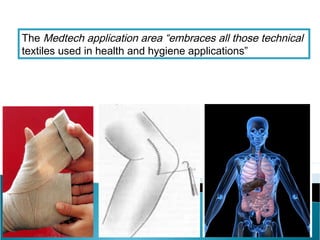
The Medtech application area “embraces all those technical
textiles used in health and hygiene applications”
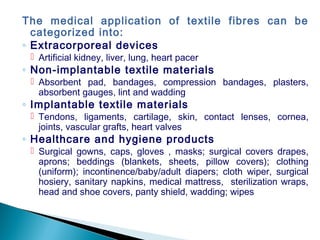
The medical application of textile fibres can be
categorized into:
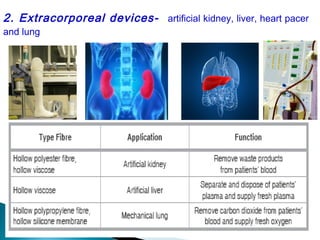
◦ Extracorporeal devices
 Artificial kidney, liver, lung, heart pacer
◦ Non-implantable textile materials
 Absorbent pad, bandages, compression bandages, plasters,
absorbent gauges, lint and wadding
◦ Implantable textile materials
 Tendons, ligaments, cartilage, skin, contact lenses, cornea,
joints, vascular grafts, heart valves
◦ Healthcare and hygiene products
 Surgical gowns, caps, gloves , masks; surgical covers drapes,
aprons; beddings (blankets, sheets, pillow covers); clothing
(uniform); incontinence/baby/adult diapers; cloth wiper, surgical
hosiery, sanitary napkins, medical mattress, sterilization wraps,
head and shoe covers, panty shield, wadding; wipes
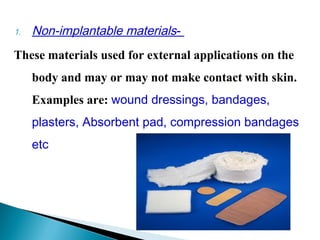
1. Non-implantable materials-
These materials used for external applications on the
body and may or may not make contact with skin.
Examples are: wound dressings, bandages,
plasters, Absorbent pad, compression bandages
etc
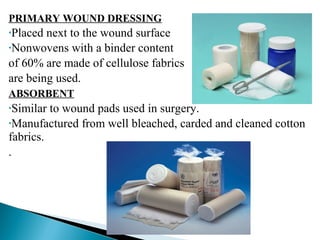
PRIMARY WOUND DRESSING
•Placed next to the wound surface
•Nonwovens with a binder content
of 60% are made of cellulose fabrics
are being used.
ABSORBENT
•Similar to wound pads used in surgery.
•Manufactured from well bleached, carded and cleaned cotton
fabrics.
.
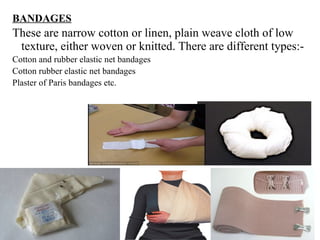
BANDAGES
These are narrow cotton or linen, plain weave cloth of low
texture, either woven or knitted. There are different types:-
Cotton and rubber elastic net bandages
Cotton rubber elastic net bandages
Plaster of Paris bandages etc.
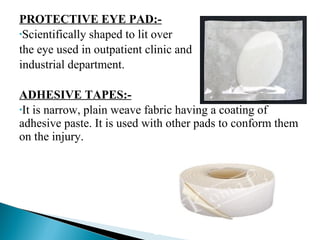
PROTECTIVE EYE PAD:-
•Scientifically shaped to lit over
the eye used in outpatient clinic and
industrial department.
ADHESIVE TAPES:-
•It is narrow, plain weave fabric having a coating of
adhesive paste. It is used with other pads to conform them
on the injury.
2. Extracorporeal devices- artificial kidney, liver, heart pacer
and lung
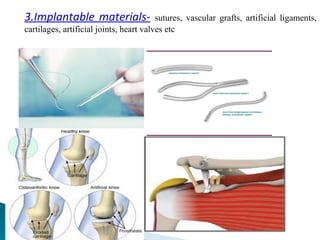
3.Implantable materials- sutures, vascular grafts, artificial ligaments,
cartilages, artificial joints, heart valves etc
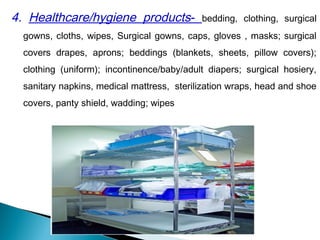
4. Healthcare/hygiene products- bedding, clothing, surgical
gowns, cloths, wipes, Surgical gowns, caps, gloves , masks; surgical
covers drapes, aprons; beddings (blankets, sheets, pillow covers);
clothing (uniform); incontinence/baby/adult diapers; surgical hosiery,
sanitary napkins, medical mattress, sterilization wraps, head and shoe
covers, panty shield, wadding; wipes
 Biocompatible
 Good resistance to alkalis, acids and
micro-organisms
 Good dimensional stability
 Elasticity
 Free from contamination or impurities
 Absorption / Repellency
 Air permeability.
• Polyesters
– Lactide/Glycolide Copolymers
• Have been used for the delivery of steriods, anticancer agent,
antibiotics, etc.
• PLGA is most widely investigated biodegradable polymers for drug
delivery.
• Lactide/glycolide copolymers have been subjected to extensive
animal and human trials without any significant harmful side effects
• Poly(amides)
–Natural Polymers
• Remain attractive because they are natural products of living
organism, readily available, relatively inexpensive, etc.
• Mostly focused on the use of proteins such as gelatin, collagen,
and albumin
 Drug Delivery:
Polymer & drug can be ground in a Micro Mill, sieve into particle size of
90-120 µm, then press into circular disc
Alternatively drug can be mixed into molten polymer to form small chips,
then it is fed into injection molder to mold into desired shape.
 Dental Application:
Zinc polycarboxylate (or polyacrylate) cement is prepared by mixing
zinc oxide and the polymer solution, and water solution of polyacrylic
acid are used as bases, liners and varnishes for cavities.
 Surgical Application:
Suture- is a strand of textile materials (natural or synthetic), used to ligate
blood vessel and draw tissue together
The properties which make nonwovens the best choice for
medical products are:
Excellent barrier properties
Superior efficiency
Better performance (comfort, porosity, thickness and weight, water
vapor transmission, air permeability etc.)
Increased protection for user (better physical properties like tensile,
tear resistance, abrasion resistance etc.)
Easy to sterilize.
Economical manufacturing process.
 Bandages: Simple bandages, Light support bandage, Orthopedic
bandages.
 Cotton pads, wound dressings and adhesive tapes
 Disposable surgical clothing: Gowns, Caps, Masks
 Disposable surgical coverings:
 -Blankets
 -Floor coverings of hospitals (anti-bacterial)
 -Cloths/ wipes
 Nonwovens are used to replace or repair different organs, bones
like artificial kidney, liver, heart, mechanical lung, ligaments,
vascular grafts, heart valves, blood vessels, artificial skins, nasal
strips etc.
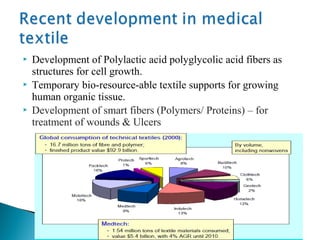
 Development of Polylactic acid polyglycolic acid fibers as
structures for cell growth.
 Temporary bio-resource-able textile supports for growing
human organic tissue.
 Development of smart fibers (Polymers/ Proteins) – for
treatment of wounds & Ulcers
 Medical Textiles are one of the dynamically expanding sectors
and development of same is to convert pain full days of
patients into comfortable days.
 As medical procedures continue and transform, the demand
for textile materials is bound to grow and grow.

Medical Textile

  • 1.
    MEDICAL TEXTILES Prepared By MD.Golam Kibria Lecturer(Wet Processing) Northern University Bangladesh B.Sc, M.Sc (Textile Engineering, BUTEX) Email: kibria.but@gmail.com
  • 2.
     What ismedical textile?  Category of medical textile.  Requirement of medical textile fiber,  Biodegradable fiber in medical textile.  Manufacturing processes.  Recent development  Conclusion.
  • 3.
     Combination oftextile technology and medical sciences has resulted into a new field called medical textiles. Textile materials and products that have been engineered to meet particular needs are suitable for any medical and surgical application where a combination of strength, flexibility and sometimes moisture and air permeability are required. Materials used include mono-filament and multi- filament yarns, woven, knitted, non-woven fabrics and composite structures.
  • 4.
     1. Conformanceto technical specs.  2. Sterile  3. Anti-Allergenic  4. Anti-Bacterial  5. Environment friendly  6. Economical
  • 5.
     Non toxicity No allergenic response  Non carcinogenic  The ability to be sterilized  Strength  Elasticity  Durability  Biocompatibility
  • 6.
    The Medtech applicationarea “embraces all those technical textiles used in health and hygiene applications”
  • 7.
    The medical applicationof textile fibres can be categorized into: ◦ Extracorporeal devices  Artificial kidney, liver, lung, heart pacer ◦ Non-implantable textile materials  Absorbent pad, bandages, compression bandages, plasters, absorbent gauges, lint and wadding ◦ Implantable textile materials  Tendons, ligaments, cartilage, skin, contact lenses, cornea, joints, vascular grafts, heart valves ◦ Healthcare and hygiene products  Surgical gowns, caps, gloves , masks; surgical covers drapes, aprons; beddings (blankets, sheets, pillow covers); clothing (uniform); incontinence/baby/adult diapers; cloth wiper, surgical hosiery, sanitary napkins, medical mattress, sterilization wraps, head and shoe covers, panty shield, wadding; wipes
  • 8.
    1. Non-implantable materials- Thesematerials used for external applications on the body and may or may not make contact with skin. Examples are: wound dressings, bandages, plasters, Absorbent pad, compression bandages etc
  • 9.
    PRIMARY WOUND DRESSING •Placednext to the wound surface •Nonwovens with a binder content of 60% are made of cellulose fabrics are being used. ABSORBENT •Similar to wound pads used in surgery. •Manufactured from well bleached, carded and cleaned cotton fabrics. .
  • 10.
    BANDAGES These are narrowcotton or linen, plain weave cloth of low texture, either woven or knitted. There are different types:- Cotton and rubber elastic net bandages Cotton rubber elastic net bandages Plaster of Paris bandages etc.
  • 11.
    PROTECTIVE EYE PAD:- •Scientificallyshaped to lit over the eye used in outpatient clinic and industrial department. ADHESIVE TAPES:- •It is narrow, plain weave fabric having a coating of adhesive paste. It is used with other pads to conform them on the injury.
  • 12.
    2. Extracorporeal devices-artificial kidney, liver, heart pacer and lung
  • 13.
    3.Implantable materials- sutures,vascular grafts, artificial ligaments, cartilages, artificial joints, heart valves etc
  • 14.
    4. Healthcare/hygiene products-bedding, clothing, surgical gowns, cloths, wipes, Surgical gowns, caps, gloves , masks; surgical covers drapes, aprons; beddings (blankets, sheets, pillow covers); clothing (uniform); incontinence/baby/adult diapers; surgical hosiery, sanitary napkins, medical mattress, sterilization wraps, head and shoe covers, panty shield, wadding; wipes
  • 15.
     Biocompatible  Goodresistance to alkalis, acids and micro-organisms  Good dimensional stability  Elasticity  Free from contamination or impurities  Absorption / Repellency  Air permeability.
  • 17.
    • Polyesters – Lactide/GlycolideCopolymers • Have been used for the delivery of steriods, anticancer agent, antibiotics, etc. • PLGA is most widely investigated biodegradable polymers for drug delivery. • Lactide/glycolide copolymers have been subjected to extensive animal and human trials without any significant harmful side effects • Poly(amides) –Natural Polymers • Remain attractive because they are natural products of living organism, readily available, relatively inexpensive, etc. • Mostly focused on the use of proteins such as gelatin, collagen, and albumin
  • 18.
     Drug Delivery: Polymer& drug can be ground in a Micro Mill, sieve into particle size of 90-120 µm, then press into circular disc Alternatively drug can be mixed into molten polymer to form small chips, then it is fed into injection molder to mold into desired shape.  Dental Application: Zinc polycarboxylate (or polyacrylate) cement is prepared by mixing zinc oxide and the polymer solution, and water solution of polyacrylic acid are used as bases, liners and varnishes for cavities.  Surgical Application: Suture- is a strand of textile materials (natural or synthetic), used to ligate blood vessel and draw tissue together
  • 21.
    The properties whichmake nonwovens the best choice for medical products are: Excellent barrier properties Superior efficiency Better performance (comfort, porosity, thickness and weight, water vapor transmission, air permeability etc.) Increased protection for user (better physical properties like tensile, tear resistance, abrasion resistance etc.) Easy to sterilize. Economical manufacturing process.
  • 22.
     Bandages: Simplebandages, Light support bandage, Orthopedic bandages.  Cotton pads, wound dressings and adhesive tapes  Disposable surgical clothing: Gowns, Caps, Masks  Disposable surgical coverings:  -Blankets  -Floor coverings of hospitals (anti-bacterial)  -Cloths/ wipes  Nonwovens are used to replace or repair different organs, bones like artificial kidney, liver, heart, mechanical lung, ligaments, vascular grafts, heart valves, blood vessels, artificial skins, nasal strips etc.
  • 23.
     Development ofPolylactic acid polyglycolic acid fibers as structures for cell growth.  Temporary bio-resource-able textile supports for growing human organic tissue.  Development of smart fibers (Polymers/ Proteins) – for treatment of wounds & Ulcers
  • 24.
     Medical Textilesare one of the dynamically expanding sectors and development of same is to convert pain full days of patients into comfortable days.  As medical procedures continue and transform, the demand for textile materials is bound to grow and grow.