Presentation on :
General view on High performance
fibre
Submitted to: submitted by:
Prof. Pramod kumar Abhishek gupta
Prof. S chakraborti Abhishek kumar
Amit kumar pal
Content:
 What are high performance fibre(HPF).
 HPF general view
 Difference between general and HPF
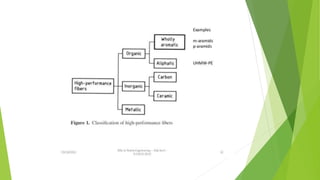
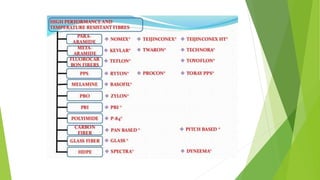
 Type of HPF
1. Glass fibre
2. Carbon fibre
3. Aramid fibre
4. PBI(polybenzimidazole)
5. PBO (polyphenylenebenzobisaxazole) and PI(polyimide) fibre
6. PPS(polyphenyl sulfide) fibre
7. Melamine fibre
8. Fluoropolymer (PTFE polytetra fluoro ethane)
9. HDPE (high-density polyethylene)
10. Ceramic fibre
11. Chemically resistance fibre
12. Thermally resistant fibre
 Application of HPF
HIGH
PERFORMANCE
FIBRES(HPF):
HPF are the fibre which
have high strength,
temperature resistance,
good flexibility, light
weight, fine diameter and
durability qualities are used
mainly for technical textile
purpose.
QUALITIES TESTED TO
QUALIFY FOR HPF:
•TENSILE STRENGTH
•OPERATING TEMPERATURE
•LIMITING OXYGEN INDEX
•CHEMICAL RESISTANCE
HIGH PERFORMANCE FIBRE GENERAL VIEW
 High-performance fibers, used in fabric applications ranging from
bulletproof vests to trampolines, they have a sufficient number of
chemical and physical bonds for transferring the stress along the
fiber.
 To limit their deformation, the fibers should possess high stiffness
and strength.
 In fiber-reinforced composites, the fibers are the load-bearing
element in the structure, and they must adhere well to the matrix
material.
 High-performance fibers offer special properties due to the
demands of the respective application. such as high tension, high
elongation and high resistance to heat and fire and other
environmental attacks.
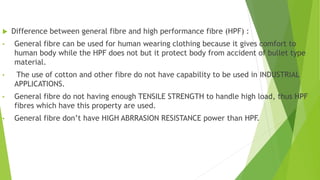
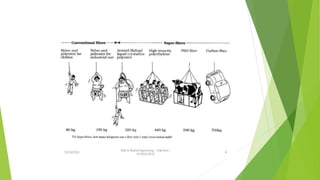
 Difference between general fibre and high performance fibre (HPF) :
• General fibre can be used for human wearing clothing because it gives comfort to
human body while the HPF does not but it protect body from accident of bullet type
material.
• The use of cotton and other fibre do not have capability to be used in INDUSTRIAL
APPLICATIONS.
• General fibre do not having enough TENSILE STRENGTH to handle high load, thus HPF
fibres which have this property are used.
• General fibre don’t have HIGH ABRRASION RESISTANCE power than HPF.
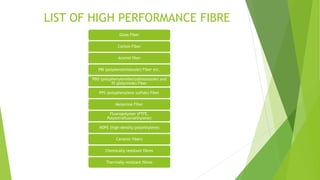
LIST OF HIGH PERFORMANCE FIBRE
Glass Fiber
Carbon Fiber
Aramid fiber
PBI (polybenzimidazole) Fiber etc.
PBO (polyphenylenebenzobisoxazole) and
PI (polyimide) Fiber
PPS (polyphenylene sulfide) Fiber
Melamine Fiber
Fluoropolymer (PTFE,
Polytetrafluoroethylene)
HDPE (high-density polyethylene)
Ceramic fibers
Chemically resistant fibres
Thermally resistant fibres
GLASS FIBRE -
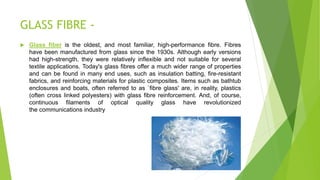
 Glass fiber is the oldest, and most familiar, high-performance fibre. Fibres
have been manufactured from glass since the 1930s. Although early versions
had high-strength, they were relatively inflexible and not suitable for several
textile applications. Today's glass fibres offer a much wider range of properties
and can be found in many end uses, such as insulation batting, fire-resistant
fabrics, and reinforcing materials for plastic composites. Items such as bathtub
enclosures and boats, often referred to as `fibre glass' are, in reality, plastics
(often cross linked polyesters) with glass fibre reinforcement. And, of course,
continuous filaments of optical quality glass have revolutionized
the communications industry
CARBON FIBRE -
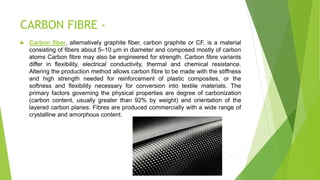
 Carbon fiber, alternatively graphite fiber, carbon graphite or CF, is a material
consisting of fibers about 5–10 μm in diameter and composed mostly of carbon
atoms Carbon fibre may also be engineered for strength. Carbon fibre variants
differ in flexibility, electrical conductivity, thermal and chemical resistance.
Altering the production method allows carbon fibre to be made with the stiffness
and high strength needed for reinforcement of plastic composites, or the
softness and flexibility necessary for conversion into textile materials. The
primary factors governing the physical properties are degree of carbonization
(carbon content, usually greater than 92% by weight) and orientation of the
layered carbon planes. Fibres are produced commercially with a wide range of
crystalline and amorphous content.
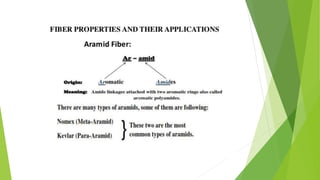
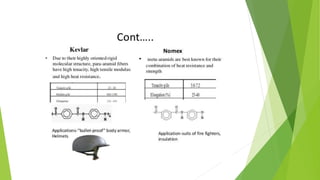
ARAMID FIBRE -
Aramide fibre are among the best known of the high-
performance, synthetic, organic fibres. Closely related
to polyamides, aramids are derived from aromatic acids
and amines. Because of the stability of the aromatic
rings and the added strength of the amide linkages,
owing to conjugation with the aromatic structures,
aramids exhibit higher tensile strength and
thermal resistance than aliphatic polyamide. The para-
aramids, based on terephthalic acid and p-phenylene
diamine, or p-aminobenzoic acid, exhibit higher
strength and thermal resistance than those with the
linkages in meta positions on the benzene rings.
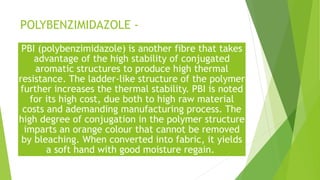
POLYBENZIMIDAZOLE -
PBI (polybenzimidazole) is another fibre that takes
advantage of the high stability of conjugated
aromatic structures to produce high thermal
resistance. The ladder-like structure of the polymer
further increases the thermal stability. PBI is noted
for its high cost, due both to high raw material
costs and ademanding manufacturing process. The
high degree of conjugation in the polymer structure
imparts an orange colour that cannot be removed
by bleaching. When converted into fabric, it yields
a soft hand with good moisture regain.
MELAMINE -
Melamine fiber is primarily known for its inherent thermal
resistance and outstanding heat-blocking capability in direct
flame applications. This high stability is due to the cross
linked nature of the polymer and the low
thermal conductivity of melamine resin. In comparison with
other high-performance fibers, melamine fibres offer
excellent value for products designed for direct flame
contact and elevated temperature exposures. Moreover, the
dielectric properties, cross-section shape and distribution
make it ideal for high- temperature filtration applications. It
is sometimes blended with aramid or other high-performance
fibres to increase final fabric strength
CERAMIC -
Ceramic is a high performance fiber. The need for reinforcements
for structural ceramic matrix composites (CMC) to be used in air at
temperatures above 1000°C, as well as for the reinforcement for
metals (MMCs), has encouraged great changes in small-diameter
ceramic fibres since their initial development as
refractory insulation. Applications envisaged are in gas turbines,
both aeronautical and ground-based, heat exchangers, first
containment walls for fusion reactors, as well as uses for which no
matrix is necessary such as candle filters for high temperature
gas filtration. Ceramic fibres can withstand such demanding
conditions but also are often required to resist static or dynamic
mechanical loading at high temperature, which can only be
achieved by a close control of their microstructures.
CHEMICALLY RESISTANT FIBRE -
Chemically resistant organic polymeric fibres include
those which are designed to resist chemical attack
for acceptable periods during their service lives at
both ambient and elevated temperatures. As a
consequence of their generally inert structures they
may also be flame resistant and so address markets
where that property is also desirable.
Fluorinated fibres: PTFE, PVF, PVDF and FEP (ARH)
and Chlorinated fibres:
PVDC (ARH) are Chemically resistant fibers.
THERMALLY RESISTANT FIBRE -
Thermally resistant organic polymeric fibres include those that
resist thermal degradation and some degree of chemical attack,
notably oxidation, for acceptable periods during their service lives. As a
consequence of their generally inert structures, like the chemically
resistant fibres in the previous chapter, they may also be flame
resistant and so address markets where that property is also desirable.
Their thermal resistance derives from their possessing aromatic and/or
ladder-like chain structures that offer a combination of both physical
and chemical resistance and the former is quantified in terms of high
second order temperatures, preferably above 200 °C or so, and very
high (>350 °C) or absence of melting transitions.
Thermosets (HE and HS), Melamine–formaldehyde fibres, Basofil (BASF)
(HE) are Thermally resistant fibres.
THANK YOU

high performance fibre, hpf,

  • 1.
    Presentation on : Generalview on High performance fibre Submitted to: submitted by: Prof. Pramod kumar Abhishek gupta Prof. S chakraborti Abhishek kumar Amit kumar pal
  • 2.
    Content:  What arehigh performance fibre(HPF).  HPF general view  Difference between general and HPF  Type of HPF 1. Glass fibre 2. Carbon fibre 3. Aramid fibre 4. PBI(polybenzimidazole) 5. PBO (polyphenylenebenzobisaxazole) and PI(polyimide) fibre 6. PPS(polyphenyl sulfide) fibre 7. Melamine fibre 8. Fluoropolymer (PTFE polytetra fluoro ethane) 9. HDPE (high-density polyethylene) 10. Ceramic fibre 11. Chemically resistance fibre 12. Thermally resistant fibre  Application of HPF
  • 3.
    HIGH PERFORMANCE FIBRES(HPF): HPF are thefibre which have high strength, temperature resistance, good flexibility, light weight, fine diameter and durability qualities are used mainly for technical textile purpose. QUALITIES TESTED TO QUALIFY FOR HPF: •TENSILE STRENGTH •OPERATING TEMPERATURE •LIMITING OXYGEN INDEX •CHEMICAL RESISTANCE
  • 4.
    HIGH PERFORMANCE FIBREGENERAL VIEW  High-performance fibers, used in fabric applications ranging from bulletproof vests to trampolines, they have a sufficient number of chemical and physical bonds for transferring the stress along the fiber.  To limit their deformation, the fibers should possess high stiffness and strength.  In fiber-reinforced composites, the fibers are the load-bearing element in the structure, and they must adhere well to the matrix material.  High-performance fibers offer special properties due to the demands of the respective application. such as high tension, high elongation and high resistance to heat and fire and other environmental attacks.
  • 5.
     Difference betweengeneral fibre and high performance fibre (HPF) : • General fibre can be used for human wearing clothing because it gives comfort to human body while the HPF does not but it protect body from accident of bullet type material. • The use of cotton and other fibre do not have capability to be used in INDUSTRIAL APPLICATIONS. • General fibre do not having enough TENSILE STRENGTH to handle high load, thus HPF fibres which have this property are used. • General fibre don’t have HIGH ABRRASION RESISTANCE power than HPF.
  • 8.
    LIST OF HIGHPERFORMANCE FIBRE Glass Fiber Carbon Fiber Aramid fiber PBI (polybenzimidazole) Fiber etc. PBO (polyphenylenebenzobisoxazole) and PI (polyimide) Fiber PPS (polyphenylene sulfide) Fiber Melamine Fiber Fluoropolymer (PTFE, Polytetrafluoroethylene) HDPE (high-density polyethylene) Ceramic fibers Chemically resistant fibres Thermally resistant fibres
  • 9.
    GLASS FIBRE - Glass fiber is the oldest, and most familiar, high-performance fibre. Fibres have been manufactured from glass since the 1930s. Although early versions had high-strength, they were relatively inflexible and not suitable for several textile applications. Today's glass fibres offer a much wider range of properties and can be found in many end uses, such as insulation batting, fire-resistant fabrics, and reinforcing materials for plastic composites. Items such as bathtub enclosures and boats, often referred to as `fibre glass' are, in reality, plastics (often cross linked polyesters) with glass fibre reinforcement. And, of course, continuous filaments of optical quality glass have revolutionized the communications industry
  • 11.
    CARBON FIBRE - Carbon fiber, alternatively graphite fiber, carbon graphite or CF, is a material consisting of fibers about 5–10 μm in diameter and composed mostly of carbon atoms Carbon fibre may also be engineered for strength. Carbon fibre variants differ in flexibility, electrical conductivity, thermal and chemical resistance. Altering the production method allows carbon fibre to be made with the stiffness and high strength needed for reinforcement of plastic composites, or the softness and flexibility necessary for conversion into textile materials. The primary factors governing the physical properties are degree of carbonization (carbon content, usually greater than 92% by weight) and orientation of the layered carbon planes. Fibres are produced commercially with a wide range of crystalline and amorphous content.
  • 12.
    ARAMID FIBRE - Aramidefibre are among the best known of the high- performance, synthetic, organic fibres. Closely related to polyamides, aramids are derived from aromatic acids and amines. Because of the stability of the aromatic rings and the added strength of the amide linkages, owing to conjugation with the aromatic structures, aramids exhibit higher tensile strength and thermal resistance than aliphatic polyamide. The para- aramids, based on terephthalic acid and p-phenylene diamine, or p-aminobenzoic acid, exhibit higher strength and thermal resistance than those with the linkages in meta positions on the benzene rings.
  • 15.
    POLYBENZIMIDAZOLE - PBI (polybenzimidazole)is another fibre that takes advantage of the high stability of conjugated aromatic structures to produce high thermal resistance. The ladder-like structure of the polymer further increases the thermal stability. PBI is noted for its high cost, due both to high raw material costs and ademanding manufacturing process. The high degree of conjugation in the polymer structure imparts an orange colour that cannot be removed by bleaching. When converted into fabric, it yields a soft hand with good moisture regain.
  • 16.
    MELAMINE - Melamine fiberis primarily known for its inherent thermal resistance and outstanding heat-blocking capability in direct flame applications. This high stability is due to the cross linked nature of the polymer and the low thermal conductivity of melamine resin. In comparison with other high-performance fibers, melamine fibres offer excellent value for products designed for direct flame contact and elevated temperature exposures. Moreover, the dielectric properties, cross-section shape and distribution make it ideal for high- temperature filtration applications. It is sometimes blended with aramid or other high-performance fibres to increase final fabric strength
  • 17.
    CERAMIC - Ceramic isa high performance fiber. The need for reinforcements for structural ceramic matrix composites (CMC) to be used in air at temperatures above 1000°C, as well as for the reinforcement for metals (MMCs), has encouraged great changes in small-diameter ceramic fibres since their initial development as refractory insulation. Applications envisaged are in gas turbines, both aeronautical and ground-based, heat exchangers, first containment walls for fusion reactors, as well as uses for which no matrix is necessary such as candle filters for high temperature gas filtration. Ceramic fibres can withstand such demanding conditions but also are often required to resist static or dynamic mechanical loading at high temperature, which can only be achieved by a close control of their microstructures.
  • 18.
    CHEMICALLY RESISTANT FIBRE- Chemically resistant organic polymeric fibres include those which are designed to resist chemical attack for acceptable periods during their service lives at both ambient and elevated temperatures. As a consequence of their generally inert structures they may also be flame resistant and so address markets where that property is also desirable. Fluorinated fibres: PTFE, PVF, PVDF and FEP (ARH) and Chlorinated fibres: PVDC (ARH) are Chemically resistant fibers.
  • 19.
    THERMALLY RESISTANT FIBRE- Thermally resistant organic polymeric fibres include those that resist thermal degradation and some degree of chemical attack, notably oxidation, for acceptable periods during their service lives. As a consequence of their generally inert structures, like the chemically resistant fibres in the previous chapter, they may also be flame resistant and so address markets where that property is also desirable. Their thermal resistance derives from their possessing aromatic and/or ladder-like chain structures that offer a combination of both physical and chemical resistance and the former is quantified in terms of high second order temperatures, preferably above 200 °C or so, and very high (>350 °C) or absence of melting transitions. Thermosets (HE and HS), Melamine–formaldehyde fibres, Basofil (BASF) (HE) are Thermally resistant fibres.
  • 25.