WHAT IS AGROTEXTILE
• Special textiles that are manufactured for agricultural applications These textile structures are
used as controlling environment for plants/animals in applications like
– Agriculture
– Horticulture
– Animal husbandry
• Benefits Of Agrotextile Products used in Protected Cultivation For Indian Agriculturists for
improved Productivity & Quality Of Produce and lower Cost Of Production
FACTORS INFLUENCING AGRICULTURAL ACTIVITIES
Sunlight – direct and indirect
•Water
•Climatic Conditions including wind, hail, humidity
•External factors like birds, insects, weeds
•Post harvest handling of produce – storage and packaging
In India, presently Agricultural Activities are carried out under Natural Conditions of Temperature
and Humidity
RECENT DEVELOPMENTS IN AGROTEXTILES
Polymer fibre balls as substitute for soil
Randomly crimped fibre balls, 0.5 - 60 mm, biodegradable/non-biodegradable, sub An object of the
present invention is to provide a method of supporting plant growth, the method provides a plant growth
substrate, such substrates after addition of water and suitable nutrients may be used for seed germination
and seedling, vegetative propagation and growth of other plant material , and to mature the plant
cultivation, plant cultivation, or to the growth and development of some other stage.
Still another object of the present invention by providing a plant growth medium to provide a method of
supporting plant growth, the matrix can be used in place of all or a large number of conventional matrix
materials such as ordinary soil, soil mixtures, clay, vermiculite, peat, bark, wood shavings hold flowers
or the like, therefore, significantly improves overall water holding capacity, maintained between solids,
water and gas balance is more suitable. Another object of the present invention is to provide a method of
supporting plant growth, the method provides a plant growth media, this matrix can be biodegradable, it
can be used as a soil substitute or from sowing to transplanting to Daejeon soil donor. This matrix can
exhibit a high water retention and water retention is high in a period of time prior to transplanting, but in
a certain period after the transplanting can be sufficiently degraded to "farmland."stitute for soil, provide
excellent drainage, oxygenation and thermal insulation
Screening fabrics for sunlight management
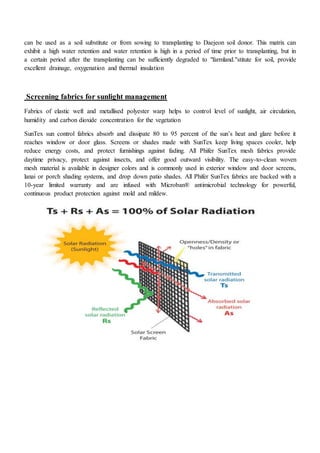
Fabrics of elastic weft and metallised polyester warp helps to control level of sunlight, air circulation,
humidity and carbon dioxide concentration for the vegetation
SunTex sun control fabrics absorb and dissipate 80 to 95 percent of the sun’s heat and glare before it
reaches window or door glass. Screens or shades made with SunTex keep living spaces cooler, help
reduce energy costs, and protect furnishings against fading. All Phifer SunTex mesh fabrics provide
daytime privacy, protect against insects, and offer good outward visibility. The easy-to-clean woven
mesh material is available in designer colors and is commonly used in exterior window and door screens,
lanai or porch shading systems, and drop down patio shades. All Phifer SunTex fabrics are backed with a
10-year limited warranty and are infused with Microban® antimicrobial technology for powerful,
continuous product protection against mold and mildew.
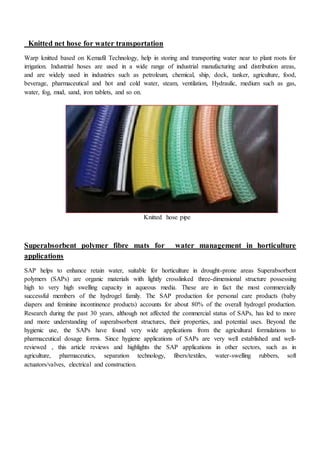
Knitted net hose for water transportation
Warp knitted based on Kemafil Technology, help in storing and transporting water near to plant roots for
irrigation. Industrial hoses are used in a wide range of industrial manufacturing and distribution areas,
and are widely used in industries such as petroleum, chemical, ship, dock, tanker, agriculture, food,
beverage, pharmaceutical and hot and cold water, steam, ventilation, Hydraulic, medium such as gas,
water, fog, mud, sand, iron tablets, and so on.
Knitted hose pipe
Superabsorbent polymer fibre mats for water management in horticulture
applications
SAP helps to enhance retain water, suitable for horticulture in drought-prone areas Superabsorbent
polymers (SAPs) are organic materials with lightly crosslinked three-dimensional structure possessing
high to very high swelling capacity in aqueous media. These are in fact the most commercially
successful members of the hydrogel family. The SAP production for personal care products (baby
diapers and feminine incontinence products) accounts for about 80% of the overall hydrogel production.
Research during the past 30 years, although not affected the commercial status of SAPs, has led to more
and more understanding of superabsorbent structures, their properties, and potential uses. Beyond the
hygienic use, the SAPs have found very wide applications from the agricultural formulations to
pharmaceutical dosage forms. Since hygiene applications of SAPs are very well established and well-
reviewed , this article reviews and highlights the SAP applications in other sectors, such as in
agriculture, pharmaceutics, separation technology, fibers/textiles, water-swelling rubbers, soft
actuators/valves, electrical and construction.
Use of water retention nets coated with Superabsorbent polymer resin
Textile structures coated with SAP resin, enhance water retention property to support plant growth
Water-absorbing polymers, which are classified as hydrogels when mixed, absorb aqueous solutions
through hydrogen bonding with water molecules. A SAP's ability to absorb water depends on the ionic
concentration of the aqueous solution. In deionized and distilled water, an SAP may absorb 300 times its
weight from 30 to 60 times its own volume) and can become up to 99.9% liquid, but when put into a
0.9% saline solution, the absorbency drops to approximately 50 times its weight.[citation needed] The
presence of valence cations in the solution impedes the polymer's ability to bond with the water
molecule. The total absorbency and swelling capacity are controlled by the type and degree of cross-
linkers used to make the gel. Low-density cross-linked SAPs generally have a higher absorbent capacity
and swell to a larger degree. These types of SAPs also have a softer and stickier gel formation. High
cross-link density polymers exhibit lower absorbent capacity and swell, but the gel strength is firmer and
can maintain particle shape even under modest pressure.
Composites of hemp or polypropylene for reducing soil pollutants
Composite of Hemp or Polypropylene nonwoven fabrics and aluminium silicate, found to be useful in
protection of soil from chemical pollutants Natural fibers as reinforced materials in polymer composites
have attracted much attention for being applicable in many fields such as automotive, aerospace,
packaging, construction, and transportation industries . Natural fibers which are used as fillers or
reinforcement materials in polymer composites including palm sheath , palm leaf , guayule biomass,
bagasse, sunflower stalk flour , banana, sugarcane, pineapple, ramie, and cotton [13] show many
advantages such as renewability, biodegradability, CO2 neutrality, nontoxicity, wide availability, low
cost, low density, low energy consumption during fabrication, and high specific strength compared to
synthetic fibers . Therefore, the polymer composites reinforced by natural fibers are becoming
significantly important for the production of a large variety of composites due to being relatively cheap,
lightweight, and eco-friendly materials .
Development of reflective Agrotextiles for Sun management
Many crops are also extremely light sensitive. Sunlight management is the process of manipulating the
sunlight quality and quantity to which plants are exposed. A new generation of agrotextiles can be
developed to address this problem. They would allow the grower to choose both the duration of light as
well as the particular wavelength that will produce the desired effect from the plants at all stages of
development. The proposed project aims to develop wide range of agrotextile screens which will reflect
light and thus ripen all plants uniformly protecting them from extreme climatic conditions. It is proposed
to develop woven reflective agro ground covers with suitable reflective coatings leading to desired
results.
Standardization of Norms for Agricultural Shade Net
The project envisages studying the different agrotextile shade nets being manufactured and used in the
country for benefits in agriculture yield improvement. Although the products are gaining popularity in
the country at the manufacturers' end and users' end, there is no clear guideline available defining the
norms for the manufacture and construction of the product. So also, the methodology to test the
functional properties of these products has not been established. The proposal is aimed towards
establishing these norms for agricultural shade nets. .
Development of Durable, Breathable and Barrier Work wear Fabrics for
Agrotextile Applications
Work wear fabrics can be identified as those fabrics that are worn by the workmen during the course of
performing their duties. The work wear fabrics used by the agro workers in the country are not
scientifically designed. They do not address the functional as well as comfort requirements of the
farmers. Hence it is desirous to develop workwear fabrics that are impervious to the chemical fluids
being handled by the farmers and at the same time comfortable to the wearer and durable in nature. The
proposed work focuses on development of such comfortable, durable, work wear fabrics for agrotextile
application by using plasma technology.
Development of Speciality Fabric for Water conservation and Soil Erosion Control used in Horticulture
Application
Controlling the environments offers crop protection for specific target, and quality maintenance by
elimination of the variations and hazards associated with the weather. It is possible to control
temperature and humidity with varying degree of precision, avoid damage from wind and rain and
regulate nutrients level to meet plants requirement by using green/ polyhouse techniques. Textile
structures can play a crucial role towards achieving this goal. Keeping in view this requirements the
present project is proposed to develop a two layered fabric made up of scrim stabilized uniform fibrous
web adhered to mono porous membrane.
PROPERTIES REQUIRED FOR AGRO PRODUCTS:
Resistance to solar-radiation: the product should withstand solar radiation according to the external
environment without creating harm to crops.
Resistance to weather: with respect to the climatic changes product must work in effect for production.
Resistance to ultraviolet radiation: product should avoid the degradation of molecular chains due to
ultraviolet rays and keep them away.
Retention of water: the water poured is to be segregated and let the crop to absorb whenever it is
essential.
Biodegradability: as the products are placed over and under the crops it is important to have
biodegradable property.
Weight of the product: in order to let the crops grow without disturbance less weight materials to be
selected.
Resistance to microorganisms: to protect the living being around the crop field it should resist
microorganisms.
Construction of material: stable constructions is essential for long life of product.
CONCLUSION
Thus the study shows the basic introduction with recent development of agro textile regarding agro
textile products and their properties.
REFERENCE
www.textilelearner.blogspot.com
www.ijarse.com
www.indiantextilejournal.com
www.technicaltextile.net
www.fiber2fashion
Handbook for agrotextiles, Dr. Karuvu Sambhasivarao,
Textile at Agriculture Application, by Hiren Jaiswal, Shyam Barhanpurkar, Swati Chandak, Neha Kabra.
Application of textile in agriculture, Mr. Sunil. K. Agarwal Asst. Professor, Department of Textile
Engineering, College of Engineering & Technology, Akola, Maharashtra.
The Indian Textile Journal-Application of Technical Textiles, Agro Textile and Home textile

Recent development in Agrotextiles

  • 2.
    WHAT IS AGROTEXTILE •Special textiles that are manufactured for agricultural applications These textile structures are used as controlling environment for plants/animals in applications like – Agriculture – Horticulture – Animal husbandry • Benefits Of Agrotextile Products used in Protected Cultivation For Indian Agriculturists for improved Productivity & Quality Of Produce and lower Cost Of Production FACTORS INFLUENCING AGRICULTURAL ACTIVITIES Sunlight – direct and indirect •Water •Climatic Conditions including wind, hail, humidity •External factors like birds, insects, weeds •Post harvest handling of produce – storage and packaging In India, presently Agricultural Activities are carried out under Natural Conditions of Temperature and Humidity RECENT DEVELOPMENTS IN AGROTEXTILES Polymer fibre balls as substitute for soil Randomly crimped fibre balls, 0.5 - 60 mm, biodegradable/non-biodegradable, sub An object of the present invention is to provide a method of supporting plant growth, the method provides a plant growth substrate, such substrates after addition of water and suitable nutrients may be used for seed germination and seedling, vegetative propagation and growth of other plant material , and to mature the plant cultivation, plant cultivation, or to the growth and development of some other stage. Still another object of the present invention by providing a plant growth medium to provide a method of supporting plant growth, the matrix can be used in place of all or a large number of conventional matrix materials such as ordinary soil, soil mixtures, clay, vermiculite, peat, bark, wood shavings hold flowers or the like, therefore, significantly improves overall water holding capacity, maintained between solids, water and gas balance is more suitable. Another object of the present invention is to provide a method of supporting plant growth, the method provides a plant growth media, this matrix can be biodegradable, it
  • 3.
    can be usedas a soil substitute or from sowing to transplanting to Daejeon soil donor. This matrix can exhibit a high water retention and water retention is high in a period of time prior to transplanting, but in a certain period after the transplanting can be sufficiently degraded to "farmland."stitute for soil, provide excellent drainage, oxygenation and thermal insulation Screening fabrics for sunlight management Fabrics of elastic weft and metallised polyester warp helps to control level of sunlight, air circulation, humidity and carbon dioxide concentration for the vegetation SunTex sun control fabrics absorb and dissipate 80 to 95 percent of the sun’s heat and glare before it reaches window or door glass. Screens or shades made with SunTex keep living spaces cooler, help reduce energy costs, and protect furnishings against fading. All Phifer SunTex mesh fabrics provide daytime privacy, protect against insects, and offer good outward visibility. The easy-to-clean woven mesh material is available in designer colors and is commonly used in exterior window and door screens, lanai or porch shading systems, and drop down patio shades. All Phifer SunTex fabrics are backed with a 10-year limited warranty and are infused with Microban® antimicrobial technology for powerful, continuous product protection against mold and mildew.
  • 4.
    Knitted net hosefor water transportation Warp knitted based on Kemafil Technology, help in storing and transporting water near to plant roots for irrigation. Industrial hoses are used in a wide range of industrial manufacturing and distribution areas, and are widely used in industries such as petroleum, chemical, ship, dock, tanker, agriculture, food, beverage, pharmaceutical and hot and cold water, steam, ventilation, Hydraulic, medium such as gas, water, fog, mud, sand, iron tablets, and so on. Knitted hose pipe Superabsorbent polymer fibre mats for water management in horticulture applications SAP helps to enhance retain water, suitable for horticulture in drought-prone areas Superabsorbent polymers (SAPs) are organic materials with lightly crosslinked three-dimensional structure possessing high to very high swelling capacity in aqueous media. These are in fact the most commercially successful members of the hydrogel family. The SAP production for personal care products (baby diapers and feminine incontinence products) accounts for about 80% of the overall hydrogel production. Research during the past 30 years, although not affected the commercial status of SAPs, has led to more and more understanding of superabsorbent structures, their properties, and potential uses. Beyond the hygienic use, the SAPs have found very wide applications from the agricultural formulations to pharmaceutical dosage forms. Since hygiene applications of SAPs are very well established and well- reviewed , this article reviews and highlights the SAP applications in other sectors, such as in agriculture, pharmaceutics, separation technology, fibers/textiles, water-swelling rubbers, soft actuators/valves, electrical and construction.
  • 5.
    Use of waterretention nets coated with Superabsorbent polymer resin Textile structures coated with SAP resin, enhance water retention property to support plant growth Water-absorbing polymers, which are classified as hydrogels when mixed, absorb aqueous solutions through hydrogen bonding with water molecules. A SAP's ability to absorb water depends on the ionic concentration of the aqueous solution. In deionized and distilled water, an SAP may absorb 300 times its weight from 30 to 60 times its own volume) and can become up to 99.9% liquid, but when put into a 0.9% saline solution, the absorbency drops to approximately 50 times its weight.[citation needed] The presence of valence cations in the solution impedes the polymer's ability to bond with the water molecule. The total absorbency and swelling capacity are controlled by the type and degree of cross- linkers used to make the gel. Low-density cross-linked SAPs generally have a higher absorbent capacity and swell to a larger degree. These types of SAPs also have a softer and stickier gel formation. High cross-link density polymers exhibit lower absorbent capacity and swell, but the gel strength is firmer and can maintain particle shape even under modest pressure. Composites of hemp or polypropylene for reducing soil pollutants Composite of Hemp or Polypropylene nonwoven fabrics and aluminium silicate, found to be useful in protection of soil from chemical pollutants Natural fibers as reinforced materials in polymer composites have attracted much attention for being applicable in many fields such as automotive, aerospace, packaging, construction, and transportation industries . Natural fibers which are used as fillers or reinforcement materials in polymer composites including palm sheath , palm leaf , guayule biomass, bagasse, sunflower stalk flour , banana, sugarcane, pineapple, ramie, and cotton [13] show many advantages such as renewability, biodegradability, CO2 neutrality, nontoxicity, wide availability, low cost, low density, low energy consumption during fabrication, and high specific strength compared to synthetic fibers . Therefore, the polymer composites reinforced by natural fibers are becoming significantly important for the production of a large variety of composites due to being relatively cheap, lightweight, and eco-friendly materials . Development of reflective Agrotextiles for Sun management Many crops are also extremely light sensitive. Sunlight management is the process of manipulating the sunlight quality and quantity to which plants are exposed. A new generation of agrotextiles can be developed to address this problem. They would allow the grower to choose both the duration of light as well as the particular wavelength that will produce the desired effect from the plants at all stages of development. The proposed project aims to develop wide range of agrotextile screens which will reflect light and thus ripen all plants uniformly protecting them from extreme climatic conditions. It is proposed to develop woven reflective agro ground covers with suitable reflective coatings leading to desired results.
  • 6.
    Standardization of Normsfor Agricultural Shade Net The project envisages studying the different agrotextile shade nets being manufactured and used in the country for benefits in agriculture yield improvement. Although the products are gaining popularity in the country at the manufacturers' end and users' end, there is no clear guideline available defining the norms for the manufacture and construction of the product. So also, the methodology to test the functional properties of these products has not been established. The proposal is aimed towards establishing these norms for agricultural shade nets. . Development of Durable, Breathable and Barrier Work wear Fabrics for Agrotextile Applications Work wear fabrics can be identified as those fabrics that are worn by the workmen during the course of performing their duties. The work wear fabrics used by the agro workers in the country are not scientifically designed. They do not address the functional as well as comfort requirements of the farmers. Hence it is desirous to develop workwear fabrics that are impervious to the chemical fluids being handled by the farmers and at the same time comfortable to the wearer and durable in nature. The proposed work focuses on development of such comfortable, durable, work wear fabrics for agrotextile application by using plasma technology. Development of Speciality Fabric for Water conservation and Soil Erosion Control used in Horticulture Application Controlling the environments offers crop protection for specific target, and quality maintenance by elimination of the variations and hazards associated with the weather. It is possible to control temperature and humidity with varying degree of precision, avoid damage from wind and rain and regulate nutrients level to meet plants requirement by using green/ polyhouse techniques. Textile structures can play a crucial role towards achieving this goal. Keeping in view this requirements the present project is proposed to develop a two layered fabric made up of scrim stabilized uniform fibrous web adhered to mono porous membrane. PROPERTIES REQUIRED FOR AGRO PRODUCTS: Resistance to solar-radiation: the product should withstand solar radiation according to the external environment without creating harm to crops. Resistance to weather: with respect to the climatic changes product must work in effect for production. Resistance to ultraviolet radiation: product should avoid the degradation of molecular chains due to ultraviolet rays and keep them away. Retention of water: the water poured is to be segregated and let the crop to absorb whenever it is essential. Biodegradability: as the products are placed over and under the crops it is important to have biodegradable property.
  • 7.
    Weight of theproduct: in order to let the crops grow without disturbance less weight materials to be selected. Resistance to microorganisms: to protect the living being around the crop field it should resist microorganisms. Construction of material: stable constructions is essential for long life of product. CONCLUSION Thus the study shows the basic introduction with recent development of agro textile regarding agro textile products and their properties. REFERENCE www.textilelearner.blogspot.com www.ijarse.com www.indiantextilejournal.com www.technicaltextile.net www.fiber2fashion Handbook for agrotextiles, Dr. Karuvu Sambhasivarao, Textile at Agriculture Application, by Hiren Jaiswal, Shyam Barhanpurkar, Swati Chandak, Neha Kabra. Application of textile in agriculture, Mr. Sunil. K. Agarwal Asst. Professor, Department of Textile Engineering, College of Engineering & Technology, Akola, Maharashtra. The Indian Textile Journal-Application of Technical Textiles, Agro Textile and Home textile