Welcome to My Presentation
Presentation Topics: Clothtech
Presented By:
Name : Md. Ibrahim Khalil
ID :16173207095
Intake : 19th
Section : 02
Program : B. Sc in Textile Engineering ( Apparel Manufacturing)1
Introduction :
Technical Textiles is defined as , Textile material and products
manufactured primarily for their technical and performance properties
rather than their aesthetic or decorative properties/ characteristics.
Technical textiles include textiles for automotive applications .
2
Types Of Technical Textiles :
 A- Agro Tech.
 B- Build Tech.
 C- Cloth Tech.
 G- Geo-Tech.
 H- Home-Tech.
 M- Medi Tech.
 M- Mobi Tech.
 O- Okeo Tech.
 P- Pack Tech.
 P- Pro Tech.
 S- Sports Tech
3
CLOTHTECH :
Clothtech is a grouping of technical textiles for further processing to
(intermediate) products in apparel and shoe industry. Multi-layer substrates
are bonded by thermoplastic powders. This is usually the blend of
polyester, modal, viscose, nylon, etc.
 Typical applications are interlinings, shoe fabrics, lingerie, elastic- and
inelastic fabrics, lining fabrics, workwear garments or temperature
sensitive leather goods, etc.
4
Advantage of Clothtech :
 It provides good performance and safety,
 Reduce the weight of the car,
 Enhance the comfort and aesthetics and provide advanced insulation,
 Fire Retardancy and resistance to water, fuels, extremes of temperature
and abrasion.
5
Properties required for Clothtech:
 Stability to high temperature and pressure
 High abrasion resistance
 Durability
 Shrink proof and Wrinkle Resistance
 Resistance to UV Radiation and waterproof
 High strength and resilience
 Tough weather and solvent resistance
6
Use of Clothtech :
 Shoe laces
 Interlinings
 Zip fasteners
 Elastic narrow fabrics (Tapes)
 Velcro
 Labels
 Umbrella cloth
 Sewing threads 7
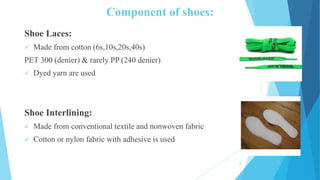
Component of shoes:
Shoe Laces:
 Made from cotton (6s,10s,20s,40s)
PET 300 (denier) & rarely PP (240 denier)
 Dyed yarn are used
Shoe Interlining:
 Made from conventional textile and nonwoven fabric
 Cotton or nylon fabric with adhesive is used
8
Component of clothing :
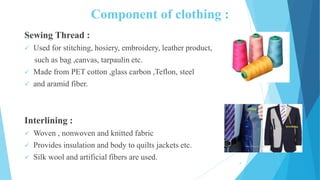
Sewing Thread :
 Used for stitching, hosiery, embroidery, leather product,
such as bag ,canvas, tarpaulin etc.
 Made from PET cotton ,glass carbon ,Teflon, steel
 and aramid fiber.
Interlining :
 Woven , nonwoven and knitted fabric
 Provides insulation and body to quilts jackets etc.
 Silk wool and artificial fibers are used.
9
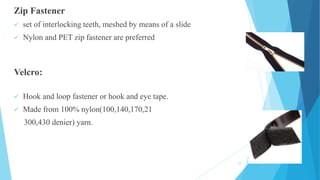
Zip Fastener
 set of interlocking teeth, meshed by means of a slide
 Nylon and PET zip fastener are preferred
Velcro:
 Hook and loop fastener or hook and eye tape.
 Made from 100% nylon(100,140,170,21
300,430 denier) yarn.
10
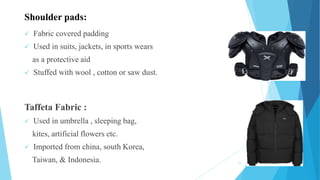
Shoulder pads:
 Fabric covered padding
 Used in suits, jackets, in sports wears
as a protective aid
 Stuffed with wool , cotton or saw dust.
Taffeta Fabric :
 Used in umbrella , sleeping bag,
kites, artificial flowers etc.
 Imported from china, south Korea,
Taiwan, & Indonesia. 11
Finishing Process
Basic finish:
 Improve the surface appearance, function or texture of a fabric.
 Include mercerizing, calendaring, napping,
cropping, embossing, sanding.
Dry Finishing:
 The cloth is handle by dry condition.
 Include perching, burling, specking, mending,
calendaring, glazing, singeing.
12
Market
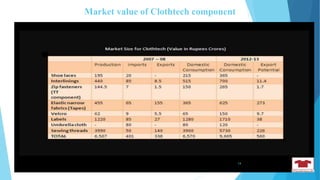
 Technical textile consumption under clothtech is estimated at Rs 6570 crore.
 Sewing thread accounts for 60% consumption of clothtech, followed by labels 19%,
interlining 8% ,elastic narrow fabric 6% , shoe laces and zip fasteners 5%and Velcro
and umbrella cloth 2%.
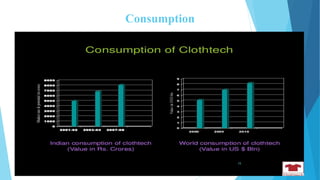
 World consumption is forecast to slowly from 1.2 mln tonnes in 2000 to 1.7 mln
tonnes in 2010 with a value of US $ of 8.3 bln.
 Consumption will be focused in low cost garment assembly location.
13
Market value of Clothtech component
14
Consumption
15
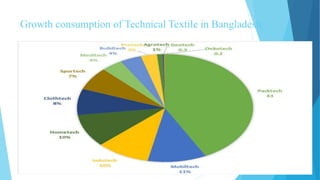
Growth consumption of Technical Textile in Bangladesh
16
THANK YOU
17

Clothtech

  • 1.
    Welcome to MyPresentation Presentation Topics: Clothtech Presented By: Name : Md. Ibrahim Khalil ID :16173207095 Intake : 19th Section : 02 Program : B. Sc in Textile Engineering ( Apparel Manufacturing)1
  • 2.
    Introduction : Technical Textilesis defined as , Textile material and products manufactured primarily for their technical and performance properties rather than their aesthetic or decorative properties/ characteristics. Technical textiles include textiles for automotive applications . 2
  • 3.
    Types Of TechnicalTextiles :  A- Agro Tech.  B- Build Tech.  C- Cloth Tech.  G- Geo-Tech.  H- Home-Tech.  M- Medi Tech.  M- Mobi Tech.  O- Okeo Tech.  P- Pack Tech.  P- Pro Tech.  S- Sports Tech 3
  • 4.
    CLOTHTECH : Clothtech isa grouping of technical textiles for further processing to (intermediate) products in apparel and shoe industry. Multi-layer substrates are bonded by thermoplastic powders. This is usually the blend of polyester, modal, viscose, nylon, etc.  Typical applications are interlinings, shoe fabrics, lingerie, elastic- and inelastic fabrics, lining fabrics, workwear garments or temperature sensitive leather goods, etc. 4
  • 5.
    Advantage of Clothtech:  It provides good performance and safety,  Reduce the weight of the car,  Enhance the comfort and aesthetics and provide advanced insulation,  Fire Retardancy and resistance to water, fuels, extremes of temperature and abrasion. 5
  • 6.
    Properties required forClothtech:  Stability to high temperature and pressure  High abrasion resistance  Durability  Shrink proof and Wrinkle Resistance  Resistance to UV Radiation and waterproof  High strength and resilience  Tough weather and solvent resistance 6
  • 7.
    Use of Clothtech:  Shoe laces  Interlinings  Zip fasteners  Elastic narrow fabrics (Tapes)  Velcro  Labels  Umbrella cloth  Sewing threads 7
  • 8.
    Component of shoes: ShoeLaces:  Made from cotton (6s,10s,20s,40s) PET 300 (denier) & rarely PP (240 denier)  Dyed yarn are used Shoe Interlining:  Made from conventional textile and nonwoven fabric  Cotton or nylon fabric with adhesive is used 8
  • 9.
    Component of clothing: Sewing Thread :  Used for stitching, hosiery, embroidery, leather product, such as bag ,canvas, tarpaulin etc.  Made from PET cotton ,glass carbon ,Teflon, steel  and aramid fiber. Interlining :  Woven , nonwoven and knitted fabric  Provides insulation and body to quilts jackets etc.  Silk wool and artificial fibers are used. 9
  • 10.
    Zip Fastener  setof interlocking teeth, meshed by means of a slide  Nylon and PET zip fastener are preferred Velcro:  Hook and loop fastener or hook and eye tape.  Made from 100% nylon(100,140,170,21 300,430 denier) yarn. 10
  • 11.
    Shoulder pads:  Fabriccovered padding  Used in suits, jackets, in sports wears as a protective aid  Stuffed with wool , cotton or saw dust. Taffeta Fabric :  Used in umbrella , sleeping bag, kites, artificial flowers etc.  Imported from china, south Korea, Taiwan, & Indonesia. 11
  • 12.
    Finishing Process Basic finish: Improve the surface appearance, function or texture of a fabric.  Include mercerizing, calendaring, napping, cropping, embossing, sanding. Dry Finishing:  The cloth is handle by dry condition.  Include perching, burling, specking, mending, calendaring, glazing, singeing. 12
  • 13.
    Market  Technical textileconsumption under clothtech is estimated at Rs 6570 crore.  Sewing thread accounts for 60% consumption of clothtech, followed by labels 19%, interlining 8% ,elastic narrow fabric 6% , shoe laces and zip fasteners 5%and Velcro and umbrella cloth 2%.  World consumption is forecast to slowly from 1.2 mln tonnes in 2000 to 1.7 mln tonnes in 2010 with a value of US $ of 8.3 bln.  Consumption will be focused in low cost garment assembly location. 13
  • 14.
    Market value ofClothtech component 14
  • 15.
  • 16.
    Growth consumption ofTechnical Textile in Bangladesh 16
  • 17.