Classification of Shuttle-less
weaving
Vignesh Dhanabalan -
vigneshdhanabalan@hotmail.com

Vignesh Dhanabalan -
vigneshdhanabalan@hotmail.com
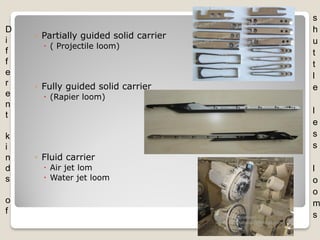
◦ Partially guided solid carrier
 ( Projectile loom)
◦ Fully guided solid carrier
 (Rapier loom)
◦ Fluid carrier
 Air jet lom
 Water jet loom
D
i
f
f
e
r
e
n
t
k
i
n
d
s
o
f
s
h
u
t
t
l
e
l
e
s
s
l
o
o
m
sVignesh Dhanabalan -
vigneshdhanabalan@hotmail.com
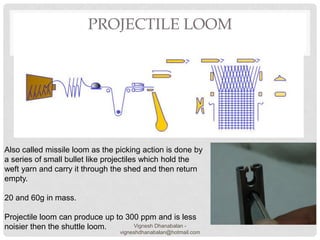
PROJECTILE LOOM
Also called missile loom as the picking action is done by
a series of small bullet like projectiles which hold the
weft yarn and carry it through the shed and then return
empty.
20 and 60g in mass.
Projectile loom can produce up to 300 ppm and is less
noisier then the shuttle loom. Vignesh Dhanabalan -
vigneshdhanabalan@hotmail.com
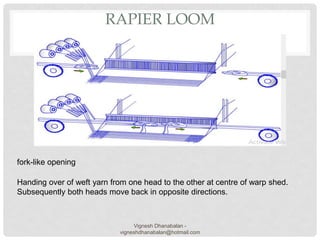
RAPIER LOOM
fork-like opening
Handing over of weft yarn from one head to the other at centre of warp shed.
Subsequently both heads move back in opposite directions.
Vignesh Dhanabalan -
vigneshdhanabalan@hotmail.com
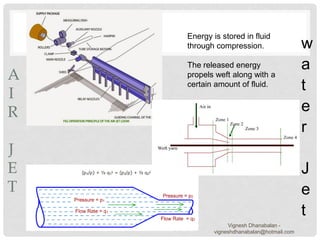
A
I
R
J
E
T
w
a
t
e
r
J
e
t
Energy is stored in fluid
through compression.
The released energy
propels weft along with a
certain amount of fluid.
Vignesh Dhanabalan -
vigneshdhanabalan@hotmail.com
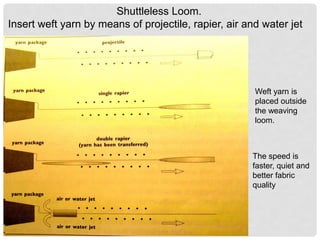
Shuttleless Loom.
Insert weft yarn by means of projectile, rapier, air and water jet
Weft yarn is
placed outside
the weaving
loom.
The speed is
faster, quiet and
better fabric
quality
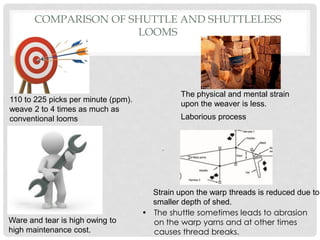
COMPARISON OF SHUTTLE AND SHUTTLELESS
LOOMS
•
110 to 225 picks per minute (ppm).
weave 2 to 4 times as much as
conventional looms
The physical and mental strain
upon the weaver is less.
Strain upon the warp threads is reduced due to
smaller depth of shed.
Laborious process
Ware and tear is high owing to
high maintenance cost.
• The shuttle sometimes leads to abrasion
on the warp yarns and at other times
causes thread breaks.
LIMITATIONS OF SHUTTLE LOOM
Unit-I / Shuttleless Weaving/ Vignesh Dhanabalan 9
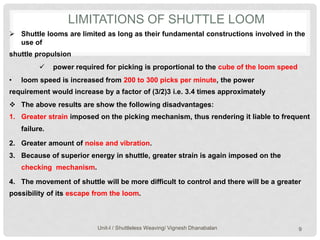
 Shuttle looms are limited as long as their fundamental constructions involved in the
use of
shuttle propulsion
 power required for picking is proportional to the cube of the loom speed
• loom speed is increased from 200 to 300 picks per minute, the power
requirement would increase by a factor of (3/2)3 i.e. 3.4 times approximately
 The above results are show the following disadvantages:
1. Greater strain imposed on the picking mechanism, thus rendering it liable to frequent
failure.
2. Greater amount of noise and vibration.
3. Because of superior energy in shuttle, greater strain is again imposed on the
checking mechanism.
4. The movement of shuttle will be more difficult to control and there will be a greater
possibility of its escape from the loom.
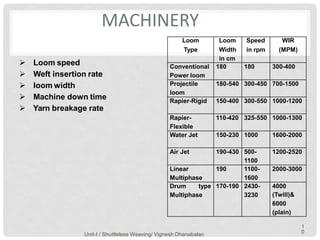
MACHINERY
 Loom speed
 Weft insertion rate
 loom width
 Machine down time
 Yarn breakage rate
Loom
Type
Loom
Width
in cm
Speed
in rpm
WIR
(MPM)
Conventional
Power loom
180 180 300-400
Projectile
loom
180-540 300-450 700-1500
Rapier-Rigid 150-400 300-550 1000-1200
Rapier-
Flexible
110-420 325-550 1000-1300
Water Jet 150-230 1000 1600-2000
Air Jet 190-430 500-
1100
1200-2520
Linear
Multiphase
190 1100-
1600
2000-3000
Drum type
Multiphase
170-190 2430-
3230
4000
(Twill)&
6000
(plain)
Unit-I / Shuttleless Weaving/ Vignesh Dhanabalan
1
0

Classifications of shuttless weaving

  • 1.
    Classification of Shuttle-less weaving VigneshDhanabalan - vigneshdhanabalan@hotmail.com
  • 2.
  • 3.
    ◦ Partially guidedsolid carrier  ( Projectile loom) ◦ Fully guided solid carrier  (Rapier loom) ◦ Fluid carrier  Air jet lom  Water jet loom D i f f e r e n t k i n d s o f s h u t t l e l e s s l o o m sVignesh Dhanabalan - vigneshdhanabalan@hotmail.com
  • 4.
    PROJECTILE LOOM Also calledmissile loom as the picking action is done by a series of small bullet like projectiles which hold the weft yarn and carry it through the shed and then return empty. 20 and 60g in mass. Projectile loom can produce up to 300 ppm and is less noisier then the shuttle loom. Vignesh Dhanabalan - vigneshdhanabalan@hotmail.com
  • 5.
    RAPIER LOOM fork-like opening Handingover of weft yarn from one head to the other at centre of warp shed. Subsequently both heads move back in opposite directions. Vignesh Dhanabalan - vigneshdhanabalan@hotmail.com
  • 6.
    A I R J E T w a t e r J e t Energy is storedin fluid through compression. The released energy propels weft along with a certain amount of fluid. Vignesh Dhanabalan - vigneshdhanabalan@hotmail.com
  • 7.
    Shuttleless Loom. Insert weftyarn by means of projectile, rapier, air and water jet Weft yarn is placed outside the weaving loom. The speed is faster, quiet and better fabric quality
  • 8.
    COMPARISON OF SHUTTLEAND SHUTTLELESS LOOMS • 110 to 225 picks per minute (ppm). weave 2 to 4 times as much as conventional looms The physical and mental strain upon the weaver is less. Strain upon the warp threads is reduced due to smaller depth of shed. Laborious process Ware and tear is high owing to high maintenance cost. • The shuttle sometimes leads to abrasion on the warp yarns and at other times causes thread breaks.
  • 9.
    LIMITATIONS OF SHUTTLELOOM Unit-I / Shuttleless Weaving/ Vignesh Dhanabalan 9  Shuttle looms are limited as long as their fundamental constructions involved in the use of shuttle propulsion  power required for picking is proportional to the cube of the loom speed • loom speed is increased from 200 to 300 picks per minute, the power requirement would increase by a factor of (3/2)3 i.e. 3.4 times approximately  The above results are show the following disadvantages: 1. Greater strain imposed on the picking mechanism, thus rendering it liable to frequent failure. 2. Greater amount of noise and vibration. 3. Because of superior energy in shuttle, greater strain is again imposed on the checking mechanism. 4. The movement of shuttle will be more difficult to control and there will be a greater possibility of its escape from the loom.
  • 10.
    MACHINERY  Loom speed Weft insertion rate  loom width  Machine down time  Yarn breakage rate Loom Type Loom Width in cm Speed in rpm WIR (MPM) Conventional Power loom 180 180 300-400 Projectile loom 180-540 300-450 700-1500 Rapier-Rigid 150-400 300-550 1000-1200 Rapier- Flexible 110-420 325-550 1000-1300 Water Jet 150-230 1000 1600-2000 Air Jet 190-430 500- 1100 1200-2520 Linear Multiphase 190 1100- 1600 2000-3000 Drum type Multiphase 170-190 2430- 3230 4000 (Twill)& 6000 (plain) Unit-I / Shuttleless Weaving/ Vignesh Dhanabalan 1 0