WELCOME
SQUARE JAMMED
FABRIC
By
• SANJITJANA
• RAJABAHADURPAUL
• ANUPAMMULA
• MIRAJUL SK
• 3RD YEAR
• TEXTILE TECHNOLOGY
1.Prediction of the maximum sett (density) of fabric and fabric
dimensions;
2.Find out relationship between geometrical parameters (picks
and ends);
3.Prediction of mechanical properties by combining fabric and
yarn properties;
4.Understanding fabric performance (handle and surface
effect.
INTRODUCTION
The objectives of fabric geometry is to:
Structure of a woven fabric is defined by weave pattern, thread
density, crimp and yarn count
3
Jammed structure
A woven fabric in which warp & weft yarns
don’t have mobility within the structure as
they are in intimate contact with each other
are called jammed structure. In such a
structure the warp & weft yarns will have
minimum thread spacing.
Pierce’s Model
Mathematical Notation for the model
• D1 & d2 - Warp & Weft diameter respectively
• D - Sum of circular diameter
• h1 & h2 -distance between axes of warp /weft & fabric
• p1 & p2 – Thread spacing of warp & weft respectively
• c1 & c2 - Crimp of warp & weft
• θ1 & θ2 – Max. angle of thread axis to plane of cloth
(radians)
• l1 & l2 - Moduler length of warp & weft respectively
Results of Pierce’s Model
Jamming Condition of a fabric
• During jamming the straight portion of the
intersecting yarn will vanish so that-
Jamming warp direction Jamming weft direction
l1–Dθ1 = 0 h2 = D(1 –cosθ2)
l1/D = 0 p1= Dsinθ2
So,
h1 = D(1 -cosθ1)
p2= Dsinθ1
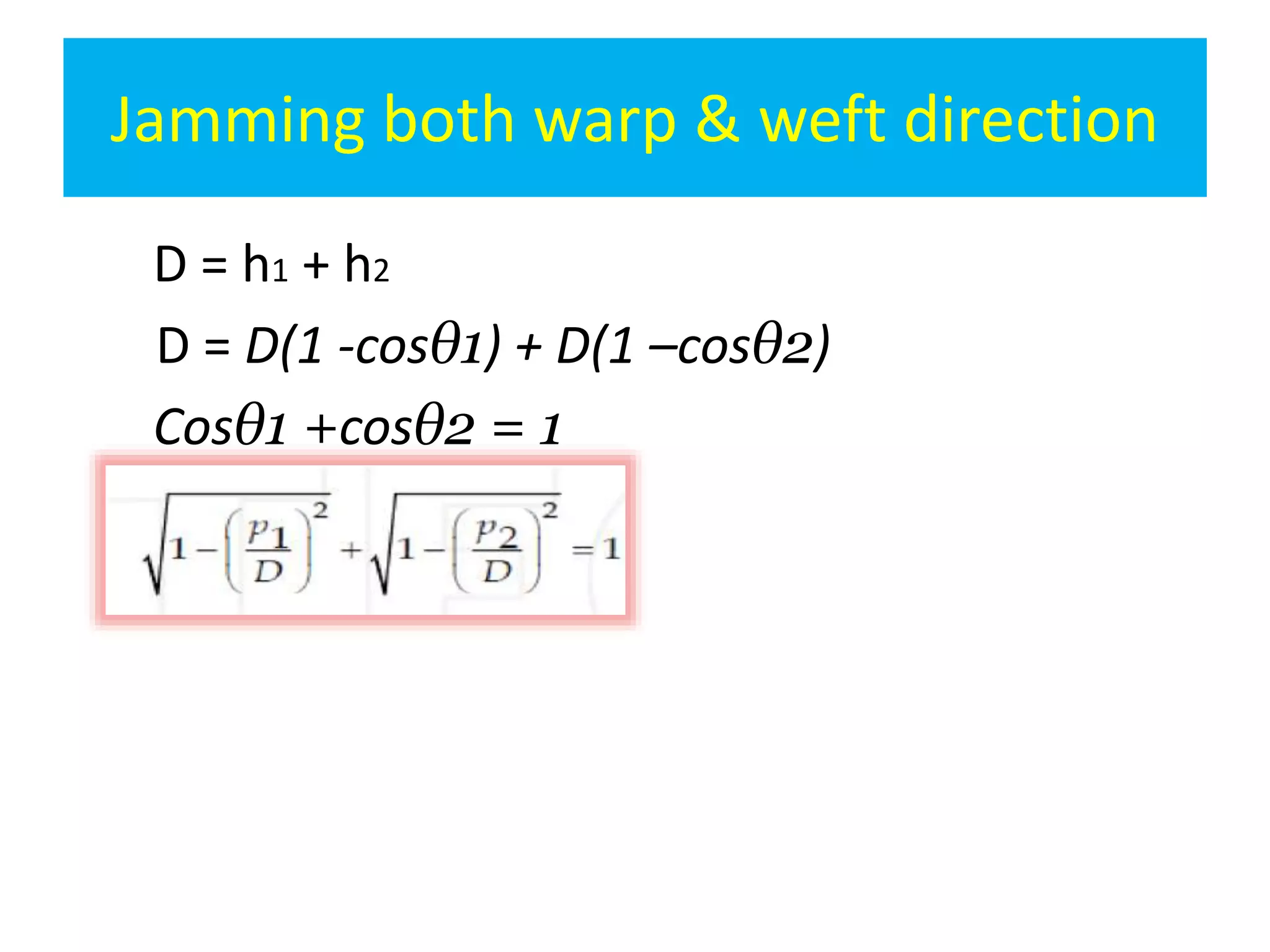
Jamming both warp & weft direction
D = h1 + h2
D = D(1 -cosθ1) + D(1 –cosθ2)
Cosθ1 +cosθ2 = 1
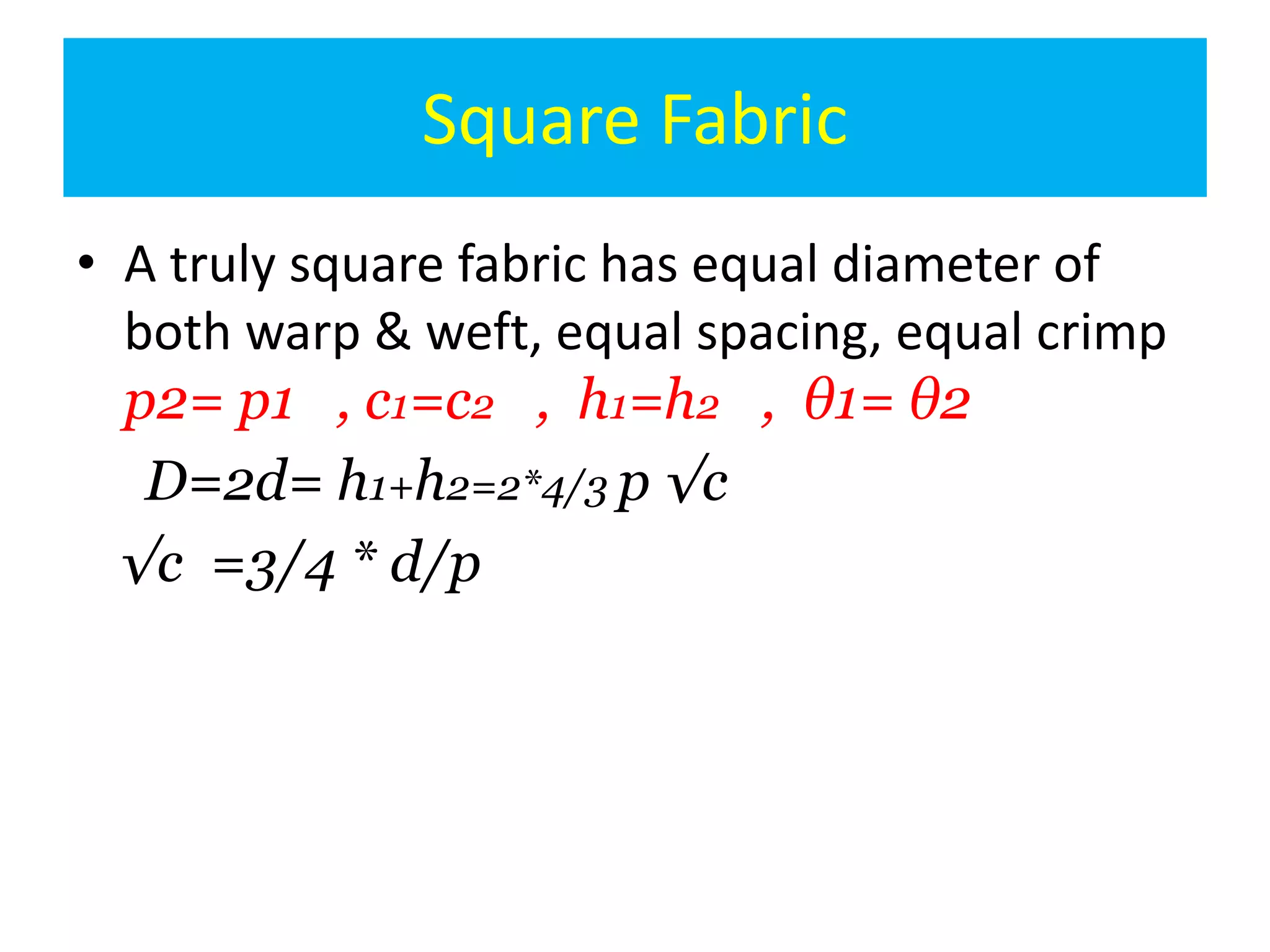
Square Fabric
• A truly square fabric has equal diameter of
both warp & weft, equal spacing, equal crimp
p2= p1 , c1=c2 , h1=h2 , θ1= θ2
D=2d= h1+h2=2*4/3 p √c
√c =3/4 * d/p
Square Jammed fabric
For a sq. jammed fabric θ1 =θ2
So,
Cosθ1 +cosθ2 = 1
Cosθ = ½
θ = π/3
p=Dsinθ
&
l=Dθ
Racetrack Model
• In the racetrack model, a and b are maximum and minimum diameters of
the cross-section. The fabric parameters with superscript refer to the zone
AB, which is analogous to the circular thread geometry; the parameters
without superscript refer to the racetrack geometry, a repeat of this is
between C and D.
Then the basic equations will be modified as under:
p2’ = p2 – (a2 – b2)
l1’ = l1 – (a2 – b2)
h1 + h2 = B = b1 + b2
Also if both warp and weft threads are jammed,
the relationship becomes
Crimp of sq. jammed fabric
• The crimp in fabric is the most important parameter which influences
several fabric properties such as extensibility , thickness , compressibility
and handle. It also decides quantity of yarn required to weave a fabric
during manufacturing.
The crimp of a sq. jammed fabric is about 20.9 %
we know,
Crimp (c) =l/p -1 [p=Dsinθ &l= Dθ ]
= Dθ/Dsinθ -1
= θ/sinθ – 1
= π/3/sin π/3 - 1 [θ = π/3]
=1.209 -1
= .209
So, c % = 20.9 %
Cover factor of square jammed fabric
• In fabric, cover is considered as fraction of the total fabric
area covered by the component yarns.
The fractional cover factor (d/p) = 1/√3
1 X n = 1/√3
28 X √N
n/ √N = 16.2
So, cover factor of both warp & weft is 16.2 AC = 2d
k1 = k2 =16.2 AB = d
And Fabric cover factor is 23 So, BC = √3 d
k1 + k2- k1k2/28 = 23 p = √3 d
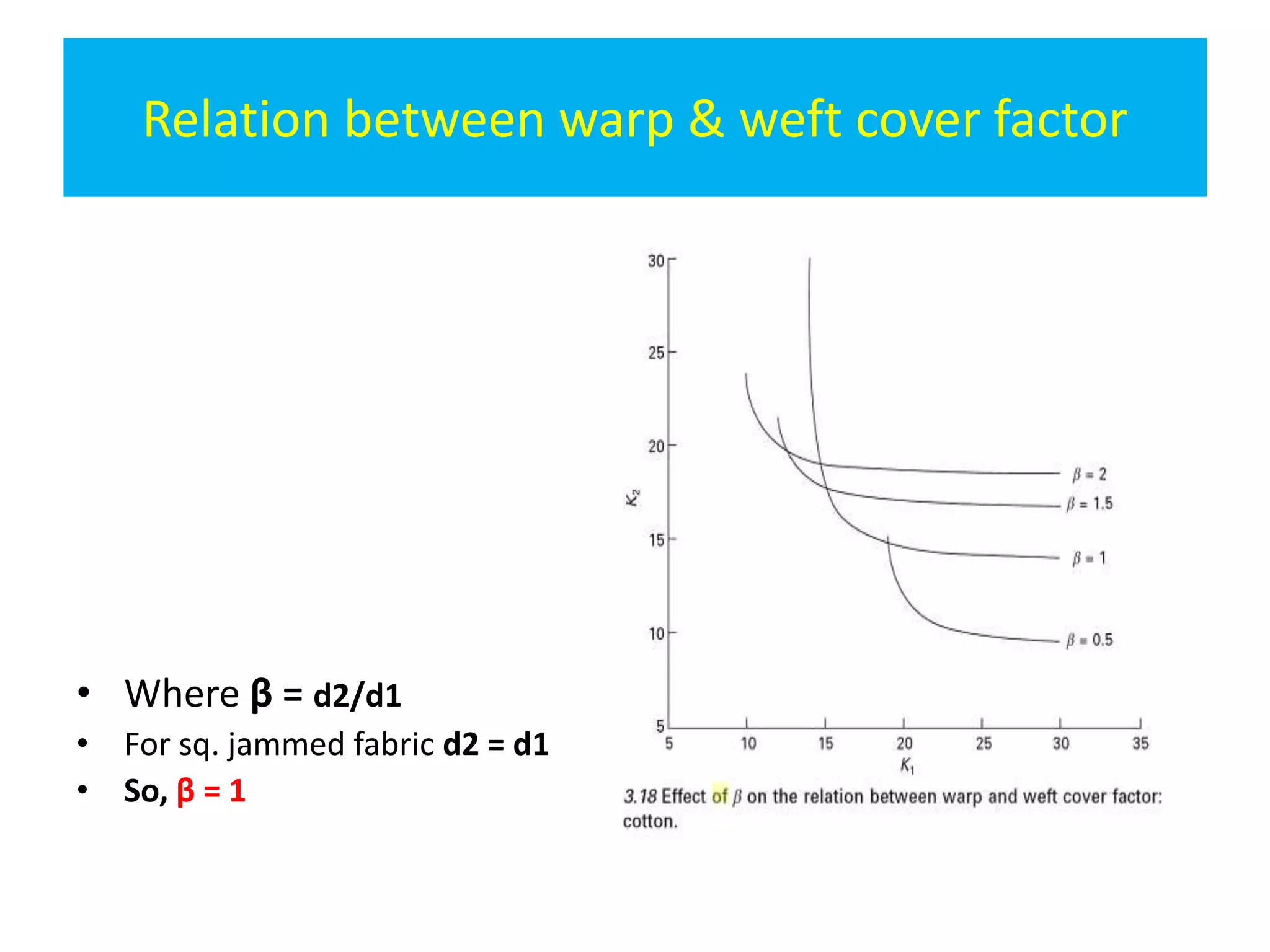
Relation between warp & weft cover factor
• Where β = d2/d1
• For sq. jammed fabric d2 = d1
• So, β = 1
Application of jammed fabric
Jammed fabric are closely woven fabric & find
application in water-proof , wind- proof, bullet-
proof requirements.
References
• Woven Textiles: Principles, Technologies and
Applications :- Edited by K Gandhi
• Woven Textile Structure: Theory and
Applications :- By B K Behera, P K Hari
Square jammed fabric

Square jammed fabric

  • 1.
  • 2.
    SQUARE JAMMED FABRIC By • SANJITJANA •RAJABAHADURPAUL • ANUPAMMULA • MIRAJUL SK • 3RD YEAR • TEXTILE TECHNOLOGY
  • 3.
    1.Prediction of themaximum sett (density) of fabric and fabric dimensions; 2.Find out relationship between geometrical parameters (picks and ends); 3.Prediction of mechanical properties by combining fabric and yarn properties; 4.Understanding fabric performance (handle and surface effect. INTRODUCTION The objectives of fabric geometry is to: Structure of a woven fabric is defined by weave pattern, thread density, crimp and yarn count 3
  • 4.
    Jammed structure A wovenfabric in which warp & weft yarns don’t have mobility within the structure as they are in intimate contact with each other are called jammed structure. In such a structure the warp & weft yarns will have minimum thread spacing.
  • 5.
  • 6.
    Mathematical Notation forthe model • D1 & d2 - Warp & Weft diameter respectively • D - Sum of circular diameter • h1 & h2 -distance between axes of warp /weft & fabric • p1 & p2 – Thread spacing of warp & weft respectively • c1 & c2 - Crimp of warp & weft • θ1 & θ2 – Max. angle of thread axis to plane of cloth (radians) • l1 & l2 - Moduler length of warp & weft respectively
  • 7.
  • 8.
    Jamming Condition ofa fabric • During jamming the straight portion of the intersecting yarn will vanish so that- Jamming warp direction Jamming weft direction l1–Dθ1 = 0 h2 = D(1 –cosθ2) l1/D = 0 p1= Dsinθ2 So, h1 = D(1 -cosθ1) p2= Dsinθ1
  • 9.
    Jamming both warp& weft direction D = h1 + h2 D = D(1 -cosθ1) + D(1 –cosθ2) Cosθ1 +cosθ2 = 1
  • 10.
    Square Fabric • Atruly square fabric has equal diameter of both warp & weft, equal spacing, equal crimp p2= p1 , c1=c2 , h1=h2 , θ1= θ2 D=2d= h1+h2=2*4/3 p √c √c =3/4 * d/p
  • 11.
    Square Jammed fabric Fora sq. jammed fabric θ1 =θ2 So, Cosθ1 +cosθ2 = 1 Cosθ = ½ θ = π/3 p=Dsinθ & l=Dθ
  • 12.
    Racetrack Model • Inthe racetrack model, a and b are maximum and minimum diameters of the cross-section. The fabric parameters with superscript refer to the zone AB, which is analogous to the circular thread geometry; the parameters without superscript refer to the racetrack geometry, a repeat of this is between C and D. Then the basic equations will be modified as under: p2’ = p2 – (a2 – b2) l1’ = l1 – (a2 – b2) h1 + h2 = B = b1 + b2 Also if both warp and weft threads are jammed, the relationship becomes
  • 13.
    Crimp of sq.jammed fabric • The crimp in fabric is the most important parameter which influences several fabric properties such as extensibility , thickness , compressibility and handle. It also decides quantity of yarn required to weave a fabric during manufacturing. The crimp of a sq. jammed fabric is about 20.9 % we know, Crimp (c) =l/p -1 [p=Dsinθ &l= Dθ ] = Dθ/Dsinθ -1 = θ/sinθ – 1 = π/3/sin π/3 - 1 [θ = π/3] =1.209 -1 = .209 So, c % = 20.9 %
  • 14.
    Cover factor ofsquare jammed fabric • In fabric, cover is considered as fraction of the total fabric area covered by the component yarns. The fractional cover factor (d/p) = 1/√3 1 X n = 1/√3 28 X √N n/ √N = 16.2 So, cover factor of both warp & weft is 16.2 AC = 2d k1 = k2 =16.2 AB = d And Fabric cover factor is 23 So, BC = √3 d k1 + k2- k1k2/28 = 23 p = √3 d
  • 15.
    Relation between warp& weft cover factor • Where β = d2/d1 • For sq. jammed fabric d2 = d1 • So, β = 1
  • 16.
    Application of jammedfabric Jammed fabric are closely woven fabric & find application in water-proof , wind- proof, bullet- proof requirements.
  • 17.
    References • Woven Textiles:Principles, Technologies and Applications :- Edited by K Gandhi • Woven Textile Structure: Theory and Applications :- By B K Behera, P K Hari

Editor's Notes