Water Proof Finish
Praveen D Nagarajan
WATER PROOFING
“Water proofing is nothing but preventing the passage of both
air and water through a fabric”
PURPOSE
For certain uses such as Tarpaulin, Umbrella
cloth, Rain coat fabric etc.,
It is required to give this type of finish as these
type of fabrics are generally used against the
air and water in the normal life.
This finish makes the wearer feel uneasy and
uncomfortable as the air circulation is not
there.
WATER PROOFING
PRINCIPLE
‘A film on the surface of the fabric should be formed
for the prevention of air and water’.
When a uniform coating of suitable substances such as
rubber is produced on the surface of a fabric, the
interstices between the warp and weft yarns are
blocked by the continuous film or substance and
both water and air will not pass through the treated
fabrics.
It is a chemical finish.
WATER PROOFING
REQUIREMENTS:
The fabric should not become unnecessarily stiff and the
fabric should have soil release or soil repellent property.
Condition:
The finish should not alter the fastness properties or
dyed material, feel, strength etc., of the fabric.
It can be carried out by 2 methods,.
1. Hydrophobic substances are deposited on the cloth.
2. The fabric itself becomes hydrophobic.
WATER PROOFING
CHEMICALS USED:
1. Vulcanized natural rubber,
2. Oxidized oils of varnishes,
3. Polyvinyl chloro acetate,
4. Polyvinylidine Chloride,
5. Cellulose acetate,
6. Cuprammonium hydroxide solution.
PROCESS:
A) The simplest method of water proofing
is the coating of fabric with rubber as a thin
film.
DISADVANTAGE:
1. Unwanted stiffness and harshness,
2. Fabric becomes hard and brittle.
WATER PROOFING
B) The application of Natural oil will also
produce this finish.
ADVANTAGE:
No cracks or brittleness.
DISADVANTAGE:
It is not permanent
WATER PROOFING
C. Coating of Water Impermeable substances
like Pitch, Asphalt and Molten waxes
produce water proofing.
ADVANTAGE:
It will give excellent proofing.
DISADVANTAGE:
Many desirable properties of the
fabric will be destroyed.
D. Using Synthetic Resins we can produce this
finish.
Example
Polyvinyl chloro acetate,
cellulose acetate,
Polyvinylidine chloride.
E. Water proofing with Wax Emulsion.
It can be applied on cotton, linen, wool, silk
fabrics.
Aluminium Acetate is used along with the wax
emulsion.
There are two steps involved in producing this
finish as follows.
First Step:
Wax emulsion - 1 – 3 kg,
Water - 50 litres
Pad the material with the wax emulsion solution.
WATER PROOFING
Second step:
In wet condition,
Aluminium acetate - 1 to 3 kg (12 TW)
Water - 50 litres.
Impregnate the fabric and squeeze thoroughly.
The dry the fabric in a stenter or on a drying range at
110 – 120 C.
PROCESS SEQUENCE: Pad – dry – Calender.
WATER REPELLENT FINISH:
‘If a fabric allows air but prevents water to pass through itself,
it is known as Water Repellent finish’.
REQUIREMENTS:
The fabric should not become
unnecessarily stiff and harsh. It is a Chemical
and Property giving finish.
Condition:
The finish should not affect the
fastness properties of dyed goods and feel,
strength etc. of the fabric.
WATER REPELLENT FINISH:
METHODS:
A) USING METALLIC SALTS:
PROCESS:
Pad the fabric with metal salts like Aluminium Acetate or
Lead Acetate.
Passing the padded fabric through Soap solution like Sodium
Stearate.
If necessary a little quantity of wax may be added.
This method is not permanent.
WATER REPELLENT FINISH:
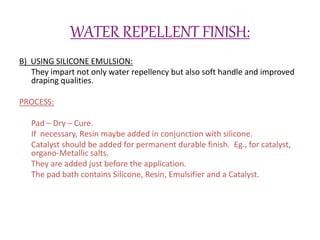
B) USING SILICONE EMULSION:
They impart not only water repellency but also soft handle and improved
draping qualities.
PROCESS:
Pad – Dry – Cure.
If necessary, Resin maybe added in conjunction with silicone.
Catalyst should be added for permanent durable finish. Eg., for catalyst,
organo-Metallic salts.
They are added just before the application.
The pad bath contains Silicone, Resin, Emulsifier and a Catalyst.
WATER REPELLENT FINISH:
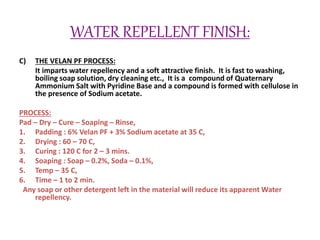
C) THE VELAN PF PROCESS:
It imparts water repellency and a soft attractive finish. It is fast to washing,
boiling soap solution, dry cleaning etc., It is a compound of Quaternary
Ammonium Salt with Pyridine Base and a compound is formed with cellulose in
the presence of Sodium acetate.
PROCESS:
Pad – Dry – Cure – Soaping – Rinse,
1. Padding : 6% Velan PF + 3% Sodium acetate at 35 C,
2. Drying : 60 – 70 C,
3. Curing : 120 C for 2 – 3 mins.
4. Soaping : Soap – 0.2%, Soda – 0.1%,
5. Temp – 35 C,
6. Time – 1 to 2 min.
Any soap or other detergent left in the material will reduce its apparent Water
repellency.
WATER REPELLENT FINISH:
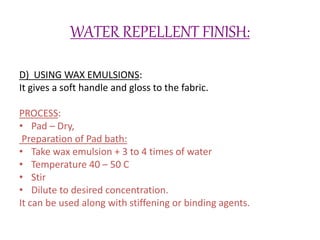
D) USING WAX EMULSIONS:
It gives a soft handle and gloss to the fabric.
PROCESS:
• Pad – Dry,
Preparation of Pad bath:
• Take wax emulsion + 3 to 4 times of water
• Temperature 40 – 50 C
• Stir
• Dilute to desired concentration.
It can be used along with stiffening or binding agents.
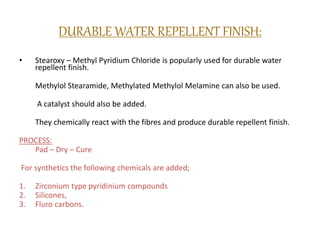
DURABLE WATER REPELLENT FINISH:
• Stearoxy – Methyl Pyridium Chloride is popularly used for durable water
repellent finish.
Methylol Stearamide, Methylated Methylol Melamine can also be used.
A catalyst should also be added.
They chemically react with the fibres and produce durable repellent finish.
PROCESS:
Pad – Dry – Cure
For synthetics the following chemicals are added;
1. Zirconium type pyridinium compounds
2. Silicones,
3. Fluro carbons.
The End

Water proof finish

  • 1.
  • 2.
    WATER PROOFING “Water proofingis nothing but preventing the passage of both air and water through a fabric”
  • 3.
    PURPOSE For certain usessuch as Tarpaulin, Umbrella cloth, Rain coat fabric etc., It is required to give this type of finish as these type of fabrics are generally used against the air and water in the normal life. This finish makes the wearer feel uneasy and uncomfortable as the air circulation is not there.
  • 4.
    WATER PROOFING PRINCIPLE ‘A filmon the surface of the fabric should be formed for the prevention of air and water’. When a uniform coating of suitable substances such as rubber is produced on the surface of a fabric, the interstices between the warp and weft yarns are blocked by the continuous film or substance and both water and air will not pass through the treated fabrics. It is a chemical finish.
  • 5.
    WATER PROOFING REQUIREMENTS: The fabricshould not become unnecessarily stiff and the fabric should have soil release or soil repellent property. Condition: The finish should not alter the fastness properties or dyed material, feel, strength etc., of the fabric. It can be carried out by 2 methods,. 1. Hydrophobic substances are deposited on the cloth. 2. The fabric itself becomes hydrophobic.
  • 6.
    WATER PROOFING CHEMICALS USED: 1.Vulcanized natural rubber, 2. Oxidized oils of varnishes, 3. Polyvinyl chloro acetate, 4. Polyvinylidine Chloride, 5. Cellulose acetate, 6. Cuprammonium hydroxide solution.
  • 7.
    PROCESS: A) The simplestmethod of water proofing is the coating of fabric with rubber as a thin film. DISADVANTAGE: 1. Unwanted stiffness and harshness, 2. Fabric becomes hard and brittle.
  • 8.
    WATER PROOFING B) Theapplication of Natural oil will also produce this finish. ADVANTAGE: No cracks or brittleness. DISADVANTAGE: It is not permanent
  • 9.
    WATER PROOFING C. Coatingof Water Impermeable substances like Pitch, Asphalt and Molten waxes produce water proofing. ADVANTAGE: It will give excellent proofing. DISADVANTAGE: Many desirable properties of the fabric will be destroyed.
  • 10.
    D. Using SyntheticResins we can produce this finish. Example Polyvinyl chloro acetate, cellulose acetate, Polyvinylidine chloride.
  • 11.
    E. Water proofingwith Wax Emulsion. It can be applied on cotton, linen, wool, silk fabrics. Aluminium Acetate is used along with the wax emulsion. There are two steps involved in producing this finish as follows. First Step: Wax emulsion - 1 – 3 kg, Water - 50 litres Pad the material with the wax emulsion solution.
  • 12.
    WATER PROOFING Second step: Inwet condition, Aluminium acetate - 1 to 3 kg (12 TW) Water - 50 litres. Impregnate the fabric and squeeze thoroughly. The dry the fabric in a stenter or on a drying range at 110 – 120 C. PROCESS SEQUENCE: Pad – dry – Calender.
  • 13.
    WATER REPELLENT FINISH: ‘Ifa fabric allows air but prevents water to pass through itself, it is known as Water Repellent finish’.
  • 14.
    REQUIREMENTS: The fabric shouldnot become unnecessarily stiff and harsh. It is a Chemical and Property giving finish. Condition: The finish should not affect the fastness properties of dyed goods and feel, strength etc. of the fabric.
  • 15.
    WATER REPELLENT FINISH: METHODS: A)USING METALLIC SALTS: PROCESS: Pad the fabric with metal salts like Aluminium Acetate or Lead Acetate. Passing the padded fabric through Soap solution like Sodium Stearate. If necessary a little quantity of wax may be added. This method is not permanent.
  • 16.
    WATER REPELLENT FINISH: B)USING SILICONE EMULSION: They impart not only water repellency but also soft handle and improved draping qualities. PROCESS: Pad – Dry – Cure. If necessary, Resin maybe added in conjunction with silicone. Catalyst should be added for permanent durable finish. Eg., for catalyst, organo-Metallic salts. They are added just before the application. The pad bath contains Silicone, Resin, Emulsifier and a Catalyst.
  • 17.
    WATER REPELLENT FINISH: C)THE VELAN PF PROCESS: It imparts water repellency and a soft attractive finish. It is fast to washing, boiling soap solution, dry cleaning etc., It is a compound of Quaternary Ammonium Salt with Pyridine Base and a compound is formed with cellulose in the presence of Sodium acetate. PROCESS: Pad – Dry – Cure – Soaping – Rinse, 1. Padding : 6% Velan PF + 3% Sodium acetate at 35 C, 2. Drying : 60 – 70 C, 3. Curing : 120 C for 2 – 3 mins. 4. Soaping : Soap – 0.2%, Soda – 0.1%, 5. Temp – 35 C, 6. Time – 1 to 2 min. Any soap or other detergent left in the material will reduce its apparent Water repellency.
  • 18.
    WATER REPELLENT FINISH: D)USING WAX EMULSIONS: It gives a soft handle and gloss to the fabric. PROCESS: • Pad – Dry, Preparation of Pad bath: • Take wax emulsion + 3 to 4 times of water • Temperature 40 – 50 C • Stir • Dilute to desired concentration. It can be used along with stiffening or binding agents.
  • 19.
    DURABLE WATER REPELLENTFINISH: • Stearoxy – Methyl Pyridium Chloride is popularly used for durable water repellent finish. Methylol Stearamide, Methylated Methylol Melamine can also be used. A catalyst should also be added. They chemically react with the fibres and produce durable repellent finish. PROCESS: Pad – Dry – Cure For synthetics the following chemicals are added; 1. Zirconium type pyridinium compounds 2. Silicones, 3. Fluro carbons.
  • 20.