Breathable Fabrics
or waterproof breathable/waterproof-breathable
Some important points
Waterproof fabric completely prevents the penetration and absorption of
liquid water.
Breathable fabric is actively ventilated and it passively allow water vapor to
diffuse through them yet prevents the penetration of liquid water.
Waterproof breathable fabrics resist water droplets from passing through
while at the same time allowing water vapor through. The breathability of
almost all waterproof breathable fabrics is very dependent upon weather
conditions, especially temperature and humidity.
Waterproof breathable fabrics are widely used in sportswear and similar
Application.
Breathable Fabrics
or waterproof breathable/waterproof-breathable
Breathability is measured by the rate at which water vapor passes through in
the units of grams of water vapor per square meter of fabric per 24 hours
period (g/m2/d), often abbreviated to just ‘g’. In recent years some of the
sporting goods manufacturers have begun including this information on their
labels. Typical mid-range fabric tends to have values of 5000 mm of water
resistance and 5000g of breathability. The highest end materials boast
20000 mm and 20000 g.
Breathable Fabrics and Applications
or waterproof breathable/waterproof-breathable
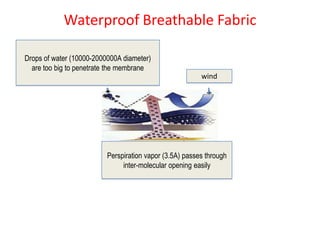
Waterproof Breathable Fabric
Drops of water (10000-2000000A diameter)
are too big to penetrate the membrane
wind
Perspiration vapor (3.5A) passes through
inter-molecular opening easily
Uses of Waterproof Breathable Fabric
Leisure Work
Heavy duty, foul weather clothing: Anoraks,
cagoules, packs , over-trousers, hats, gloves,
gaiters
Foul weather clothing: survival suits, special
military protective clothing, clean room
garments, surgical garments, hospital drapes,
mattress and seat covers, specialized
tarpaulins, packaging, wound dressings
,filtration
Domestic and transport: non-allergic bedding, car
covers, fire smoke curtains in ships, cargo wraps
in aircraft
Fashionable weather protection: rainwater,
skiwear, golf suits, walking boot linings,
panels and inserts, sport footwear linings,
panels and inserts
Tents
Sleeping bag covers
Examples of Breathable Fabrics
Anorak
Cagoule
Gaiter
Gaiter
Examples of Breathable Fabrics
Types of waterproof breathable fabric
There are several types of waterproof breathable fabric. These can be divided
into three groups:
Densely woven waterproof breathable fabrics
Membranes/Laminated waterproof breathable fabrics
Coated waterproof breathable fabrics
Waterproof Breathable Fabric
Densely Woven
• For cotton, the finest type of long staple are selected so that there are
very small space between the fibers. The cotton is processed into
combed yarn, which is then plied. This improves regularity and ensures
that the fibers are as parallel as possible to the yarn axis, and that there
are no large pores where water can penetrate. The yarn is woven using
an oxford weave, which is a plain weave with two threads acting together
in the warp. This gives maximum crimp in the weft, again ensuring that
the fibers are as parallel as possible to the surface of the fabric. When
the fabric surface is wetted by water, the cotton fibers sell transversely
reducing the size of the pores in the fabric and requiring very high
pressure to cause penetration. This fabric is thus become waterproof
without the need for water-repellent.
Waterproof Breathable Fabric
Densely Woven
Densely woven fabric can be made from synthetic microfilament yarns. The
individual filaments are less than 10 micrometer in diameter, so that fiber
with very small pores can be engineered. Microfilaments are usually made
from polyamide or polyester. The latter is particularly useful as it has
inherent water-repellent properties. The water penetration resistance of the
fabric is improved by application of silicone or fluorocarbon finish.
The use of very fine fibers and microfilaments and dense construction (sett)
results in fabric with very small pores size compared with conventional
fabrics. Typical pores size for a waterproof fabric is about 10um compared to
60um for a conventional fabric. Fabric made from microfilaments is claimed
to have up to 7000 filaments per centimeter.
Waterproof Breathable Fabric
Fig: Maximum crimp in weft
Warp
Weft
Microscopic View
Scanning Electron
Micrograph of Densely
woven Fabric
Photomicrograph of
Densely woven Fabric
(Dry)
Photomicrograph of
Densely woven Fabric
(Wet))
Scanning Electron
Micrograph of
Microfilament Fabric
Waterproof Breathable Fabric
Membranes/Laminated waterproof breathable fabrics: are made by application
of membranes into textile product. These thin membrane made from polymeric
materials. This offer high resistance to water penetration but allow water vapor.
The maximum thickness of the membrane is 10micron. They are two types:
Micro porous membranes
Hydrophilic membranes
• Micro porous membranes
Micro porous membrane is a thin film of expanded polytetrafluoroethylene
• The membrane contains tiny holes which are much smaller than the finest raindrop
but much larger than a water vapor molecule.
• The hydrophobic nature of the polymer and small pore size requires very high
pressure to cause water penetration.
Hydrophilic membranes
• Hydrophilic membranes are very thin films of chemically modified
polyester or polyurethane containing no holes which therefore are
sometimes referred to as non-poromeric.
• The polyester or polyurethane polymer is modified by incorporating
up to 40% by weight of poly(ethylene oxide)
• The poly(ethylene oxide) constitutes the hydrophilic part of the
membrane by forming part of the amorphous regions of the
polyurethane polymer system.
• These amorphous regions are described as acting like intermolecular
pores’ allowing water vapor molecules to pass through but
preventing the penetration of liquid water owing to the solid nature of
the membrane.
Figure that differ coated Laminated fabric
Methods of Membrane incorporation
There are four main methods of incorporating membranes into
textile articles. The method employed depends on cost, required
function and processing condition,
1 Laminate of membrane and outer fabric (Fig. a) –
The membrane is laminated to the underside of the outer fabric to
produce a two-layer system.
Advantage:1.Has very effective protective properties like waterproof,
wind resistance.
Disadvantage:1.This method produces a rustling ,paper-like handling
apparel.
Use: mainly used in protective clothing.
Methods of Membrane incorporation
Liner or insert processing (Fig. b) – The membrane is laminated
to a light- weight knitted material or web. This structure is then loosely
inserted between the outer fabric and the liner. The three materials
(outer, laminate and lining) are joined together by concealed stitch
seams.
Advantage :1.This method gives soft handle  good drape properties
2.In this method ,the outer fabric can be modified to suit
fashion demand.
Methods of Membrane incorporation
Laminate of membrane and lining fabric (Fig. c)
– The laminate is attached to the right side of the lining material.
-The functional layer is incorporated into the garment as a
separate layer independent of the outer fabric.
Advantage: In this method the fashion aspects can be maximized.
Methods of Membrane incorporation
Laminate of outer fabric, membrane and lining (Fig. d) –
This produces a three-layer system, which gives a less
attractive handle and drape than the other methods and, therefore, is
not commonly used.
Coated waterproof breathable fabrics: consist of
polymeric material applied to one surface of fabric.
Polyurethane is used as coating material. The
coatings are of two types:
Micro porous Coating
Hydrophilic Coating
Figure of Micro porous coating
• Micro porous Coating
• Micro porous coatings have a similar structure
to the micro porous membranes.
• The coating contains very fine interconnected
channels, much smaller than the finest
raindrop but much larger than a water vapour
molecule
Micro porous Coating
Hydrophilic coating
• Hydrophilic coating: It uses the same basic water
vapour permeability mechanism as the hydrophilic
membranes.
• These coatings are all based on polyurethane, which
has been chemically modified by incorporating
polyvinyl alcohols and polyethylene oxides. These
have a chemical affinity for water vapour allowing
the diffusion of water vapour through the
amorphous regions of the polymer
Figure of Waterproof coating
Desirable Attributes of WBF for Sportswear
Optimum heat and moisture regulation
Good air and water vapor permeability
Rapid moisture absorption and conveyance capacity
Absence of dampness
Rapid drying to prevent catching cold
Low water absorption of the layer of clothing just positioned to the skin
Dimensionally stable even when wet
Durable, Easy care lightweight, Soft and pleasant touch
Does it possible to maintain above mentioned qualities in one fabric?
How to get these attributes?
Two layer structures are needed. The first layer closed to skin should be of the
wicking property, made of synthetic fibers, e.g., micro-denier polyester. The
outer layer usually cotton that absorbs and evaporates the perspiration/water
vapor. The first layer is ideal for wicking perspiration away from the skin.
Wicking refers to technical property in fabrics that move sweat away from the skin to the outer surface
of the fabric where it evaporates
Moisture Transport Mechanism
The mechanism by which moisture is transported in textiles is similar to the
wicking of a liquid in capillaries. Capillary action is determined by two
fundamental properties of the capillary:
Its diameter, and
Surface energy of its inside face.
The smaller the diameter of the greater the surface energy (hydrophilic
action), the greater the tendency of a liquid to move up the capillary. In textile
structures, the space between the fibers effectively form capillaries. Hence,
the narrower the spaces between these fibers, the greater the ability of the
textile to wick moisture. Fabric constructions, which effectively form narrow
capillaries, pick up moisture easily. Such constructions include fabrics made
from micro fibers are packed closely together. However, capillary action
ceases when all parts of a garments are equally wet.
Factors affecting Moisture Transport
There are several factors, which affect moisture transport in a fabric. The
most important are:
Fiber type
Cloth construction or weave
Weight or thickness of the materials
Presence of chemical treatments
Assessment Techniques
Assessment of the effectiveness of waterproof breathable fabrics
requires measurement of three properties:
Resistance to penetration and absorption of liquid water
Wind resistance
Water vapor permeability.

Breathable fabric

  • 1.
    Breathable Fabrics or waterproofbreathable/waterproof-breathable Some important points Waterproof fabric completely prevents the penetration and absorption of liquid water. Breathable fabric is actively ventilated and it passively allow water vapor to diffuse through them yet prevents the penetration of liquid water. Waterproof breathable fabrics resist water droplets from passing through while at the same time allowing water vapor through. The breathability of almost all waterproof breathable fabrics is very dependent upon weather conditions, especially temperature and humidity. Waterproof breathable fabrics are widely used in sportswear and similar Application.
  • 3.
    Breathable Fabrics or waterproofbreathable/waterproof-breathable Breathability is measured by the rate at which water vapor passes through in the units of grams of water vapor per square meter of fabric per 24 hours period (g/m2/d), often abbreviated to just ‘g’. In recent years some of the sporting goods manufacturers have begun including this information on their labels. Typical mid-range fabric tends to have values of 5000 mm of water resistance and 5000g of breathability. The highest end materials boast 20000 mm and 20000 g.
  • 4.
    Breathable Fabrics andApplications or waterproof breathable/waterproof-breathable
  • 5.
    Waterproof Breathable Fabric Dropsof water (10000-2000000A diameter) are too big to penetrate the membrane wind Perspiration vapor (3.5A) passes through inter-molecular opening easily
  • 6.
    Uses of WaterproofBreathable Fabric Leisure Work Heavy duty, foul weather clothing: Anoraks, cagoules, packs , over-trousers, hats, gloves, gaiters Foul weather clothing: survival suits, special military protective clothing, clean room garments, surgical garments, hospital drapes, mattress and seat covers, specialized tarpaulins, packaging, wound dressings ,filtration Domestic and transport: non-allergic bedding, car covers, fire smoke curtains in ships, cargo wraps in aircraft Fashionable weather protection: rainwater, skiwear, golf suits, walking boot linings, panels and inserts, sport footwear linings, panels and inserts Tents Sleeping bag covers
  • 7.
    Examples of BreathableFabrics Anorak Cagoule Gaiter Gaiter
  • 8.
  • 9.
    Types of waterproofbreathable fabric There are several types of waterproof breathable fabric. These can be divided into three groups: Densely woven waterproof breathable fabrics Membranes/Laminated waterproof breathable fabrics Coated waterproof breathable fabrics
  • 10.
    Waterproof Breathable Fabric DenselyWoven • For cotton, the finest type of long staple are selected so that there are very small space between the fibers. The cotton is processed into combed yarn, which is then plied. This improves regularity and ensures that the fibers are as parallel as possible to the yarn axis, and that there are no large pores where water can penetrate. The yarn is woven using an oxford weave, which is a plain weave with two threads acting together in the warp. This gives maximum crimp in the weft, again ensuring that the fibers are as parallel as possible to the surface of the fabric. When the fabric surface is wetted by water, the cotton fibers sell transversely reducing the size of the pores in the fabric and requiring very high pressure to cause penetration. This fabric is thus become waterproof without the need for water-repellent.
  • 11.
    Waterproof Breathable Fabric DenselyWoven Densely woven fabric can be made from synthetic microfilament yarns. The individual filaments are less than 10 micrometer in diameter, so that fiber with very small pores can be engineered. Microfilaments are usually made from polyamide or polyester. The latter is particularly useful as it has inherent water-repellent properties. The water penetration resistance of the fabric is improved by application of silicone or fluorocarbon finish. The use of very fine fibers and microfilaments and dense construction (sett) results in fabric with very small pores size compared with conventional fabrics. Typical pores size for a waterproof fabric is about 10um compared to 60um for a conventional fabric. Fabric made from microfilaments is claimed to have up to 7000 filaments per centimeter.
  • 12.
    Waterproof Breathable Fabric Fig:Maximum crimp in weft Warp Weft
  • 13.
    Microscopic View Scanning Electron Micrographof Densely woven Fabric Photomicrograph of Densely woven Fabric (Dry) Photomicrograph of Densely woven Fabric (Wet)) Scanning Electron Micrograph of Microfilament Fabric
  • 14.
    Waterproof Breathable Fabric Membranes/Laminatedwaterproof breathable fabrics: are made by application of membranes into textile product. These thin membrane made from polymeric materials. This offer high resistance to water penetration but allow water vapor. The maximum thickness of the membrane is 10micron. They are two types: Micro porous membranes Hydrophilic membranes • Micro porous membranes Micro porous membrane is a thin film of expanded polytetrafluoroethylene • The membrane contains tiny holes which are much smaller than the finest raindrop but much larger than a water vapor molecule. • The hydrophobic nature of the polymer and small pore size requires very high pressure to cause water penetration.
  • 16.
    Hydrophilic membranes • Hydrophilicmembranes are very thin films of chemically modified polyester or polyurethane containing no holes which therefore are sometimes referred to as non-poromeric. • The polyester or polyurethane polymer is modified by incorporating up to 40% by weight of poly(ethylene oxide) • The poly(ethylene oxide) constitutes the hydrophilic part of the membrane by forming part of the amorphous regions of the polyurethane polymer system. • These amorphous regions are described as acting like intermolecular pores’ allowing water vapor molecules to pass through but preventing the penetration of liquid water owing to the solid nature of the membrane.
  • 19.
    Figure that differcoated Laminated fabric
  • 22.
    Methods of Membraneincorporation There are four main methods of incorporating membranes into textile articles. The method employed depends on cost, required function and processing condition, 1 Laminate of membrane and outer fabric (Fig. a) – The membrane is laminated to the underside of the outer fabric to produce a two-layer system. Advantage:1.Has very effective protective properties like waterproof, wind resistance. Disadvantage:1.This method produces a rustling ,paper-like handling apparel. Use: mainly used in protective clothing.
  • 23.
    Methods of Membraneincorporation Liner or insert processing (Fig. b) – The membrane is laminated to a light- weight knitted material or web. This structure is then loosely inserted between the outer fabric and the liner. The three materials (outer, laminate and lining) are joined together by concealed stitch seams. Advantage :1.This method gives soft handle good drape properties 2.In this method ,the outer fabric can be modified to suit fashion demand.
  • 24.
    Methods of Membraneincorporation Laminate of membrane and lining fabric (Fig. c) – The laminate is attached to the right side of the lining material. -The functional layer is incorporated into the garment as a separate layer independent of the outer fabric. Advantage: In this method the fashion aspects can be maximized.
  • 25.
    Methods of Membraneincorporation Laminate of outer fabric, membrane and lining (Fig. d) – This produces a three-layer system, which gives a less attractive handle and drape than the other methods and, therefore, is not commonly used.
  • 26.
    Coated waterproof breathablefabrics: consist of polymeric material applied to one surface of fabric. Polyurethane is used as coating material. The coatings are of two types: Micro porous Coating Hydrophilic Coating
  • 27.
    Figure of Microporous coating
  • 28.
    • Micro porousCoating • Micro porous coatings have a similar structure to the micro porous membranes. • The coating contains very fine interconnected channels, much smaller than the finest raindrop but much larger than a water vapour molecule Micro porous Coating
  • 29.
    Hydrophilic coating • Hydrophiliccoating: It uses the same basic water vapour permeability mechanism as the hydrophilic membranes. • These coatings are all based on polyurethane, which has been chemically modified by incorporating polyvinyl alcohols and polyethylene oxides. These have a chemical affinity for water vapour allowing the diffusion of water vapour through the amorphous regions of the polymer
  • 30.
  • 31.
    Desirable Attributes ofWBF for Sportswear Optimum heat and moisture regulation Good air and water vapor permeability Rapid moisture absorption and conveyance capacity Absence of dampness Rapid drying to prevent catching cold Low water absorption of the layer of clothing just positioned to the skin Dimensionally stable even when wet Durable, Easy care lightweight, Soft and pleasant touch Does it possible to maintain above mentioned qualities in one fabric?
  • 32.
    How to getthese attributes? Two layer structures are needed. The first layer closed to skin should be of the wicking property, made of synthetic fibers, e.g., micro-denier polyester. The outer layer usually cotton that absorbs and evaporates the perspiration/water vapor. The first layer is ideal for wicking perspiration away from the skin. Wicking refers to technical property in fabrics that move sweat away from the skin to the outer surface of the fabric where it evaporates
  • 33.
    Moisture Transport Mechanism Themechanism by which moisture is transported in textiles is similar to the wicking of a liquid in capillaries. Capillary action is determined by two fundamental properties of the capillary: Its diameter, and Surface energy of its inside face. The smaller the diameter of the greater the surface energy (hydrophilic action), the greater the tendency of a liquid to move up the capillary. In textile structures, the space between the fibers effectively form capillaries. Hence, the narrower the spaces between these fibers, the greater the ability of the textile to wick moisture. Fabric constructions, which effectively form narrow capillaries, pick up moisture easily. Such constructions include fabrics made from micro fibers are packed closely together. However, capillary action ceases when all parts of a garments are equally wet.
  • 35.
    Factors affecting MoistureTransport There are several factors, which affect moisture transport in a fabric. The most important are: Fiber type Cloth construction or weave Weight or thickness of the materials Presence of chemical treatments
  • 36.
    Assessment Techniques Assessment ofthe effectiveness of waterproof breathable fabrics requires measurement of three properties: Resistance to penetration and absorption of liquid water Wind resistance Water vapor permeability.