Printing
Textile Printing
- Methods & Styles
- Ingredients of Printing paste
- Printing paste preparation
- Fixation & after-treatment process
May, 2016
Dr. RAMESH DURAISAMY
Asso.Professor, Dept. of Chemistry
College of Natural Sciences, Arba Minch University
Arba Minch, Ethiopia (East Africa)
Printing
• Printing is the process of applying color to fabric in defined areas to obtain
the desired pattern.
• In properly printed fabrics the color is bonded with the fiber, so as to resist
washing and friction.
• Textile printing is related to dyeing but, where as in dyeing proper the whole
fabric is uniformly covered with one color, in printing one or more colors
are applied in certain
parts only.
• Textile printing is one of the procedures of textile decoration. Textile
printing requires the correct coordination between the printing machinery
support and the human skill for producing the best of the results.
• In printing, wooden blocks, stencils, engraved plates, rollers, or silk screens
are used to place colors on the fabric.
• Pigment dyes and reactive dyes are used in the company.
There are broadly categorized into four types of printing:
(i) Direct printing
(ii) Mordant printing
(iii) Resist printing
(iv) Discharge printing
 Direct printing, in which colorants containing dyes, thickeners, and the
mordant or substances necessary for fixing the colour on the cloth are
printed in the desired pattern.
 Printing of a mordant in the desired pattern prior to dyeing cloth; the
colour adheres only where the mordant was printed.
Types / Styles of Printing
 Resist printing, in which a wax or other substance is printed onto
fabric which is subsequently dyed. The waxed areas do not accept the
dye, leaving uncoloured patterns against a coloured ground.
 Discharge printing, in which a bleaching agent is printed onto
previously dyed fabrics to remove some or the entire colour.
Printing is carried out with different instruments. Different methods are use
to produce impression on fabric. Methods of printing differ on the demand
of user. Also, it depends on the materials type and type of purpose of end
product use. The following methods can be applied for textile printing
operation. They are as follows:
1. Block printing 10. Photo printing
2. Burn-out printing 11. Rotary Screen printing
3. Blotch printing 12. Screen printing
4. Digital printing 13. Stencil printing
5. Duplex printing 14. Jet spray printing
6. Engraved roller printing 16. Transfer printing
7. Electrostatic printing 17. Warp printing
8. Flock printing 18. Spray printing
9. Ink-jet printing 19. Tie and Batik dyeing (special method)
Methods of Printing
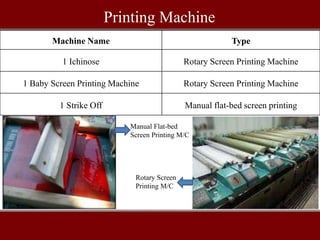
Printing Machine
Machine Name Type
1 Ichinose Rotary Screen Printing Machine
1 Baby Screen Printing Machine Rotary Screen Printing Machine
1 Strike Off Manual flat-bed screen printing
Manual Flat-bed
Screen Printing M/C
Rotary Screen
Printing M/C
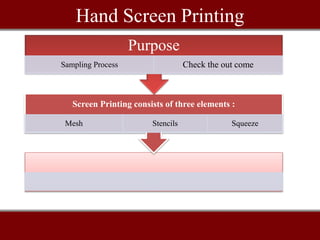
Hand Screen Printing
Screen Printing consists of three elements :
Mesh Stencils Squeeze
Purpose
Sampling Process Check the out come
Hand screen printing
• Printing process involves following steps:
 The print paste is prepared using binder, water and dyestuff.1 kg
binder is used for every 10 g of color.
 The table top is a sandwich of a rubber blanket, a cotton fabric and a
resin coated screen.
 The fabric is glued on to the table top & the screen is placed over the
fabric; the print paste is poured over it and spread on the fabric
manually by a wooden squeegee.
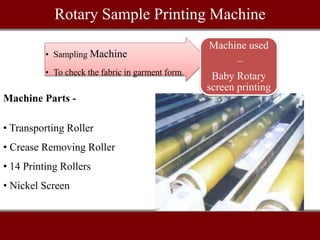
Rotary Sample Printing Machine
• Sampling Machine
• To check the fabric in garment form.
Machine used
–
Baby Rotary
screen printing
Machine Parts -
• Transporting Roller
• Crease Removing Roller
• 14 Printing Rollers
• Nickel Screen
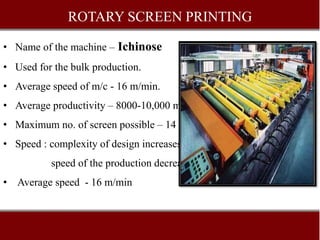
ROTARY SCREEN PRINTING
• Name of the machine – Ichinose
• Used for the bulk production.
• Average speed of m/c - 16 m/min.
• Average productivity – 8000-10,000 m/shift
• Maximum no. of screen possible – 14
• Speed : complexity of design increases –
speed of the production decreases.
• Average speed - 16 m/min
Steps in Printing Process
A typical Printing process involves:
 Preparation of print paste
 Printing of fabric
 Drying
 Fixation of dyestuff
 Washing-off
1. Preparation of printing paste: Type of specific formulation used
depends on the fibre, the colorant system used and to some extent the
type of printing machine.
2. Printing of fabric: Dye or pigment paste is applied to the
substrate using different techniques.
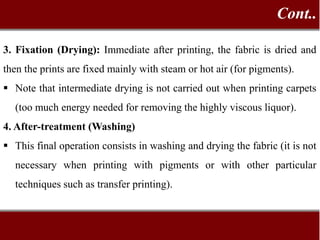
3. Fixation (Drying): Immediate after printing, the fabric is dried and
then the prints are fixed mainly with steam or hot air (for pigments).
 Note that intermediate drying is not carried out when printing carpets
(too much energy needed for removing the highly viscous liquor).
4. After-treatment (Washing)
 This final operation consists in washing and drying the fabric (it is not
necessary when printing with pigments or with other particular
techniques such as transfer printing).
Cont..
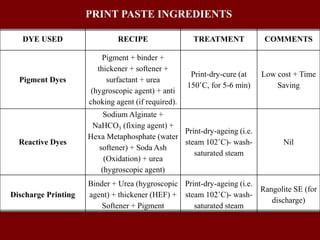
DYE USED RECIPE TREATMENT COMMENTS
Pigment Dyes
Pigment + binder +
thickener + softener +
surfactant + urea
(hygroscopic agent) + anti
choking agent (if required).
Print-dry-cure (at
150˚C, for 5-6 min)
Low cost + Time
Saving
Reactive Dyes
Sodium Alginate +
NaHCO3 (fixing agent) +
Hexa Metaphosphate (water
softener) + Soda Ash
(Oxidation) + urea
(hygroscopic agent)
Print-dry-ageing (i.e.
steam 102˚C)- wash-
saturated steam
Nil
Discharge Printing
Binder + Urea (hygroscopic
agent) + thickener (HEF) +
Softener + Pigment
Print-dry-ageing (i.e.
steam 102˚C)- wash-
saturated steam
Rangolite SE (for
discharge)
PRINT PASTE INGREDIENTS
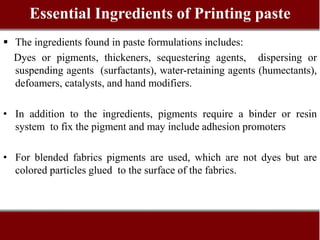
Essential Ingredients of Printing paste
 The ingredients found in paste formulations includes:
Dyes or pigments, thickeners, sequestering agents, dispersing or
suspending agents (surfactants), water-retaining agents (humectants),
defoamers, catalysts, and hand modifiers.
• In addition to the ingredients, pigments require a binder or resin
system to fix the pigment and may include adhesion promoters
• For blended fabrics pigments are used, which are not dyes but are
colored particles glued to the surface of the fabrics.
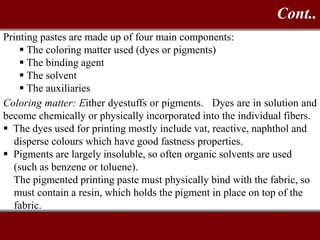
Printing pastes are made up of four main components:
 The coloring matter used (dyes or pigments)
 The binding agent
 The solvent
 The auxiliaries
Coloring matter: Either dyestuffs or pigments. Dyes are in solution and
become chemically or physically incorporated into the individual fibers.
 The dyes used for printing mostly include vat, reactive, naphthol and
disperse colours which have good fastness properties.
 Pigments are largely insoluble, so often organic solvents are used
(such as benzene or toluene).
The pigmented printing paste must physically bind with the fabric, so
must contain a resin, which holds the pigment in place on top of the
fabric.
Cont..
Binder: Responsible for the fastness of the pigment prints during use.
The most important fastnesses are wash fastness, chemical cleaning
fastness and friction fastness.
 Binders are “self-crosslinking polymers” mainly on acrylates,
butadiene and vinyl acetate, with solid contents of approx.. 40 - 50%.
 Binders made of natural wood resin, wax stand linseed or safflower
oils and chitosan , when using chitosan as a binder, and no solvent is
necessary.
Solvents: Usually added in the formulation of the thickeners.
 Type of paste (emulsion or plastisol) and thickening agent determines
the type of solvent needed.
 White spirit is commonly used organic solvent.
 The organic solvent concentration in print pastes may vary from
0 - 60% , with no consistent ration of organic solvent to water.
Cont..
Generally, the auxiliaries used for printing are the same as those used in
dyeing with a dye bath. These types of auxiliaries include:
Thickener: To make viscous paste of dyes in water, a thickener is used.
 Thickeners used depends on the printing technique and fabric and
dyestuff used.
 Thickening agents are starch derivatives, flour, gum Senegal and gum
arabic and albumin and sodium alginate.
 Starch used to be the most preferred of all the thickenings, but
nowadays gums or alginates derived from seaweed is preferred as they
allow better penetration of color and are easier to wash out.
Wetting agent: It helps in obtaining a smooth paste of dyes without any
lumps, for example: TRO and ethylene oxide condensator.
Cont..
Defoaming agent: Formation of foam during print paste preparation and
application is quite common but should be avoided. Foam may produce
specky dyeing. The antifoaming agents help in foam generation.
E.g. Silicon compounds, organic & inorganic esters, aliphatic esters, etc.
Acid or alkali: Depending on the types of dyes used in printing, acid or
alkali is used in the print paste. An acid liberating salt is commonly used,
For example ammonium chloride and diammonium hydrogen phosphate.
For reactive printing on cotton, sodium carbonate or sodium bicarbonate
are used.
Cont..
Oxidizing or reducing agent: They are used in printing with solubilized
vat colors and also in discharge and resist printing. Discharging agents
such as sodium sulphoxylate formaldehyde are used in the discharge
printing. E.g. m-nitrobene sulphonate, sodium chlorate, H2O2, sodium
dithionite, formaldehyde sulphoxylates, thiourea dioxide, tin (II) chloride
Hygroscopic agents: The function of hygroscopic agents is to take up
sufficient amount of water (moisture) during steaming to give mobility to
the dyes to move into the fibre. Eg. Urea and Glycerin.
Cont..
Dispersing agent: Dispersing agents are necessary in the print paste to
prevent aggregation of the dyestuff in the highly concentrated pastes.
E.g. Diethylene glycol.
Preservatives: Used to prevent the action of bacteria and fungus to make
it dilute. E.g. Salicylic acid.
Carriers: Cresotinic acid methyl ester, trichlorobenzene, n-butyl
phthalimide in combination with other phthalimides, methylnaphthalene)
Retarders: Derivatives of quaternary amines, leveling agents
Resist agents: zinc oxide, alkalis, amines, complexing agents
Metal complexes : copper or nickel salts of sarcosine or
hydroxyethylsarcosine)
Cont..
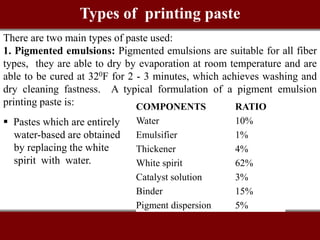
There are two main types of paste used:
1. Pigmented emulsions: Pigmented emulsions are suitable for all fiber
types, they are able to dry by evaporation at room temperature and are
able to be cured at 320F for 2 - 3 minutes, which achieves washing and
dry cleaning fastness. A typical formulation of a pigment emulsion
printing paste is: COMPONENTS RATIO
Water 10%
Emulsifier 1%
Thickener 4%
White spirit 62%
Catalyst solution 3%
Binder 15%
Pigment dispersion 5%
 Pastes which are entirely
water-based are obtained
by replacing the white
spirit with water.
Types of printing paste
2. Plastisol printing pastes: Based on a vinyl resin dispersed in
plasticizer; characterized by virtually 100% non-volatility (no solvent is
present); used frequently for printing on dark or dark-colored
fabrics. Components of plastisol printing pastes consist of
 PVC homopolymer (i.e., a vinyl resin) dispersed in phthalate
plasticizer;
 liquid plasticizer (i.e., dialkyl phthalate or di-iso-octyl phthalate);
 heat and light stabilisers (i.e., liquid barium/cadmium/zinc
combined with epoxy plasticizer);
 high proportion of extender to improve wet-on-wet properties.
Cont..
Printing paste preparation
 All the necessary ingredients for the paste are metered (dosed) and
mixed together in a mixing station.
 Since between 5 and 10 different printing pastes are usually necessary
to print a single pattern.
 In order to reduce losses, due to incorrect measurement, the
preparation of the pastes is done in automatic stations.
 In modern plants, with the help of special devices, the exact amount of
printing paste required is determined and prepared in continuous mode
for each printing position, thus reducing leftovers at the end of the run.
Fixation processes
 After printing, the fabric is dried. Water evaporation leads to an
increase in dye concentration and at the same time prevents the
colours from smearing when the fabric is transported over the guide
rollers. At this stage the dye is not yet fixed.
 The aim of the subsequent fixation step is to transport as much as
possible of the dye, which is retained by the thickener, into the fibres.
This is especially important with dyes, such as vat dyes, for example,
that are printed in the insoluble form and are converted into the
corresponding soluble state only after reaction with the reducing
agents during the fixation process.
Fixation Methods
1. Atmospheric steam
Treatment at 2120F with saturated steam.
Used with direct dyes, vat dyes, napthol dyes, acid dyes, cationic
dyes, reactive dyes.
Festoon steamer most common equipment
Acid agar for acid dyes.
2. Pressure steam
Treatment at 2300F under pressure
Used with disperse dyes
Turbo-autoclave most common equipment.
3. High temperature steam
Treatment with superheated steam at temperature up to 4200F.
Used with disperse dyes and pigments
Can also be used as an atmospheric steamer.
4. Dry heat
Treatment with dry heat at temperature up to 4200F.
Used with disperse dyes and reactive dyes.
Cont..
Fixation Methods after Printing with Disperse Dyes
After printing with disperse dyes the dyes is fixed on the
fabric by one of the following dye- fixation methods,
1. Thermo fixation
2. Super Heated Steaming
3. High Pressure Steaming
The features of this method of dye fixation are:
1. No steam is used.
2. Dye is fixed by subjecting the print to hot air at 2100C for 1 minute.
3. The fixation is carried out in a backing oven or in a stenter where heat
setting can also be done simultaneously.
4. The process productivity is high.
5. The dye which have good sublimation fastness are subjected to this
thermofixation process.
6. There is 10-15% loss of colour in thermofixation, so the shade
becomes dull.
7. It is a continuous process of dye fixation which gives high production.
Thermofixation
Super Heated Steaming
The features of this method of dye fixation are:
1. It is a continuous process of dye fixation.
2. This method is the best of the three methods.
3. Dye is fixed at 1000-1800C for 2-1 minutes by radiators.
4. Higher productivity.
5. No loss of color.
6. Dyes with medium sublimation fastness can be applied.
7. The fabric handle is very soft.
High Pressure Steaming
The features of this method of dye fixation are :
1. Discontinuous process of dye fixation
2. Low productivity.
3. Dye fixation is done by high pressure steam.
4. Low production so costly process.
5. Dyes with low sublimation fastness can be applied.
6. It gives good Colour yield and bright print & smoothness.
The Essential Requirements in all Print Fixation Processes
 The pick-up of enough water to swell the thickener film, but not so
much as to cause the print to spread.
 Dispersion and solution of the dye, and production of a liquid medium
through which the dye can diffuse to the fibre surface.
 Absorption of water by fibres such as cotton, nylon and wool, which
must be swollen to allow penetration of dye.
 Raising the temperature to a level that accelerates the processes of
diffusion, especially into the fibre.
In some cases steam can satisfy all the requirements but, as in all
coloration processes, auxiliary chemicals may be introduced to assist dye
solution and diffusion, or to make the process less critically dependent on
the maintenance of ideal conditions.
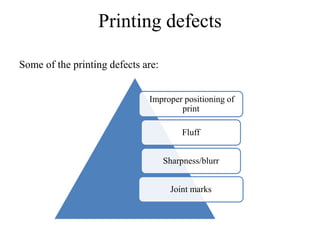
Printing defects
Some of the printing defects are:
Improper positioning of
print
Fluff
Sharpness/blurr
Joint marks

Printing Methods & Styles

  • 1.
    Printing Textile Printing - Methods& Styles - Ingredients of Printing paste - Printing paste preparation - Fixation & after-treatment process May, 2016 Dr. RAMESH DURAISAMY Asso.Professor, Dept. of Chemistry College of Natural Sciences, Arba Minch University Arba Minch, Ethiopia (East Africa)
  • 2.
    Printing • Printing isthe process of applying color to fabric in defined areas to obtain the desired pattern. • In properly printed fabrics the color is bonded with the fiber, so as to resist washing and friction. • Textile printing is related to dyeing but, where as in dyeing proper the whole fabric is uniformly covered with one color, in printing one or more colors are applied in certain parts only. • Textile printing is one of the procedures of textile decoration. Textile printing requires the correct coordination between the printing machinery support and the human skill for producing the best of the results. • In printing, wooden blocks, stencils, engraved plates, rollers, or silk screens are used to place colors on the fabric. • Pigment dyes and reactive dyes are used in the company.
  • 3.
    There are broadlycategorized into four types of printing: (i) Direct printing (ii) Mordant printing (iii) Resist printing (iv) Discharge printing  Direct printing, in which colorants containing dyes, thickeners, and the mordant or substances necessary for fixing the colour on the cloth are printed in the desired pattern.  Printing of a mordant in the desired pattern prior to dyeing cloth; the colour adheres only where the mordant was printed. Types / Styles of Printing
  • 4.
     Resist printing,in which a wax or other substance is printed onto fabric which is subsequently dyed. The waxed areas do not accept the dye, leaving uncoloured patterns against a coloured ground.  Discharge printing, in which a bleaching agent is printed onto previously dyed fabrics to remove some or the entire colour.
  • 5.
    Printing is carriedout with different instruments. Different methods are use to produce impression on fabric. Methods of printing differ on the demand of user. Also, it depends on the materials type and type of purpose of end product use. The following methods can be applied for textile printing operation. They are as follows: 1. Block printing 10. Photo printing 2. Burn-out printing 11. Rotary Screen printing 3. Blotch printing 12. Screen printing 4. Digital printing 13. Stencil printing 5. Duplex printing 14. Jet spray printing 6. Engraved roller printing 16. Transfer printing 7. Electrostatic printing 17. Warp printing 8. Flock printing 18. Spray printing 9. Ink-jet printing 19. Tie and Batik dyeing (special method) Methods of Printing
  • 6.
    Printing Machine Machine NameType 1 Ichinose Rotary Screen Printing Machine 1 Baby Screen Printing Machine Rotary Screen Printing Machine 1 Strike Off Manual flat-bed screen printing Manual Flat-bed Screen Printing M/C Rotary Screen Printing M/C
  • 7.
    Hand Screen Printing ScreenPrinting consists of three elements : Mesh Stencils Squeeze Purpose Sampling Process Check the out come
  • 8.
    Hand screen printing •Printing process involves following steps:  The print paste is prepared using binder, water and dyestuff.1 kg binder is used for every 10 g of color.  The table top is a sandwich of a rubber blanket, a cotton fabric and a resin coated screen.  The fabric is glued on to the table top & the screen is placed over the fabric; the print paste is poured over it and spread on the fabric manually by a wooden squeegee.
  • 9.
    Rotary Sample PrintingMachine • Sampling Machine • To check the fabric in garment form. Machine used – Baby Rotary screen printing Machine Parts - • Transporting Roller • Crease Removing Roller • 14 Printing Rollers • Nickel Screen
  • 10.
    ROTARY SCREEN PRINTING •Name of the machine – Ichinose • Used for the bulk production. • Average speed of m/c - 16 m/min. • Average productivity – 8000-10,000 m/shift • Maximum no. of screen possible – 14 • Speed : complexity of design increases – speed of the production decreases. • Average speed - 16 m/min
  • 11.
    Steps in PrintingProcess A typical Printing process involves:  Preparation of print paste  Printing of fabric  Drying  Fixation of dyestuff  Washing-off 1. Preparation of printing paste: Type of specific formulation used depends on the fibre, the colorant system used and to some extent the type of printing machine. 2. Printing of fabric: Dye or pigment paste is applied to the substrate using different techniques.
  • 12.
    3. Fixation (Drying):Immediate after printing, the fabric is dried and then the prints are fixed mainly with steam or hot air (for pigments).  Note that intermediate drying is not carried out when printing carpets (too much energy needed for removing the highly viscous liquor). 4. After-treatment (Washing)  This final operation consists in washing and drying the fabric (it is not necessary when printing with pigments or with other particular techniques such as transfer printing). Cont..
  • 13.
    DYE USED RECIPETREATMENT COMMENTS Pigment Dyes Pigment + binder + thickener + softener + surfactant + urea (hygroscopic agent) + anti choking agent (if required). Print-dry-cure (at 150˚C, for 5-6 min) Low cost + Time Saving Reactive Dyes Sodium Alginate + NaHCO3 (fixing agent) + Hexa Metaphosphate (water softener) + Soda Ash (Oxidation) + urea (hygroscopic agent) Print-dry-ageing (i.e. steam 102˚C)- wash- saturated steam Nil Discharge Printing Binder + Urea (hygroscopic agent) + thickener (HEF) + Softener + Pigment Print-dry-ageing (i.e. steam 102˚C)- wash- saturated steam Rangolite SE (for discharge) PRINT PASTE INGREDIENTS
  • 14.
    Essential Ingredients ofPrinting paste  The ingredients found in paste formulations includes: Dyes or pigments, thickeners, sequestering agents, dispersing or suspending agents (surfactants), water-retaining agents (humectants), defoamers, catalysts, and hand modifiers. • In addition to the ingredients, pigments require a binder or resin system to fix the pigment and may include adhesion promoters • For blended fabrics pigments are used, which are not dyes but are colored particles glued to the surface of the fabrics.
  • 15.
    Printing pastes aremade up of four main components:  The coloring matter used (dyes or pigments)  The binding agent  The solvent  The auxiliaries Coloring matter: Either dyestuffs or pigments. Dyes are in solution and become chemically or physically incorporated into the individual fibers.  The dyes used for printing mostly include vat, reactive, naphthol and disperse colours which have good fastness properties.  Pigments are largely insoluble, so often organic solvents are used (such as benzene or toluene). The pigmented printing paste must physically bind with the fabric, so must contain a resin, which holds the pigment in place on top of the fabric. Cont..
  • 16.
    Binder: Responsible forthe fastness of the pigment prints during use. The most important fastnesses are wash fastness, chemical cleaning fastness and friction fastness.  Binders are “self-crosslinking polymers” mainly on acrylates, butadiene and vinyl acetate, with solid contents of approx.. 40 - 50%.  Binders made of natural wood resin, wax stand linseed or safflower oils and chitosan , when using chitosan as a binder, and no solvent is necessary. Solvents: Usually added in the formulation of the thickeners.  Type of paste (emulsion or plastisol) and thickening agent determines the type of solvent needed.  White spirit is commonly used organic solvent.  The organic solvent concentration in print pastes may vary from 0 - 60% , with no consistent ration of organic solvent to water. Cont..
  • 17.
    Generally, the auxiliariesused for printing are the same as those used in dyeing with a dye bath. These types of auxiliaries include: Thickener: To make viscous paste of dyes in water, a thickener is used.  Thickeners used depends on the printing technique and fabric and dyestuff used.  Thickening agents are starch derivatives, flour, gum Senegal and gum arabic and albumin and sodium alginate.  Starch used to be the most preferred of all the thickenings, but nowadays gums or alginates derived from seaweed is preferred as they allow better penetration of color and are easier to wash out. Wetting agent: It helps in obtaining a smooth paste of dyes without any lumps, for example: TRO and ethylene oxide condensator. Cont..
  • 18.
    Defoaming agent: Formationof foam during print paste preparation and application is quite common but should be avoided. Foam may produce specky dyeing. The antifoaming agents help in foam generation. E.g. Silicon compounds, organic & inorganic esters, aliphatic esters, etc. Acid or alkali: Depending on the types of dyes used in printing, acid or alkali is used in the print paste. An acid liberating salt is commonly used, For example ammonium chloride and diammonium hydrogen phosphate. For reactive printing on cotton, sodium carbonate or sodium bicarbonate are used. Cont..
  • 19.
    Oxidizing or reducingagent: They are used in printing with solubilized vat colors and also in discharge and resist printing. Discharging agents such as sodium sulphoxylate formaldehyde are used in the discharge printing. E.g. m-nitrobene sulphonate, sodium chlorate, H2O2, sodium dithionite, formaldehyde sulphoxylates, thiourea dioxide, tin (II) chloride Hygroscopic agents: The function of hygroscopic agents is to take up sufficient amount of water (moisture) during steaming to give mobility to the dyes to move into the fibre. Eg. Urea and Glycerin. Cont..
  • 20.
    Dispersing agent: Dispersingagents are necessary in the print paste to prevent aggregation of the dyestuff in the highly concentrated pastes. E.g. Diethylene glycol. Preservatives: Used to prevent the action of bacteria and fungus to make it dilute. E.g. Salicylic acid. Carriers: Cresotinic acid methyl ester, trichlorobenzene, n-butyl phthalimide in combination with other phthalimides, methylnaphthalene) Retarders: Derivatives of quaternary amines, leveling agents Resist agents: zinc oxide, alkalis, amines, complexing agents Metal complexes : copper or nickel salts of sarcosine or hydroxyethylsarcosine) Cont..
  • 21.
    There are twomain types of paste used: 1. Pigmented emulsions: Pigmented emulsions are suitable for all fiber types, they are able to dry by evaporation at room temperature and are able to be cured at 320F for 2 - 3 minutes, which achieves washing and dry cleaning fastness. A typical formulation of a pigment emulsion printing paste is: COMPONENTS RATIO Water 10% Emulsifier 1% Thickener 4% White spirit 62% Catalyst solution 3% Binder 15% Pigment dispersion 5%  Pastes which are entirely water-based are obtained by replacing the white spirit with water. Types of printing paste
  • 22.
    2. Plastisol printingpastes: Based on a vinyl resin dispersed in plasticizer; characterized by virtually 100% non-volatility (no solvent is present); used frequently for printing on dark or dark-colored fabrics. Components of plastisol printing pastes consist of  PVC homopolymer (i.e., a vinyl resin) dispersed in phthalate plasticizer;  liquid plasticizer (i.e., dialkyl phthalate or di-iso-octyl phthalate);  heat and light stabilisers (i.e., liquid barium/cadmium/zinc combined with epoxy plasticizer);  high proportion of extender to improve wet-on-wet properties. Cont..
  • 23.
    Printing paste preparation All the necessary ingredients for the paste are metered (dosed) and mixed together in a mixing station.  Since between 5 and 10 different printing pastes are usually necessary to print a single pattern.  In order to reduce losses, due to incorrect measurement, the preparation of the pastes is done in automatic stations.  In modern plants, with the help of special devices, the exact amount of printing paste required is determined and prepared in continuous mode for each printing position, thus reducing leftovers at the end of the run.
  • 24.
    Fixation processes  Afterprinting, the fabric is dried. Water evaporation leads to an increase in dye concentration and at the same time prevents the colours from smearing when the fabric is transported over the guide rollers. At this stage the dye is not yet fixed.  The aim of the subsequent fixation step is to transport as much as possible of the dye, which is retained by the thickener, into the fibres. This is especially important with dyes, such as vat dyes, for example, that are printed in the insoluble form and are converted into the corresponding soluble state only after reaction with the reducing agents during the fixation process.
  • 25.
    Fixation Methods 1. Atmosphericsteam Treatment at 2120F with saturated steam. Used with direct dyes, vat dyes, napthol dyes, acid dyes, cationic dyes, reactive dyes. Festoon steamer most common equipment Acid agar for acid dyes. 2. Pressure steam Treatment at 2300F under pressure Used with disperse dyes Turbo-autoclave most common equipment.
  • 26.
    3. High temperaturesteam Treatment with superheated steam at temperature up to 4200F. Used with disperse dyes and pigments Can also be used as an atmospheric steamer. 4. Dry heat Treatment with dry heat at temperature up to 4200F. Used with disperse dyes and reactive dyes. Cont..
  • 27.
    Fixation Methods afterPrinting with Disperse Dyes After printing with disperse dyes the dyes is fixed on the fabric by one of the following dye- fixation methods, 1. Thermo fixation 2. Super Heated Steaming 3. High Pressure Steaming
  • 28.
    The features ofthis method of dye fixation are: 1. No steam is used. 2. Dye is fixed by subjecting the print to hot air at 2100C for 1 minute. 3. The fixation is carried out in a backing oven or in a stenter where heat setting can also be done simultaneously. 4. The process productivity is high. 5. The dye which have good sublimation fastness are subjected to this thermofixation process. 6. There is 10-15% loss of colour in thermofixation, so the shade becomes dull. 7. It is a continuous process of dye fixation which gives high production. Thermofixation
  • 29.
    Super Heated Steaming Thefeatures of this method of dye fixation are: 1. It is a continuous process of dye fixation. 2. This method is the best of the three methods. 3. Dye is fixed at 1000-1800C for 2-1 minutes by radiators. 4. Higher productivity. 5. No loss of color. 6. Dyes with medium sublimation fastness can be applied. 7. The fabric handle is very soft.
  • 30.
    High Pressure Steaming Thefeatures of this method of dye fixation are : 1. Discontinuous process of dye fixation 2. Low productivity. 3. Dye fixation is done by high pressure steam. 4. Low production so costly process. 5. Dyes with low sublimation fastness can be applied. 6. It gives good Colour yield and bright print & smoothness.
  • 31.
    The Essential Requirementsin all Print Fixation Processes  The pick-up of enough water to swell the thickener film, but not so much as to cause the print to spread.  Dispersion and solution of the dye, and production of a liquid medium through which the dye can diffuse to the fibre surface.  Absorption of water by fibres such as cotton, nylon and wool, which must be swollen to allow penetration of dye.  Raising the temperature to a level that accelerates the processes of diffusion, especially into the fibre. In some cases steam can satisfy all the requirements but, as in all coloration processes, auxiliary chemicals may be introduced to assist dye solution and diffusion, or to make the process less critically dependent on the maintenance of ideal conditions.
  • 32.
    Printing defects Some ofthe printing defects are: Improper positioning of print Fluff Sharpness/blurr Joint marks