Chapter No. 4
Water Management (6 to 8 Marks Theory)
Content of the Topic:
Part A:-
•Sources of water
•Introduction to Dams
•Types of Dams
•Introduction to canals
Part B:-
• Methods of Irrigation
• Rain water Harvesting
Prepared by Mr. KORE P. N.
Questions from University Paper
• Name and explain different methods of irrigation. (4 Mks)
• Name different methods of irrigation. (2 Mks)
• Explain rain water harvesting with neat sketch. (4 Mks)
• Enlist types of Dam. Explain any one with sketch.(4 Mks)
• Draw the cross section of concrete dam and show various
level? (4 Mks)
• Selection of Dam site.
• Write short note on: (4 Mks) each
•Methods of Irrigation
•Sources of water
•Types of Dams
•Drip Irrigation
Prepared by Mr. KORE P. N.
Part-I
What is Water Management?
Water management is an activity of planning, developing,
distributing and managing the optimum use of limited water
resources under defined water policies and regulations.
Why water management?
•India- Agricultural land
•Main Source of water- Rain
•Rainfall- Uncertain
- Unpredictable
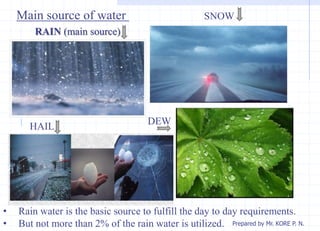
•Types of rainfall- rain, hail, snow and dew (shown in Following Fig.)
•Use of water for remaining months of year
Prepared by Mr. KORE P. N.
RAIN (main source)
HAIL
SNOWMain source of water
DEW
• Rain water is the basic source to fulfill the day to day requirements.
• But not more than 2% of the rain water is utilized. Prepared by Mr. KORE P. N.
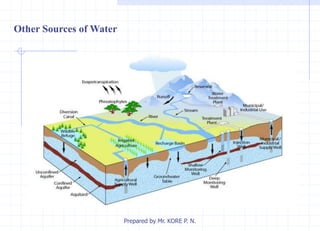
Other Sources of Water
Prepared by Mr. KORE P. N.
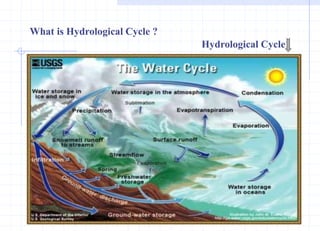
What is Hydrological Cycle ?
Hydrological Cycle
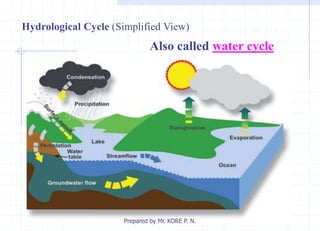
Hydrological Cycle (Simplified View)
Also called water cycle
Prepared by Mr. KORE P. N.
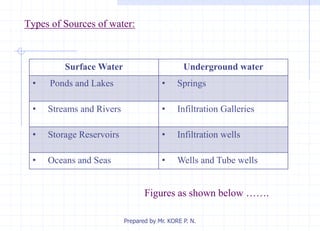
Types of Sources of water:
Surface Water Underground water
• Ponds and Lakes • Springs
• Streams and Rivers • Infiltration Galleries
• Storage Reservoirs • Infiltration wells
• Oceans and Seas • Wells and Tube wells
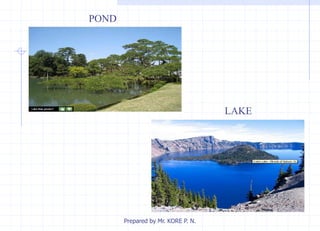
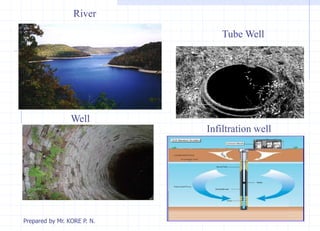
Figures as shown below …….
Prepared by Mr. KORE P. N.
POND
LAKE
Prepared by Mr. KORE P. N.
Tube Well
Well
Infiltration well
River
Prepared by Mr. KORE P. N.
DAMS
Content:
• Introduction
• Selection of Dam site
• Types of Dams
Prepared by Mr. KORE P. N.
Canal
Content:
• Introduction
• Types of Canals
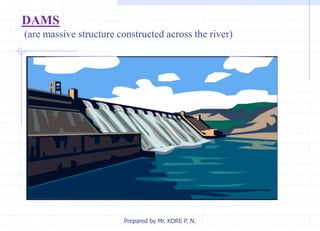
DAMS
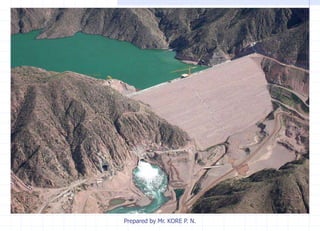
(are massive structure constructed across the river)
Prepared by Mr. KORE P. N.
Storage reservoir
• It is an artificial lake formed on the upstream side of the river by
constructing a dam (or barrier) across it.
• So the constructed barrier will form a reservoir which can be utilized
as a source of public water supply through canals and sub-canals.
• Therefore we have to study
•Dams (source)
•Canals (supply)
•Method of irrigation or systems of irrigation (procedure)
Prepared by Mr. KORE P. N.
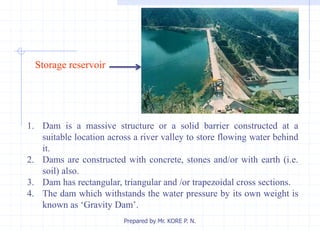
1. Dam is a massive structure or a solid barrier constructed at a
suitable location across a river valley to store flowing water behind
it.
2. Dams are constructed with concrete, stones and/or with earth (i.e.
soil) also.
3. Dam has rectangular, triangular and /or trapezoidal cross sections.
4. The dam which withstands the water pressure by its own weight is
known as ‘Gravity Dam’.
Storage reservoir
Prepared by Mr. KORE P. N.
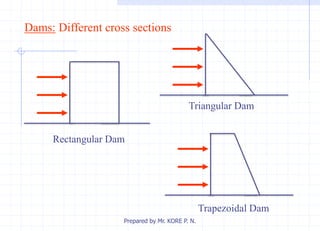
Dams: Different cross sections
Rectangular Dam
Triangular Dam
Trapezoidal Dam
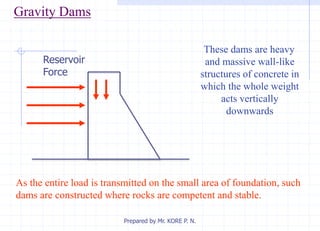
Gravity Dams
These dams are heavy
and massive wall-like
structures of concrete in
which the whole weight
acts vertically
downwards
Reservoir
Force
As the entire load is transmitted on the small area of foundation, such
dams are constructed where rocks are competent and stable.
Prepared by Mr. KORE P. N.
Selection of Dam Site:
1. Availability of suitable foundation
2. The river valley should be narrow at dam site (it becomes economical).
3. The river valley should be wide at upstream side (to store maximum water).
4. The river bed level at the dam site should be at higher than the river basin.
5. Site for spillway should be availability near to the dam site.
6. Nearness of the locality.
7. The reservoir basin should be leak proof.
8. Minimum land and property should be submerged.
9. The dam site should be accessible to the cities.
10. The project should meet the increased demand in future.
Prepared by Mr. KORE P. N.
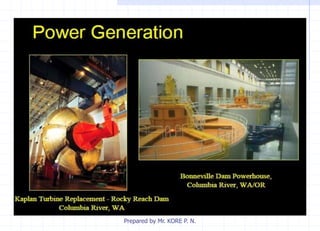
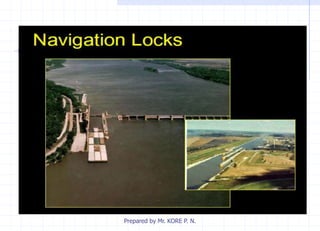
Stored water is utilized for following purpose:
• Drought and flood control
• Generation of hydropower
• Irrigation
• Water for domestic consumption
• For navigational facilities
• Other additional utilization is to develop fisheries.
Prepared by Mr. KORE P. N.
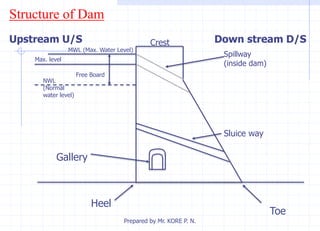
Structure of Dam
Heel
Gallery
Toe
Spillway
(inside dam)
Crest
NWL
(Normal
water level)
MWL (Max. Water Level)
Free Board
Sluice way
Upstream U/S Down stream D/S
Prepared by Mr. KORE P. N.
Max. level
Heel: contact with the ground on the upstream side
Toe: contact on the downstream side
Abutment: Sides of the valley on which the structure of the dam rest
Galleries: small rooms like structure left within the dam for checking
operations.
Diversion tunnel: Tunnels are constructed for diverting water before
the construction of dam. This helps in keeping the river bed dry.
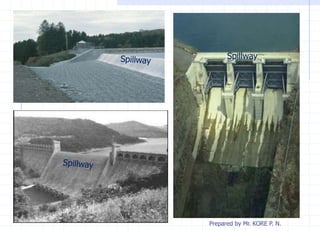
Spillways: It is the arrangement near the top to release the excess water
of the reservoir to downstream side
Sluice way: An opening in the dam near the ground level, which is used
to clear the silt accumulation in the reservoir side.
Prepared by Mr. KORE P. N.
Structure of Dam
Prepared by Mr. KORE P. N.
Spillway
TYPES OF DAMS
•Earth dam
•Rock-fill dam
•Solid- Masonry Gravity dam
•Hollow- Masonry Gravity dam
•Steel dam
•Timber dam
•Arch dam
Prepared by Mr. KORE P. N.
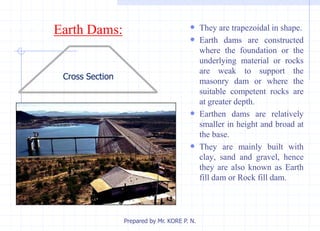
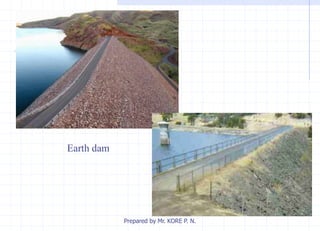
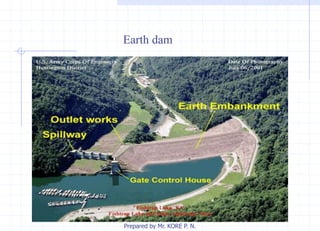
Earth Dams:  They are trapezoidal in shape.
 Earth dams are constructed
where the foundation or the
underlying material or rocks
are weak to support the
masonry dam or where the
suitable competent rocks are
at greater depth.
 Earthen dams are relatively
smaller in height and broad at
the base.
 They are mainly built with
clay, sand and gravel, hence
they are also known as Earth
fill dam or Rock fill dam.
Prepared by Mr. KORE P. N.
Cross Section
Earth dam
Prepared by Mr. KORE P. N.
Earth dam
Prepared by Mr. KORE P. N.
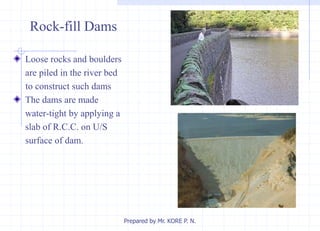
Loose rocks and boulders
are piled in the river bed
to construct such dams
The dams are made
water-tight by applying a
slab of R.C.C. on U/S
surface of dam.
Rock-fill Dams
Prepared by Mr. KORE P. N.
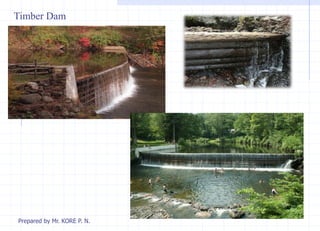
Timber Dam
Prepared by Mr. KORE P. N.
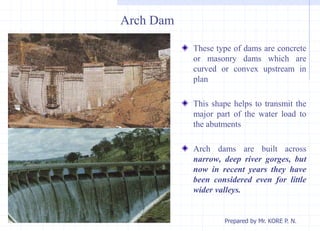
These type of dams are concrete
or masonry dams which are
curved or convex upstream in
plan
This shape helps to transmit the
major part of the water load to
the abutments
Arch dams are built across
narrow, deep river gorges, but
now in recent years they have
been considered even for little
wider valleys.
Arch Dam
Prepared by Mr. KORE P. N.
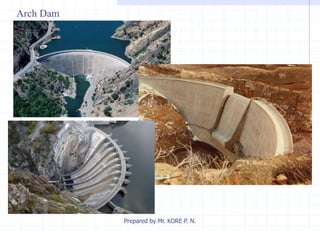
Arch Dam
Prepared by Mr. KORE P. N.
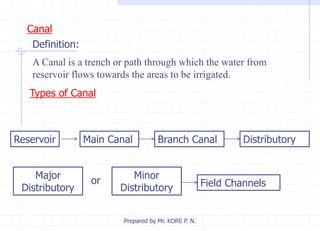
Canal
A Canal is a trench or path through which the water from
reservoir flows towards the areas to be irrigated.
Definition:
Types of Canal
Reservoir Main Canal Branch Canal Distributory
Major
Distributory
Minor
Distributory
or Field Channels
Prepared by Mr. KORE P. N.
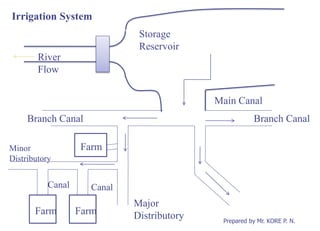
Storage
Reservoir
Branch Canal
Major
Distributory
Minor
Distributory
Farm Farm
Irrigation System
River
Flow
Main Canal
CanalCanal
Farm
Branch Canal
Prepared by Mr. KORE P. N.
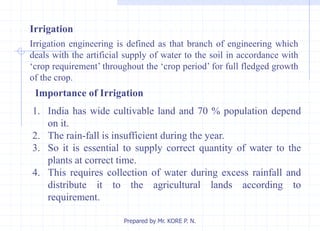
Irrigation
Irrigation engineering is defined as that branch of engineering which
deals with the artificial supply of water to the soil in accordance with
‘crop requirement’ throughout the ‘crop period’ for full fledged growth
of the crop.
Importance of Irrigation
1. India has wide cultivable land and 70 % population depend
on it.
2. The rain-fall is insufficient during the year.
3. So it is essential to supply correct quantity of water to the
plants at correct time.
4. This requires collection of water during excess rainfall and
distribute it to the agricultural lands according to
requirement.
Prepared by Mr. KORE P. N.
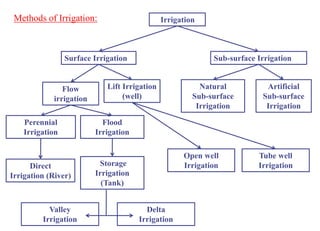
Irrigation
Surface Irrigation Sub-surface Irrigation
Flow
irrigation
Lift Irrigation
(well)
Natural
Sub-surface
Irrigation
Artificial
Sub-surface
Irrigation
Perennial
Irrigation
Flood
Irrigation
Direct
Irrigation (River)
Storage
Irrigation
(Tank)
Valley
Irrigation
Delta
Irrigation
Open well
Irrigation
Tube well
Irrigation
Methods of Irrigation:
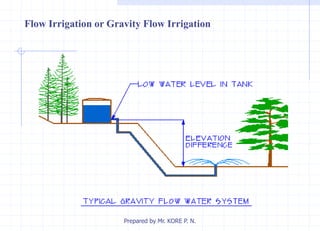
Flow Irrigation or Gravity Flow Irrigation
Prepared by Mr. KORE P. N.
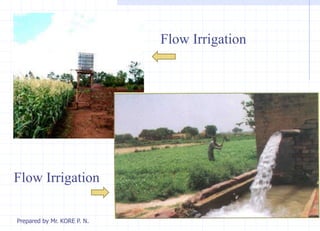
Flow Irrigation
Flow Irrigation
Prepared by Mr. KORE P. N.
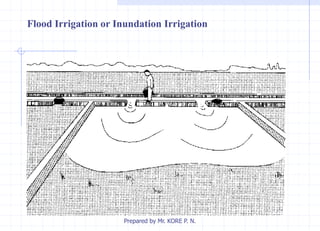
Flood Irrigation or Inundation Irrigation
Prepared by Mr. KORE P. N.
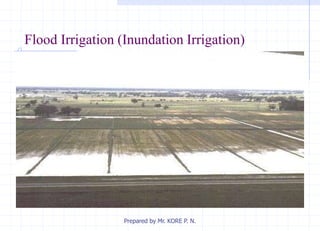
Flood Irrigation (Inundation Irrigation)
Prepared by Mr. KORE P. N.
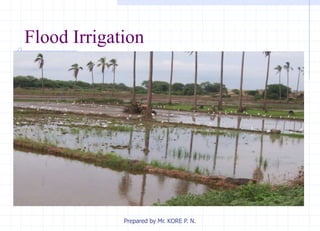
Flood Irrigation
Prepared by Mr. KORE P. N.
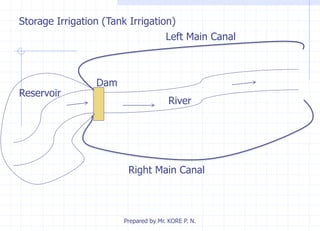
Left Main Canal
Right Main Canal
River
Reservoir
Dam
Storage Irrigation (Tank Irrigation)
Prepared by Mr. KORE P. N.
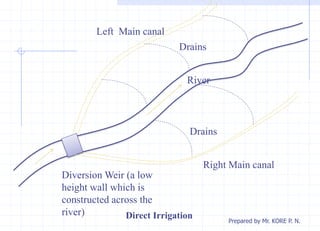
River
Left Main canal
Right Main canal
Diversion Weir (a low
height wall which is
constructed across the
river) Direct Irrigation
Drains
Drains
Prepared by Mr. KORE P. N.
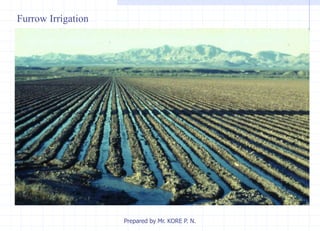
Furrow Irrigation
Prepared by Mr. KORE P. N.
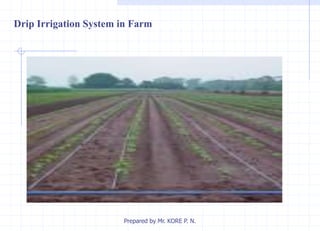
Drip Irrigation System in Farm
Prepared by Mr. KORE P. N.
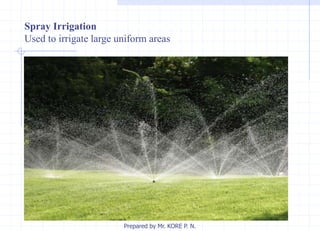
Spray Irrigation
Used to irrigate large uniform areas
Prepared by Mr. KORE P. N.
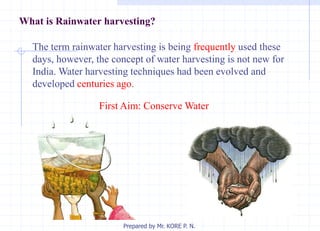
What is Rainwater harvesting?
The term rainwater harvesting is being frequently used these
days, however, the concept of water harvesting is not new for
India. Water harvesting techniques had been evolved and
developed centuries ago.
First Aim: Conserve Water
Prepared by Mr. KORE P. N.
• Ground water resource gets naturally recharged through
percolation.
• But due to rapid development of urbanization, exposed surface
for soil has been reduced drastically with resultant reduction in
percolation of rainwater, thereby depleting ground water
resource.
• Rainwater harvesting is the process in which their is filtration
of rainwater in to the underground formation by some artificial
methods.
What is the aim behind Rainwater harvesting?
How to harvest rainwater ? Broadly there are two
ways of harvesting
rainwater
Surface runoff
harvesting
Roof top
rainwater
harvesting
Prepared by Mr. KORE P. N.
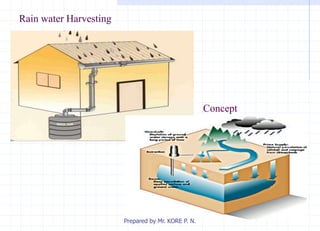
Rain water Harvesting
Concept
Prepared by Mr. KORE P. N.
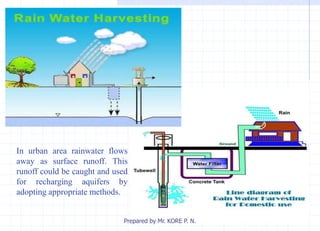
In urban area rainwater flows
away as surface runoff. This
runoff could be caught and used
for recharging aquifers by
adopting appropriate methods.
Prepared by Mr. KORE P. N.
Purpose of Rainwater harvesting
• To arrest ground water decline and augment ground water
table.
• To beneficiate water quality in aquifers.
• To conserve surface water runoff during monsoon.
• To reduce soil erosion.
• To inculcate a culture of water conservation.
Prepared by Mr. KORE P. N.

Water Management

  • 1.
    Chapter No. 4 WaterManagement (6 to 8 Marks Theory) Content of the Topic: Part A:- •Sources of water •Introduction to Dams •Types of Dams •Introduction to canals Part B:- • Methods of Irrigation • Rain water Harvesting Prepared by Mr. KORE P. N.
  • 2.
    Questions from UniversityPaper • Name and explain different methods of irrigation. (4 Mks) • Name different methods of irrigation. (2 Mks) • Explain rain water harvesting with neat sketch. (4 Mks) • Enlist types of Dam. Explain any one with sketch.(4 Mks) • Draw the cross section of concrete dam and show various level? (4 Mks) • Selection of Dam site. • Write short note on: (4 Mks) each •Methods of Irrigation •Sources of water •Types of Dams •Drip Irrigation Prepared by Mr. KORE P. N.
  • 3.
    Part-I What is WaterManagement? Water management is an activity of planning, developing, distributing and managing the optimum use of limited water resources under defined water policies and regulations. Why water management? •India- Agricultural land •Main Source of water- Rain •Rainfall- Uncertain - Unpredictable •Types of rainfall- rain, hail, snow and dew (shown in Following Fig.) •Use of water for remaining months of year Prepared by Mr. KORE P. N.
  • 4.
    RAIN (main source) HAIL SNOWMainsource of water DEW • Rain water is the basic source to fulfill the day to day requirements. • But not more than 2% of the rain water is utilized. Prepared by Mr. KORE P. N.
  • 5.
    Other Sources ofWater Prepared by Mr. KORE P. N.
  • 6.
    What is HydrologicalCycle ? Hydrological Cycle
  • 7.
    Hydrological Cycle (SimplifiedView) Also called water cycle Prepared by Mr. KORE P. N.
  • 8.
    Types of Sourcesof water: Surface Water Underground water • Ponds and Lakes • Springs • Streams and Rivers • Infiltration Galleries • Storage Reservoirs • Infiltration wells • Oceans and Seas • Wells and Tube wells Figures as shown below ……. Prepared by Mr. KORE P. N.
  • 9.
  • 10.
  • 11.
    DAMS Content: • Introduction • Selectionof Dam site • Types of Dams Prepared by Mr. KORE P. N. Canal Content: • Introduction • Types of Canals
  • 12.
    DAMS (are massive structureconstructed across the river) Prepared by Mr. KORE P. N.
  • 13.
    Storage reservoir • Itis an artificial lake formed on the upstream side of the river by constructing a dam (or barrier) across it. • So the constructed barrier will form a reservoir which can be utilized as a source of public water supply through canals and sub-canals. • Therefore we have to study •Dams (source) •Canals (supply) •Method of irrigation or systems of irrigation (procedure) Prepared by Mr. KORE P. N.
  • 14.
    1. Dam isa massive structure or a solid barrier constructed at a suitable location across a river valley to store flowing water behind it. 2. Dams are constructed with concrete, stones and/or with earth (i.e. soil) also. 3. Dam has rectangular, triangular and /or trapezoidal cross sections. 4. The dam which withstands the water pressure by its own weight is known as ‘Gravity Dam’. Storage reservoir Prepared by Mr. KORE P. N.
  • 15.
    Prepared by Mr.KORE P. N. Dams: Different cross sections Rectangular Dam Triangular Dam Trapezoidal Dam
  • 16.
    Gravity Dams These damsare heavy and massive wall-like structures of concrete in which the whole weight acts vertically downwards Reservoir Force As the entire load is transmitted on the small area of foundation, such dams are constructed where rocks are competent and stable. Prepared by Mr. KORE P. N.
  • 17.
    Selection of DamSite: 1. Availability of suitable foundation 2. The river valley should be narrow at dam site (it becomes economical). 3. The river valley should be wide at upstream side (to store maximum water). 4. The river bed level at the dam site should be at higher than the river basin. 5. Site for spillway should be availability near to the dam site. 6. Nearness of the locality. 7. The reservoir basin should be leak proof. 8. Minimum land and property should be submerged. 9. The dam site should be accessible to the cities. 10. The project should meet the increased demand in future. Prepared by Mr. KORE P. N.
  • 18.
    Stored water isutilized for following purpose: • Drought and flood control • Generation of hydropower • Irrigation • Water for domestic consumption • For navigational facilities • Other additional utilization is to develop fisheries. Prepared by Mr. KORE P. N.
  • 19.
    Prepared by Mr.KORE P. N.
  • 20.
    Prepared by Mr.KORE P. N.
  • 21.
    Prepared by Mr.KORE P. N.
  • 22.
    Prepared by Mr.KORE P. N.
  • 23.
    Structure of Dam Heel Gallery Toe Spillway (insidedam) Crest NWL (Normal water level) MWL (Max. Water Level) Free Board Sluice way Upstream U/S Down stream D/S Prepared by Mr. KORE P. N. Max. level
  • 24.
    Heel: contact withthe ground on the upstream side Toe: contact on the downstream side Abutment: Sides of the valley on which the structure of the dam rest Galleries: small rooms like structure left within the dam for checking operations. Diversion tunnel: Tunnels are constructed for diverting water before the construction of dam. This helps in keeping the river bed dry. Spillways: It is the arrangement near the top to release the excess water of the reservoir to downstream side Sluice way: An opening in the dam near the ground level, which is used to clear the silt accumulation in the reservoir side. Prepared by Mr. KORE P. N. Structure of Dam
  • 25.
    Prepared by Mr.KORE P. N.
  • 26.
    Prepared by Mr.KORE P. N. Spillway
  • 27.
    TYPES OF DAMS •Earthdam •Rock-fill dam •Solid- Masonry Gravity dam •Hollow- Masonry Gravity dam •Steel dam •Timber dam •Arch dam Prepared by Mr. KORE P. N.
  • 28.
    Earth Dams: They are trapezoidal in shape.  Earth dams are constructed where the foundation or the underlying material or rocks are weak to support the masonry dam or where the suitable competent rocks are at greater depth.  Earthen dams are relatively smaller in height and broad at the base.  They are mainly built with clay, sand and gravel, hence they are also known as Earth fill dam or Rock fill dam. Prepared by Mr. KORE P. N. Cross Section
  • 29.
    Earth dam Prepared byMr. KORE P. N.
  • 30.
    Earth dam Prepared byMr. KORE P. N.
  • 31.
    Loose rocks andboulders are piled in the river bed to construct such dams The dams are made water-tight by applying a slab of R.C.C. on U/S surface of dam. Rock-fill Dams Prepared by Mr. KORE P. N.
  • 32.
    Timber Dam Prepared byMr. KORE P. N.
  • 33.
    These type ofdams are concrete or masonry dams which are curved or convex upstream in plan This shape helps to transmit the major part of the water load to the abutments Arch dams are built across narrow, deep river gorges, but now in recent years they have been considered even for little wider valleys. Arch Dam Prepared by Mr. KORE P. N.
  • 34.
    Arch Dam Prepared byMr. KORE P. N.
  • 35.
    Prepared by Mr.KORE P. N.
  • 36.
    Prepared by Mr.KORE P. N.
  • 38.
    Prepared by Mr.KORE P. N.
  • 39.
    Canal A Canal isa trench or path through which the water from reservoir flows towards the areas to be irrigated. Definition: Types of Canal Reservoir Main Canal Branch Canal Distributory Major Distributory Minor Distributory or Field Channels Prepared by Mr. KORE P. N.
  • 40.
    Storage Reservoir Branch Canal Major Distributory Minor Distributory Farm Farm IrrigationSystem River Flow Main Canal CanalCanal Farm Branch Canal Prepared by Mr. KORE P. N.
  • 41.
    Irrigation Irrigation engineering isdefined as that branch of engineering which deals with the artificial supply of water to the soil in accordance with ‘crop requirement’ throughout the ‘crop period’ for full fledged growth of the crop. Importance of Irrigation 1. India has wide cultivable land and 70 % population depend on it. 2. The rain-fall is insufficient during the year. 3. So it is essential to supply correct quantity of water to the plants at correct time. 4. This requires collection of water during excess rainfall and distribute it to the agricultural lands according to requirement. Prepared by Mr. KORE P. N.
  • 42.
    Irrigation Surface Irrigation Sub-surfaceIrrigation Flow irrigation Lift Irrigation (well) Natural Sub-surface Irrigation Artificial Sub-surface Irrigation Perennial Irrigation Flood Irrigation Direct Irrigation (River) Storage Irrigation (Tank) Valley Irrigation Delta Irrigation Open well Irrigation Tube well Irrigation Methods of Irrigation:
  • 43.
    Flow Irrigation orGravity Flow Irrigation Prepared by Mr. KORE P. N.
  • 44.
  • 45.
    Flood Irrigation orInundation Irrigation Prepared by Mr. KORE P. N.
  • 46.
    Flood Irrigation (InundationIrrigation) Prepared by Mr. KORE P. N.
  • 47.
  • 48.
    Left Main Canal RightMain Canal River Reservoir Dam Storage Irrigation (Tank Irrigation) Prepared by Mr. KORE P. N.
  • 49.
    River Left Main canal RightMain canal Diversion Weir (a low height wall which is constructed across the river) Direct Irrigation Drains Drains Prepared by Mr. KORE P. N.
  • 50.
  • 51.
    Drip Irrigation Systemin Farm Prepared by Mr. KORE P. N.
  • 52.
    Spray Irrigation Used toirrigate large uniform areas Prepared by Mr. KORE P. N.
  • 53.
    What is Rainwaterharvesting? The term rainwater harvesting is being frequently used these days, however, the concept of water harvesting is not new for India. Water harvesting techniques had been evolved and developed centuries ago. First Aim: Conserve Water Prepared by Mr. KORE P. N.
  • 54.
    • Ground waterresource gets naturally recharged through percolation. • But due to rapid development of urbanization, exposed surface for soil has been reduced drastically with resultant reduction in percolation of rainwater, thereby depleting ground water resource. • Rainwater harvesting is the process in which their is filtration of rainwater in to the underground formation by some artificial methods. What is the aim behind Rainwater harvesting? How to harvest rainwater ? Broadly there are two ways of harvesting rainwater Surface runoff harvesting Roof top rainwater harvesting Prepared by Mr. KORE P. N.
  • 55.
  • 56.
    In urban arearainwater flows away as surface runoff. This runoff could be caught and used for recharging aquifers by adopting appropriate methods. Prepared by Mr. KORE P. N.
  • 57.
    Purpose of Rainwaterharvesting • To arrest ground water decline and augment ground water table. • To beneficiate water quality in aquifers. • To conserve surface water runoff during monsoon. • To reduce soil erosion. • To inculcate a culture of water conservation. Prepared by Mr. KORE P. N.
  • 58.
    Prepared by Mr.KORE P. N.