

Author
Mr. KORE P. N.
Co-Authors
Mr. JAVHERI S. B.
Mr. SWAMI P. S.
Mr. VARDHAMAN R. R.
1
A
Presentation
on
“Seismic Response of Cellwise Concentrically Braced Frames”
LAYOUT OF PRESENTATION
 INTRODUCTION
 DESCRIPTION OF STUDY BUILDING STRUCTURES
 CELLWISE BRACED FRAMES
 RESULTS AND DISCUSSION
 CONCLUSION
 REFERANCE
2
INTRODUCTION
3
4
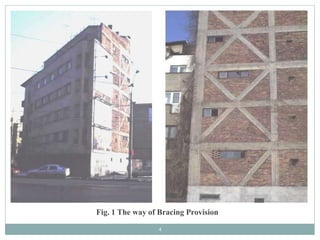
Fig. 1 The way of Bracing Provision
5
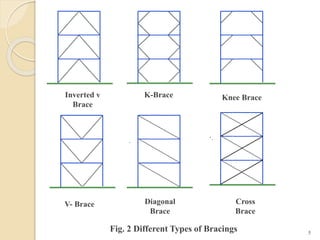
Inverted v
Brace
K-Brace Knee Brace
V- Brace Diagonal
Brace
Cross
Brace
Fig. 2 Different Types of Bracings
INTRODUCTION:
 Braced frames widen their resistance to lateral forces by the bracing action of
inclined members.
 Therefore, it is necessary to provide special mechanism and/or mechanisms that
to improve lateral stability of the structure. Braced frames develop their
confrontation to lateral forces by the bracing action.
 Fully braced frames are more rigid. From saving view point arbitrarily braced
ones have least forces induced in the structure and at the same time produce
maximum displacement within prescribed limits.
 Frames can be analysed by various methods. However, the method of analysis
adopted depends upon the types of frame, its configuration of (portal bay or
multi-bay) multi-storey frame and degree of indeterminacy.
6
7
Description of study building structures
8
 PROBLEM DEFINATION
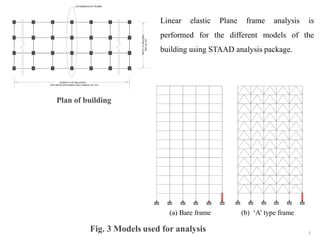
(a) Bare frame (b) ‘A’ type frame
Fig. 3 Models used for analysis
Linear elastic Plane frame analysis is
performed for the different models of the
building using STAAD analysis package.
Plan of building
 In order to study the behaviour of moment resisting braced frames 5 bay
12 storey structures (with 350 mm beam depth) are modeled and
analysed numerically.
 The sections of columns are reduced from top to bottom which is kept
same for every 3 storey (1-3, 4-6, 7-9, and 10-12) in order to achieve an
economy in bare frames itself.
 In all cases, span length and story elevation are 4 and 3 meters,
respectively. A typical frame of this type is shown in Figure 1 (a).
 The structural analysis was based on structural models plotted in the
STAAD PRO V8i structural analysis and design commercial software.
9
DESCRIPTION OF STUDY BUILDING STRUCTURES
10
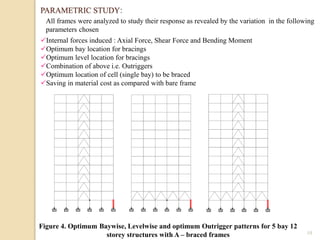
Figure 4. Optimum Baywise, Levelwise and optimum Outrigger patterns for 5 bay 12
storey structures with A – braced frames
PARAMETRIC STUDY:
All frames were analyzed to study their response as revealed by the variation in the following
parameters chosen
Internal forces induced : Axial Force, Shear Force and Bending Moment
Optimum bay location for bracings
Optimum level location for bracings
Combination of above i.e. Outriggers
Optimum location of cell (single bay) to be braced
Saving in material cost as compared with bare frame
11
CELLWISE BRACED FRAMES
 It is advantageous to try cellwise bracing with symmetrical cases
beyond which the economy is going to decrease.
 These locations are finalised based on rigorous analysis and design
made on the frames which have shown the economy due to baywise,
levelwise and partially braced systems.
 The hidden advantage behind the provision of cellwise bracing is that,
the speedy construction which is faster than other bracing patterns
utilized previously.
 The same logic is applied for all braces tried on these frames i.e. A, V
and Diagonal. It is wise to try to find out such a cell or combinations of
them i.e. single cell, two or three cells braced at a time which gives
economy more than to provide the bracing throughout the central
position of bay.
 Similarly, for the same structure levelwise braced frames offer more
economy when braced at first level. Specifically, at the first floor when
braced throughout offer more economy as compared to bare and
baywise braced frames. This logic leads to develop the number of
combinations of cellwise braced frame which is not feasible.
12
13
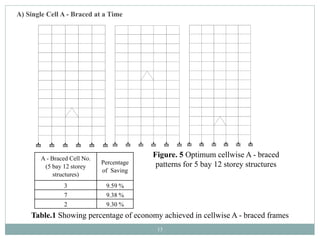
A) Single Cell A - Braced at a Time
A - Braced Cell No.
(5 bay 12 storey
structures)
Percentage
of Saving
3 9.59 %
7 9.38 %
2 9.30 %
Table.1 Showing percentage of economy achieved in cellwise A - braced frames
Figure. 5 Optimum cellwise A - braced
patterns for 5 bay 12 storey structures
14
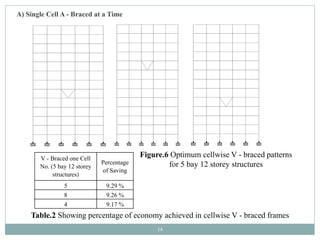
A) Single Cell A - Braced at a Time
V - Braced one Cell
No. (5 bay 12 storey
structures)
Percentage
of Saving
5 9.29 %
8 9.26 %
4 9.17 %
Table.2 Showing percentage of economy achieved in cellwise V - braced frames
Figure.6 Optimum cellwise V - braced patterns
for 5 bay 12 storey structures
15
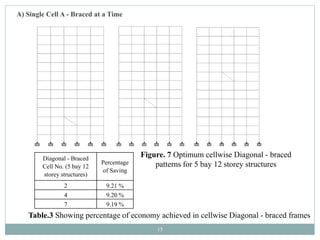
A) Single Cell A - Braced at a Time
Diagonal - Braced
Cell No. (5 bay 12
storey structures)
Percentage
of Saving
2 9.21 %
4 9.20 %
7 9.19 %
Table.3 Showing percentage of economy achieved in cellwise Diagonal - braced frames
Figure. 7 Optimum cellwise Diagonal - braced
patterns for 5 bay 12 storey structures
16
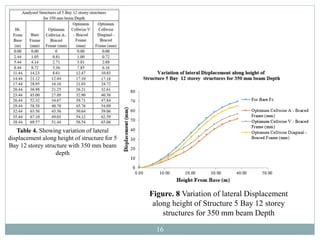
Figure. 8 Variation of lateral Displacement
along height of Structure 5 Bay 12 storey
structures for 350 mm beam Depth
Table 4. Showing variation of lateral
displacement along height of structure for 5
Bay 12 storey structure with 350 mm beam
depth
SINGLE CELL BRACED AT A TIME
 Initially it is tried with single cells braced at a time and later on few
cases tried with two cells and three cells braced at a time in order to
check economy to be procured with lesser or more braces.
 It is wise to localize our view over such cellwise braced frames which
offers more economy.
 It is seen that A braced frames offer more economy as compared to V
and Diagonal braced frames which is 9.59 %.
 It is also seen that as the bracing location moves away from the base
ultimately the economy is getting reduced nominally owing to the
lateral displacements.
 The lateral displacements are found to be more in case of cells braced
away from the base of the structure but within prescribed limits [12].
17
18
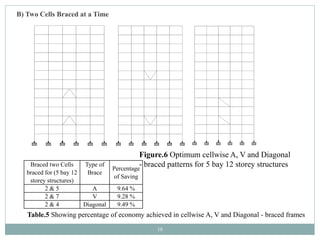
B) Two Cells Braced at a Time
Table.5 Showing percentage of economy achieved in cellwise A, V and Diagonal - braced frames
Figure.6 Optimum cellwise A, V and Diagonal
- braced patterns for 5 bay 12 storey structuresBraced two Cells
braced for (5 bay 12
storey structures)
Type of
Brace
Percentage
of Saving
2 & 5 A 9.64 %
2 & 7 V 9.28 %
2 & 4 Diagonal 9.49 %
19
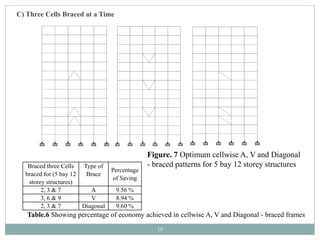
C) Three Cells Braced at a Time
Table.6 Showing percentage of economy achieved in cellwise A, V and Diagonal - braced frames
Figure. 7 Optimum cellwise A, V and Diagonal
- braced patterns for 5 bay 12 storey structuresBraced three Cells
braced for (5 bay 12
storey structures)
Type of
Brace
Percentage
of Saving
2, 3 & 7 A 9.56 %
3, 6 & 9 V 8.94 %
2, 3 & 7 Diagonal 9.60 %
20
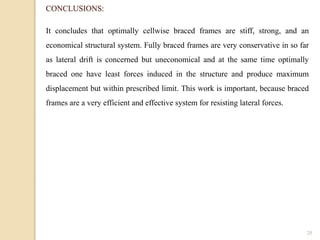
CONCLUSIONS:
It concludes that optimally cellwise braced frames are stiff, strong, and an
economical structural system. Fully braced frames are very conservative in so far
as lateral drift is concerned but uneconomical and at the same time optimally
braced one have least forces induced in the structure and produce maximum
displacement but within prescribed limit. This work is important, because braced
frames are a very efficient and effective system for resisting lateral forces.
21
REFERANCES:
 A. R. Khaloo & M. Mahdi Mohseni, “Nonlinear Seismic Behaviour of RC Frames with RC Braces”
Asian Journal of Civil Engineering, Vol. 9, No. 6 (2008).
 A.A.Shish Ranka, Arathy Gopal, RahuL Jee, “Earthquake Resistant Building Design Seminar
Report”
 J.P. Desai, A.K. Jain and A.S. Arya, “Seismic response of R.C. Braced Frames”, Computers and
Structures Vol. 29, No. 4 (1987).
 Mahmoud R. Maheri, R. Akbari, “seismic behaviour factor, for steel x-braced and knee-braced rc
buildings”, Engineering Structures, Volume 25, Issue 12, October 2003, Pages1505-1513.
 Kulkarni J. G., Kore P. N., Tanawade S. B., “Seismic Response of Reinforced Concrete Braced
Frames”, International Journal of Engineering Research and Applications (IJERA) ISSN: 2248-9622
Vol. 3, Issue 4, Jul-Aug 2013, pp.1047-1053.
 Tanawade S. B., Kore P. N., Swami P. S., Javheri S. B., “Seismic Response of Reinforced Concrete
Concentrically A - Braced Frames”, International Journal of Innovation in Engineering, Research
and Technology (IJIERT) Conference Proceedings ISSN: 2394-3696 11th & 12th March 2016.
22
THANK YOU…

Presentation_on_Cellwise_Braced_frames

  • 1.
    Author Mr. KORE P.N. Co-Authors Mr. JAVHERI S. B. Mr. SWAMI P. S. Mr. VARDHAMAN R. R. 1 A Presentation on “Seismic Response of Cellwise Concentrically Braced Frames”
  • 2.
    “Seismic Response ofCellwise Concentrically Braced Frames” LAYOUT OF PRESENTATION  INTRODUCTION  DESCRIPTION OF STUDY BUILDING STRUCTURES  CELLWISE BRACED FRAMES  RESULTS AND DISCUSSION  CONCLUSION  REFERANCE 2
  • 3.
  • 4.
    4 Fig. 1 Theway of Bracing Provision
  • 5.
    5 Inverted v Brace K-Brace KneeBrace V- Brace Diagonal Brace Cross Brace Fig. 2 Different Types of Bracings
  • 6.
    INTRODUCTION:  Braced frameswiden their resistance to lateral forces by the bracing action of inclined members.  Therefore, it is necessary to provide special mechanism and/or mechanisms that to improve lateral stability of the structure. Braced frames develop their confrontation to lateral forces by the bracing action.  Fully braced frames are more rigid. From saving view point arbitrarily braced ones have least forces induced in the structure and at the same time produce maximum displacement within prescribed limits.  Frames can be analysed by various methods. However, the method of analysis adopted depends upon the types of frame, its configuration of (portal bay or multi-bay) multi-storey frame and degree of indeterminacy. 6
  • 7.
    7 Description of studybuilding structures
  • 8.
    8  PROBLEM DEFINATION (a)Bare frame (b) ‘A’ type frame Fig. 3 Models used for analysis Linear elastic Plane frame analysis is performed for the different models of the building using STAAD analysis package. Plan of building
  • 9.
     In orderto study the behaviour of moment resisting braced frames 5 bay 12 storey structures (with 350 mm beam depth) are modeled and analysed numerically.  The sections of columns are reduced from top to bottom which is kept same for every 3 storey (1-3, 4-6, 7-9, and 10-12) in order to achieve an economy in bare frames itself.  In all cases, span length and story elevation are 4 and 3 meters, respectively. A typical frame of this type is shown in Figure 1 (a).  The structural analysis was based on structural models plotted in the STAAD PRO V8i structural analysis and design commercial software. 9 DESCRIPTION OF STUDY BUILDING STRUCTURES
  • 10.
    10 Figure 4. OptimumBaywise, Levelwise and optimum Outrigger patterns for 5 bay 12 storey structures with A – braced frames PARAMETRIC STUDY: All frames were analyzed to study their response as revealed by the variation in the following parameters chosen Internal forces induced : Axial Force, Shear Force and Bending Moment Optimum bay location for bracings Optimum level location for bracings Combination of above i.e. Outriggers Optimum location of cell (single bay) to be braced Saving in material cost as compared with bare frame
  • 11.
  • 12.
    CELLWISE BRACED FRAMES It is advantageous to try cellwise bracing with symmetrical cases beyond which the economy is going to decrease.  These locations are finalised based on rigorous analysis and design made on the frames which have shown the economy due to baywise, levelwise and partially braced systems.  The hidden advantage behind the provision of cellwise bracing is that, the speedy construction which is faster than other bracing patterns utilized previously.  The same logic is applied for all braces tried on these frames i.e. A, V and Diagonal. It is wise to try to find out such a cell or combinations of them i.e. single cell, two or three cells braced at a time which gives economy more than to provide the bracing throughout the central position of bay.  Similarly, for the same structure levelwise braced frames offer more economy when braced at first level. Specifically, at the first floor when braced throughout offer more economy as compared to bare and baywise braced frames. This logic leads to develop the number of combinations of cellwise braced frame which is not feasible. 12
  • 13.
    13 A) Single CellA - Braced at a Time A - Braced Cell No. (5 bay 12 storey structures) Percentage of Saving 3 9.59 % 7 9.38 % 2 9.30 % Table.1 Showing percentage of economy achieved in cellwise A - braced frames Figure. 5 Optimum cellwise A - braced patterns for 5 bay 12 storey structures
  • 14.
    14 A) Single CellA - Braced at a Time V - Braced one Cell No. (5 bay 12 storey structures) Percentage of Saving 5 9.29 % 8 9.26 % 4 9.17 % Table.2 Showing percentage of economy achieved in cellwise V - braced frames Figure.6 Optimum cellwise V - braced patterns for 5 bay 12 storey structures
  • 15.
    15 A) Single CellA - Braced at a Time Diagonal - Braced Cell No. (5 bay 12 storey structures) Percentage of Saving 2 9.21 % 4 9.20 % 7 9.19 % Table.3 Showing percentage of economy achieved in cellwise Diagonal - braced frames Figure. 7 Optimum cellwise Diagonal - braced patterns for 5 bay 12 storey structures
  • 16.
    16 Figure. 8 Variationof lateral Displacement along height of Structure 5 Bay 12 storey structures for 350 mm beam Depth Table 4. Showing variation of lateral displacement along height of structure for 5 Bay 12 storey structure with 350 mm beam depth
  • 17.
    SINGLE CELL BRACEDAT A TIME  Initially it is tried with single cells braced at a time and later on few cases tried with two cells and three cells braced at a time in order to check economy to be procured with lesser or more braces.  It is wise to localize our view over such cellwise braced frames which offers more economy.  It is seen that A braced frames offer more economy as compared to V and Diagonal braced frames which is 9.59 %.  It is also seen that as the bracing location moves away from the base ultimately the economy is getting reduced nominally owing to the lateral displacements.  The lateral displacements are found to be more in case of cells braced away from the base of the structure but within prescribed limits [12]. 17
  • 18.
    18 B) Two CellsBraced at a Time Table.5 Showing percentage of economy achieved in cellwise A, V and Diagonal - braced frames Figure.6 Optimum cellwise A, V and Diagonal - braced patterns for 5 bay 12 storey structuresBraced two Cells braced for (5 bay 12 storey structures) Type of Brace Percentage of Saving 2 & 5 A 9.64 % 2 & 7 V 9.28 % 2 & 4 Diagonal 9.49 %
  • 19.
    19 C) Three CellsBraced at a Time Table.6 Showing percentage of economy achieved in cellwise A, V and Diagonal - braced frames Figure. 7 Optimum cellwise A, V and Diagonal - braced patterns for 5 bay 12 storey structuresBraced three Cells braced for (5 bay 12 storey structures) Type of Brace Percentage of Saving 2, 3 & 7 A 9.56 % 3, 6 & 9 V 8.94 % 2, 3 & 7 Diagonal 9.60 %
  • 20.
    20 CONCLUSIONS: It concludes thatoptimally cellwise braced frames are stiff, strong, and an economical structural system. Fully braced frames are very conservative in so far as lateral drift is concerned but uneconomical and at the same time optimally braced one have least forces induced in the structure and produce maximum displacement but within prescribed limit. This work is important, because braced frames are a very efficient and effective system for resisting lateral forces.
  • 21.
    21 REFERANCES:  A. R.Khaloo & M. Mahdi Mohseni, “Nonlinear Seismic Behaviour of RC Frames with RC Braces” Asian Journal of Civil Engineering, Vol. 9, No. 6 (2008).  A.A.Shish Ranka, Arathy Gopal, RahuL Jee, “Earthquake Resistant Building Design Seminar Report”  J.P. Desai, A.K. Jain and A.S. Arya, “Seismic response of R.C. Braced Frames”, Computers and Structures Vol. 29, No. 4 (1987).  Mahmoud R. Maheri, R. Akbari, “seismic behaviour factor, for steel x-braced and knee-braced rc buildings”, Engineering Structures, Volume 25, Issue 12, October 2003, Pages1505-1513.  Kulkarni J. G., Kore P. N., Tanawade S. B., “Seismic Response of Reinforced Concrete Braced Frames”, International Journal of Engineering Research and Applications (IJERA) ISSN: 2248-9622 Vol. 3, Issue 4, Jul-Aug 2013, pp.1047-1053.  Tanawade S. B., Kore P. N., Swami P. S., Javheri S. B., “Seismic Response of Reinforced Concrete Concentrically A - Braced Frames”, International Journal of Innovation in Engineering, Research and Technology (IJIERT) Conference Proceedings ISSN: 2394-3696 11th & 12th March 2016.
  • 22.