


WATER RESOURCESWATER RESOURCES
MANAGEMENTMANAGEMENT
Components and view points:Components and view points:
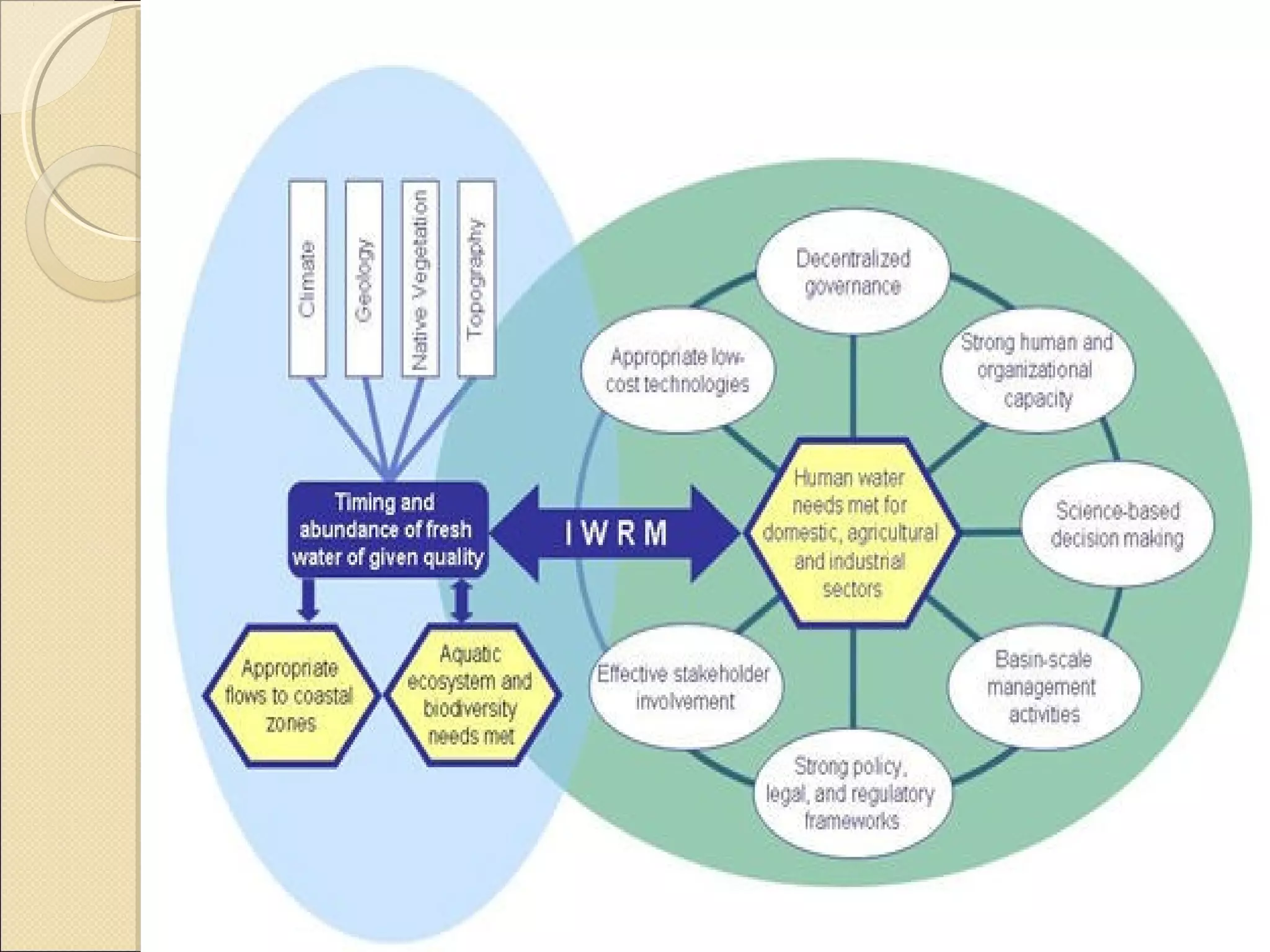
Integrated water resources management
begins with the term “water resources
management” itself, which uses structural
measures to control natural and human-
made water resources systems for beneficial
uses.
Elements of natural water resources
systems include the atmosphere, watersheds
(drainage basins), stream channels, wetlands,
floodplains, aquifers, lakes, estuaries, seas,
and the ocean.
Multiple purposes
Integrated water resources management
considers the viewpoints of water management
agencies with specific purposes, governmental
and stakeholder groups, geographic regions, and
disciplines of knowledge.
As the practice of water resources management
evolved, the term "multipurpose" water
resources development (or management) came
to refer to projects with more than one
purpose.
Challenges to water management
integration:
The term "functional integration" means to join
purposes of water management such as to
manage water supply and wastewater within a
single unit.
Government and interest groups:
Special interest groups range from those
favoring development of resources to those
favoring preservation. In many cases, conflicts
arise between the same types of interest
groups, as, for example, between fly fishers and
rafters on a stream.
Another aspect of geographic integration is the
scale of water-accounting units, such as small
watershed, major river basin, region, or state,
even up to global scale.
Total Water Management:
 Integrated water resources management can
take different forms and is examined best in
specific situations.
the most comprehensive concept for water
supply is "Total Water Management."
Taking into consideration local and regional
variations, Total Water Management:
Encourages planning and management on a
natural water systems basis through a dynamic
Process that adapts to changing conditions
Promotes water conservation
Fosters public health, safety, and community
goodwill.
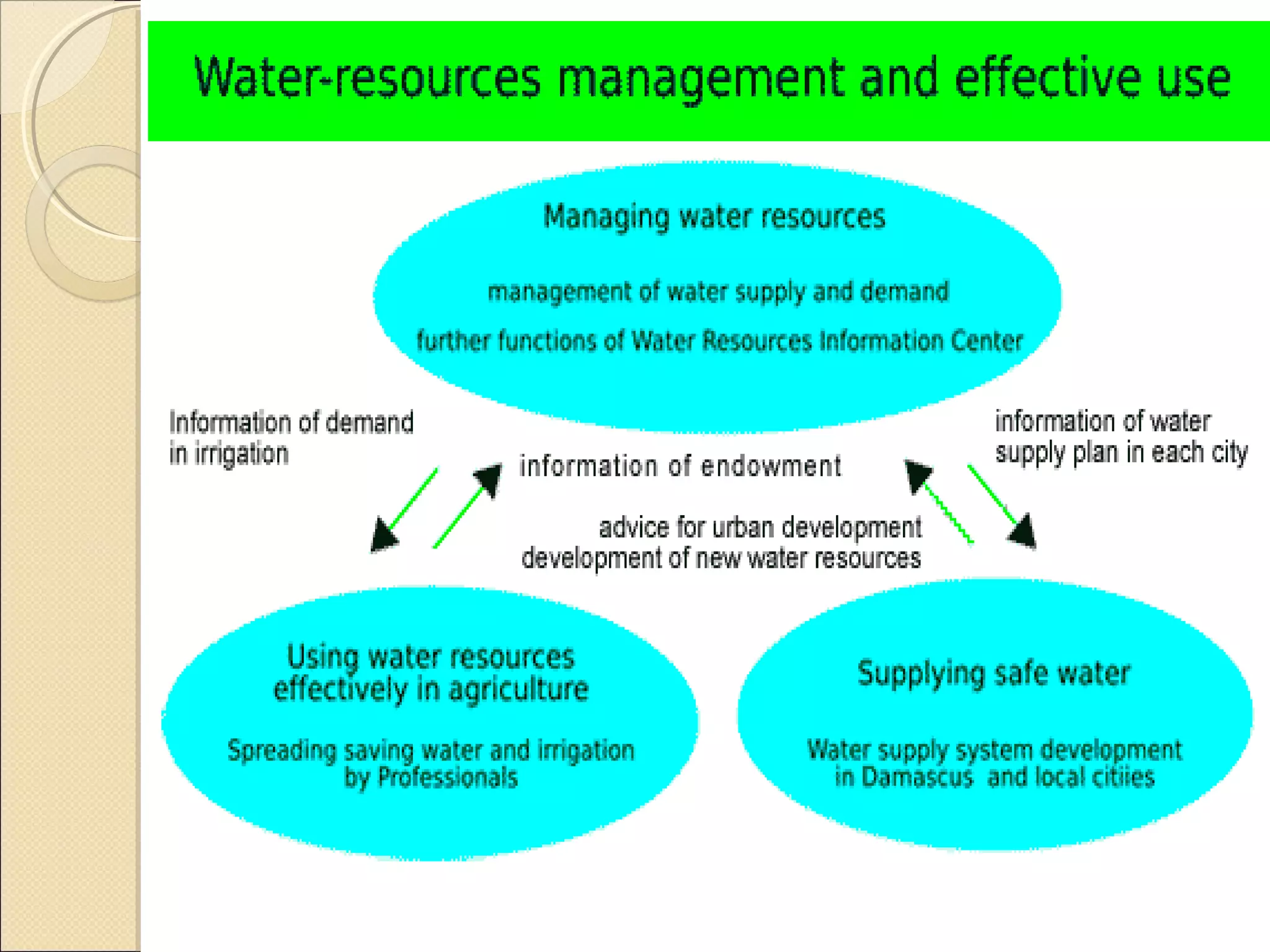
Water management and irrigation
systems;
"Irrigation system" is defined as a set of
components which includes (may include) the
water source, water distribution network,
control components, and possibly other general
irrigation equipment.
Scheme water management:
Despite the increase in water use by sectors
other than agriculture, irrigation continues to
be the main water user on a global scale.
However, there is an increasing pressure for
water to be used more efficiently in agriculture.
On-farm water management:
 The Water Resources, Development and
Management Service offers technical assistance
to country members in the design and
implementation of on-farm irrigation systems,
as well as in the identification and adaptation of
irrigation techniques.
Crop water management:
 The great challenge for the coming decades
will be the task of increasing food production
with less water, particularly in countries with
limited water and land resources.
Training and Capacity building:
Training and capacity building are identified as
key elements in developing the skills,
knowledge and means to define, plan and
implement the action programmers in
integrated water resources development for
agriculture.
 Managing irrigation water for drinking
and domestic use:
 Developing country's efforts to supply drinking
water to their rural communities have focused
primarily on digging deep tube wells and
installing hand-pumps to exploit groundwater,
which is free from harmful bacteria and
parasites.  
In large areas of South Asia, the Middle East and
East Africa, groundwater is not an option
because of high arsenic, fluoride, iron, or salt
levels. Here irrigation water is often the only
water available for drinking, bathing, and
washing.
Conservation planning:
 Most developing countries are continuing to
develop and implement comprehensive water
resource management plans.
Comprehensive plans are increasingly popular
as a method of combining supply and
conservation projects.
Planning and management , water
resources:
Traditional Supply Planning:
Three principal concerns about the traditional
approach have been advanced.
 First, forecast demand is taken as a given, and
virtually no attempt is made to integrate supply
management and demand management options.
 Second, the public-at-large, outside experts,
and government regulators generally have little
or no involvement in traditional utility planning.
 Third, traditional planning also tends to be
confined to individual utilities in virtual isolation.
Supply-Driven Focus:
 Like other types of public utilities, the
prevailing planning processes undertaken by
water utilities have been internally driven and
dominated by supply considerations.
Least-Cost Planning:
 Least-cost planning emphasizes a balanced
consideration of supply management and
demand management options in identifying
feasible least-cost alternatives for meeting
future water needs.
Complexity, Risk, and Cost:
 Least-cost utility and planning is complicated by
the lack of familiarly with demand management,
barriers to coordination with nearby utilities,
the use of broad definitions of costs and the
inclusion of goals not directly attributable to
the utility.
Integrated resource planning:
 Integrated resource planning is a
somewhat more encompassing term than
least-cost utility planning, although the
two are consistent and can be used
interchangeably for many analytical
purposes.
 Integrated resource planning also emphasizes
the importance of establishing a more open and
participatory decision-making process and
coordinating the many water institutions that
govern water resources.
Integrative Assessments:
Like least-cost planning, IRP explicitly
recognizes that demand management can be a
cost-effective and viable resource option. In a
somewhat broadened sense, IRP recognizes
that demand management can help achieve
multiple policy goals (such as cost control and
pollution prevention).
Methods of water management:
Rain Sensor Device:
 This measure requires that any person
purchasing or installing an automatic sprinkler
system must install and operate a rain sensor
device or an automatic switch. This equipment
will override the irrigation cycle of the sprinkler
system when adequate rainfall has occurred.
Leak Detection and Repair Program:
 Public water supply systems desire to attain a
10 percent or less unaccounted-for water loss.
Commercial and Industrial Users:
 All individual commercial and industrial users
submit a conservation plan that generally
includes: audits of water use; implementation of
cost-effective conservation measures.
Social Acceptability:
Water conservation is not an isolated activity
and its social acceptability is related to many
factors such as the characteristics of the utility
market; the pricing system; and economic,
political, technological, and willingness to
conserve.
Ways to conserve water at home:
Take quick showers and eliminate unnecessary
showers
Clean fruits and vegetables in a water basin
rather than under running tap water
Install low-flow appliances
Avoid toxic cleaning materials, which can
pollute water
Never use the toilet as a wastebasket
Use a bucket or spring-loaded nozzle to wash
the car
Conclusion:
A description of the current situation in water
resources management, in the efficiency of
water use and how decisions are made and
actions taken .
Conservation benefits include reduced water
bills and greater water supplies that help in
better economic development. Environmental
benefits include ecosystem and habitat
protection.
THANK YOUTHANK YOU
06 115 water resources management

06 115 water resources management

  • 1.
  • 2.
    Components and viewpoints:Components and view points: Integrated water resources management begins with the term “water resources management” itself, which uses structural measures to control natural and human- made water resources systems for beneficial uses. Elements of natural water resources systems include the atmosphere, watersheds (drainage basins), stream channels, wetlands, floodplains, aquifers, lakes, estuaries, seas, and the ocean.
  • 3.
    Multiple purposes Integrated waterresources management considers the viewpoints of water management agencies with specific purposes, governmental and stakeholder groups, geographic regions, and disciplines of knowledge. As the practice of water resources management evolved, the term "multipurpose" water resources development (or management) came to refer to projects with more than one purpose.
  • 5.
    Challenges to watermanagement integration: The term "functional integration" means to join purposes of water management such as to manage water supply and wastewater within a single unit. Government and interest groups: Special interest groups range from those favoring development of resources to those favoring preservation. In many cases, conflicts arise between the same types of interest groups, as, for example, between fly fishers and rafters on a stream.
  • 6.
    Another aspect ofgeographic integration is the scale of water-accounting units, such as small watershed, major river basin, region, or state, even up to global scale. Total Water Management:  Integrated water resources management can take different forms and is examined best in specific situations. the most comprehensive concept for water supply is "Total Water Management."
  • 8.
    Taking into considerationlocal and regional variations, Total Water Management: Encourages planning and management on a natural water systems basis through a dynamic Process that adapts to changing conditions Promotes water conservation Fosters public health, safety, and community goodwill.
  • 9.
    Water management andirrigation systems; "Irrigation system" is defined as a set of components which includes (may include) the water source, water distribution network, control components, and possibly other general irrigation equipment. Scheme water management: Despite the increase in water use by sectors other than agriculture, irrigation continues to be the main water user on a global scale. However, there is an increasing pressure for water to be used more efficiently in agriculture.
  • 11.
    On-farm water management: The Water Resources, Development and Management Service offers technical assistance to country members in the design and implementation of on-farm irrigation systems, as well as in the identification and adaptation of irrigation techniques. Crop water management:  The great challenge for the coming decades will be the task of increasing food production with less water, particularly in countries with limited water and land resources.
  • 12.
    Training and Capacitybuilding: Training and capacity building are identified as key elements in developing the skills, knowledge and means to define, plan and implement the action programmers in integrated water resources development for agriculture.  Managing irrigation water for drinking and domestic use:  Developing country's efforts to supply drinking water to their rural communities have focused primarily on digging deep tube wells and installing hand-pumps to exploit groundwater, which is free from harmful bacteria and parasites.  
  • 13.
    In large areasof South Asia, the Middle East and East Africa, groundwater is not an option because of high arsenic, fluoride, iron, or salt levels. Here irrigation water is often the only water available for drinking, bathing, and washing. Conservation planning:  Most developing countries are continuing to develop and implement comprehensive water resource management plans. Comprehensive plans are increasingly popular as a method of combining supply and conservation projects.
  • 14.
    Planning and management, water resources: Traditional Supply Planning: Three principal concerns about the traditional approach have been advanced.  First, forecast demand is taken as a given, and virtually no attempt is made to integrate supply management and demand management options.  Second, the public-at-large, outside experts, and government regulators generally have little or no involvement in traditional utility planning.
  • 15.
     Third, traditionalplanning also tends to be confined to individual utilities in virtual isolation. Supply-Driven Focus:  Like other types of public utilities, the prevailing planning processes undertaken by water utilities have been internally driven and dominated by supply considerations. Least-Cost Planning:  Least-cost planning emphasizes a balanced consideration of supply management and demand management options in identifying feasible least-cost alternatives for meeting future water needs.
  • 16.
    Complexity, Risk, andCost:  Least-cost utility and planning is complicated by the lack of familiarly with demand management, barriers to coordination with nearby utilities, the use of broad definitions of costs and the inclusion of goals not directly attributable to the utility. Integrated resource planning:  Integrated resource planning is a somewhat more encompassing term than least-cost utility planning, although the two are consistent and can be used interchangeably for many analytical purposes.
  • 17.
     Integrated resourceplanning also emphasizes the importance of establishing a more open and participatory decision-making process and coordinating the many water institutions that govern water resources. Integrative Assessments: Like least-cost planning, IRP explicitly recognizes that demand management can be a cost-effective and viable resource option. In a somewhat broadened sense, IRP recognizes that demand management can help achieve multiple policy goals (such as cost control and pollution prevention).
  • 18.
    Methods of watermanagement: Rain Sensor Device:  This measure requires that any person purchasing or installing an automatic sprinkler system must install and operate a rain sensor device or an automatic switch. This equipment will override the irrigation cycle of the sprinkler system when adequate rainfall has occurred. Leak Detection and Repair Program:  Public water supply systems desire to attain a 10 percent or less unaccounted-for water loss.
  • 19.
    Commercial and IndustrialUsers:  All individual commercial and industrial users submit a conservation plan that generally includes: audits of water use; implementation of cost-effective conservation measures. Social Acceptability: Water conservation is not an isolated activity and its social acceptability is related to many factors such as the characteristics of the utility market; the pricing system; and economic, political, technological, and willingness to conserve.
  • 20.
    Ways to conservewater at home: Take quick showers and eliminate unnecessary showers Clean fruits and vegetables in a water basin rather than under running tap water Install low-flow appliances Avoid toxic cleaning materials, which can pollute water Never use the toilet as a wastebasket Use a bucket or spring-loaded nozzle to wash the car
  • 21.
    Conclusion: A description ofthe current situation in water resources management, in the efficiency of water use and how decisions are made and actions taken . Conservation benefits include reduced water bills and greater water supplies that help in better economic development. Environmental benefits include ecosystem and habitat protection.
  • 22.