Water pollution and its
management
By,
Vishwajith
PALB5046
1st Ph.D.
CONTENTS
• Introduction
• Types
• Causes
• Indicators
• Effects
• Management
• Conclusion
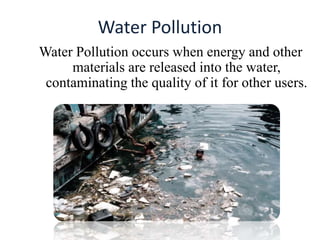
Water Pollution
Water Pollution occurs when energy and other
materials are released into the water,
contaminating the quality of it for other users.
• Petroleum hydrocarbons
• Plastics
• Paints and arsenics
• Heavy metals
• Sewage
• Radioactive waste
• Thermal effluents detergents
• Chloroform
• Food processing waste, (fats and grease)
• Insecticides and herbicides
• Petroleum hydrocarbons (gasoline, diesel fuel, jet fuels and fuel oil)
• Lubricants (motor oil)
• From storm water runoff
Water Pollutants….
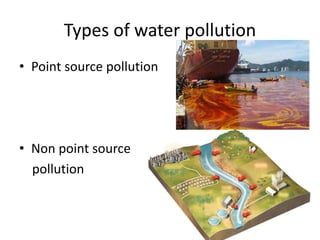
Types of water pollution
• Point source pollution
• Non point source
pollution
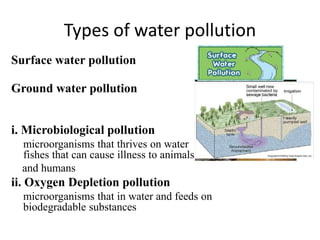
Types of water pollution
Surface water pollution
Ground water pollution
i. Microbiological pollution
microorganisms that thrives on water and
fishes that can cause illness to animals
and humans
ii. Oxygen Depletion pollution
microorganisms that in water and feeds on
biodegradable substances
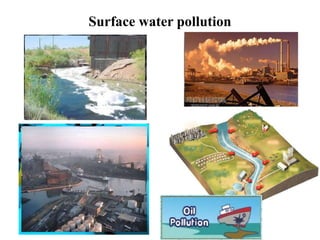
Surface water pollution
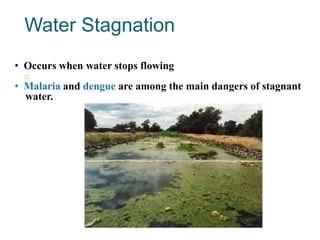
Water Stagnation
• Occurs when water stops flowing
• Malaria and dengue are among the main dangers of stagnant
water.

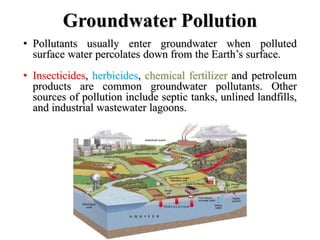
Groundwater Pollution
• Pollutants usually enter groundwater when polluted
surface water percolates down from the Earth’s surface.
• Insecticides, herbicides, chemical fertilizer and petroleum
products are common groundwater pollutants. Other
sources of pollution include septic tanks, unlined landfills,
and industrial wastewater lagoons.
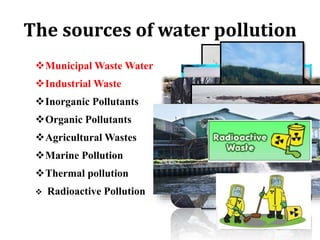
The sources of water pollution
Municipal Waste Water
Industrial Waste
Inorganic Pollutants
Organic Pollutants
Agricultural Wastes
Marine Pollution
Thermal pollution
 Radioactive Pollution
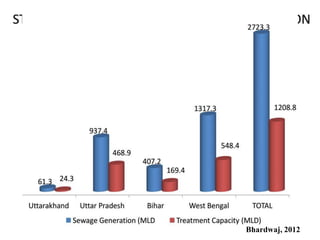
Bhardwaj, 2012
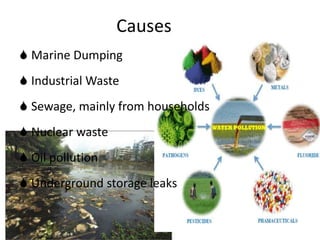
Causes
 Marine Dumping
 Industrial Waste
 Sewage, mainly from households
 Nuclear waste
 Oil pollution
 Underground storage leaks
Effects of Water Pollution
 Lower DO may be harmful to animals.
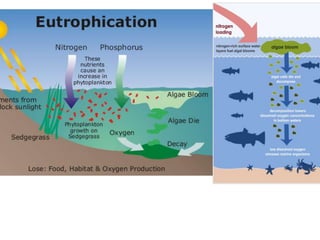
 Eutrophication.
 Bioaccumulation.
 Biomagnification.
 Minimata disease, Blue Baby Syndrome or Methaemoglobinemia
and Fluorosis
 Pesticides are harmful to aquatic life.
 Dyes and inorganic compounds induce colour change in animals
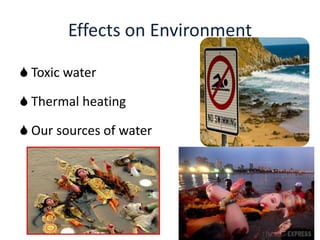
Effects on Environment
 Toxic water
 Thermal heating
 Our sources of water
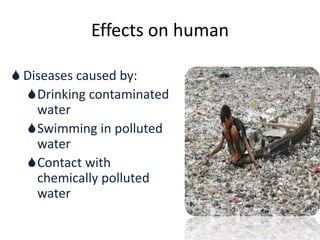
Effects on human
 Diseases caused by:
Drinking contaminated
water
Swimming in polluted
water
Contact with
chemically polluted
water
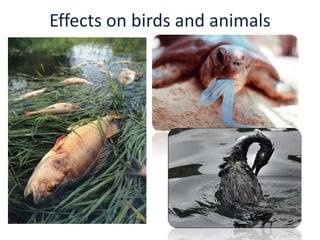
Effects on birds and animals
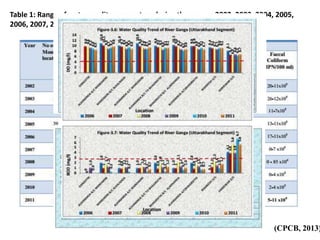
Table 1: Range of water quality parameters during the years – 2002, 2003, 2004, 2005,
2006, 2007, 2008, 2009, 2010 and 2011 in river Ganga
(CPCB, 2013)
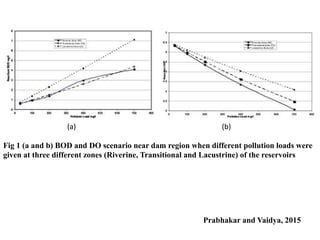
Fig 1 (a and b) BOD and DO scenario near dam region when different pollution loads were
given at three different zones (Riverine, Transitional and Lacustrine) of the reservoirs
(a) (b)
Prabhakar and Vaidya, 2015
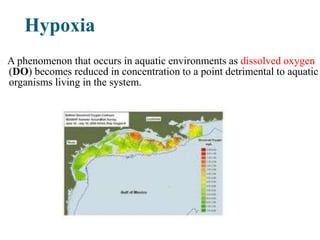
Hypoxia
A phenomenon that occurs in aquatic environments as dissolved oxygen
(DO) becomes reduced in concentration to a point detrimental to aquatic
organisms living in the system.
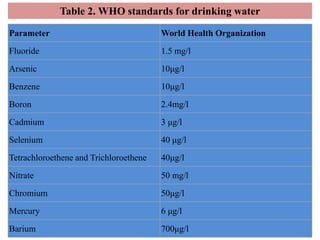
Parameter World Health Organization
Fluoride 1.5 mg/l
Arsenic 10μg/l
Benzene 10μg/l
Boron 2.4mg/l
Cadmium 3 μg/l
Selenium 40 μg/l
Tetrachloroethene and Trichloroethene 40μg/l
Nitrate 50 mg/l
Chromium 50μg/l
Mercury 6 μg/l
Barium 700μg/l
Table 2. WHO standards for drinking water
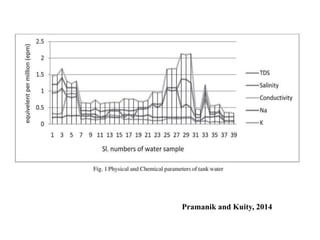
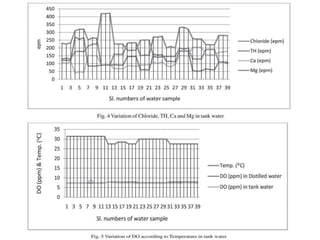
Pramanik and Kuity, 2014
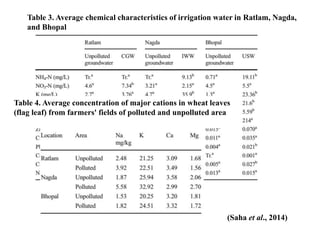
Table 3. Average chemical characteristics of irrigation water in Ratlam, Nagda,
and Bhopal
(Saha et al., 2014)
Table 4. Average concentration of major cations in wheat leaves
(flag leaf) from farmers' fields of polluted and unpolluted area
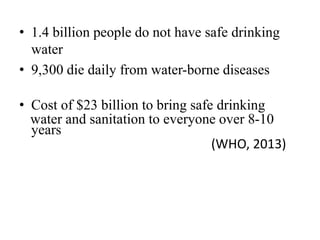
• 1.4 billion people do not have safe drinking
water
• 9,300 die daily from water-borne diseases
• Cost of $23 billion to bring safe drinking
water and sanitation to everyone over 8-10
years
(WHO, 2013)
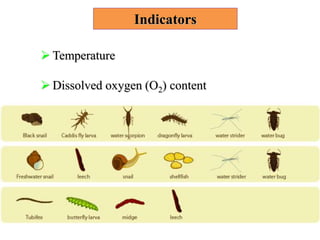
Indicators
 Temperature
 Dissolved oxygen (O2) content
 pH
 Nitrate & phosphate levels
 Turbidity
 Various bio-indicators
What You Can Do
How do we prevent water pollution
• Turn off the tap when running water is not
necessary.
• Use environmentally household products.
• Avoid over dosage of pesticides and fertilisers
• Don’t throw the non degradable substances to
rivers, lakes or oceans.
• Pre-treatment of industrial waste water before
leaving to water bodies.
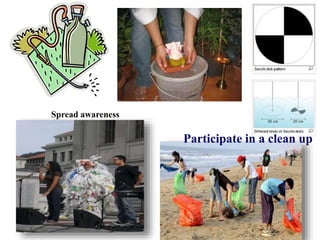
Participate in a clean up
Spread awareness
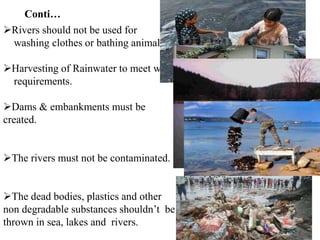
Rivers should not be used for
washing clothes or bathing animals in.
Harvesting of Rainwater to meet water
requirements.
Dams & embankments must be
created.
The rivers must not be contaminated.
The dead bodies, plastics and other
non degradable substances shouldn’t be
thrown in sea, lakes and rivers.
Conti…
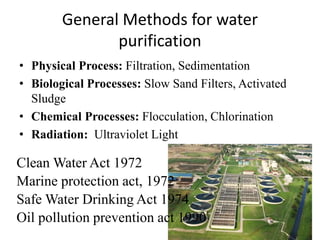
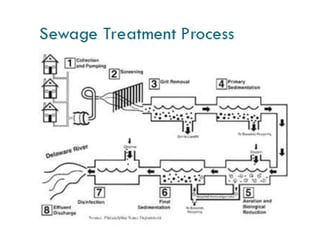
General Methods for water
purification
• Physical Process: Filtration, Sedimentation
• Biological Processes: Slow Sand Filters, Activated
Sludge
• Chemical Processes: Flocculation, Chlorination
• Radiation: Ultraviolet Light
Clean Water Act 1972
Marine protection act, 1972
Safe Water Drinking Act 1974
Oil pollution prevention act 1990
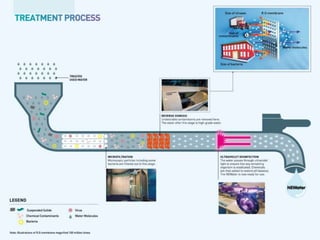
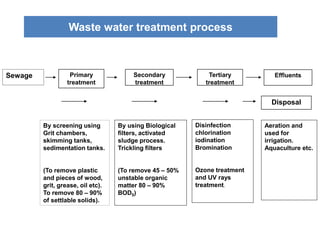
Waste water treatment process
Sewage Primary
treatment
Secondary
treatment
Tertiary
treatment
Effluents
By screening using
Grit chambers,
skimming tanks,
sedimentation tanks.
(To remove plastic
and pieces of wood,
grit, grease, oil etc).
To remove 80 – 90%
of settlable solids).
By using Biological
filters, activated
sludge process.
Trickling filters
(To remove 45 – 50%
unstable organic
matter 80 – 90%
BOD5)
Disinfection
chlorination
iodination
Bromination
Ozone treatment
and UV rays
treatment.
Aeration and
used for
irrigation.
Aquaculture etc.
Disposal
Pawar et al., 2015
5
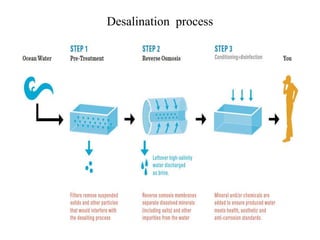
Desalination process
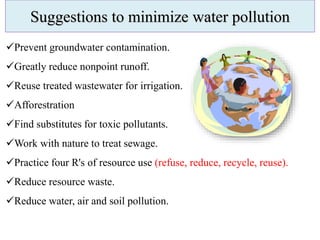
Suggestions to minimize water pollution
Prevent groundwater contamination.
Greatly reduce nonpoint runoff.
Reuse treated wastewater for irrigation.
Afforestration
Find substitutes for toxic pollutants.
Work with nature to treat sewage.
Practice four R's of resource use (refuse, reduce, recycle, reuse).
Reduce resource waste.
Reduce water, air and soil pollution.
Conclusion
The bad health effects on humans and animals
Polluted water is not good for irrigation, drink and for
all organisms that need water to survive
We should take steps to stop water pollution to save
our water reservoirs
We must all cooperate with one another to save our
fresh and marine life as much as possible.
THANK YOU!!!

Water pollution and its management ppt

  • 2.
    Water pollution andits management By, Vishwajith PALB5046 1st Ph.D.
  • 3.
    CONTENTS • Introduction • Types •Causes • Indicators • Effects • Management • Conclusion
  • 4.
    Water Pollution Water Pollutionoccurs when energy and other materials are released into the water, contaminating the quality of it for other users.
  • 5.
    • Petroleum hydrocarbons •Plastics • Paints and arsenics • Heavy metals • Sewage • Radioactive waste • Thermal effluents detergents • Chloroform • Food processing waste, (fats and grease) • Insecticides and herbicides • Petroleum hydrocarbons (gasoline, diesel fuel, jet fuels and fuel oil) • Lubricants (motor oil) • From storm water runoff Water Pollutants….
  • 6.
    Types of waterpollution • Point source pollution • Non point source pollution
  • 7.
    Types of waterpollution Surface water pollution Ground water pollution i. Microbiological pollution microorganisms that thrives on water and fishes that can cause illness to animals and humans ii. Oxygen Depletion pollution microorganisms that in water and feeds on biodegradable substances
  • 8.
  • 9.
    Water Stagnation • Occurswhen water stops flowing • Malaria and dengue are among the main dangers of stagnant water. 
  • 10.
    Groundwater Pollution • Pollutantsusually enter groundwater when polluted surface water percolates down from the Earth’s surface. • Insecticides, herbicides, chemical fertilizer and petroleum products are common groundwater pollutants. Other sources of pollution include septic tanks, unlined landfills, and industrial wastewater lagoons.
  • 11.
    The sources ofwater pollution Municipal Waste Water Industrial Waste Inorganic Pollutants Organic Pollutants Agricultural Wastes Marine Pollution Thermal pollution  Radioactive Pollution
  • 12.
  • 13.
    Causes  Marine Dumping Industrial Waste  Sewage, mainly from households  Nuclear waste  Oil pollution  Underground storage leaks
  • 14.
    Effects of WaterPollution  Lower DO may be harmful to animals.  Eutrophication.  Bioaccumulation.  Biomagnification.  Minimata disease, Blue Baby Syndrome or Methaemoglobinemia and Fluorosis  Pesticides are harmful to aquatic life.  Dyes and inorganic compounds induce colour change in animals
  • 16.
    Effects on Environment Toxic water  Thermal heating  Our sources of water
  • 17.
    Effects on human Diseases caused by: Drinking contaminated water Swimming in polluted water Contact with chemically polluted water
  • 18.
    Effects on birdsand animals
  • 19.
    Table 1: Rangeof water quality parameters during the years – 2002, 2003, 2004, 2005, 2006, 2007, 2008, 2009, 2010 and 2011 in river Ganga (CPCB, 2013)
  • 20.
    Fig 1 (aand b) BOD and DO scenario near dam region when different pollution loads were given at three different zones (Riverine, Transitional and Lacustrine) of the reservoirs (a) (b) Prabhakar and Vaidya, 2015
  • 21.
    Hypoxia A phenomenon thatoccurs in aquatic environments as dissolved oxygen (DO) becomes reduced in concentration to a point detrimental to aquatic organisms living in the system.
  • 22.
    Parameter World HealthOrganization Fluoride 1.5 mg/l Arsenic 10μg/l Benzene 10μg/l Boron 2.4mg/l Cadmium 3 μg/l Selenium 40 μg/l Tetrachloroethene and Trichloroethene 40μg/l Nitrate 50 mg/l Chromium 50μg/l Mercury 6 μg/l Barium 700μg/l Table 2. WHO standards for drinking water
  • 23.
  • 25.
    Table 3. Averagechemical characteristics of irrigation water in Ratlam, Nagda, and Bhopal (Saha et al., 2014) Table 4. Average concentration of major cations in wheat leaves (flag leaf) from farmers' fields of polluted and unpolluted area
  • 26.
    • 1.4 billionpeople do not have safe drinking water • 9,300 die daily from water-borne diseases • Cost of $23 billion to bring safe drinking water and sanitation to everyone over 8-10 years (WHO, 2013)
  • 27.
    Indicators  Temperature  Dissolvedoxygen (O2) content  pH  Nitrate & phosphate levels  Turbidity  Various bio-indicators
  • 28.
  • 29.
    How do weprevent water pollution • Turn off the tap when running water is not necessary. • Use environmentally household products. • Avoid over dosage of pesticides and fertilisers • Don’t throw the non degradable substances to rivers, lakes or oceans. • Pre-treatment of industrial waste water before leaving to water bodies.
  • 30.
    Participate in aclean up Spread awareness
  • 31.
    Rivers should notbe used for washing clothes or bathing animals in. Harvesting of Rainwater to meet water requirements. Dams & embankments must be created. The rivers must not be contaminated. The dead bodies, plastics and other non degradable substances shouldn’t be thrown in sea, lakes and rivers. Conti…
  • 32.
    General Methods forwater purification • Physical Process: Filtration, Sedimentation • Biological Processes: Slow Sand Filters, Activated Sludge • Chemical Processes: Flocculation, Chlorination • Radiation: Ultraviolet Light Clean Water Act 1972 Marine protection act, 1972 Safe Water Drinking Act 1974 Oil pollution prevention act 1990
  • 35.
    Waste water treatmentprocess Sewage Primary treatment Secondary treatment Tertiary treatment Effluents By screening using Grit chambers, skimming tanks, sedimentation tanks. (To remove plastic and pieces of wood, grit, grease, oil etc). To remove 80 – 90% of settlable solids). By using Biological filters, activated sludge process. Trickling filters (To remove 45 – 50% unstable organic matter 80 – 90% BOD5) Disinfection chlorination iodination Bromination Ozone treatment and UV rays treatment. Aeration and used for irrigation. Aquaculture etc. Disposal
  • 36.
  • 37.
  • 38.
    Suggestions to minimizewater pollution Prevent groundwater contamination. Greatly reduce nonpoint runoff. Reuse treated wastewater for irrigation. Afforestration Find substitutes for toxic pollutants. Work with nature to treat sewage. Practice four R's of resource use (refuse, reduce, recycle, reuse). Reduce resource waste. Reduce water, air and soil pollution.
  • 39.
    Conclusion The bad healtheffects on humans and animals Polluted water is not good for irrigation, drink and for all organisms that need water to survive We should take steps to stop water pollution to save our water reservoirs We must all cooperate with one another to save our fresh and marine life as much as possible.
  • 40.