Dams and river (world
scenario)
Name- Pradeep
Roll No.- 20110140
B.Tech. Civil Engineering,
IIT GANDHINAGAR
CE 201 PROJECT PRESENTATION
CONTENT:
► INTRODUCTION
► REASONS TO BUILD A DAM
► ANCIENT DAMS
► DIFFERENT PARTS OF A DAM
► TYPES OF DAM
► SOME OF FAMOUS INDIAN DAMS
INTRODUCTION:
►Dams are massive barriers built across rivers and streams to
confine and utilize the flow of water for human purposes. These
purposes maybe Irrigation, Hydropower, Water-supply, Flood
Control, Navigation, Fishing and Recreation. This confinement of
water creates lakes or reservoirs.
RESONS TO BUILD A DAM:
► Power- Hydroelectric power is made when water passes through a dam.
Irrigation- Dams and waterways store and provide water for irrigation so
farmers can use the water for growing crops.
► Flood Control- Dams help in preventing floods.
► Drinking Water
► Recreation
► Transportation
RESONS TO BUILD A DAM:
Recreation-
Dams provide a wonderful opportunity for recreation. In building a dam water is stored
behind it. This water is called a reservoir. Reservoirs are used to store water, especially
during times of excess. They provide activities like fishing, boating, swimming, camping,
and hiking.
RESONS TO BUILD A DAM:
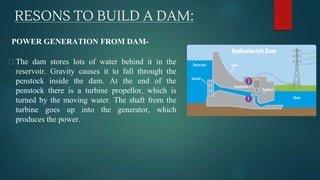
⮚ The dam stores lots of water behind it in the
reservoir. Gravity causes it to fall through the
penstock inside the dam. At the end of the
penstock there is a turbine propellor, which is
turned by the moving water. The shaft from the
turbine goes up into the generator, which
produces the power.
POWER GENERATION FROM DAM-
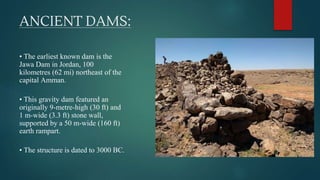
ANCIENT DAMS:
• The earliest known dam is the
Jawa Dam in Jordan, 100
kilometres (62 mi) northeast of the
capital Amman.
• This gravity dam featured an
originally 9-metre-high (30 ft) and
1 m-wide (3.3 ft) stone wall,
supported by a 50 m-wide (160 ft)
earth rampart.
• The structure is dated to 3000 BC.
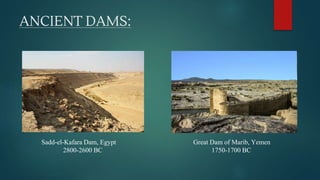
ANCIENT DAMS:
Sadd-el-Kafara Dam, Egypt
2800-2600 BC
Great Dam of Marib, Yemen
1750-1700 BC
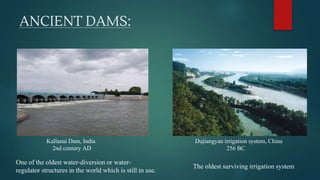
ANCIENT DAMS:
Kallanai Dam, India
2nd century AD
One of the oldest water-diversion or water-
regulator structures in the world which is still in use.
Dujiangyan irrigation system, China
256 BC
The oldest surviving irrigation system
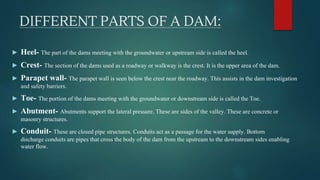
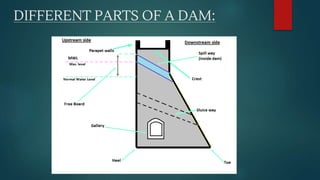
DIFFERENT PARTS OF A DAM:
► Heel- The part of the dams meeting with the groundwater or upstream side is called the heel.
► Crest- The section of the dams used as a roadway or walkway is the crest. It is the upper area of the dam.
► Parapet wall- The parapet wall is seen below the crest near the roadway. This assists in the dam investigation
and safety barriers.
► Toe- The portion of the dams meeting with the groundwater or downstream side is called the Toe.
► Abutment- Abutments support the lateral pressure. These are sides of the valley. These are concrete or
masonry structures.
► Conduit- These are closed pipe structures. Conduits act as a passage for the water supply. Bottom
discharge conduits are pipes that cross the body of the dam from the upstream to the downstream sides enabling
water flow.
DIFFERENT PARTS OF A DAM:
► Cutoff- Cut off is an impervious barrier constructed beneath the earthen dams .The main function is to
reduce the loss of stored water in the reservoir by preventing seepage.
► Galleries- These are hollow openings passing through the dam. The main purpose of providing
drainage gallery is to collect seepage water from the foundation and body of the dam, and drain it out.
► Diversion tunnel- The purpose of the diversion canal is to redirect the water. Diversion tunnels
are constructed during the construction stage of dams.
► Spillways- The role of the spillway is conveying excess water and preventing damages. The water
passes from upstream to downstream. Spillway helps in the emergency discharge of water.
► Sluice way- The role of the sluiceway is to remove the silt accumulated.
► Free board- The interval between the dam heads to the maximum water level on the upstream side.
DIFFERENT PARTS OF A DAM:
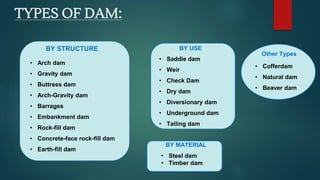
TYPES OF DAM:
BY STRUCTURE
• Arch dam
• Gravity dam
• Buttress dam
• Arch-Gravity dam
• Barrages
• Embankment dam
• Rock-fill dam
• Concrete-face rock-fill dam
• Earth-fill dam
BY USE
• Saddle dam
• Weir
• Check Dam
• Dry dam
• Diversionary dam
• Underground dam
• Tailing dam
BY MATERIAL
• Steel dam
• Timber dam
Other Types
• Cofferdam
• Natural dam
• Beaver dam
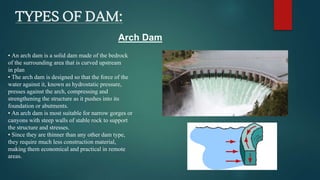
TYPES OF DAM:
• An arch dam is a solid dam made of the bedrock
of the surrounding area that is curved upstream
in plan
• The arch dam is designed so that the force of the
water against it, known as hydrostatic pressure,
presses against the arch, compressing and
strengthening the structure as it pushes into its
foundation or abutments.
• An arch dam is most suitable for narrow gorges or
canyons with steep walls of stable rock to support
the structure and stresses.
• Since they are thinner than any other dam type,
they require much less construction material,
making them economical and practical in remote
areas.
Arch Dam
TYPES OF DAM:
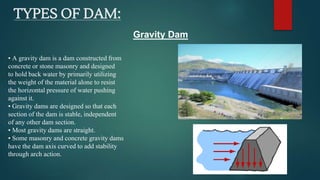
• A gravity dam is a dam constructed from
concrete or stone masonry and designed
to hold back water by primarily utilizing
the weight of the material alone to resist
the horizontal pressure of water pushing
against it.
• Gravity dams are designed so that each
section of the dam is stable, independent
of any other dam section.
• Most gravity dams are straight.
• Some masonry and concrete gravity dams
have the dam axis curved to add stability
through arch action.
Gravity Dam
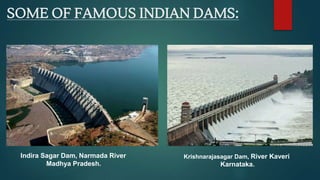
SOME OF FAMOUS INDIAN DAMS:
Indira Sagar Dam, Narmada River
Madhya Pradesh.
Krishnarajasagar Dam, River Kaveri
Karnataka.
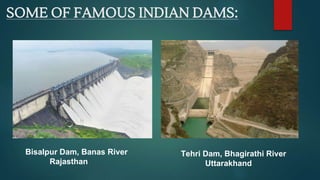
SOME OF FAMOUS INDIAN DAMS:
Bisalpur Dam, Banas River
Rajasthan
Tehri Dam, Bhagirathi River
Uttarakhand
THANK
YOU

Dams and River (World Scenario)

  • 1.
    Dams and river(world scenario) Name- Pradeep Roll No.- 20110140 B.Tech. Civil Engineering, IIT GANDHINAGAR CE 201 PROJECT PRESENTATION
  • 2.
    CONTENT: ► INTRODUCTION ► REASONSTO BUILD A DAM ► ANCIENT DAMS ► DIFFERENT PARTS OF A DAM ► TYPES OF DAM ► SOME OF FAMOUS INDIAN DAMS
  • 3.
    INTRODUCTION: ►Dams are massivebarriers built across rivers and streams to confine and utilize the flow of water for human purposes. These purposes maybe Irrigation, Hydropower, Water-supply, Flood Control, Navigation, Fishing and Recreation. This confinement of water creates lakes or reservoirs.
  • 4.
    RESONS TO BUILDA DAM: ► Power- Hydroelectric power is made when water passes through a dam. Irrigation- Dams and waterways store and provide water for irrigation so farmers can use the water for growing crops. ► Flood Control- Dams help in preventing floods. ► Drinking Water ► Recreation ► Transportation
  • 5.
    RESONS TO BUILDA DAM: Recreation- Dams provide a wonderful opportunity for recreation. In building a dam water is stored behind it. This water is called a reservoir. Reservoirs are used to store water, especially during times of excess. They provide activities like fishing, boating, swimming, camping, and hiking.
  • 6.
    RESONS TO BUILDA DAM: ⮚ The dam stores lots of water behind it in the reservoir. Gravity causes it to fall through the penstock inside the dam. At the end of the penstock there is a turbine propellor, which is turned by the moving water. The shaft from the turbine goes up into the generator, which produces the power. POWER GENERATION FROM DAM-
  • 7.
    ANCIENT DAMS: • Theearliest known dam is the Jawa Dam in Jordan, 100 kilometres (62 mi) northeast of the capital Amman. • This gravity dam featured an originally 9-metre-high (30 ft) and 1 m-wide (3.3 ft) stone wall, supported by a 50 m-wide (160 ft) earth rampart. • The structure is dated to 3000 BC.
  • 8.
    ANCIENT DAMS: Sadd-el-Kafara Dam,Egypt 2800-2600 BC Great Dam of Marib, Yemen 1750-1700 BC
  • 9.
    ANCIENT DAMS: Kallanai Dam,India 2nd century AD One of the oldest water-diversion or water- regulator structures in the world which is still in use. Dujiangyan irrigation system, China 256 BC The oldest surviving irrigation system
  • 10.
    DIFFERENT PARTS OFA DAM: ► Heel- The part of the dams meeting with the groundwater or upstream side is called the heel. ► Crest- The section of the dams used as a roadway or walkway is the crest. It is the upper area of the dam. ► Parapet wall- The parapet wall is seen below the crest near the roadway. This assists in the dam investigation and safety barriers. ► Toe- The portion of the dams meeting with the groundwater or downstream side is called the Toe. ► Abutment- Abutments support the lateral pressure. These are sides of the valley. These are concrete or masonry structures. ► Conduit- These are closed pipe structures. Conduits act as a passage for the water supply. Bottom discharge conduits are pipes that cross the body of the dam from the upstream to the downstream sides enabling water flow.
  • 11.
    DIFFERENT PARTS OFA DAM: ► Cutoff- Cut off is an impervious barrier constructed beneath the earthen dams .The main function is to reduce the loss of stored water in the reservoir by preventing seepage. ► Galleries- These are hollow openings passing through the dam. The main purpose of providing drainage gallery is to collect seepage water from the foundation and body of the dam, and drain it out. ► Diversion tunnel- The purpose of the diversion canal is to redirect the water. Diversion tunnels are constructed during the construction stage of dams. ► Spillways- The role of the spillway is conveying excess water and preventing damages. The water passes from upstream to downstream. Spillway helps in the emergency discharge of water. ► Sluice way- The role of the sluiceway is to remove the silt accumulated. ► Free board- The interval between the dam heads to the maximum water level on the upstream side.
  • 12.
  • 13.
    TYPES OF DAM: BYSTRUCTURE • Arch dam • Gravity dam • Buttress dam • Arch-Gravity dam • Barrages • Embankment dam • Rock-fill dam • Concrete-face rock-fill dam • Earth-fill dam BY USE • Saddle dam • Weir • Check Dam • Dry dam • Diversionary dam • Underground dam • Tailing dam BY MATERIAL • Steel dam • Timber dam Other Types • Cofferdam • Natural dam • Beaver dam
  • 14.
    TYPES OF DAM: •An arch dam is a solid dam made of the bedrock of the surrounding area that is curved upstream in plan • The arch dam is designed so that the force of the water against it, known as hydrostatic pressure, presses against the arch, compressing and strengthening the structure as it pushes into its foundation or abutments. • An arch dam is most suitable for narrow gorges or canyons with steep walls of stable rock to support the structure and stresses. • Since they are thinner than any other dam type, they require much less construction material, making them economical and practical in remote areas. Arch Dam
  • 15.
    TYPES OF DAM: •A gravity dam is a dam constructed from concrete or stone masonry and designed to hold back water by primarily utilizing the weight of the material alone to resist the horizontal pressure of water pushing against it. • Gravity dams are designed so that each section of the dam is stable, independent of any other dam section. • Most gravity dams are straight. • Some masonry and concrete gravity dams have the dam axis curved to add stability through arch action. Gravity Dam
  • 16.
    SOME OF FAMOUSINDIAN DAMS: Indira Sagar Dam, Narmada River Madhya Pradesh. Krishnarajasagar Dam, River Kaveri Karnataka.
  • 17.
    SOME OF FAMOUSINDIAN DAMS: Bisalpur Dam, Banas River Rajasthan Tehri Dam, Bhagirathi River Uttarakhand
  • 18.